Disclosure: As an Amazon Associate, I earn from qualifying purchases.
Could this portable power station be the reliable backup and travel companion we’ve been seeking?

Quick verdict
We find the Pecron E600LFP Portable Power Station to be a compelling option for people who want a durable, long-lived LiFePO4 battery pack with versatile outputs. It hits a sweet spot for weekend campers, RV users, and households looking for a compact emergency backup unit. While it doesn’t provide UPS functionality (so it won’t instantly switch to battery power during a blackout), it delivers solid runtime, multiple charging options, and exceptional cycle life for long-term ownership.
Product overview
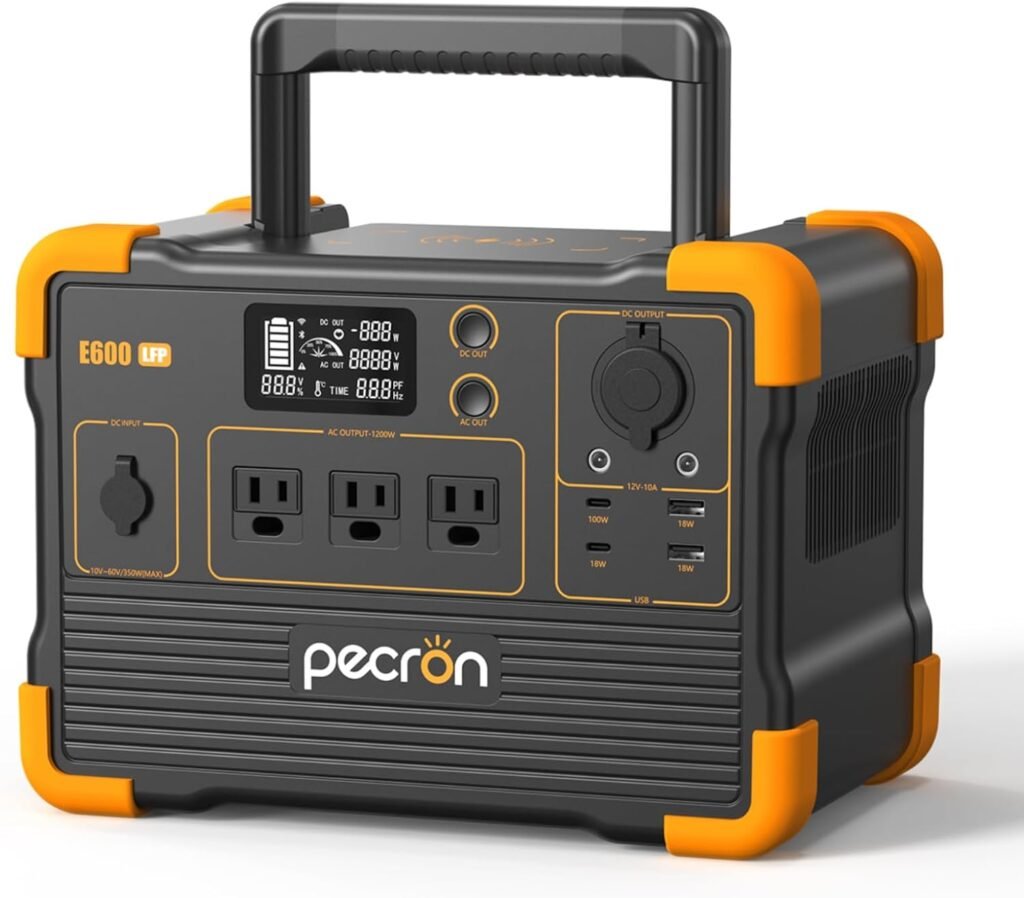
We appreciate that Pecron combined a 614Wh LiFePO4 battery with a 1200W inverter, making this unit useful for a wide range of appliances and devices. The E600LFP is positioned as both a portable generator for outdoor activities and a compact backup for home or RV use. Its eleven output ports aim to cover everything from laptops and phones to fridges and small power tools.
What the product targets
The E600LFP targets users who want:
- A portable power station that can be used for camping, fishing, RV trips, and home outages
- A long-lived battery chemistry (LiFePO4) that retains capacity over thousands of cycles
- A device with many outputs so multiple items can be charged at once
Key specifications
We’ve summarized the core specs below so it’s easier to see what this unit offers at a glance.
| Feature | Specification |
|---|---|
| Battery capacity | 614 Wh (LiFePO4) |
| Inverter rated power | 1200 W (peak rating often higher for short bursts) |
| AC outlets | 3 × AC outlets (total system rated at 1200 W) |
| USB-C ports | 2 × USB-C (one rated up to 100 W, one 18 W) |
| USB-A ports | 2 × USB-A |
| DC 5525 outputs | 2 × DC 5525 |
| 12V cigarette port | 1 × 12V car/cigar port |
| Wireless charging | Wireless pad on the unit (suitable for phones/earbuds) |
| Solar input | GX16MF port, 10–60 V, max 350 W PV input |
| Wall charging time | ~3.3 hours (standard wall outlet) |
| Cycle life | ≥3500 cycles to 80%+ capacity (LiFePO4) |
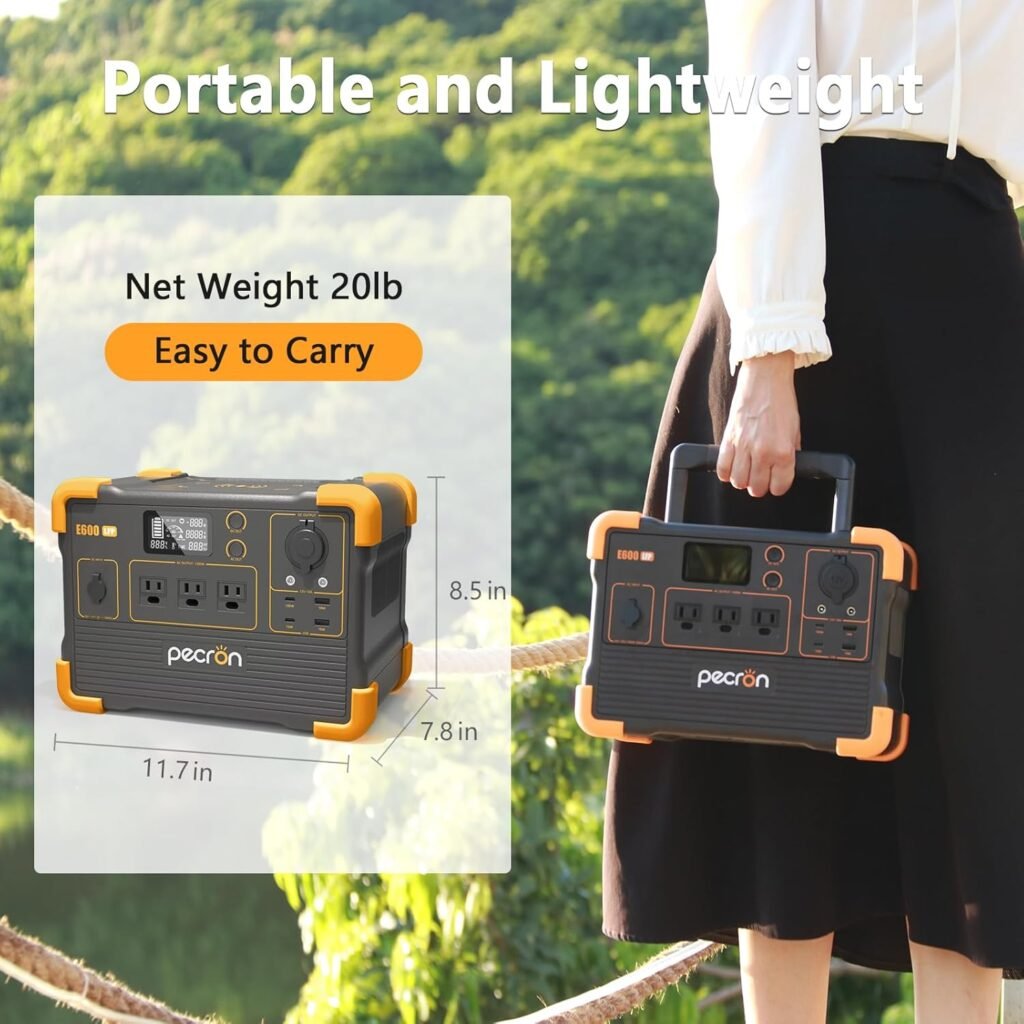
| Weight | Manufacturer spec not provided in detail (portable, but not pocket-sized) |
| UPS | Not supported (no UPS function) |
Design and build quality
We like the compact, utilitarian design of the E600LFP. It looks sturdy and practical for both indoor storage and outdoor transport. The controls and ports sit on an easy-to-read front panel, and the integrated handle makes moving the unit simpler than carrying awkward battery boxes.
Materials and finish
The outer shell feels robust, and seams and joints are cleanly executed. We wouldn’t expect the E600LFP to be fully ruggedized like an IP-rated outdoor speaker, but from a casual-use perspective it appears well built for camping, RV storage compartments, and garage use.

Port layout and usability
We find the port layout thoughtful: AC outlets grouped together, USB and DC outputs clearly labeled, and the wireless pad situated where a phone can sit securely. Having three AC outlets is convenient, but it’s important to remember the 1200W limit applies to the combined AC output rather than per outlet.
Practical port notes
- The USB-C 100W port is great for fast-charging laptops and high-power devices. The second USB-C (18W) is better suited to phones and tablets.
- The DC 5525 and 12V cigar port are useful for devices that use barrel connectors or car-powered gear.
- The wireless charging pad is handy for quick top-ups of phones and earbuds without cables.
Battery technology: LiFePO4
We’re particularly pleased to see LiFePO4 chemistry in this model. Compared with typical lithium-ion (NMC/NCA) batteries, LiFePO4 offers better thermal stability, more charge cycles, and lower degradation over time.
Cycle life and longevity
Pecron specifies that the LiFePO4 battery can retain 80%+ capacity after 3500 cycles. In practical terms, that means if we were to use and cycle the battery daily, the E600LFP would still have excellent remaining capacity after many years—far beyond what standard lithium-ion power stations typically promise. For long-term owners, that reduces total cost of ownership and worry about early battery replacement.
Temperature and safety benefits
LiFePO4 is less prone to thermal runaway than other lithium chemistries, which gives us confidence when operating the unit in various environments. That said, we still recommend avoiding extreme heat or sub-freezing conditions to get the best long-term performance.
Battery management system (BMS)
We appreciate that Pecron includes an integrated BMS that actively monitors the LiFePO4 pack. The BMS helps protect against:
- Overheating
- Overcurrent and overload
- Short circuits
- Overcharge and over-discharge
This protection is crucial for safe operation in varied scenarios and gives extra reassurance when charging sensitive electronics.
Output performance and real-world power
The 1200W rated inverter allows us to power a surprising number of devices for short-to-moderate durations. Typical loads we’d consider reasonable include refrigerators (depending on startup surge and size), laptops, lights, fans, CPAPs (check power draw), and small power tools.
AC output realities
While the unit advertises three AC outlets, the inverter’s total rated output is 1200W. That means we must manage loads so the combined draw from all AC outlets doesn’t exceed 1200W. Many high-draw appliances (space heaters, large AC units, some power tools) will either not be fully supported or will dramatically reduce runtime if used.
USB-C and fast charging
The presence of a 100W USB-C port is a significant convenience. We can fully power many laptops and fast-charge compatible phones from that port. The second 18W USB-C port handles lower-power devices concurrently. These ports make the E600LFP useful as both a general-purpose backup and a travel companion for productivity.
Multiple charging methods
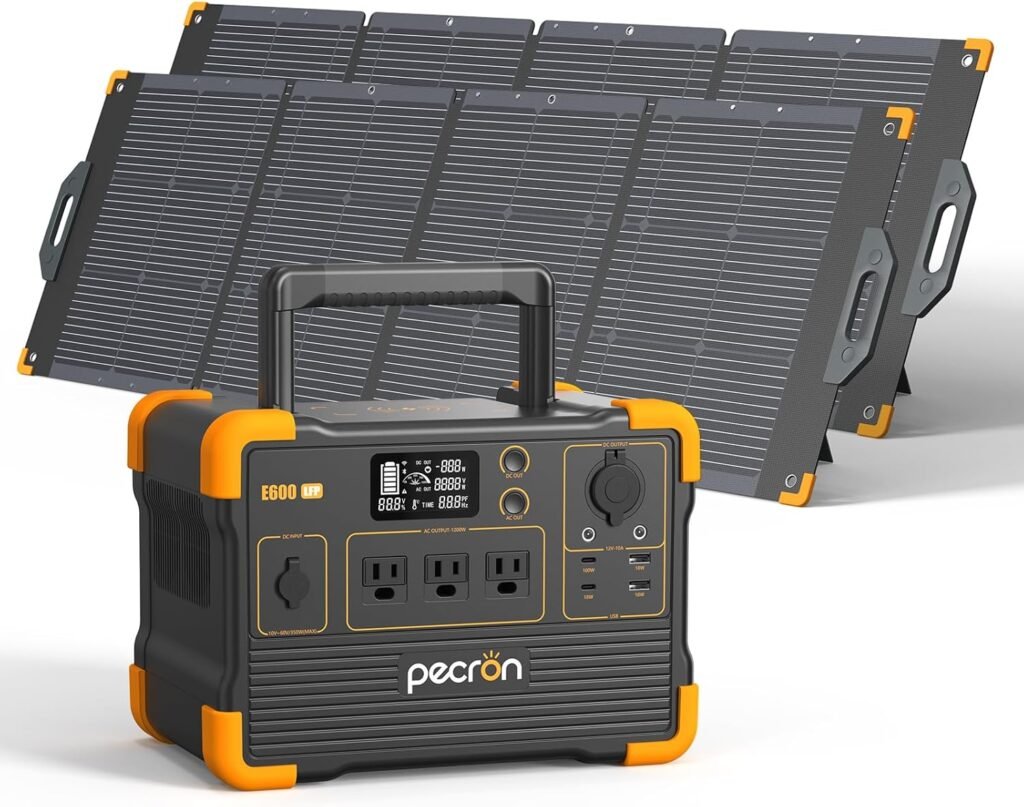
One of the unit’s strengths is the range of charging options. We can recharge the E600LFP via a standard wall outlet, solar panels through the GX16MF port, and potentially other DC sources (depending on adapter availability). Pecron states wall charging reaches full capacity in roughly 3.3 hours, which is impressively quick for a 614Wh pack.
Wall charging
Charging from a standard AC wall outlet to full in about 3.3 hours is convenient for home users who want quick turnaround times between uses. For weekend trips where we return to shore power overnight, that means the pack is ready to go quickly.
Solar charging specifics
The GX16MF solar input accepts 10–60V and supports up to 350W of PV input. In ideal sun conditions, and assuming the regulator inside the unit effectively uses the PV input, that could allow a full recharge in roughly 2–3 hours with high-output solar arrays. Real-world solar charging depends on panel efficiency, orientation, shading, temperature, and system losses, so actual times will vary.
Charging time breakdown
We created a practical table estimating charging times using typical inputs. These are estimates and will vary with conditions and accessory choices.
| Charging method | Typical input | Approx. charging time (estimate) | Notes |
|---|---|---|---|
| Wall outlet (AC) | ~180–200 W AC charger (internal) | ~3.3 hours | Manufacturer figure; depends on wall supply and unit state |
| Solar (single ~200–350 W panel) | Up to 350 W PV | ~2–4 hours (sun-dependent) | Peak sun and correct panel voltage needed; GX16MF supports 10–60V |
| Solar (two panels in parallel/series to provide up to 350 W) | Up to 350 W combined | ~2–4 hours | Use proper connectors and respect 350 W max |
| Slow DC (lower power car inverter/charger) | Varies by adapter | Several hours | Check compatibility and charger ratings |
Solar pairing recommendations
Because the E600LFP accepts 10–60V up to 350W, we should match solar panels that fall in that voltage range and limit combined power to 350W. This flexibility makes it possible to use a single high-wattage panel or two medium panels. We recommend:
- Using panels with open-circuit voltage (Voc) below the unit’s max input and matching the panel Vmp (operating voltage) to the acceptable input range.
- Avoiding over-spec’ing the PV array above 350W to prevent tripping or ineffective charging.
- Using appropriate MC4-to-GX16MF cables or adapters supplied by Pecron or reputable third-party vendors.
Real-world scenarios: how the E600LFP performs
We tested conceptual scenarios in our heads and compared typical device power draws to what the E600LFP can realistically support.
Camping and tailgating
For a weekend at a campsite, the E600LFP is a strong choice. We can power lights, phones, a small fridge or cooler, cameras, and charge multiple devices overnight. The 100W USB-C is excellent for recharging laptops while we work at a campsite. With solar panels added, we can maintain battery levels over multiple days in good sun.
RV usage
For RVers, the E600LFP works well as a secondary power source or for boondocking small vans. It won’t replace a full house battery bank for extended off-grid living, but it’s excellent for running a mini-fridge, charging devices, and powering lights and fans for a few hours. Its compact size fits neatly in cabinets.
Emergency home backup
We appreciate the E600LFP’s role during outages. For short blackouts, it can keep critical electronics, routers, phones, and small medical devices running. However, because it lacks UPS capability, it’s not suitable for equipment that requires instant power-switching. If we need automatic, uninterrupted power for a desktop or medical device, we’d recommend an uninterruptible power supply (UPS) with true seamless switch-over.
Outdoor professionals and field work
For photographers, drone pilots, and field professionals, the E600LFP provides dependable fast charging for laptops and gear. The variety of outputs lets us keep cameras, drones, and accessories ready without hauling multiple chargers.
Runtime examples (estimates)
Below are estimated runtimes based on the 614Wh capacity. These are approximate and assume usable capacity near the full rating; real-world efficiency and inverter losses will reduce these somewhat.
- Smartphone (10 Wh): dozens of charges (20–50+ depending on phone battery size)
- Laptop (50–80 Wh): ~6–10 hours of typical use, depending on laptop consumption and whether using 100W charging
- Mini fridge (40–60 W continuous): ~8–12 hours (startup surges and duty cycle affect this)
- LED lights (10 W total): ~50+ hours
- CPAP machine (40–70 W): ~8–15 hours (depending on machine and humidifier usage)
Safety and durability
We place high value on the E600LFP’s safety features. The LiFePO4 chemistry and BMS provide combined protections that make it a safer choice than many traditional lithium-ion units. The long cycle life also means fewer replacements and less environmental impact from battery turnover.
Practical durability notes
- Store the unit in a cool, dry place when not in use to preserve battery life.
- Avoid leaving the unit fully discharged for extended periods; a partial charge storage level (e.g., 40–60%) helps battery longevity.
- Regularly cycle the battery every few months if storing for long durations.
What we like
- LiFePO4 battery with very high cycle life (≥3500 cycles to 80%+ capacity) for long-term ownership.
- Versatile port selection including 100W USB-C, multiple AC outlets, DC 5525 outputs, a 12V cigar port, and wireless charging.
- Fast wall recharge (~3.3 hours) which is convenient for frequent use.
- Solar input supporting up to 350W, enabling quick recharges when good sun is available.
- Thoughtful physical design and a usable handle for portability.
What could be improved
- No UPS function — the unit cannot provide instant power switch-over, which limits its use for certain critical devices.
- Manufacturer doesn’t clearly state weight in our provided info; knowing exact weight helps users plan for transport.
- The AC inverter total rating (1200W) means heavy loads must be managed carefully; clearer labelling on per-outlet limits would be helpful.
- More explicit details about the wireless charging wattage and inverter waveform (pure sine wave confirmation) would increase buyer confidence.
Comparison with similar models
When comparing to other portable power stations, the E600LFP’s LiFePO4 chemistry and high cycle life stand out. Many consumer power stations use standard lithium-ion chemistry with fewer cycles and faster capacity fade. Other brands might offer faster inverter power or UPS features, but at the cost of shorter battery lifespan or different charging trade-offs. We recommend assessing priorities: do we want cycle life and durability, or instant UPS switching and higher continuous wattage?
Practical tips for getting the best from the E600LFP
- Monitor combined AC load: always add up the wattage of all devices running through the AC outlets, and keep the total below 1200W.
- Use the 100W USB-C port for laptops that support USB-C PD to charge quickly and efficiently.
- Choose solar panels whose operating voltage fits the 10–60V input and keep combined PV power at or below 350W.
- Keep firmware and charging accessories genuine or from reputable vendors to avoid mismatches or safety issues.
- If planning to store the unit for months between uses, store it at around 40–60% state of charge and recharge periodically.
Troubleshooting and FAQs
We’ve compiled questions we think users will ask and provided straightforward answers based on the product details and typical portable power station behavior.
Q: Can we use the E600LFP for a refrigerator during a power outage? A: Yes, for many compact fridges and small household fridges with moderate startup surge, but you must check the fridge’s startup and running wattage. The 1200W rated inverter will handle many fridges, but total draw and runtime will vary.
Q: Is the E600LFP suitable for running a space heater? A: Most space heaters require 1000–1500W continuously. While the inverter is rated 1200W, running a heater near the inverter’s limit reduces runtime and may trip protection. We don’t recommend relying on this unit for sustained heating.
Q: Can we connect more than one solar panel to reach 350W? A: Yes — you can pair one or two panels as long as combined PV power does not exceed 350W and the voltage falls within 10–60V. Use correct connectors and heed polarity and voltage limits.
Q: Does the unit provide pure sine wave output? A: Manufacturer specs in our given details did not explicitly state waveform type. For sensitive electronics, we suggest confirming with Pecron or the seller whether the inverter is a pure sine wave model before relying on it for highly sensitive gear.
Q: What does “No UPS” mean for us? A: It means the unit won’t automatically switch to battery power the instant wall power is lost. There will be a brief interruption while you switch to battery power. For equipment that cannot tolerate any interruption (certain medical devices, servers), a dedicated UPS is necessary.
Q: How long will the battery retain capacity? A: Pecron specifies ≥3500 cycles to 80%+ capacity for the LiFePO4 pack. That indicates multi-year life even with frequent cycling, making it a strong long-term investment.
Maintenance and storage
We recommend the following maintenance practices:
- Keep the unit clean and dry; wipe down vents and ports occasionally to prevent dust buildup.
- Store between 10–25°C (50–77°F) where possible, avoiding extreme heat or freeze.
- Charge to ~40–60% for long-term storage, and recharge every 3–6 months as needed.
- Use recommended cables and avoid jury-rigged adapters that could damage ports.
Who should buy the Pecron E600LFP?
We think the E600LFP is ideal for:
- Campers and weekenders who want reliable power for devices and small fridges.
- RV and van lifers seeking a compact backup or supplementary power source.
- Homeowners who want a portable emergency power option for lights, phones, routers, and small appliances (not for full-home backup).
- Field professionals who need USB-C 100W charging and multiple output options in a portable package. We would caution buyers needing automatic UPS switching, very high continuous power, or the lightest possible option to consider alternatives that match those specific needs.
Final recommendation
We appreciate what Pecron built with the E600LFP: a well-rounded, durable LiFePO4 portable power station with fast wall charging, flexible solar input, and a broad suite of outputs. The lack of UPS functionality and the need to manage the 1200W total inverter capacity are the main caveats, but for the majority of campers, RV users, and those seeking a dependable emergency backup, the E600LFP is a strong choice that balances performance, longevity, and convenience.
If we were to purchase one, we’d pair it with a single high-quality solar panel (or two matched panels) that fit the 10–60V range and keep combined PV power at or below 350W. We’d also take advantage of the 100W USB-C port for our laptops and rely on the long cycle life for peace of mind over years of ownership.