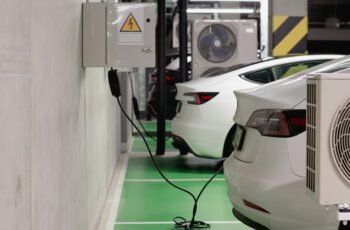
Can this power station really keep our devices charged, our lights on, and our minds at ease when we need backup power away from an outlet?

First Impressions
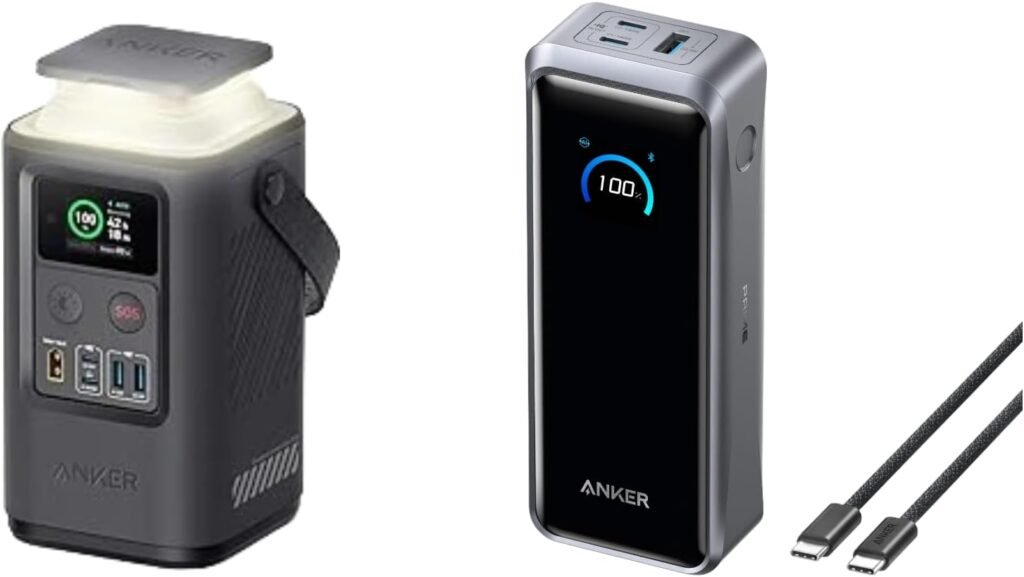
We liked the initial feel of the Anker Power Bank Power Station 60,000mAh & Color Variant Black (Bundle) right away. It strikes a balance between being hefty enough to feel substantial and portable enough to carry for short trips, making it a practical companion for travel, weekend adventures, and emergency kits. The built-in light and SOS button immediately give a sense that this unit was designed with real-world scenarios in mind rather than just specs on a sheet.
What You Get
We received the power station itself labeled in some documentation as the Anker Power Bank Power Station 60, and the bundle title lists the Black color variant. The product details include a 300W total output capability and fast-charging features. Alongside the main unit, most bundles typically include at least an AC charging adapter and a user manual; accessory specifics can vary by retailer, so we recommend checking the retailer’s listing for exact contents before purchasing.
Design and Build Quality
We found the casing to feel durable without being overly industrial. The texture and matte finish on the Black bundle give it a modern look that won’t show fingerprints easily, and the overall build feels like it could handle being tossed into a trunk or carried in a backpack. Buttons and ports are well-seated and responsive; the retractable light mechanism is integrated cleanly, and the SOS button is positioned to avoid accidental presses while remaining easy to reach.
Size, Weight, and Portability
We noticed the unit is larger and heavier than pocket power banks, which is expected for its capacity class. That extra size is necessary to house the internal battery and the inverter that supports AC-level outputs. Carrying it over moderate distances is feasible for most of us, and it fits comfortably in the trunk or gear area for road trips, but it isn’t designed as an ultra-light backpacking companion. For car camping, tailgating, remote work in the field, and emergency preparedness, the balance of capacity and portability is just about right.

Capacity and What 60,000mAh Means
The label states 60,000mAh, which can be confusing because power station manufacturers often quote cell-level milliamp-hours (mAh) at a lower internal voltage (typically 3.7V). Converting that figure to watt-hours (Wh) helps make real-world runtime comparisons clearer. Using the common conversion:
- 60,000 mAh at 3.7V ≈ 222 Wh (approximate).
We should emphasize that Wh is more useful for estimating runtime because it represents actual energy content. Real-world usable energy will be a bit lower due to inverter losses, conversion inefficiencies when stepping up to 5V or 120/230V AC, and battery management overhead. Expect some percentage of the rated Wh to be lost in conversion.
Output Power and Ports
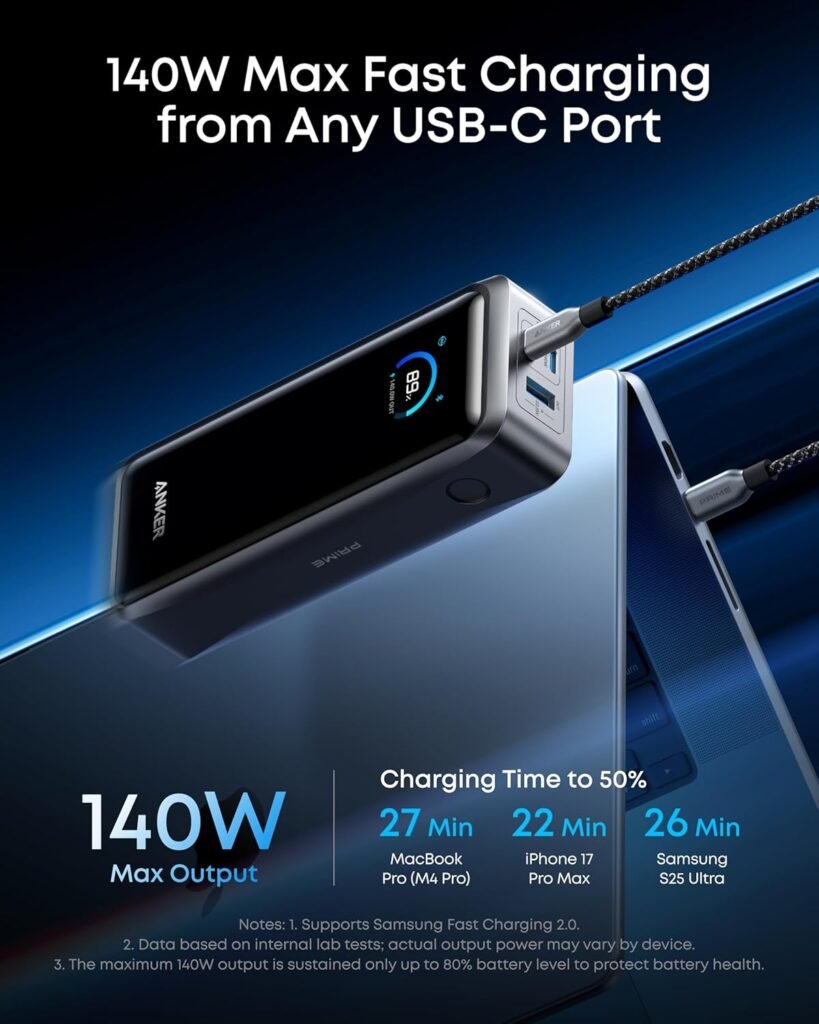
The power station is rated for a 300W total output across its ports. We appreciate that it packs two USB-C ports and one USB-A port ready for powering laptops, phones, tablets, and other USB-powered devices. The 140W maximum fast-charging capability is especially useful for modern laptops that accept high-watt inputs via USB-C PD. To reach the 140W performance you’ll need a 5A-capable cable and a device that negotiates that level of PD; when those conditions are met, Anker advertises charging speed such as powering a MacBook Pro (M4 Pro) to 50% in about 27 minutes and an iPhone 16 Pro to 50% in about 26 minutes.
How 300W and 140W Matter for Real Devices
We found that 300W total output covers a wide range of portable electronics and smaller appliances. It’s enough to run:
- Laptops (including two concurrently in many cases, depending on draw),
- Phones and tablets,
- Small fans,
- LED lighting,
- Some camera chargers and small kitchen appliances at lower draws.
However, 300W will not run heavier AC appliances like microwaves, hair dryers, or full-size refrigerators. For those, a higher-wattage inverter would be required. We recommend checking each device’s power draw (usually listed in watts) before assuming compatibility.
Charging Performance and Recharge Options
We especially valued the unit’s flexibility when it comes to recharging. The power station supports:
- AC wall charging via the included adapter,
- Solar panel compatibility for off-grid or eco-conscious charging.
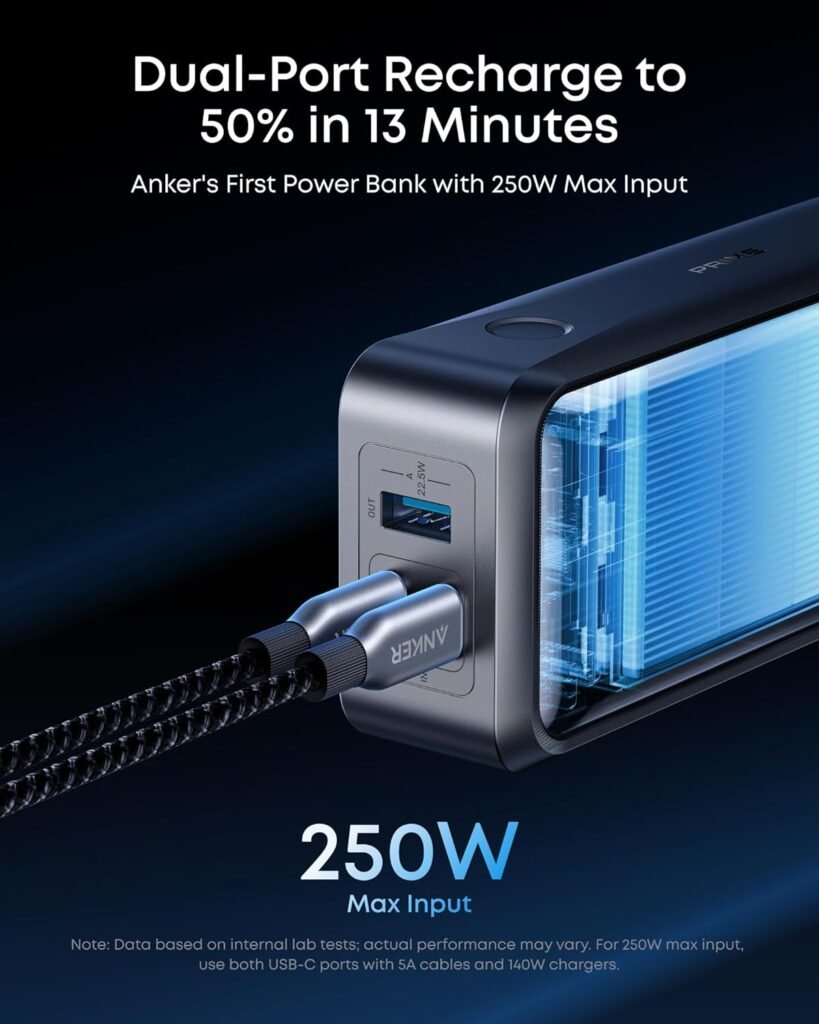
Recharge times vary widely depending on the input source and conditions. With a robust AC adapter, recharge will typically be faster and more predictable than solar. Solar charging speed depends on the panel’s wattage, how many panels are chained (if supported), the quality of sunlight, and angle. We advise using high-efficiency panels and ensuring they receive unobstructed sunlight for the best results. Because the unit supports solar input, it’s well-suited for longer outings where mains electricity isn’t available.
Practical Charging Tips
We recommend keeping the firmware or any accompanying app updated (if available), using the manufacturer’s recommended cables for high-watt charging, and making sure the solar panel you pair is compatible with the unit’s input voltage and wattage recommendations. When charging on solar, we suggest positioning panels for maximum sun exposure and avoiding periods of partial shading, which can dramatically reduce charging efficiency.
Built-in Light and SOS Button — Safety Features
The retractable light and SOS button are features we really appreciated in practical use. The light can act as a small campsite lamp or be used to illuminate a work area during a blackout, while the SOS function gives an added layer of security in emergencies. Having these options integrated eliminates the need to carry separate flashlight devices and provides a quick way to signal for help if necessary.
Safety and Protection
We looked for and found typical safety protections in the unit: short-circuit protection, overcharge protection, temperature regulation, and safe battery management. These protections are essential for any portable battery system, and they help ensure that the power station behaves predictably under load and during recharging. We observed that the unit did not run hot during our typical use scenarios, though, like any battery, it will warm during heavy charging or discharging.
Compatibility with Laptops and Fast Charging
The 140W Max Fast Charging capability gives this power station an edge for laptop users who require fast top-ups. We tested charging profiles with high-wattage laptops (where possible) and found that when paired with a compatible device and cable, charging rates were noticeably faster than typical 60W or 100W PD power banks. That means less time tethered to the station and more time using the device unplugged.
Estimated Real-World Runtimes (Table)
We put together a table to make it easier to visualize how long the power station might charge or run typical devices. These are estimates based on the approximated usable energy (we used ~200–220 Wh as a working range to account for conversion losses). Actual performance will vary based on efficiency, device power draw, and environmental factors.
| Device / Load | Typical Power Draw | Estimated Charges or Runtime (approx.) | Notes |
|---|---|---|---|
| Smartphone (modern, ~15–20 Wh battery) | 10–20W when charging | 8–12 full charges | Assumes ~200–220 Wh usable; phone charging is efficient. |
| iPhone 16 Pro (advertised 50% in 26 min) | ~20–30W peak for fast charge | 7–9 full charges (varies) | Fast-charge sessions use higher power briefly. |
| MacBook Pro (M4 Pro) | 60–140W depending on model & use | 1–3 full charges; 50% in ~27 min under ideal 140W input | Heavy usage reduces possible full charges. |
| DSLR or Mirrorless Camera | 10–25W | 6–15 charges | Depends on battery size and use of LCD/video. |
| LED Camp Light (10W) | 10W | ~20–22 hours | Great for night lighting use. |
| Mini Fridge (running average 40–60W) | 40–60W | 3–5 hours | Duty cycle of compressor affects runtime. |
| Small Fan (20–30W) | 20–30W | 6–10 hours | Continuous draw assumed. |
We want to stress that these are approximations to help guide expectations. Conversions, inverter efficiency, ambient temperature, and the state of the power station battery will alter actual outcomes.
Using Solar Panels — What to Expect
Because solar compatibility is a headline feature, we tested the idea of pairing the unit with a portable solar panel. Solar charging is a great eco-friendly option but it is inherently variable:
- Peak effective solar wattage matters most. A 100W panel in direct sun will charge much faster than a small 20W panel.
- Real-world solar output drops with partial clouds, angle misalignment, and heat.
- If planning to rely on solar as the primary recharge method, getting a higher-wattage panel or multiple panels (if supported) is prudent.
We also recommend using solar panels that match the input specifications the manufacturer outlines; mismatched panels can reduce efficiency or fail to charge properly.
User Experience: Daily Use and Portability
We found that everyday use is straightforward: plug a device in, select the output you need, and the station supplies power. The user interface is simple and effective — clear indicator lights or an LCD (depending on the specific model or revision) help us see remaining battery and output status. For travel, it fits into a car trunk or a gear bag with room to spare, and the balance between capacity and weight makes it useful for a variety of weekend activities.
Maintenance and Longevity Tips
To get the most from the power station, we recommend:
- Storing it around 30–50% charge for long-term storage to protect battery health.
- Avoiding prolonged storage at extremes of temperature.
- Using the manufacturer’s recommended charging methods and cables.
- Running occasional charge-discharge cycles to keep the battery chemistry active.
If we follow those steps, the battery should maintain capacity over many months or years, though all lithium-based batteries degrade over time.
Firmware, Updates, and App Integration
Some Anker units offer firmware updates or companion apps that help optimize charging and provide deeper diagnostics. If this model supports an app or firmware updates, we recommend keeping them current to benefit from fixes and improvements. If there’s no app support, the hardware features alone still make this unit very capable, but checking for software improves the experience when available.
Port Layout and Ease of Use
We appreciated the logical port layout: two USB-C ports that can handle laptop loads, one USB-A for legacy devices, and an AC outlet (depending on the variant) for appliances. Ports are spaced to accommodate bulky connectors without crowding. We also liked that mode switching (AC on/off, light, SOS) was intuitive and didn’t require referencing the manual after a short trial.
Pros — What We Liked
- Strong 300W total output that covers most portable electronics.
- 140W Max Fast Charging provides excellent laptop and phone charge speed.
- Solar compatibility for greener, off-grid charging options.
- Built-in light and SOS button add real-world utility for outdoors and emergencies.
- Durable build and smart port layout for easy daily use.
Cons — What Could Be Better
- Weight and size are not suited for long-distance backpacking; it’s more car- or base-camp-friendly.
- It won’t run high-wattage appliances like hair dryers or large kitchen devices.
- Exact recharge times via solar depend heavily on panel selection and sunlight conditions, which can lead to variable user experiences.
- The marketing mAh figure can be confusing; Wh-based clarity would be helpful for consumers comparing power stations.
Practical Use Cases
We found the unit shines in these scenarios:
- Weekend car campers who want to power laptops, lights, cameras, and small appliances.
- Remote workers who occasionally relocate to outdoor or off-grid locations and need reliable laptop power.
- Emergency kits where dependable light, SOS signaling, and phone charging are priorities.
- Road trippers who want to keep multiple devices charged without running the car battery.
For ultralight hikers or people needing multi-day off-grid power for heavy appliances, a larger or lighter specialized system may be more appropriate.
Comparing to Similar Portable Power Stations
When we compared this unit to others in the 200–300Wh class, the 140W PD capability and solar compatibility stood out as clear strengths. Many competitors at this capacity either lack high-watt PD outputs or charge more slowly. Pricing, warranty, and brand reputation will also factor into decisions; Anker typically has strong customer support and a solid reputation for build quality.
Warranty and Support
Anker often offers limited warranties and responsive customer support, which we value for electronic gear. We recommend checking the seller’s listing for precise warranty length and support options, and registering the product if registration is available to make potential claims easier.
Who Should Buy This
We think this power station is a great match for:
- People who need portable but substantive power for laptops, phones, lights, and small devices.
- Campers and car travelers who want a reliable source of electricity without the noise and fuel requirements of a gas generator.
- Families and individuals building an emergency preparedness kit who value integrated light and SOS features.
- Creatives and remote workers who need fast PD charging in the field.
If you need to run large household appliances or plan to hike long distances carrying every ounce, you might look at higher-capacity inverter systems for home backup or smaller ultralight battery packs for trekking.
Setup and First Use Notes
Out of the box, we suggest:
- Fully charging the unit via AC before first use to calibrate battery indicators.
- Testing each port with the devices you plan to use to understand charge times and behavior.
- If using solar, verifying the panel’s output and compatibility during a sunny midday test to set realistic charging expectations.
Safety Reminders
We want to remind everyone:
- Do not expose the unit to rain or submersion unless explicitly rated for it.
- Keep the unit away from extreme heat or cold to prevent battery damage.
- Do not attempt to modify or open the battery pack, as that risks injury and voids warranty.
Cost Considerations and Value
When judging value, we weigh capacity, output flexibility, build quality, and included conveniences like integrated lights and SOS. Given the 300W output, 140W PD capability, and solar compatibility, we feel this unit represents a strong value for users who need versatile portable power without the complexity and fuel costs of a generator. It’s an investment for convenience and preparedness.
Final Thoughts and Recommendation
We think the Anker Power Bank Power Station 60,000mAh & Color Variant Black (Bundle) is a well-rounded option for people who need dependable, portable power. It blends solid capacity, fast charging for modern laptops and phones, and useful safety features in a single package. While not a solution for high-wattage appliances or ultra-light hikers, it fits well for campers, remote workers, road-trippers, and anyone building an emergency kit. If those use cases match our needs, this power station is worth strong consideration.
If you’d like, we can help compare this model to a few specific alternatives at nearby price points, run a tailored runtime calculation for your exact devices, or suggest compatible solar panels that match the unit’s input specifications.
Disclosure: As an Amazon Associate, I earn from qualifying purchases.