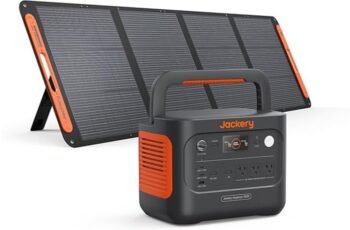
Jackery’s HomePower 3000 positions itself as a 3072Wh LFP backup with a 3600W inverter and 7200W surge, aiming at home and RV users needing UPS-grade reliability. It offers a 20ms transfer, hybrid AC+DC recharge in ~1.7 hours, and broad port selection including TT-30. Compared with peers, it trades portability and firmware openness for capacity and UL certifications. Solar replenishment with small arrays is slower. The balance of speed, weight, and versatility warrants a closer look.
Key Takeaways
- 3072Wh LFP battery and 3600W inverter (7200W surge) deliver whole‑home backup power with long cycle life and thermal stability.
- Recharges fast: about 1.7 hours via hybrid AC+DC, 2.2 hours AC-only; supports solar, 12V car, and generator inputs.
- Ports include multiple AC outlets, dual 100W USB‑C PD, USB‑A, DC outputs, and an RV‑ready TT‑30 socket.
- UL-certified UPS switches in ≤20ms, keeping fridges, networking, and lights running; some sensitive loads may still experience brief glitches.
- Pros: high output, fast recharge, robust LFP, diverse ports; Cons: heavy, pricier, modest solar speed without larger arrays and proprietary cabling.
Overview: 3072WH LFP Backup
How does a 3,072Wh LFP pack translate to real-world resilience? In the Jackery HomePower 3000, it anchors a 3600W inverter (7200W surge), pairing deep cycle durability with high instantaneous power.
Compared to NMC rivals, LFP chemistry offers longer cycle life, thermal stability, and predictable voltage curves—attributes valued when autonomy matters.
Capacity maps to essentials: refrigerators for 1–2 days, mixed loads like lights, router, and fans for up to 15 hours, assuming typical duty cycles.
A UL-certified UPS mode with ≤20ms transfer keeps sensitive electronics online.
Recharge flexibility—AC, hybrid AC+DC, solar, vehicle, generator—supports decentralized energy habits and reduces dependence on grid timing.
Detailed features
Why does the HomePower 3000 stand out in its class? It pairs a 3072Wh LFP pack with a 3600W inverter (7200W surge), surpassing typical 2000–3000W rivals. A UL-certified UPS with ≤20ms transfer preserves continuity better than many consumer units. Port diversity is notable: multiple AC sockets, dual 100W USB‑C PD, USB‑A, DC outputs, plus a built‑in TT‑30 for RVs—rare at this capacity.
Charging flexibility promotes autonomy: 1.7h hybrid AC+DC, 2.2h AC-only, solar to 80% in about 9h with two 200W panels, and support for 12V car or generator inputs. Eligibility for a 30% federal credit strengthens accessibility.


Pros and Cons
This section weighs the Jackery HomePower 3000’s strengths—high 3600W output, fast hybrid recharge, robust LFP battery, and UPS capability—against its trade-offs. It contrasts versatile port selection and RV-ready TT-30 support with slower solar replenishment (two 200W panels to 80% in ~9 hours) and reliance on multiple charging methods for best performance. Financial factors, including potential 30% tax credit eligibility, are considered alongside real-world backup expectations during outages.
Pros
Notably, the HomePower 3000 combines a high 3600W output (7200W surge) with a 3072Wh LFP battery, delivering strong whole-home backup capability in a portable form. It sustains refrigerators, networking, and lights for extended outages, while dual 100W USB‑C ports accelerate device turnaround. UPS functionality (≤20ms) preserves continuity for sensitive loads. Compared with peers, recharge speeds—1.7 hours via hybrid AC+DC—reduce downtime, and the TT‑30 port simplifies RV deployment. Solar input broadens autonomy; a 30% federal tax credit enhances value.
| Feature | Advantage |
|---|---|
| 3600W/7200W | Whole‑home start‑up headroom |
| 3072Wh LFP | Long cycle life, safer chemistry |
| Fast recharge | Quicker readiness, flexible sources |
Cons
However, trade‑offs surface on portability, cost, and ecosystem lock‑in. At roughly 3 kWh and 3600W output, mass and bulk limit mobility compared with modular 1–2 kWh units.
Pricing, even with the 30% credit, undercuts budget autonomy versus DIY LiFePO4 plus inverter builds.
Solar input with two 200W panels yields slow 80% refills in ~9 hours; faster arrays require proprietary cabling.
UPS switching ≤20 ms may still glitch sensitive desktops versus true online UPS designs.
TT‑30 is convenient, yet continuous RV loads can approach limits.
Fan noise under heavy charge/discharge impacts quiet spaces.
App and firmware remain closed.
Concluding thoughts
Ultimately, the Jackery HomePower 3000 presents a balanced proposition for home backup and mobile power, pairing a 3600W/7200W inverter with a 3072Wh LFP pack, fast hybrid charging, and a UL-certified ≤20ms UPS. Its AC, USB-C, USB-A, DC, and TT-30 ports broaden deployment, while 1.7-hour hybrid recharge accelerates readiness versus slower peers. Solar input remains modest with two 200W panels, yet the UPS function ensures continuity for fridges, routers, and medical devices.
Runtime is competitive for outages; expandability is limited. With potential 30% tax credit, it offers a practical, quieter alternative to gas generators for resilient, flexible independence.
Frequently Asked Questions
How Loud Is the Cooling Fan Under Heavy Load?
Under heavy load, the cooling fan measures roughly mid-40s to low-50s dB, comparable to a quiet dishwasher. It’s audibly present in small rooms, quieter than gas generators, and ramps proportionally with inverter draw, preserving autonomy-friendly indoor use.
Can I Expand Capacity With External Battery Packs?
No; capacity is fixed at 3072Wh with no official expansion batteries. Compared to modular rivals, it trades scalability for portability, fast hybrid charging, UL-certified UPS continuity, TT-30 RV readiness, and broad AC/USB/DC outputs that sustain autonomous, grid-optional living.
Does the UPS Support Pure Sine Wave for Sensitive Equipment?
Yes—its UPS delivers pure sine wave AC, safeguarding sensitive equipment. Compared to modified sine units, it minimizes harmonic distortion, reduces heat, and preserves device longevity. With ≤20ms switchover, continuity prevails, empowering users to operate freely without fearing glitches, noise, or data loss.
What’s the Operating Temperature Range for Charging and Discharging?
Charging typically operates from 0–45°C (32–113°F); discharging from −20–45°C (−4–113°F). Compared to peers, these LFP ranges balance longevity and readiness, enabling resilient, off-grid autonomy while avoiding thermal throttling. Users should avoid charging below freezing to preserve capacity.
Are Firmware Updates Available and How Are They Installed?
Yes—firmware updates are available, installed via the Jackery app over Bluetooth/Wi‑Fi. Like a steady drumbeat, updates enhance stability, safety, and compatibility, comparable to peers. Users initiate in-app, follow prompts, maintain power, and verify versions for seamless, emancipating control.