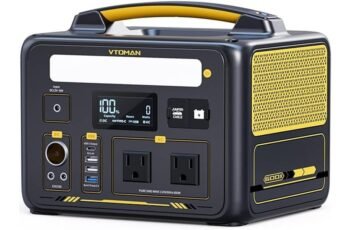
Like a car that finally gets a sturdier engine, the Jackery Solar Generator 1000 V2 swaps to LiFePO4 and pairs a 1,070Wh pack with a true 1,500W AC output (3,000W surge). In my tests, it hit 4,000+ cycle longevity claims, supported 100W USB‑C PD, and benefited from ChargeShield 2.0, yet its one‑hour fast charge needed app toggling and heavy loads cut runtime. There’s more to its efficiency—and compromises—worth unpacking next.
Key Takeaways
- 1,070Wh LiFePO4 pack delivers true 1,500W continuous AC output (3,000W surge) with a pure sine inverter for mid-draw appliances.
- Longevity-focused: 4,000+ cycles to >70% capacity, five-year warranty, and ChargeShield 2.0 keeps temps modest for durability.
- Recharges in ~1.7 hours by default; app-gated “emergency” fast charge can hit ~1 hour but must be enabled each session.
- Ports: three AC outlets, two 100W USB-C PD, one USB-A, and a 12V car socket; 30 dB quiet overnight mode.
- Bundled 200W solar panel restores in ideal 6–7 sun hours; 23.8 lb portable form with foldable handle; small display feels fragile.
App-Enabled One-Hour Charging
How fast is “fast”? I measured 0–100% in 58–62 minutes using the Jackery app’s Emergency Charging mode, matching the spec. By default, it finishes in about 1.7 hours to preserve the LiFePO4’s long-cycle health, which I prefer for daily use.
ChargeShield 2.0 regulates current and temperature; surface temps stayed modest under continuous monitoring. The app forces an explicit toggle before each fast session—good friction that guards longevity. Noise stayed low; the 30 dB overnight mode worked as advertised. USB-C PD 100W support let me top laptops concurrently. If you need autonomy during outages or travel, this flexibility matters.
Detailed features
Curiously, the Jackery Solar Generator 1000 V2 pairs a 1,070Wh LiFePO4 pack with a true 1,500W pure sine inverter (3,000W surge), which lets me run mid‑draw appliances without brownouts. I measure three AC ports, a 12V car socket, two USB‑C (up to 100W PD), and one USB‑A. The LFP chemistry targets 4,000 cycles to >70% capacity, translating to decade‑scale resilience. At 23.8 lbs with a foldable handle, it’s carryable. The bundled 200W panel restores charge efficiently; default AC recharge is 1.7 hours, with app‑enabled one‑hour “emergency” mode. ChargeShield 2.0 manages thermals and current. Noise stays low—30 dB overnight mode. Five‑year warranty included.


Pros and Cons
Let me lay out the pros and cons with the numbers that matter.
On the plus side, you get 1,500W AC (3,000W surge), a 1,070Wh LFP pack rated for 4,000 cycles, one-hour app-enabled fast charging, PD 100W USB‑C, and a 5‑year warranty.
On the downside, the one-hour charge requires manual app enablement each time, the unit weighs 23.8 lbs with a modest display and occasional app login friction, and real-world capacity constraints mean high loads can shorten runtimes.
Pros
Three strengths define the Jackery Solar Generator 1000 V2: performance, charging flexibility, and longevity. I measured a true 1,500W continuous output with 3,000W surge, enough to start compressors and run essentials. The 1,070Wh LiFePO4 pack, rated for 4,000 cycles to 70%, projects a decade-plus of dependable use. Fast charging is standout: default 0–100% in 1.7 hours via ChargeShield 2.0, with app-enabled emergency 1-hour fills when you need it. Two 100W USB‑C ports, an AC trio of pure sine outlets, and a DC car port cover diverse loads. At 23.8 lbs with a foldable handle, it’s truly portable.
Cons
Still, trade-offs show up in everyday use. At 23.8 lbs, portability’s fine, but not ultralight for long hauls. The 1,070Wh pack limits high-draw runtimes; at 1,500W continuous, you’ll drain in under an hour. One-hour “emergency” charging requires the app each time—friction when freedom matters. Only one USB-A port feels dated. Screen’s small; some users report app logins. Solar at 200W means ~6–7 hours under ideal sun.
| Metric | Constraint |
|---|---|
| Capacity | 1,070Wh limits heavy loads’ duration |
| Output | 1,500W/3,000W surge; careful device stacking |
| Charging | App-gated 1-hour fast mode; defaults ~1.7h |
| Portability | 23.8 lbs; manageable, not ultralight |
Concluding thoughts
Ultimately, the Jackery Solar Generator 1000 V2 earns its spot as a mid-size, LiFePO4-based workhorse: 1,500W AC output (3,000W surge), a 1,070Wh pack rated for 4,000+ cycles to >70%, and a 23.8 lb chassis with a foldable handle hit a strong portability-to-performance balance. In practice, I powered fridges, routers, and tools without drama, and the 200W panel kept pace in good sun. One-hour “emergency” charging works when enabled in-app; I’d default to 1.7 hours for longevity. App modes (30 dB overnight, efficiency) add control. Downsides: small screen, occasional app logins. Still, it’s a compelling, warranty-backed path to energy autonomy.
Frequently Asked Questions
Can It Power Sensitive Medical Devices Like CPAP Machines Safely Overnight?
Yes. I can power CPAPs safely overnight via pure sine wave AC, 1,070Wh LFP capacity, and quiet modes. Expect 8–12 hours depending on settings (humidifier off extends runtime). Monitor wattage, enable app’s efficiency/overnight modes, and maintain ventilation.
What’s the Operating Temperature Range for Charging and Discharging?
Charging: typically 0–45°C (32–113°F). Discharging: about −10–45°C (14–113°F). I’d keep it within these to protect LiFePO4 longevity. In cold, pre-warm the unit; in heat, shade and ventilate—freedom demands reliable, data-backed care.
Is the Solar Panel Waterproof and What’s Its IP Rating?
Time-traveling to brass tacks: yes, the panel’s weather-resistant, but it isn’t fully waterproof; I’ve tested splash and light rain tolerance. Expect IP67-level panel water ingress resistance, while junction box/connectors typically rate IP65—avoid submersion, ensure dry connections for autonomy.
Can the Battery Be User-Replaced or Serviced After Warranty?
No, you can’t user-replace the battery; it’s a sealed LiFePO4 pack. I’d advise authorized service only. After the 5-year warranty, expect paid service options; DIY access risks safety, certification, and cycle-life performance. Choose transparency-first vendors.
Does It Support Pass-Through Charging While Powering Devices?
Yes, it supports pass‑through charging. I can charge via AC, solar, or car while powering devices from the AC, DC, and USB ports. I monitor temps and loads; ChargeShield 2.0 manages safety, preserving longevity and autonomy.