Disclosure: As an Amazon Associate, I earn from qualifying purchases.
Have we noticed how much more we depend on constant power than we did just a few years ago?

What Is the Jackery HomePower 3000 and Who Is It For?
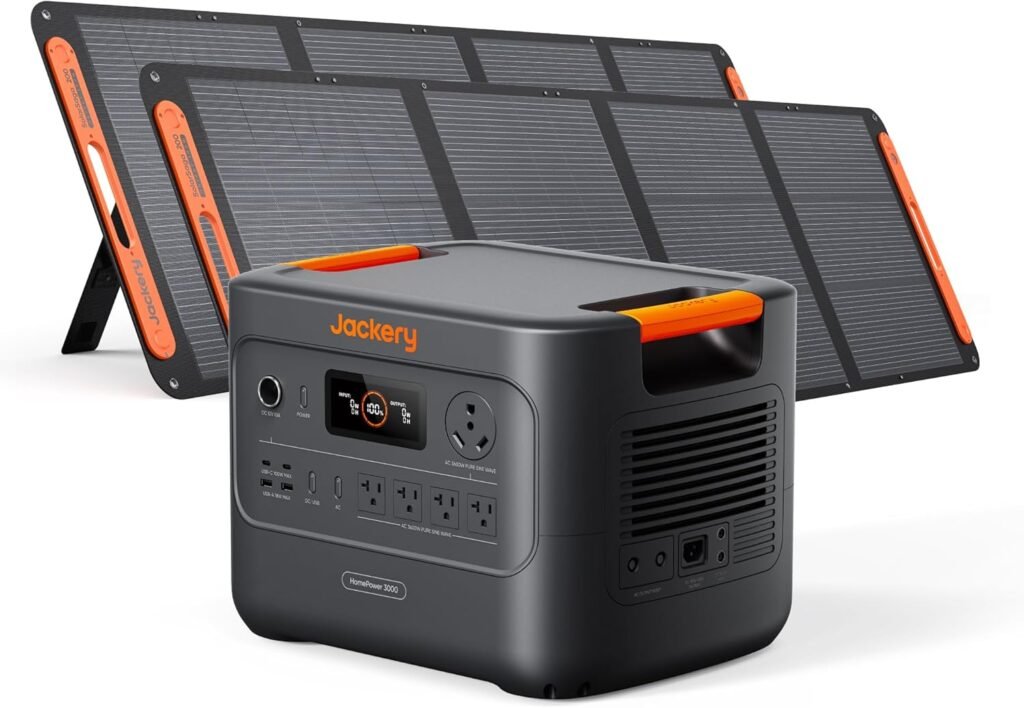
When we look at the Jackery HomePower 3000 Portable Power Station with 2×200W Solar Panels, we are really looking at a compact home backup system. It sits somewhere between a traditional gas generator and a full-blown home battery wall, but with portability, solar integration, and plug‑and‑play simplicity.
This model feels designed for households that want reliable backup without complicated wiring, as well as for RV travelers and off‑grid adventures where quiet, clean power is a must. If we want something that can live in the house most of the year and double as an outdoor power hub, this unit fits that role well.
Key Specifications at a Glance
Sometimes it helps to see the core specs laid out clearly so we can quickly judge whether a product matches our needs. This power station stacks up strongly against other 3kWh solutions.
| Feature | Specification |
|---|---|
| Product Name | Jackery HomePower 3000 Portable Power Station with 2×200W Solar Panels |
| Battery Capacity | 3072Wh (LiFePO₄ / LFP) |
| Continuous Output Power | 3600W |
| Surge Output Power | 7200W |
| Battery Chemistry | LiFePO₄ (LFP) with ~4,000 cycles to 70% capacity |
| UPS Transfer Time | ≤ 20ms (UL‑certified UPS functionality) |
| Solar Input | 2 × SolarSaga 200W panels (400W total), up to ~80% in 9 hours |
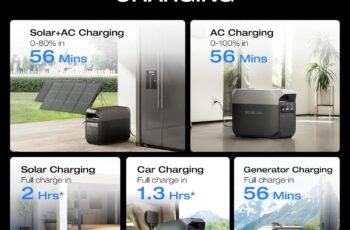
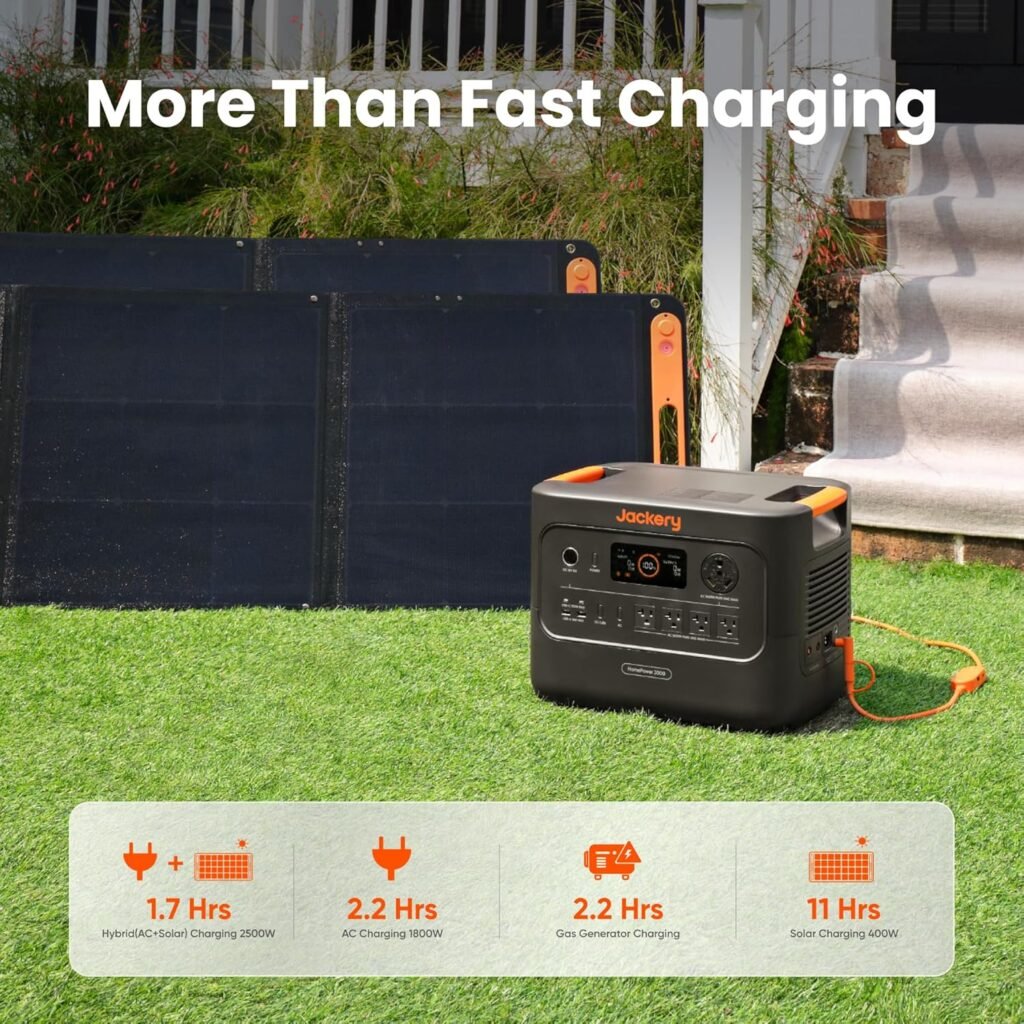
| AC + DC Hybrid Charging | Full recharge in about 1.7 hours |
| AC Charging Only | Full recharge in about 2.2 hours |
| Other Charging Options | 12V car charger, gas generator |
| Ports | AC outlets, USB‑C (dual 100W PD), USB‑A, DC outputs, TT‑30 RV port |
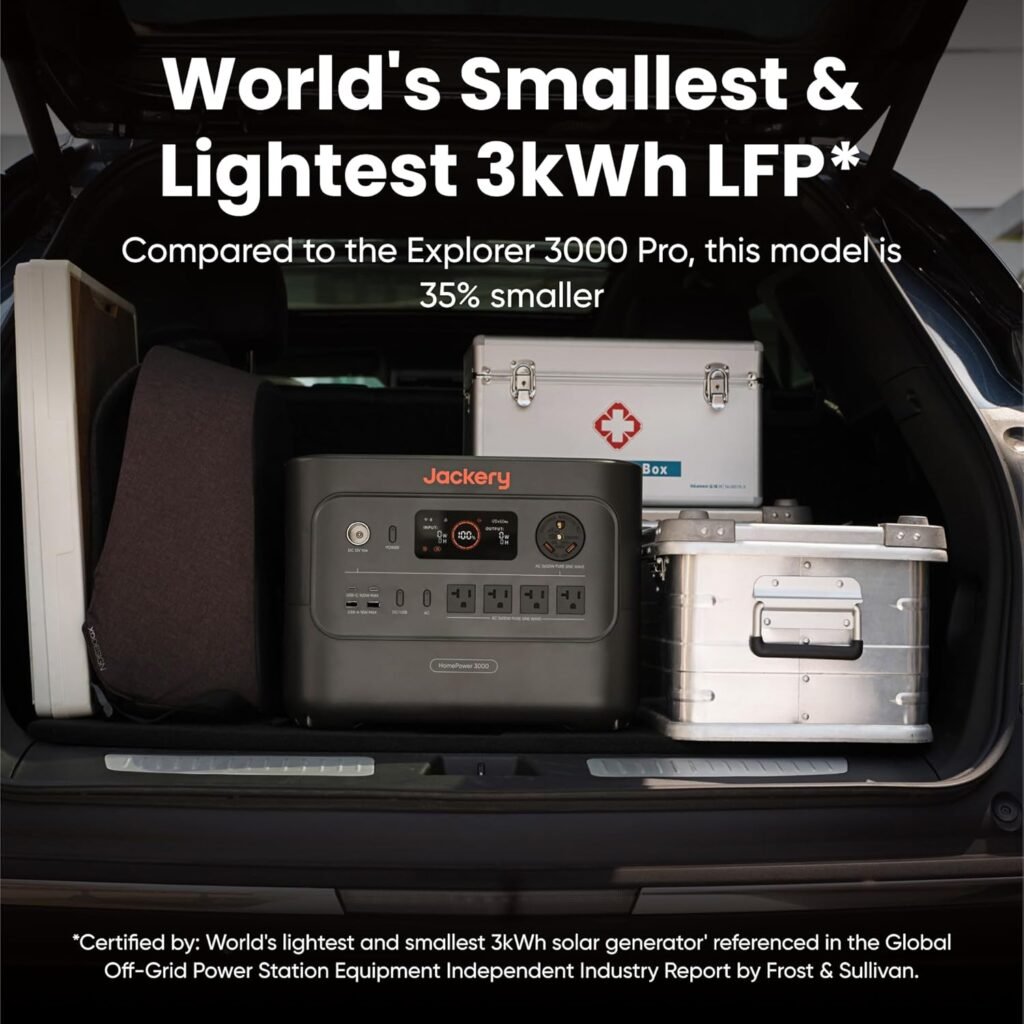
| Weight & Size | 47% smaller and 43% lighter vs similar 3kWh models (CTB tech, compact body) |
| Special Tech | ChargeShield 2.0, CTB technology, honeycomb bottom shell |
This combination of 3kWh capacity, 3600W output, fast charging, and solar support is essentially a sweet spot for serious home backup while staying relatively portable.
Capacity and Real‑World Runtime
Understanding the 3072Wh Battery Capacity
On paper, 3072Wh sounds impressive, but we might ask what that really means in daily use. In practical terms, this capacity gives us enough energy to ride through most short to medium power outages while keeping our essentials alive.
The manufacturer suggests that it can:
- Support a typical household’s essentials for up to about 15 hours
- Keep a refrigerator running for 1–2 days (depending on the fridge and usage)
That aligns reasonably well with what we’d expect from a 3kWh battery running intermittent loads like fridges, lights, and intermittent device charging.
Example Usage Scenarios
To make this more concrete, we can break down approximate runtimes based on realistic power draws. Actual numbers will vary with efficiency, inverter losses, and usage patterns, but these estimates give us a sense of what the HomePower 3000 can handle.
| Appliance / Device | Approx. Power Draw | Estimated Runtime on 3072Wh* |
|---|---|---|
| Full‑size fridge | 150W average | ~18–20 hours of compressor-on time (1–2 days use) |
| WiFi router + modem | 20W | ~120–130 hours |
| LED light (10W) × 4 | 40W total | ~60–70 hours |
| Laptop (light work) | 60W | ~40–45 hours |
| 55″ LED TV | 100W | ~25–28 hours |
| CPAP machine | 40W | ~60–70 hours |
| Portable heater (low) | 1000W | ~2.5–3 hours |
| Microwave (intermittent) | 1000–1500W | 1–2 hours total accumulated use |
*These are rough estimates and assume around 85–90% usable capacity once we account for real‑world conditions.
In most outage scenarios, we are not running every appliance at once for hours on end. Instead, we are cycling them, which is why the “up to 15 hours” for a household and “1–2 days” for a fridge are reasonable claims.

Power Output: What 3600W (Surge 7200W) Means for Us
Running Multiple Appliances at Once
A continuous output of 3600W gives us headroom to run several heavy loads simultaneously. That might include:
- Refrigerator (150–300W peak)
- Freezer (if we have a separate unit)
- A few lights and electronics
- Possibly a microwave or coffee maker intermittently
- Or a small portable AC or space heater (depending on exact wattage)
Because the surge rating goes up to 7200W, the HomePower 3000 handles startup spikes from appliances like fridges, pumps, and some power tools. We do not have to worry as much about tripping the unit when a compressor kicks in.
Safe for Sensitive Electronics
One of the big advantages over gas generators is the pure and stable power output. We can plug in:
- Laptops and desktops
- Smart TVs
- Gaming consoles
- Medical devices (within power limits)
without stressing about voltage dips, dirty power, or fuel fumes in our living space. The high wattage plus clean sine wave output is a huge win for home use.
UPS Functionality: ≤20ms Switch‑Over During Outages
Why the ≤20ms UPS Feature Matters
The built‑in UL‑certified UPS (uninterruptible power supply) is a standout feature. When the grid power fails, the HomePower 3000 switches over within 20 milliseconds or less. That is fast enough for many sensitive devices to keep running without shutting off.
This matters a lot for:
- Security cameras and network video recorders
- Home office setups with desktops, monitors, and routers
- Ongoing Zoom calls and remote work sessions
- Medical refrigerators storing insulin or other temperature‑sensitive medicine
- Pet feeders and smart home devices that need constant power
We can keep these essentials online seamlessly when a storm or grid failure hits, which greatly reduces stress and potential damage.
Real‑Life UPS Use Cases
We can imagine a typical scenario: we are on a video call while our router, modem, and laptop are powered through the HomePower 3000 in UPS mode. The power flickers, the house goes dark, but our call does not drop and our devices keep running. We notice the lights off in the background, but our work continues uninterrupted.
For many of us working from home, that aspect alone can justify a serious backup system.
Port Selection: Powering Everything from One Hub
AC, USB, DC, and RV Connections
Port variety is one of the strengths of this unit. It is not just a big battery and a couple of AC outlets; it is more like a portable power strip with multiple charging standards.
While exact port counts vary, we can expect:
- Multiple AC outlets for general appliances
- USB‑C ports with Power Delivery up to 100W (two 100W PD ports)
- USB‑A ports for smaller devices
- DC output ports for certain electronics
- A built‑in TT‑30 RV port
This mix lets us power a typical home office setup, kitchen essentials, entertainment devices, and RV power, all from one central station.
Fast USB‑C Charging for Modern Devices
The dual 100W USB‑C PD ports deserve their own spotlight. Many modern laptops, tablets, drones, and high‑end smartphones can fast‑charge at 60–100W. With two 100W ports, we can:
- Charge two USB‑C laptops at full speed
- Rapid‑charge a power‑hungry tablet while keeping a laptop topped off
- Charge camera batteries, drones, and other gear without extra adapters
This reduces how many bulky chargers we have to pack or keep plugged in and turns the HomePower 3000 into a universal charging hub.
Home Backup Performance: Handling Real Emergencies
Keeping Essential Appliances Running
Our first priority during an outage usually centers on food preservation, communication, and basic comfort. With 3600W output and 3072Wh capacity, we can structure our loads sensibly:
- Run the fridge and possibly a small chest freezer
- Keep our WiFi router and phones charged
- Run a few LED lights in key rooms
- Power a laptop, TV, or radio for news and entertainment
- Possibly run a CPAP machine, medical fridge, or other small medical device
By managing our usage—turning heavier loads on only when needed—we can stretch the battery through a full day or two while still feeling connected and secure.
Estimated Home Backup Scenario
A realistic outage setup might look like this:
- Fridge: ~150W average over the day
- Router + modem: 20W
- 4 LED lights: 40W total (used 6–8 hours per day)
- Laptop and small electronics: 60–80W for a few hours
- Occasional microwave or kettle: 1000W but only for short bursts
In this scenario, we can comfortably ride through a long outage by rationing high‑draw appliances. Add in the solar contribution from the two 200W panels, and we can extend that window significantly during sunny periods.
RV and Outdoor Use: Power on the Road
TT‑30 RV Port for Easy Hookup
For RV owners, the built‑in TT‑30 port is a huge convenience. Instead of using adapters and cobbled‑together wiring, we can plug our RV directly into the HomePower 3000 and power:
- Interior lights
- Small AC or space heaters (depending on the RV and power draw)
- Water pump, fans, and control systems
- Outlets for TVs, laptops, and chargers
This makes it an ideal power center for boondocking and off‑grid camping trips where we want quiet, clean, non‑gas power without waking up the campground or inhaling exhaust.
Camping and Off‑Grid Activities
Even outside of RVs, the HomePower 3000 suits:
- Cabin getaways where grid power is unreliable
- Outdoor events, tailgates, and backyard gatherings
- Field work that requires tools, lighting, and electronics
- Film shoots, photography sessions, and drone operations in remote areas
Its output is strong enough to support power tools or a decent PA system, while the solar panels keep us topped up during the day.
Charging Options: Keeping the Battery Full
Fast AC and Hybrid Charging
One of the strongest quality‑of‑life benefits here is how quickly we can refuel the battery. We have three main high‑speed options:
- AC only: Full recharge in about 2.2 hours
- Hybrid AC + DC: Full recharge in about 1.7 hours
- Solar: Up to 80% in about 9 hours using the included 2×200W panels (under ideal sun)
That means we can realistically bring a nearly depleted battery back to full before dinner if we start charging in the afternoon from AC. Combined with smart energy management, it gives us a lot of flexibility in between outages or during multi‑day trips.
Solar Charging with 2×200W SolarSaga Panels
The included 200W panels (two of them, totaling 400W) turn this unit into a full solar generator package. Under good sun, we can expect:
- Around 300–350W effective input in real‑world conditions (angle, temperature, clouds affect this)
- Roughly 80% capacity recharge in a long sunny day
We should not expect miracles on very cloudy days, but in many climates, this solar addition can:
- Extend our runtime through prolonged outages
- Provide daytime energy while we conserve battery at night
- Allow off‑grid camping without regularly using a gas generator
We also have the backup options of using:
- A 12V car charger input
- A gas generator to feed AC power in really extended emergencies
so there is no single point of failure when it comes to refueling.
Battery Technology: LiFePO₄ Longevity and Safety
Why LiFePO₄ Matters
The Jackery HomePower 3000 uses LiFePO₄ (LFP) batteries, which stand out from standard lithium‑ion packs in several ways:
- Cycle life: Around 4,000 charge cycles while retaining about 70% of original capacity
- Thermal stability: More resistant to overheating and thermal runaway
- Chemistry safety: Generally regarded as safer in home environments
- Flatter discharge curve: More stable voltage across most of the capacity range
For us, this means we can use the unit regularly—possibly even daily for partial charges—and still expect a long service life.
ChargeShield 2.0 and Smart Charging
Jackery mentions ChargeShield 2.0 technology with AI algorithms to manage charging. While much of this is behind the scenes, the effect for us is:
- Optimized charging curves to minimize battery stress
- Improved overall charging speed without compromising safety
- Better heat management during fast AC or hybrid recharging
The goal is to preserve longevity while letting us enjoy quick turnarounds between uses.
Design, Size, and Portability
World’s First 3kWh Station with CTB Technology
The HomePower 3000 claims to be the world’s first 3kWh portable power station with CTB (Cell‑to‑Battery) technology. In practice, that means:
- About 14% improvement in space efficiency
- Roughly 47% smaller and 43% lighter than other power stations of similar capacity
For a 3kWh unit, this size reduction matters. We are still dealing with a substantial device, but:
- It takes less floor space in a closet, behind a couch, or in an RV
- It is easier to move between rooms or from house to vehicle
- It is more realistic for one or two people to lift and position where needed
Honeycomb‑Style Bottom Shell and Integrated Design
The honeycomb‑style bottom shell is engineered to add structural strength and stability, which matters when we are moving the unit in and out of vehicles or over uneven surfaces. Combined with the integrated PV and inverter design, we get:
- Fewer exposed components and cables to manage
- A more streamlined, robust body that feels like a single, solid product
- Improved safety thanks to better internal integration and fewer potential failure points
Overall, the physical design focuses on real‑world practicality rather than just lab specs.
Ease of Use and Everyday Experience
Plug‑and‑Play Operation
One of the biggest advantages of a portable station over a traditional home backup system is that we do not need an electrician to get started. We simply:
- Charge the unit via AC (and optionally solar)
- Plug devices into the appropriate ports
- Optionally set it up as a UPS for key electronics
There is no fuel to manage, no complicated startup sequence, and no maintenance schedule like we would have with a gas generator.
Noise, Smell, and Indoor Friendliness
Because this is a battery‑based system, we avoid:
- Engine noise
- Fumes
- Fuel storage issues
We can keep it inside a living room, office, bedroom, or RV cabin without worrying about carbon monoxide or disturbing neighbors. It is overall a quieter, cleaner way to maintain backup power.
Safety Features and Protections
Electrical and Battery Safeguards
A unit of this power and capacity needs robust safety systems. While we do not see every circuit in marketing materials, we can infer typical protections, such as:
- Over‑voltage, under‑voltage, and over‑current protection
- Short‑circuit protection
- Over‑temperature protection
- Battery management system (BMS) for cell balancing and monitoring
Combined with the stable LiFePO₄ chemistry and the integrated design, this gives us confidence in running the station in an indoor environment near family members or pets.
UPS Reliability for Critical Loads
The UL‑certified UPS function gives us an extra layer of trust when we connect critical electronics. Knowing that the switch‑over time is ≤20ms and tested under safety standards is important if we plan to use this for home office or medical applications. It is not just a convenience; it is a reliability and safety assurance.
Solar Integration: Building a Small Home Solar Backup
Daily Solar‑Backed Operation
With 2×200W panels, we essentially own a small solar charging system bundled with our backup battery. In daily life, we can:
- Keep the battery topped off during sunny days
- Reduce reliance on grid power for light loads
- Use it as a stepping stone toward a more robust off‑grid system later
If we live in an area with frequent, short‑term outages, we can think of the HomePower 3000 as a resilient buffer. When the grid fails, we have a precharged 3kWh reserve and a way to recover some of that capacity during the daytime.
Long Outages and Energy Strategy
During a multi‑day blackout, our approach might look like this:
- Use the battery mainly for high‑value loads (fridge, communications, select lighting, medical devices)
- Limit high‑draw devices like heaters, kettles, or large power tools to short intervals
- Use solar panels to replenish as much energy as possible during the day
- Run sensitive devices and critical loads continuously, while cycling others on and off
We are not building a fully off‑grid home with 3kWh and 400W solar alone, but we are dramatically increasing our comfort and safety in prolonged emergencies.
Advantages Compared to Gas Generators and Smaller Stations
Versus Traditional Gas Generators
Compared to a gas generator, the HomePower 3000 delivers:
- Indoor‑safe operation with no fumes
- Nearly silent power compared to a roaring engine
- UPS functionality for truly seamless backup
- No fuel storage, carb issues, or maintenance
- Much smaller environmental footprint
The tradeoff is that we have a finite energy store unless we add solar or AC recharging, and we cannot match the sheer continuous runtime of a gas unit fed by a full fuel tank. However, for many households, the convenience, cleanliness, and safety tradeoffs are worth it.
Versus Smaller Portable Power Stations
If we have used 500–1000Wh portable stations before, we know how quickly they can drain under real loads. The jump to 3072Wh and 3600W output gives us:
- Enough power to run major appliances, not just small gadgets
- Meaningful whole‑home backup capacity (at least for essentials)
- Less need to constantly baby‑sit the battery percentage
It transforms a backup station from a “nice gadget” into a serious resilience tool.
Use Cases: How We Might Actually Use It
Everyday Life and Minor Outages
For brief flickers or short outages, the station works mostly like a UPS and high‑capacity power bank. We might:
- Keep the home office powered during grid hiccups
- Charge phones and laptops faster than via wall bricks
- Power outdoor projects without running extension cords everywhere
Even when the grid is stable, it can function as a central charging hub that tidies up wall outlets.
Major Storms, Hurricanes, or Wildfire Shutdowns
For planned shutoffs or big storms, the HomePower 3000 becomes our safety net. We can:
- Pre‑charge it fully from AC
- Position it near our kitchen or in a central room
- Connect the fridge, communications gear, and a few lights
- Set up the solar panels where they can catch sun after the storm passes
This combination lets us ride out long disruptions more calmly, especially if we have vulnerable family members or refrigerated medications.
Travel, RVing, and Off‑Grid Experiences
On the road, the HomePower 3000 is both our generator and our house battery. It is particularly appealing if we:
- Want an RV setup without noisy generators
- Enjoy boondocking on public lands with minimal disturbances
- Need to power drones, camera gear, or laptops for content creation
- Plan extended road trips where remote work is part of the routine
The TT‑30 port, solar integration, and high AC output all work together to give us RV‑style power in a compact footprint.
Practical Considerations and Things to Keep in Mind
Separate Shipments for Station and Panels
Jackery notes that the HomePower 3000 unit and the solar panels ship separately and might arrive at different times. That means we should:
- Plan our schedule so someone is available for both deliveries
- Avoid scheduling an immediate trip assuming everything will arrive the same day
- Check the tracking for both packages individually
It is not a functional issue, but it is worth anticipating to avoid surprises.
Weight and Mobility
Even though this model is significantly lighter than many competing 3kWh solutions, it is still a sizable device. We will want:
- A clear storage spot where it can remain easily accessible
- A plan for moving it between rooms or up/down stairs if needed
- To avoid placing it in damp or very dusty environments
The reduced size and CTB technology help a lot, but we should still treat it as a serious piece of home infrastructure rather than a tiny gadget.
Summary of Strengths and Tradeoffs
What We Gain with the Jackery HomePower 3000
We get a combination that is hard to match in one package:
- 3600W continuous / 7200W surge output for real appliances
- 3072Wh LiFePO₄ battery with long cycle life and safer chemistry
- UPS functionality with ≤20ms switchover for sensitive devices
- 2×200W solar panels included for renewable recharging
- Fast AC and hybrid charging (as fast as ~1.7 hours)
- Versatile port selection, including dual 100W USB‑C and TT‑30 RV port
- Compact design that is lighter and smaller than many comparable units
Together, these features position it as a serious home backup solution that still remains portable enough for RVs and off‑grid trips.
What We Should Consider Before Buying
We also want to be realistic about what it is and what it is not:
- It is not a whole‑house permanent backup system that can run every appliance indefinitely
- It requires some power management and prioritization during long outages
- Its solar recharge speed depends heavily on sunlight and panel placement
- It is still a significant investment, especially compared with smaller power banks
If we accept those limitations and plan our usage around them, the HomePower 3000 becomes a powerful, flexible tool for increasing our resilience and comfort.
Final Thoughts: Is It a Good Fit for Our Situation?
If our priorities include reliable home backup, quiet indoor‑safe operation, solar charging, and enough power to handle actual household appliances, the Jackery HomePower 3000 Portable Power Station with 2×200W Solar Panels fits that checklist remarkably well.
We see it as an excellent match if we:
- Live in an area with frequent power outages
- Work from home and cannot afford dropped connections
- Want to keep a fridge, lights, and communications running in emergencies
- Own an RV or spend time off‑grid and need serious but portable power
- Prefer a long‑life LiFePO₄ system with robust charging and safety features
With thoughtful planning and reasonable expectations, this unit can move from being just another gadget to becoming an essential part of how we protect our household and stay connected, no matter what happens to the grid outside.