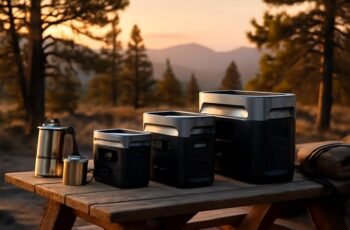
We’re exploring the 7 best power stations with app control, blending smart safety with portable power on tap. From LiFePO4 reliability to UPS-style backup, these units promise real-time monitoring, OTA updates, and multiple charging inputs. Each option brings a different mix of capacity and expandability, plus user-friendly dashboards you can trust. But there’s more to weigh—battery chemistry, inverter size, and ecosystem compatibility—to help you choose the right fit for camping, emergencies, or off-grid living.
Key Takeaways
- App-controlled power stations offer real-time monitoring of battery, input/output watts, and runtime for easy management.
- High-capacity options like OUPES Mega 3 and DABBSSON 2000L provide extensible energy with robust safety features and LiFePO4 chemistry.
- 5-in-1 modular stations add detachable modules (lights, speaker, power bank) for versatile on-tap power and tasks.
- Compact models such as BLUETTI AC2A and Anker SOLIX C300 deliver fast charging, multiple outputs, and user-friendly app interfaces.
- Jackery Explorer 1000 v2 and similar units balance long life, pass-through charging, and app-based control for campers and emergencies.
BLUETTI AC2A Portable Power Station (204Wh)
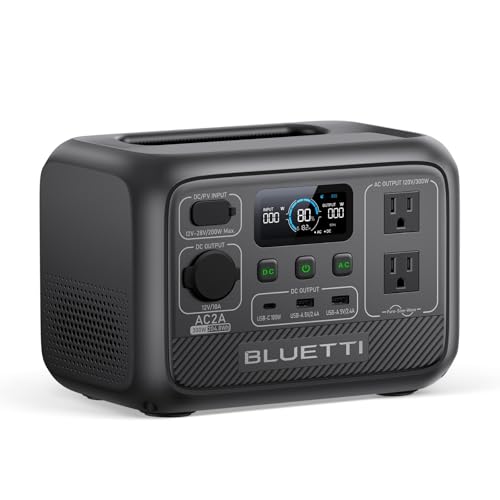

If you want a compact, capable power station you can control from your phone, the BLUETTI AC2A stands out with its 204Wh LiFePO4 battery and 300W inverter. We’re looking at a portable unit that weighs 7.9 lbs with 6 outlets and a silent 20 ms UPS backup. It charges via AC, solar, car, or lead-acid sources, delivering 0–80% in 40 minutes and full charge in about 70. The LiFePO4 battery promises 3,000+ cycles, and the BLUETTI app lets you monitor, set modes, and update OTA. It suits camping, emergencies, and home backup.
Best For: campers, emergency preparedness planners, and light home backup users who want a compact, app-controllable power source with a durable LiFePO4 battery.
Pros:
- 204Wh LiFePO4 battery with 3,000+ cycles and silent operation
- 300W inverter with 600W peak, UPS backup ≤20 ms, and six outlets
- Fast charging: 0–80% in about 40 minutes and full charge around 70 minutes via multiple sources
Cons:
- 300W continuous output may limit power-hungry devices
- 7.9 lb weight is portable but may be heavier than ultra-compact packs for certain hikers
- No built-in heavy-duty solar input or higher-capacity expansion options integrated
OUPES Mega 3 Portable Power Station (3600W)

The OUPES Mega 3 stands out for heavy-duty power with a 3600W continuous inverter and expandability up to 15.36kWh. We value its LiFePO4 battery and 3072Wh base capacity, plus five AC outlets for flexible setups. With 0.8-hour fast charging from 1800W wall input and 2.5 hours solar charging, it keeps amps and amps usable in outages, camps, or RV trips. The Smart App Control lets us monitor battery, runtimes, and watts in real time, with safety features like auto shutoff and short-circuit protection. Expansion with B2 batteries boosts capacity, while the 88-pound frame remains portable for heavy-duty needs. 5-year warranty backs the choice.
Best For: people needing a heavy-duty, expandable portable power station for outages, camps, RVs, and off-grid setups.
Pros:
- High 3600W continuous inverter with expandable capacity up to 15.36kWh via B2 batteries.
- LiFePO4 chemistry offers long life and safety with multiple safety protections.
- Multiple outlets (5 AC) and Smart App Control for real-time monitoring and control.
Cons:
- Hefty weight (88 pounds) and large footprint may limit portability.
- Fast charging is strong but requires a high input (1800W) and may still take time in practical scenarios.
- Higher upfront cost compared to smaller portable power stations.
5-in-1 Portable Power Station with Detachable Modules

This 5-in-1 portable power station stands out for its modular design with detachable modules, letting us tailor power to camping, RV trips, or home backup. We’ve got 512Wh capacity with 800W continuous and 1600W surge, plus 3 AC outlets, 2 DC5521, 2 USB-A, 2 USB-C, and a car socket. The four detachable modules—Spot Light, Panel Light, Speaker, Power Bank—expand versatility, while mounting accessories like a magnetic holder, tripod, and backpack clip keep setups flexible. Controlled by voice or app, it uses LiFePO4 cells for 4,000+ cycles and multi-layer safety. Independent or combined use makes it a practical, durable outdoor and home option.
Best For: campers, RV travelers, and home backup users who want a modular, expandable portable power solution with multiple outlets and smart control.
Pros:
- Modular design with detachable light, speaker, and power bank modules for customizable setups
- LiFePO4 chemistry offering 4,000+ charge cycles and multi-layer safety protections
- Voice and app control for convenient power management in outdoor or home scenarios
Cons:
- Weight at 15 pounds may affect portability for some users
- 512Wh capacity may be limiting for high-power or extended off-grid needs
- Requires additional accessories to maximize mounting versatility in rugged setups
Anker SOLIX C300 Portable Power Station (288Wh)

With 288Wh of LiFePO4 capacity and a 300W continuous output, the Anker SOLIX C300 is ideal for compact, reliable power on the go. We appreciate its 9.02-pound design and 6.46L x 6.34W x 9.45H footprint, plus 8 outlets (3 AC, 1 car, 2 USB-C, 1 USB-C, 1 USB-A). It charges to 80% in ~50 minutes and supports 140W USB-C two-way fast charging. We value pass-through charging, quiet 25dB operation, and a 3,000+ cycle life with a 10-year design life. While solar panels vary, 60–100W panels fit well, and app features add useful monitoring.
Best For: campers, travelers, and emergency-ready households seeking a compact, quiet 300W portable power station with LiFePO4 chemistry and solid battery life.
Pros:
- 288Wh LiFePO4 battery with 3,000+ cycles and 10-year design life for long-term reliability
- Compact, lightweight design (9.02 lb) with 8 outlets (AC, car, USB-C, USB-A) and pass-through charging
- Fast charging capability (80% in ~50 minutes) and quiet operation (25dB)
Cons:
- 300W continuous output limits use with high-wattage appliances; not suitable for kitchen appliances
- Solar panel performance varies by conditions; real-world input may be lower than ideal
- Some users report missing strap on certain units and limited app connectivity/features
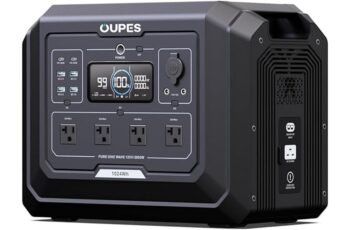
OUPES Mega 1 Portable Power Station (1024Wh)

OUPES Mega 1 stands out for its expandable capacity, growing from 1024Wh to 5kWh with an extra battery for bigger power needs. We like its LiFePO4 battery, long life, and 5-year warranty, plus a compact 27.8-pound form. The unit delivers 2000W continuous (4500W peak) from four 120V AC outlets, plus USB-C 100W, USB-A 18W, DC5521, and a car outlet. It charges from up to 2200W via solar, AC, car, or hybrid, with 0–80% in about 50 minutes (fast) or slower for longevity. UPS-ready for outages, it supports quiet, clean energy and broad device compatibility, including camping and home backup. Smart app control enhances usability.
Best For: Camping, home backup, and off-grid users who need expandable capacity, quiet operation, and flexible charging options.
Pros:
- Expands from 1024Wh to up to 5kWh with an additional battery, meeting larger power needs.
- LiFePO4 chemistry offers safety, longevity, and a 5-year warranty.
- High versatility with 2000W continuous/4500W peak AC output, multiple USB and DC ports, and UPS capability.
Cons:
- 27.8 pounds is relatively heavy for a portable unit; may be less convenient for frequent Portability.
- Solar charging up to 800W MPPT noted; overall max input is 2200W, which may be slower on large loads or cloudy days.
- Higher upfront cost typical for expandable LiFePO4 systems compared to non-expandable rivals.
DABBSSON 2000L Solar Generator – Portable Power Station
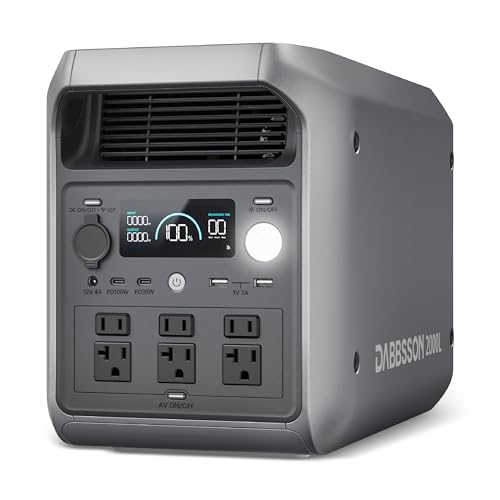
The DABBSSON 2000L stands out for big-capacity reliability with smart app control, making it ideal for extended off-grid use and UPS-like reliability. We’re looking at a 2048Wh semi-solid LiFePO4 core, 2000L with 2200W AC, boosted to 3300W. It’s ultra-compact at 11.2×18.3×8.9 inches and about 41 pounds, with a built-in handle and fire-resistant design. Six AC outlets, multiple USB ports, car, and DC options power 12 devices via intelligent management. It delivers 15 ms EPS switching, 80% charge in 1.5 hours, and 800W solar input. Users praise runtime, app ease, and durable build for camping, home, and job sites.
Best For: Off-grid enthusiasts and professionals who need a high-capacity, reliable, smartly managed power station with UPS-like reliability for camping, homes, RVs, job sites, and extended outages.
Pros:
- High capacity (2048Wh) with reliable LiFePO4 chemistry and long cycle life
- 15 ms fast UPS switching, app-controlled monitoring, and robust safety features
- Versatile charging and outputs: 6 AC outlets, multiple USB ports, car and DC options, plus up to 800W solar input
Cons:
- Hefty for portable use (around 41 lbs) despite compact dimensions
- Charging with AC at 1500W still takes 1.5 hours to 80%, which is solid but not the absolute fastest for all users
- 800W solar input may limit off-grid performance in very sunny, high-demand scenarios
Jackery Explorer 1000 v2 Portable Power Station

Powerful yet portable, the Explorer 1000 v2 suits campers and off-grid homeowners who want serious AC delivery and fast app-assisted control. We pack 1,500W continuous AC, 3,000W surge, and a 1,070Wh LiFePO4 battery into a 23.8–lb unit with a foldable handle, ideal for camping, road trips, and emergencies. It doors two USB-C ports, USB-A, DC car port, and three pure sine wave AC outlets, plus PD 100W charging. Our fast charging hits 0–100% in about an hour, with App-based modes, ChargeShield 2.0, and quiet overnight charging. Battery longevity, 4,000 cycles, plus 10+ years, keep it reliable. Compatible with Jackery solar panels for solar charging.
Best For: Campers, off-grid homeowners, and emergency prep households who need strong AC power, portable lithium iron phosphate durability, and app-assisted control in a compact 23.8 lb package.
Pros:
- High continuous AC output (1,500W) with 3,000W surge and 1,070Wh LiFePO4 battery for reliable power delivery.
- Fast PD 100W charging and one-hour 0–100% top-ups, plus app-based control, ChargeShield 2.0, and quiet overnight charging.
- Durable, long-lasting battery life (4,000+ cycles; 10+ years) with solar charging compatibility (Jackery panels).
Cons:
- Solar panel not included and charging compatibility limited to Jackery solar panels (potentially higher total cost).
- App requires account management; some users report small screen size and price variances.
- Not ideal for very large or high-energy users needing more than 1,500W continuous output or extensive multi-unit setups.
Factors to Consider When Choosing Power Stations With App Control
We’ll start by looking at how easy the App Control setup is and whether it works with our devices right away. Then we’ll weigh real-time monitoring, remote charging modes, and how safety alerts keep us in the loop. Finally, we’ll consider data privacy and how transparent the app is about what it collects and shares.
App Control Setup
Navigating app control? We’ll break down setup essentials so you can start strong. Real-time monitoring is core: check battery level, input/output wattages, and remaining runtime through the app, ensuring you have an accurate readout at a glance. Look for remote charging/discharging options and OTA firmware updates, which simplify upkeep without extra tools. Consider UPS-like features that auto-switch over during outages and restore power smoothly. Compatibility matters: some devices use Wi‑Fi or Bluetooth directly, others need a local network gateway. Account management is common, so keep credentials organized. Also note occasional connectivity hiccups and rely on clear in-app status dashboards for ongoing performance checks. In short, verify setup steps, connectivity options, and update pathways to avoid surprises when you need power most.
Real-Time Monitoring
Real-time monitoring is the heartbeat of app-controlled power stations. We rely on real-time dashboards that show battery percentage, input/output wattages, and remaining runtime estimates, so you know exactly where you stand. Our apps pull live status from the built-in BMS, including cell temperatures, charge/discharge rates, and fault alerts, keeping you informed and prepared. You can see UPS status and automatic switching events (grid-to-battery and back) as they happen, so outages don’t catch you off guard. Dashboards often display charging source and rate—AC, solar, or car—and MPPT/charging efficiency, helping you optimize setup. Some apps offer live throttling or mode changes (eco, performance) that respond immediately to real-time data. This clarity guides smarter, safer power use.
Remote Charging Modes
Remote charging modes matter because they determine how and when your power station re-charges without interrupting your loads. When we compare models, we look for multiple input options—AC wall, solar, car/DC, or hybrid solar+AC—so you can pick what fits your situation. Some units promise fast remote charging, like 0–80% in 40–50 minutes via high-fidelity AC input, while solar charging remains longer and highly panel-dependent. App control should enable scheduling and automating sources based on availability or time of day, which helps optimize efficiency and cost. Many devices offer UPS-style pass-through during charging, keeping loads powered while the battery refuels. Real-time monitoring, MTTP/MPPT optimization, and OTA updates further influence how smoothly remote charging works.
Safety and Alerts
Curious how a power station stays safe while under app control? We rely on a Remote BMS that monitors battery health, safety metrics, and fault alerts in real time, so you stay informed. Alerts cover overcurrent, overvoltage, overtemperature, low battery, and UPS/maintenance mode status, helping you react quickly. Push notifications or in-app alerts trigger when input/output wattages drift or protective shutdowns occur, so nothing sneaks by unnoticed. Some units offer automatic safety responses via the app, like auto-shutoff, voltage regulation, or switching to auxiliary power to prevent damage. Historical data plus live readings—battery level, temperature, input/output power—enable proactive safety decisions and preventive maintenance, reducing surprises and extending component life for peaceful, reliable use.
Data Privacy
Data privacy matters more than you might think when you choose an app-controlled power station. We know these devices collect usage data like battery level, input/output wattages, and running time to fuel real-time monitoring and analytics. That data may travel over Wi-Fi or Bluetooth to companion apps, which raises exposure risks if encryption isn’t solid. Many systems store information in cloud servers for OTA updates and remote monitoring, so unclear data-retention policies or lax server access can create privacy gaps. Access controls, authentication, and permission scopes determine who—manufacturer or third parties—can access your data. We should review privacy policies for data collection, storage duration, and sharing practices, and consider local-only operation options when available to minimize exposure.
Ecosystem Compatibility
What does ecosystem compatibility mean for app-controlled power stations, and why does it matter when you’re expanding your setup? It’s about how well a device’s app and hardware fit the manufacturer’s broader product line and accessories, like panels, docks, and modules. App control usually relies on a proprietary app that talks to the unit via Wi‑Fi or Bluetooth, showing battery status, input/output watts, and charging modes within the same ecosystem. Some brands enable OTA updates and remote monitoring only when you stay within their devices or panels, ensuring consistent data formats and commands. Cross‑compatibility with third‑party apps or accessories is often limited, making ecosystem compatibility essential for seamless growth and management. A mature ecosystem may add UPS monitoring, runtime estimates, and plug‑and‑play module additions, consistently across the brand family.
Frequently Asked Questions
How Reliable Are App Updates for Power Station Control?
App updates are generally reliable for power-station control, but reliability varies by vendor. We test updates before rollout, encourage backups, and warn users about potential brief reconnects. We’ll notify you of issues and provide quick fixes when needed.
Do Apps Require a Subscription for Full Features?
Apps often require no subscription for core features, but premium options exist. Consider our guidance like a toolbox: you get essential tools upfront, with optional upgrades unsealing deeper controls for true power-user performance.
Can I Control Charging Schedules via the App?
Yes, you can control charging schedules via the app. We sync with the power station, set start/stop times, adjust limits, and save presets for automatic daily charging, so your device charges when it’s most cost- or energy-efficient.
Is There a Delay Between App Command and Action?
Yes, there’s usually a brief delay as commands sync, verify, and execute. We’ll see it in app-to-device latency, often under a second, but it can stretch with connectivity or firmware checks. We’ll monitor and optimize together.
Are There Privacy Concerns With Device Data in Apps?
We don’t ignore privacy—we protect it, honestly. We share only what’s needed and secure data, yet we keep you in control. We’re cautious, transparent, and wary of over-sharing from apps, always prioritizing your safety and trust.
Conclusion
We’ve explored power stations that put control at your fingertips, merging LiFePO4 reliability with real-time app dashboards. As you compare runtimes, inputs, and safety nets, you’ll see the future of portable power humming with OTA updates and UPS-ready backups. Think of it as a bridge: from camping trips to emergencies, you’re stepping onto solid ground with a reliable spark at hand. Your next choice? a smart, seamless power companion that’s always one tap away.