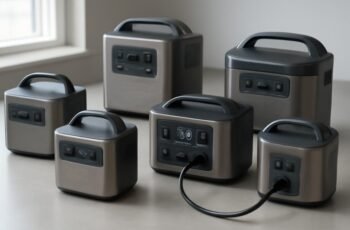
Like a beacon in a storm, these 14 best power stations for RVs promise comfort on the road. We’ll guide you through options from high-capacity LiFePO4 giants to compact daily chargers, all with solid safety, multi-output ports, and scalable expandability. But there’s more to weigh—how each fits your off-grid mealtime, climate, and travel pace. Let’s explore what matters most so you can choose confidently and stay powered up wherever the journey takes us.
Key Takeaways
- High-capacity LiFePO4 options with multi-source charging and expandability meet extended RV trips and heavy loads.
- Units with multiple outputs (AC, USB-C, USB-A, DC/car) support diverse RV devices and comfort electronics.
- Fast charging and expansion plans (extra batteries) help minimize downtime and scale for bigger camps.
- UPS/bypass features enhance reliability for critical devices during outages or low-sun days.
- Clear trade-offs on weight, price, and app reliability; pick by power needs, footprint, and expansion potential.
DJI Power 1000 V2 Portable Power Station


If you want robust, fast charging without breaking the bank, the DJI Power 1000 V2 Portable Power Station stands out with its 2600W peak output and a rapid 37-minute 80% recharge, powered by a 1024Wh LFP battery that’s built to last. We value its portability—about 14.14 kg with compact 19.2 L x 8.85 W x 9.05 H dimensions—and its wide versatility, powering kettles, projectors, drills, and more. It offers 4 outlets, dual 140W USB-C ports, and UPS backup with a 10 ms switch. While MPPT and car charging require adapters, its 5-year warranty and quiet operation reinforce reliability.
Best For: portable power users who need high-wampage capability, fast recharges, and reliable backup for camping, DIY projects, outdoor filming, and home/off-grid power needs.
Pros:
- High 2600W peak output with 80% recharge in 37 minutes for rapid power availability
- Large 1024Wh LFP battery with quiet operation and 5-year warranty
- Versatile multi-port outputs including dual 140W USB-C, 4 outlets, UPS backup with 10 ms switch
Cons:
- MPPT and car charging modules are not built-in and require separate adapters
- Heavier at ~14.14 kg, which affects portability compared to smaller units
- Higher upfront cost relative to basic portable power stations
EF ECOFLOW Delta 3 Portable Power Station 1024Wh

The EF ECOFLOW Delta 3 1024Wh stands out for RVers who want fast charging and long-life reliability in one compact unit. We’re impressed by its 1024Wh LiFePO4 battery, 1800W continuous output (3600W surge with X-Boost), and 4000-cycle life to 80%. It recharges to 80% in 30 minutes and full in 56, with up to 1500W AC input and 500W solar input—plus simultaneous solar and AC charging. It powers 13 outlets, including a 100W USB-C, and expands to about 5kWh with EcoFlow extras. Built for durability (IP65, 10-year lifespan) and backed by a 5-year warranty, it fits our camping-forward setup.
Best For: RVers and campers who need fast charging, long-lasting capacity, and reliable power for multiple devices in a compact, durable package.
Pros:
- Rapid recharge: full in 56 minutes and 80% in 30 minutes with high input options (up to 1500W AC and 500W solar).
- Long lifespan: LiFePO4 chemistry rated for ~4000 cycles to 80% and a 10-year lifespan with IP65 protection.
- Flexible output and expandability: 13 outlets, 1800W continuous (3600W with X-Boost), expandable to ~5kWh with EcoFlow extras.
Cons:
- Heavier than some competitors (approx. 27.5 pounds) for a 1024Wh unit.
- Higher upfront cost typical of premium LiFePO4 portable power stations.
- Requires compatible accessories (Extra Battery) to reach the 5kWh expansion, which adds to total cost and setup.
GRECELL Portable Power Station 300W AC Outlets

GRECELL’s 300W power station stands out for quick, versatile charging with 230Wh and a 600W surge, making it ideal for RV trips where packing light matters. We’ll power laptops, phones, lights, fans, and a mini-fridge with two AC outlets and USB-C/USB-A options, plus DC ports. It charges in 1.5 hours via Type-C or DC, or faster with multiple inputs, and supports up to seven devices at once. The LiFePO4 battery with smart BMS keeps protections in check, while dual cooling fans guard temperatures. Lightweight, compact, and safe for varied environments, it’s a solid home-backup and outdoor companion.
Best For: RV travelers, campers, and remote workers who need a compact, reliable 300W power station for laptops, phones, lights, and small appliances.
Pros:
- 230Wh LiFePO4 battery with 600W surge and smart BMS for safety
- Fast charging: 1.5 hours via Type-C or DC, plus multi-input charging up to 7 devices
- Dual AC outlets, multiple USB-C/USB-A ports, and DC car port for versatile device charging
Cons:
- Not suitable for high-watt appliances like coffee pots or kettles
- 300W continuous output may limit usage of multiple high-demand devices simultaneously
- Real-world charging gauge behavior reported by some users
OUPES Mega 1 Portable Power Station (1024Wh)

Looking for a compact, expandable power solution? The OUPES Mega 1 delivers 1024Wh of LiFePO4 capacity with expandability to 5kWh via an extra battery. It powers 4×120V/2000W AC (4500W peak) and a full array of ports: 2×USB-C 100W, 4×USB-A 18W, 2×DC5521, and a car lighter. With multi-source charging up to 2200W, you can fast-charge 0–80% in ~50 minutes and also use solar, AC, car, or hybrid inputs. It’s quiet (≈58 dB), safe, and backed by a 5-year warranty. Ideal for camping, off-grid, and emergencies, while remaining easy to manage via an app.
Best For: campers, off-grid explorers, and households seeking a safe, expandable 1024Wh LiFePO4 power source with multi-input charging and app control.
Pros:
- 1024Wh LiFePO4 battery with expandable capacity up to 5kWh, offering long cycle life and safety.
- High output capability: 2000W continuous AC, 4500W peak, plus versatile ports (USB-C, USB-A, DC, car).
- Flexible charging: up to 2200W total input from solar, AC, car, or hybrid solar+AC, with fast 0–80% in ~50 minutes and app control.
Cons:
- Heavier for a portable unit (around 27.8 pounds).
- Solar panel is optional, requiring additional purchase for solar charging.
- 58 dB noise level, which may be noticeable indoors in quiet settings.
Portable Power Station 600W with 299Wh Battery Backup

This compact 600W power station delivers 299Wh with a 1200W surge, making it an ideal pick for short trips where lightweight, reliable backup matters. We appreciate its 6.8 lb frame and compact 9.4 x 6.5 x 7.1-inch footprint, easy to stash in the RV. It offers 600W continuous output across 7 ports, including 2 AC outlets, a 140W USB-C PD, USB-A QC, a 12V car port, and a DC port, all powered by a 299Wh lithium-ion battery with a pure sine wave inverter. Quick recharge via 140W USB-C, AC, or solar MPPT keeps your weekends running smoothly. Lifetime support backs every purchase.
Best For: Campers and weekend travelers who need lightweight, reliable off-grid power with multiple ports and quick recharging.
Pros:
- Lightweight and compact at 6.8 lbs with a small footprint, easy to stash in an RV or backpack.
- Pure sine wave inverter and 299Wh battery provide clean, safe power for sensitive electronics across 7 ports (2 AC, USB-C PD, USB-A, 12V car, DC).
- Fast recharging options (140W USB-C PD, AC wall, solar MPPT) keep weekend trips running with minimal downtime.
Cons:
- 299Wh capacity may fill up quickly on extended trips with high power draw; may require careful energy management.
- Car charger cable not included, requiring an additional purchase for in-vehicle recharging.
- 600W continuous output could be limiting for high-wattage appliances despite 1200W surge capability.
Jackery Explorer 300 Portable Power Station, 293Wh

The Jackery Explorer 300 shines for compact, reliable off-grid power with 293Wh and dual AC outlets, perfect when space and weight matter for RV trips. We value its 7.1-pound portability, 2 Pure Sine Wave outlets, and 53.27W running load, plus a 500W peak start. It includes 60W USB-C, USB-A, car port, and fast-charge 3.0. Recharging is flexible: 2 hours to 80% wall recharge, plus car, home AC, or SolarSaga 100 with MPPT for faster solar input. It supports pass-through so critical devices stay powered while recharging. Ideal for camping, emergencies, and compact setups.
Best For: off-grid campers and compact setups where weight and space matter, needing reliable 293Wh backup power with multiple ports and fast recharging.
Pros:
- Compact 7.1-pound design with dual Pure Sine Wave outlets and multiple ports (AC, USB-C 60W, USB-A, car) for versatile device charging.
- Fast wall recharge to ~80% in 2 hours plus flexible charging via car, home AC, or SolarSaga 100 with MPPT for solar boosts.
- Pass-through charging keeps critical devices powered while the unit itself recharges.
Cons:
- Not suitable for high-watt appliances like induction cooktops or blenders.
- 293Wh capacity may be limiting for long outages or high-power loads.
- Solar panel is optional/add-on (SolarSaga 100 not included) and charging speed depends on sunlight conditions.
DARAN 600W Portable Power Station with Solar

With 600W of output and a 288Wh LiFePO4 battery, the DARAN Portable Power Station keeps RV life running smoothly even on days without hookups. We appreciate its 6-port design—two AC outlets (600W, 1200W surge), USB-C PD60W, two USB-A 18W, and a DC input/output—letting us run fridges, CPAPs, laptops, phones, lights, and drones simultaneously. It recharges quickly—80% in 2 hours via AC, with solar plus AC speeding it up (panel not included). A 12‑protections BMS and real-time display boost safety, while auto-off on the AC port protects the battery. Compact, under 9 pounds, and ready for camping, RVing, or emergencies.
Best For: RVers, campers, and emergency prep households needing a compact, LiFePO4 portable power station with multiple ports and fast AC recharge.
Pros:
- 600W continuous output with 1200W surge suitable for fridges, CPAPs, laptops, and more
- LiFePO4 chemistry rated for 3500+ cycles and a lightweight 8.3–13.77 lb range with solid safety protections
- Fast recharging: up to 80% in 2 hours via AC, plus solar + AC option for quicker top-ups (panel not included)
Cons:
- Solar panel not included and car charging option sold separately
- AC port auto-off at 10% battery could reduce immediate accessibility for some use cases
- Peak performance limited to 600W continuous; avoid exceeding surge and manage loads accordingly
Jackery Solar Generator 300 with 40W Panel

Options like the Jackery Solar Generator 300 with a 40W panel stand out for off-grid RV trips thanks to its light 7.5 lb design and 300W steady output. We value its portability, with an integrated handle and LiFePO4 chemistry delivering over 4,000 charge cycles to 70% capacity, promising long life. It provides 300W running power (600W peak) to run laptops, drones, cameras, and even CPAP when needed. With 2 AC outlets, USB-C PD, USB-A, and a 12V car port, it pairs with 40W panels for about 7.5 hours to 80% charge. Three-year warranty plus two-year extension offer confidence.
Best For: Off-grid RV travelers and campers seeking a lightweight, portable solar generator with reliable 300W output for charging essentials and small devices.
Pros:
- Ultra-lightweight at 7.5 lb with integrated handle for easy transport
- LiFePO4 chemistry offering 4,000+ charge cycles and long service life
- 300W continuous output (600W peak) with multiple ports (2 AC outlets, USB-C PD, USB-A, 12V car port)
Cons:
- 40W panel included results in ~7.5 hours to 80% charge under optimal conditions, slower than higher-watt panels
- Lower solar input may extend charging times in cloudy conditions or with limited sun
- Not a full-featured power station for heavy AC loads or extended boondocking without additional panels or larger capacity plans
EF ECOFLOW Delta 2 Portable Power Station 1024Wh

For RV trips needing fast, safe power, the Delta 2 stands out with its 1024Wh LiFePO4 battery and 1800W continuous output. Weighing about 27 pounds, it delivers 1800W running and 2700W starting watts across 15 outlets at 120V. It charges 0-80% in 50 minutes and 0-100% in 80, supports 500W solar input, and can expand to 3kWh with extra batteries. Built with a robust BMS and LiFePO4 chemistry for 3000+ cycles, it’s a quiet, green option. It’s ideal for RVs, camping, and back‑ups, with fast charging, multiple outputs, and expandable capacity for longer trips.
Best For: RVs, campers, and off-grid enthusiasts who need fast-charging, expandable, LiFePO4-powered backup power with robust safety features.
Pros:
- Fast recharge: 0-80% in 50 minutes and 0-100% in 80 minutes, plus 500W solar input.
- High-quality LiFePO4 battery with 3000+ cycles and strong BMS for safety and longevity.
- Expandable capacity up to 3kWh with additional batteries and versatile 15-outlet 120V support.
Cons:
- About 27 pounds may be heavy for single-handed transport.
- Higher price point relative to some competition.
- Some reviews note standby behavior and occasional fan warnings during charge/discharge.
GROWATT Helios 3600W Portable Power Station
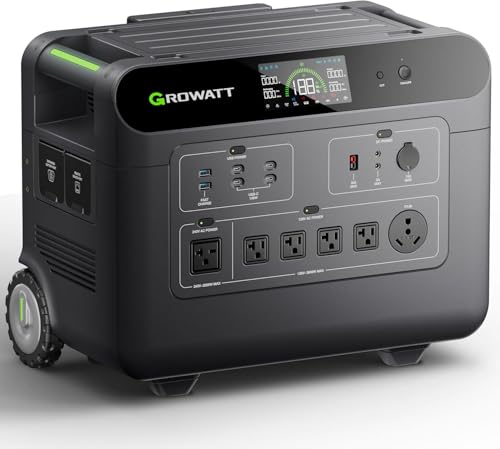
Powerful and versatile, the GROWATT Helios 3600W shines with 3600W AC output and 16 ports, perfect for RV trips requiring big loads. We value its 3686Wh LiFePO4 battery, EV-grade cells, and a lifespan beyond a decade, backed by a 5-year warranty. With 3600W (4500W with Watt+) output and 16 ports, it supports whole-home expansion up to 7200W / 36kWh using two units and a split-phase connector. Fast charging shines: 1.5 hours to full, plus solar input, wall outlets, or car power. Outdoor-ready, it uses Anderson, NEMA TT-30, and expandable batteries for 18kWh or 36kWh setups.
Best For: RVers, off-grid campers, and small-to-mid sized homes needing powerful, expandable energy with fast charging and long-lasting LFP batteries.
Pros:
- High continuous output (3600W) with up to 4500W peak (Watt+), suitable for demanding loads.
- Large 3686Wh LiFePO4 battery with 10+ year lifespan and 5-year warranty.
- Flexible expansion and multiple charging options (solar, wall, car, generator) with rapid 1.5-hour full charge.
Cons:
- Heavy (around 51 lb) and bulky for portable use, may require wheels for transport.
- Occasional charging hum and some app setup translation/ UI issues reported.
- Higher upfront cost and requires additional units for whole-home 7200W/36kWh expansion.
Anker SOLIX F2000 Portable Power Station (767)
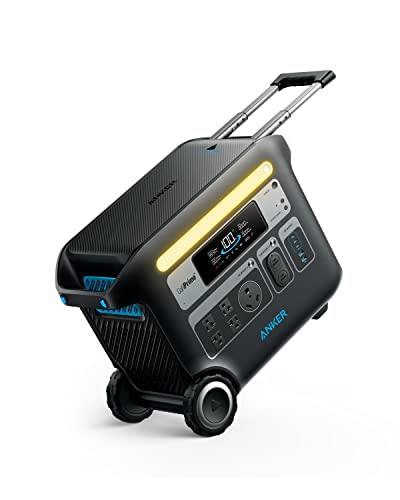
If you need a robust, long-lasting power solution, the Anker SOLIX F2000 stands out with its LiFePO4 battery and 2048Wh capacity. We value its 13 outputs, including 4 AC ports, 3 USB-C, 2 USB-A, 2 car outlets, plus an exclusive RV port, plus a 2400W continuous, 2800W surge capability. HyperFlash recharges to 80% in ~1.4–1.5 hours, and InfiniPower promises a decade-plus life. It’s quiet, solar compatible, and ships with cables and a manual under a 5-year warranty. Real-world UPS mode tops ~1440W; care needed for high-wattage, multi-device use during camping adventures.
Best For: Home backups, RVs and camping setups needing a high-capacity, long-life LiFePO4 power station with multiple output options and solar charging capability.
Pros:
- 2048Wh LiFePO4 battery with 3000+ cycle life and quiet operation
- 2400W continuous, 2800W surge output with 13 total ports (including RV port, USB-C/USB-A, and car outlets)
- Fast HyperFlash charging to ~80% in 1.4–1.5 hours and 5-year full-device warranty
Cons:
- Real UPS/bypass mode output limited to ~1440W, not true online UPS performance
- Mixed real-world reliability reports and occasional app/support issues
- Some users report inconsistent 30A port behavior and higher weight (about 67 pounds) for portable use
AFERIY P210 Portable Power Station 2400W
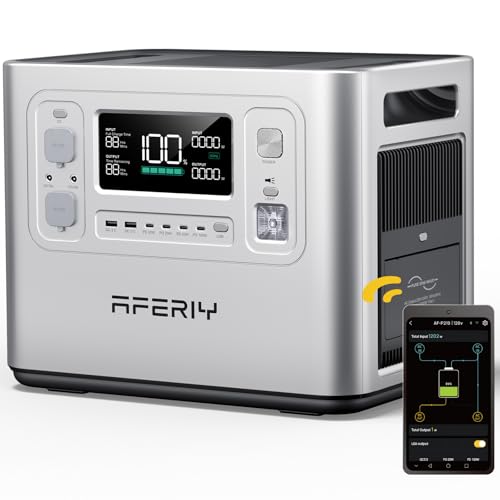
The AFERIY P210 stands out for its massive 2048Wh LiFePO4 battery and 2400W continuous output, delivering reliable power for extended RV stays. We appreciate its 16 outlets and rugged ABS build, plus a compact 54-pound frame that still feels manageable. With pure sine wave inverter, sensitive devices stay protected, and the 4000+ cycle life promises long-term reliability. Dual charging hits about 1.5 hours with 1100W AC plus 500W solar, or around 2 hours AC-only, while solar charging remains efficient via MPPT. We also value the built-in UPS, 5-year warranty (extendable), and app control for remote monitoring.
Best For: RV enthusiasts and outdoor living setups needing high-capacity, reliable off-grid power with sensitive-device protection and remote monitoring.
Pros:
- Massive 2048Wh LiFePO4 battery with 4000+ cycle life for long-term reliability
- 2400W continuous / 4800W surge inverter with 16 outlets and pure sine wave output
- Built-in UPS, app control, and dual charging (AC + solar) for fast recharging and seamless outages
Cons:
- Hefty 54-pound weight and sizable footprint may limit portability
- Higher upfront cost compared to smaller portable power stations
- Requires solar setup or AC source for optimal dual charging efficiency
AFERIY 3840Wh Portable Power Station with LiFePO4 Battery

For RV campers needing big, reliable energy, the AFERIY 3840Wh Power Station stands out with its 3600W LiFePO4 battery and expandable capacity. We’ve got five 120V AC outlets, plus USB-C, USB-A, DC outputs, plus a car socket and XT60, totaling diverse charging. The 3600W AC output pairs with a 3840Wh pack, expandable from 3.8kWh to 11.5kWh using extra batteries. Fast AC charging hits 0–100% in 2.5 hours; solar setup fills in 2.5 hours with efficient panels. LiFePO4 delivers long life, and the 5+2 year warranty backs reliability. Practical for home backup, RV use, or outages.
Best For: RV campers and outdoor enthusiasts who need high-capacity, expandable, reliable power with fast charging and versatile output options.
Pros:
- High 3600W AC output with expandable capacity up to 11.5kWh using extra batteries
- Fast charging 0–100% in 2.5 hours (AC) and similarly quick solar fill with efficient panels
- LiFePO4 chemistry offers long cycle life ( >3500 cycles ) and 5+2 year warranty for reliability
Cons:
- Heavy unit (about 104.7 pounds) may be cumbersome to transport
- Solar panels not included; requires additional purchase for solar charging setup
- Mixed customer feedback on display readability and support responsiveness
DJI Power 2000 Portable Power Station (2048Wh)

The DJI Power 2000 stands out with a 2048Wh LFP battery and 3000W peak, delivering reliable, long-lasting power for RV trips and off-grid stays. We like its 110V AC, 60 Hz output and 55-minute runtime at typical loads, plus a fast 80% recharge in 55 minutes. We appreciate the silent operation around 30 dB and the rugged, flame-retardant housing with a smart BMS. With expansion batteries, it scales to 22.5kWh. It powers most appliances, offers 15 ports and DJI Home app control, and backs a 5-year warranty for camping, DIY, and home backup needs.
Best For: RV owners, off-grid campers, and DIY enthusiasts needing reliable, long-lasting portable power with expansion capability and app monitoring.
Pros:
- High capacity and power: 2048Wh LFP battery with 3000W peak, supporting most appliances and expandable up to 22.5kWh.
- Fast, quiet, and durable: 80% recharge in 55 minutes, silent operation around 30 dB, flame-retardant housing with smart BMS.
- versatile connectivity and control: 15 ports including dual USB-C, DJI Home app for remote monitoring and management.
Cons:
- Heavy unit: about 21.72 kg, which can be cumbersome to transport.
- Higher upfront cost typical of premium portable power stations.
- Requires expansion batteries separately for multi-day off-grid use beyond base capacity.
Factors to Consider When Choosing Power Stations for RVS
We’re breaking down what matters when picking a power station for our RVs, from battery chemistry and lifespan to output power and surge capabilities. We’ll also cover charging options and speed, port selection, expandability, and app control so you can tailor a setup that fits your trips. Let’s explore how these factors influence reliability, convenience, and future-proofing your campsite power.
Battery Chemistry And Lifespan
Considering battery chemistry and lifespan is essential when choosing power stations for RV use, because it directly affects longevity, safety, and reliability on the road. We favor LiFePO4 (LFP) for its long cycle life, with many units delivering 3000–4000+ cycles and practical lifespans of 10 years or more. LFP provides improved thermal stability and safer operation, reducing thermal runaway risk versus other chemistries. Energy density is lower than NMC, but 1024Wh–2048Wh packs work well for portable RV setups while still offering longevity. A robust Battery Management System is essential with LFP to prevent overcharge, overdischarge, and short circuits, enabling stable UPS functionality. Proper care and monthly top-ups when unused help preserve capacity and extend practical lifespan for off-grid use.
Output Power And Surge
How much power can a unit deliver, and how quickly can it respond to a sudden load? We’ll look at continuous watts versus surge watts. Continuous output is what a unit can sustain for running devices, like a fridge or CPAP. Surge watts show the maximum it can deliver for short startup needs, such as a compressor starting up. For RV use, ensure the continuous rating meets your running wattage and that surge capacity handles startup currents. LiFePO4 packs often sustain high loads and tolerate strong surges, sometimes 2000–3600W. Some models gain extra surge with features like X-Boost or multi-unit expansions, great for brief spikes from resistive or compressor loads. When comparing specs, verify both continuous and peak surge, and note whether surge is across all ports or limited outlets.
Charging Options And Speed
Charging speed and flexibility matter when choosing a power station for an RV. We look for fast AC charging that can hit 0–80% in roughly 30–56 minutes with high-watt inputs, like 500–1500W, so replenishment isn’t a bottleneck. Solar input matters too; MPPT-enabled charging with 400–1500W lets us top up while the sun does the work, allowing concurrent AC and solar charging for quicker resets. Multi-source options are ideal, since top performers combine AC, solar, car, and alternator inputs to maximize recharge speed. Fast recharge benchmarks show 80% in about 30–56 minutes; full charges vary 56–80+ minutes depending on capacity and input mix. Expandable capacity or multiple batteries may necessitate repeating charging cycles to reach full, impacting total time.
Port Selection And Ports
Choosing the right power station for an RV means looking at ports as much as the battery itself. We evaluate how many outlets of each type you get—AC, USB-C, USB-A, and DC/car ports—and how many devices you can run at once. Higher-wattage needs demand models with 1800–3600W continuous output and 2600–4500W peak to cover kitchen appliances or coffee makers. Dedicated car/12V ports and RV-specific outlets improve compatibility with your rig and accessories. Port availability and distribution matter, since more outlets per type reduce the need for adapters or daisy-chaining. Some units include UPS or bypass modes with usable outputs around 1440W, which can constrain continuous loads during outages. Choose a balance that fits your typical RV gear lineup.
Expandability And App Control
Expandability and app control matter because they determine how far your power station can grow with your RV needs. We look for expandable capacity, not just base power, so add-on batteries or modular units can push total kWh higher for longer trips. Some models even offer multi-kWh expansions, up to 5 kWh with extra packs or 36 kWh in split-phase setups, which matters for longer off-grid durations. App control lets you monitor expansions, charging status, and power routing from a phone or tablet, simplifying management. When expanding, check compatibility between base unit and expansion batteries, including communication protocols and port availability. Real-world impact includes how expansion affects UPS performance, peak output, and overall reliability in RV environments.
Frequently Asked Questions
How Long Can Each Station Power Essential RV Devices?
We can power essential RV devices for about 6–12 hours on smaller units, 12–24 hours on mid-range packs, and 2–4 days on higher-capacity stations, depending on device draw and battery management.
Which Units Support Solar Recharging Most Effectively?
We power with solar best when panels stay sunny, when controllers optimize charging, and when capacities handle clouds. We’ll choose units with fast MPPT, high solar input, and reliable efficiency to maximize daytime recharging for you.
Are Battery Lifespan and Cycle Life Clearly Stated?
Yes, they’re clearly stated in specs. We share each product’s cycle life and expected battery lifespan, including how many full cycles and depth of discharge. We’ll guide you to compare numbers and choose confidently.
What Safety Features Are Standard Across Models?
We ensure standard safety features include short-circuit protection, overcurrent and overvoltage protection, thermal shutoff, fuses, and proper isolation. We also require UL/NRTL listings, rugged housings, and clear status indicators for safe, reliable operation.
Do Weight and Portability Suit Bumper-To-Bumper RV Travel?
Yes, weight and portability suit bumper-to-bumper RV travel when units are compact, light, and with ergonomic handles; we prioritize carry-friendly designs, balanced weight distribution, and secure mounting so you can move, store, and deploy them confidently.
Conclusion
We’ve covered a versatile lineup, from compact 299Wh units to colossal 2048Wh beasts, all built on LiFePO4 reliability and scalable expansion. On average, a well-mred RV setup can combine two units to hit 5000Wh for a weekend off-grid. One striking stat: LiFePO4 offers 4x longer cycle life than lead-acid, so you’ll savor years of camping without swapping packs. Choose a station that fits your load, charging speed, and future expansion needs.