Nearly 60% of RV owners plan to camp off-grid more often in 2025, so dependable power matters. We’ve rounded up portable stations that balance capacity, noise, weight, and real RV features like TT-30 ports and LiFePO4 batteries. From 1–3 kWh units to expandable systems with fast AC and solar input, these picks aim to keep fridges cold and laptops charged without fuss. Let’s compare what actually works on the road—and what to skip.
Key Takeaways
- Prioritize LiFePO4 units (3000+ cycles) with 5-year warranties for longevity and dependable RV use.
- Match inverter output and surge to RV loads; look for 2,400–3,600W continuous with X-Boost/Surge for ACs and microwaves.
- Choose RV-friendly ports (TT-30/30A), ample AC outlets, and 100W USB-C for modern devices.
- Ensure fast, flexible charging: 1–2 hour AC recharge, 1,200–2,400W solar input, and dual AC+solar support.
- Consider portability and control: sub-60 lb if possible, wheels/handles, and robust app (Wi‑Fi/Bluetooth) for monitoring and tuning.
BLUETTI AC200L Portable Power Station (2048Wh LiFePO4)


If you need serious RV-ready power without the roar of a generator, BLUETTI’s AC200L stands out for its 2,048 Wh LiFePO4 battery, 2,400 W output, and dedicated 30 A RV port. We get 13 outlets, 100 W USB-C, and a 48 V/8 A DC port for flexible rigs. It’s about 61.4 pounds, built for camping, boondocking, and home backup.
Charging’s fast: up to 2,400 W AC to 80% in ~45 minutes, or 1,200 W solar for a full charge in ~1.7–2.2 hours. Expand to 8,192 Wh with B300K/B210/B300/B230. App control (Wi-Fi/Bluetooth) is solid. Note the D40 for some 48 V setups. Five-year warranty.
Best For: RV owners, campers, and home backup users who need quiet, fast-charging, high-capacity power with a dedicated 30A RV output and flexible expansion.
Pros:
- 2,400 W output (3,600 W surge) with 30A RV port and 13 total outlets, including 100 W USB-C and 48 V/8 A DC
- Rapid recharge: up to 2,400 W AC (0–80% ~45 min) or 1,200 W solar (full ~1.7–2.2 hrs); app control via Wi‑Fi/Bluetooth
- Expandable from 2,048 Wh to 8,192 Wh with multiple battery options; 5-year warranty and long-life LiFePO4 cells
Cons:
- Heavy at ~61.4 lb, making frequent lifting or solo transport harder
- Some proprietary connectors and 48 V setups may require the D40 regulator; 12 V car port limited to 10 A
- Expansion batteries add cost and footprint, impacting small RV/van layouts
Jackery Solar Generator 1000 v2 with 200W Solar Panel

Looking for fast, app-controlled charging in a compact LFP unit? The Jackery Solar Generator 1000 v2 pairs a 1,070Wh LiFePO4 battery with a 1,500W AC output (3,000W surge) and an included 200W solar panel. At 23.8 lbs with a foldable handle, it’s RV-friendly, quiet, and reliable.
We like the one-hour “emergency” fast charge via the Jackery App—just remember to enable it each time. Default full charge is 1.7 hours to protect battery health, backed by ChargeShield 2.0. You get three 120V pure sine AC ports, PD 100W USB-C (two ports), USB-A, and a car port. Expect >4,000 cycles, a 5-year warranty, and steady 1500W performance.
Best For: RVers, campers, and emergency-preppers who want a compact LiFePO4 power station with app-controlled fast charging, solid 1500W output, and an included 200W solar panel.
Pros:
- One-hour “emergency” fast charge via app; default 1.7-hour full charge protects battery health with ChargeShield 2.0
- 1,500W continuous (3,000W surge) with three pure sine AC outlets plus dual 100W USB-C, USB-A, and a 12V car port
- Long-life LFP battery (>4,000 cycles to 70%), portable 23.8 lbs design, and 5-year warranty
Cons:
- Must manually enable emergency fast charge in the app before each use
- App reliance can mean occasional login or connectivity friction
- Screen is modest and unit/solar panel ship separately, which can affect delivery timing
EF ECOFLOW DELTA 2 Max Solar Generator with 220W Panel (2048Wh)

Serious RVers who want fast, flexible charging will zero in on the EF ECOFLOW DELTA 2 Max with its blistering 80% recharge in as little as 43 minutes using AC + up to 1000W solar. We like that it ships with a 220W panel, packs a 2048Wh LiFePO4 battery (3000 cycles, quiet 30 dB), and expands to 6 kWh for longer boondocking. With 2400W output (4800W surge) and X-Boost up to 3400W across 15 outlets, it runs fridges, microwaves, and tools smoothly. At 71 pounds, it’s portable enough for RV bays. The EcoFlow app simplifies monitoring, automations, and smart charging.
Best For: RVers, homeowners, and off-grid users who need ultra-fast, flexible charging and expandable backup power to run high-wattage appliances reliably.
Pros:
- Blazing recharge speeds: 80% in 43 minutes with AC + up to 1000W solar; 1.1 hours on AC alone
- Robust, long-life 2048Wh LiFePO4 battery (3000 cycles) expandable to 6 kWh; quiet operation from 30 dB
- 2400W output (4800W surge) with X-Boost up to 3400W across 15 outlets; app-based monitoring and automations
Cons:
- Heavy at 71 lbs, which can be cumbersome for frequent carry or stairs
- Included solar is a single 220W panel; to hit 1000W solar input you’ll need additional panels
- Higher upfront cost than smaller-capacity power stations despite strong feature set
Jackery HomePower 3000 Portable Power Station with 2x 200W Solar Panels
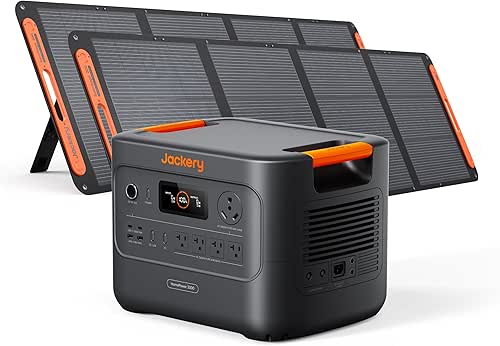
Power-hungry RVers who want true home-backup muscle on the road will appreciate Jackery’s HomePower 3000 bundle, pairing a 3,600W (7,200W surge) inverter with a 3,072Wh LiFePO4 battery and a dedicated TT-30 RV port. We get four AC outlets, USB-A/C, DC ports, and app control over WiFi/Bluetooth. It charges fast—2.2 hours via AC or 1.7 hours hybrid AC/DC—and the ≤20ms UPS keeps essentials online. The included two 200W SolarSaga panels can push up to 80% in about nine hours of good sun. At 59.5 pounds, it’s portable for RV duty. Note potential accessory costs and separate shipments.
Best For: Power-hungry RVers and homeowners needing fast-charging, portable whole-home backup for essentials with RV-ready TT-30 support and app control.
Pros:
- 3,600W (7,200W surge) output with ≤20ms UPS for seamless backup of essentials like fridges, routers, and lights
- Fast recharge: 2.2 hours via AC or 1.7 hours hybrid AC/DC; app monitoring via WiFi/Bluetooth
- Durable 3,072Wh LiFePO4 battery (≈4,000 cycles) with TT-30 RV port and included 2x 200W solar panels
Cons:
- Solar expansion may require extra-cost splitters/adapters and Jackery panels are pricier than some alternatives
- 59.5 lb weight can be cumbersome for frequent moving despite “portable” design
- Solar charging to ~80% can take up to 9 hours and varies with sunlight conditions
EF ECOFLOW DELTA 2 Portable Power Station (1024Wh, 1800W)

Need a fast-recharging RV power hub that still packs real muscle? The EcoFlow DELTA 2 delivers 1024Wh of LiFePO4 capacity, 1800W AC output (2700W surge), and 15 outlets in a 27-pound package. We love its blistering AC recharge: 0–80% in 50 minutes, 0–100% in 80. Add up to 3kWh with extra batteries or feed it up to 500W of solar for quiet, green camping.
It powers 90% of appliances—mini-fridges, fans, tools, lights—and doubles as plug-and-play home backup. The LFP battery boasts 3000+ cycles and a smart BMS for safety. Notes: fan may kick on during heavy charge, cable lengths vary, 5-year support included.
Best For: RVers, campers, and home backup users who need ultra-fast recharging, strong 1800W output, and expandable LiFePO4 power in a portable package.
Pros:
- Blazing recharge: 0–80% in ~50 minutes via AC; supports up to 500W solar for quiet, green charging
- Robust performance: 1800W continuous (2700W surge) powers 90% of common appliances; 15 total outlets
- Long-life LiFePO4 battery with 3000+ cycles and smart BMS; expandable from 1kWh to 3kWh
Cons:
- At ~27 lb, portability can be noticeable for frequent moves
- Fan can kick on under heavy charge/discharge, adding noise
- Accessory cable lengths (e.g., XT60) may be limiting without extensions; warranty specifics not fully detailed
EF ECOFLOW DELTA Pro Solar Generator with 400W Panel

Looking for a flagship RV power pick that can run almost anything? The EF ECOFLOW DELTA Pro pairs a 3600Wh battery with 3600W AC output (X-Boost 4500W), plus 15 outlets for rigs loaded with gadgets. We like the rapid recharge: 0–100% in about 1.8 hours on a 240V outlet (2.7 hours on 1800W). The included 400W solar panel (22.4% efficiency, IP68) fully tops the Pro in roughly 11 hours; add two more to cut that to about 3.5 hours.
It’s heavy at 99 lbs, but the wheels and handle help. The EcoFlow app streamlines monitoring. Just manage high-wattage loads and expect separate shipments.
Best For: RV owners and home-backup users who want a high-capacity, fast-charging solar generator that can power most appliances and gadgets with app-based monitoring.
Pros:
- 3600Wh capacity with 3600W AC output (X-Boost 4500W) and 15 versatile outlets covers most RV and home-backup needs
- Rapid recharge: 0–100% in ~1.8 hrs on 240V (2.7 hrs on 1800W); solar-ready with included 400W panel and scalable to 3 panels
- EcoFlow app (Wi‑Fi/Bluetooth) for real-time status, controls, and customization; wheels and handle aid mobility
Cons:
- Heavy at 99 lbs, which can be cumbersome without ramps or a second person
- May struggle with very high-wattage or surge-heavy appliances; load management required
- Generator and solar panel ship separately; full solar recharge with a single 400W panel takes about 11 hours
Anker SOLIX F3000 Portable Power Station (3,072Wh)

For RVers who want serious off-grid stamina without firing up a loud generator, the Anker SOLIX F3000 stands out with a 3,072Wh base that expands to a massive 24kWh and a 3,600W continuous output. We get 11 outlets, 120V output, and the option to pair two units for 240V loads. At 91.5 pounds, the wheels matter. Solar is a highlight: up to 2,400W input via 165V or 60V ports, plus hyper-fast 6,000W when combining solar with a fuel generator. It sips power at idle, supports app controls, and offers a 5-year warranty—ideal for RVs, outages, and long boondocks.
Best For: RVers, homeowners, and off‑grid users who need high-capacity, quiet backup power with robust solar and generator integration for extended outages or boondocking.
Pros:
- 3,072Wh base expandable to 24kWh with 3,600W continuous output; can pair two units for 240V loads
- Strong solar capability (up to 2,400W via 165V/60V inputs) and 6,000W hyper‑fast recharging when combined with a fuel generator
- Ultra‑low idle draw, app controls with port memory/charge‑rate settings, 5‑year warranty
Cons:
- Heavy at ~91.5 lb despite wheels; still bulky to move
- Some users report Wi‑Fi drops and minimal standby draw on certain ports
- 120V outlet spacing can be tight; extra batteries required for expansion (not included)
EF ECOFLOW DELTA 2 Portable Power Station (1024Wh)
Serious about fast turnarounds on the road? The EF ECOFLOW DELTA 2 delivers 0–80% in 50 minutes and a full charge in about 80. Its 1024Wh LiFePO4 battery offers 3000+ cycles and a smart BMS for safety. We get 1800W AC output (2700W surge) to run 90% of RV appliances—fans, lights, mini-fridges, even small tools. With 15 outlets, 120V, and 100W USB-C, it’s plug-and-play.
We appreciate the 500W solar input and expandable capacity to 3kWh for longer boondocking. At 27 pounds, it’s portable yet substantial. In the box: unit, AC cable, manual, and a 5-year service promise. Downsides: price and occasional fan noise.
Best For: RVers, campers, and homeowners who need a fast-charging, portable power station with strong AC output and expandable capacity for off-grid use or backup power.
Pros:
- Ultra-fast AC recharge: 0–80% in ~50 minutes, 0–100% in ~80 minutes
- Robust 1024Wh LiFePO4 battery with 3000+ cycles, smart BMS, and 1800W AC output (2700W surge)
- Versatile: 15 outlets, 100W USB-C, 500W solar input, and expandable up to ~3kWh
Cons:
- Price may be high compared to smaller-capacity options
- Fan can be audible during heavy charge/discharge
- At 27 lbs, it’s portable but still hefty for frequent carrying
Anker SOLIX C1000 Portable Power Station (1056Wh, 1800W)

Need fast, quiet power that keeps nearly any RV appliance humming? The Anker SOLIX C1000 delivers 1800W output with 2400W SurgePad, covering 99% of gear. Its 1056Wh LiFePO4 battery packs 3,000 cycles for a 10-year lifespan, so we can road-trip with confidence.
Recharging is the headline: hit 80% in 43 minutes and full in under an hour via AC. Prefer solar? Pull up to 600W and refill in about 1.8 hours. It’s 15% smaller than typical 1kWh units and offers 11 ports for broad compatibility.
In the box: power station, solar connector, AC and car cables, user guide.
Best For: RV travelers, homeowners, and campers who need fast, quiet, high-wattage backup power with rapid AC or solar recharging and long-life LiFePO4 reliability.
Pros:
- UltraFast AC recharge: 80% in 43 minutes, full in under 1 hour; up to 600W solar for ~1.8-hour refill
- 1800W output with 2400W SurgePad powers 99% of common appliances; 11 versatile ports
- Durable 1056Wh LiFePO4 battery rated for 3,000 cycles over a 10-year lifespan; compact design (15% smaller)
Cons:
- Full-speed UltraFast charging control requires the Anker app and a smartphone
- 1056Wh capacity may be limiting for extended off-grid use without frequent recharging
- Solar panel not included; requires compatible panels despite included connector
EF ECOFLOW DELTA 2 Max Solar Generator with 400W Panel (2048Wh)

Quiet power hounds who want rapid refuels will eye the EF ECOFLOW DELTA 2 Max with its 2048Wh LFP battery and blistering 2400W output (X-Boost to 3400W). We like its dual charging: up to 2400W combined solar+AC hits 0–80% in 43 minutes, or 1.1 hours via AC alone. The included 400W IP68 panel reaches up to 23% efficiency, topping up in about 5.1 hours; add a second panel to cut that to 2.6 hours. With 15 outlets, it runs fridges and essentials. Expect 3000 cycles to 80%, solid standby performance, useful app controls, 50.6-pound portability, and a 5-year service plan.
Best For: Home backup users, RV/campers, and off-grid enthusiasts who need fast recharging, high output, and long-lasting LFP reliability in a portable solar generator.
Pros:
- Rapid recharge: 0–80% in 43 minutes with dual solar+AC (up to 2400W); 1.1 hours via AC alone
- Robust power and capacity: 2048Wh LFP battery, 2400W output (X-Boost 3400W), 15 outlets for running most household appliances
- Long lifespan and support: 3000 cycles to 80% capacity, strong standby performance, app controls, and 5-year service
Cons:
- Heavy for frequent carry: 50.6 lb power station plus a 35.3 lb 400W panel
- Single 400W panel tops up in about 5.1 hours; faster solar requires buying an additional panel
- Premium price tier and potential stock/availability concerns reported by some users
Factors to Consider When Choosing Portable Power Stations for RV
Before we pick a unit, let’s match battery capacity to our typical daily loads and confirm the inverter’s continuous output fits our highest sustained draws. We’ll also check surge power handling for startups, look for RV‑specific ports (TT‑30, 12V DC), and ensure we have the charging methods and speed we need—solar, AC, or alternator. With these boxes checked, we’ll avoid bottlenecks and keep every onboard essential powered.
Battery Capacity Needs
So how much battery do we really need in an RV power station? Capacity is measured in watt-hours (Wh) and tells us how long we can run essentials between charges. Higher Wh equals longer runtime for fridges, lights, fans, and TVs. For most rigs, we should target 1000–1500 Wh for overnight support of core loads; stepping up to 2000–4000 Wh delivers multi-day resilience without constant recharging.
We also prefer LiFePO4 batteries. They typically deliver 3,000–4,000+ cycles and handle temperature swings better than other chemistries, which means longer life and more reliable performance on the road. If we’re unsure, choose systems with expandable battery modules so we can grow capacity later. Finally, plan around real-world demand—tally continuous watts and account for surge watts from compressors and pumps.
Inverter Output Rating
Capacity keeps the lights on, but the inverter’s output rating decides what we can run at once. It’s the continuous wattage we can rely on without tripping. We should total the watts of everything we’ll power simultaneously—A/C, microwave, induction cooktop, laptops—and choose an inverter with running watts above that number. High-draw devices, like air conditioners or well pumps, demand higher continuous output.
We also need the unit’s surge (startup) rating to cover brief inrush current when motors and compressors kick on. Compare models by both numbers: for example, 1800W running/3600W surge versus 2400W running/4800W surge. A higher-rated inverter gives us headroom, keeps voltage stable, and reduces power juggling. Align the inverter’s rated output with our simultaneous loads, including expected peaks.
Surge Power Handling
How do we keep compressors and motors from tripping our system the moment they kick on? We look at surge power handling. Surge (peak or starting) watts are the maximum instantaneous output a power station can deliver for a short burst, and they’re higher than its continuous rating. Many units claim 2x–4x their running wattage, which lets them spin up high-draw loads like RV air conditioners, compressor fridges, or power tools.
We should match the station’s surge rating to the appliance’s starting watts—meet or exceed it to avoid inrush trips or shutdowns. Check whether surge specs differ between AC outlets and DC/USB ports; only certain outlets can handle abrupt startup loads. If our setup frequently starts compressors or pumps, prioritize high, clearly stated surge ratings backed by credible real-world performance.
Rv-Specific Ports
Looking beyond wattage, we should check whether a power station includes RV-specific ports that simplify hookups and cut down on adapters. A true RV-friendly unit offers a 30 A RV output (often labeled RV or TT-30) for straightforward connection to the rig’s panel. We also like seeing multiple AC outlets alongside the RV/TT-30 so we can run essential appliances and plug in extras without a power strip.
For DC needs, a dedicated 12 V car port (cigarette lighter-style) is handy for fans, coolers, routers, and tire inflators. Some models add a 12 V DC port for direct battery access, and a few include a 48 V DC port for RV charging or auxiliary systems—sometimes requiring a D40 regulator. Always confirm compatibility and whether expansion batteries or adapters preserve RV-specific outputs.
Charging Methods Speed
Ports make hookups painless, but fast, flexible charging determines whether we’re ready for the next leg by lunchtime or stuck waiting. AC input is the pace-setter: top units accept up to 2400 W, jumping to about 80% in roughly 45 minutes. When we pair AC with solar, recharge time drops further—0–80% in under an hour is common if we can feed 1000–1200 W of solar alongside the wall.
Solar alone hinges on panel wattage and sun. Higher input ratings and good irradiance can halve daytime charging versus modest arrays, but expect several hours if clouds linger or panels are limited.
We also look for smart charge management—app controls that prioritize solar and a well-tuned BMS—to maximize speed while protecting long-term battery health.
Weight and Portability
Weight defines how livable a power station feels in an RV. A compact 23–28 lb unit is easy to lift into a storage bay or under a bench, while 90+ lb powerhouses change how we hitch, load, and maneuver. We balance capacity needs with how often we plan to move the unit around camp.
We look for wheels and solid handles; some nearly 100 lb models roll easily between the tow vehicle and the pad. Weight-to-capacity matters too: big LiFePO4 packs (3000+ Wh) deliver endurance but add serious heft, so we plan placement carefully.
RV-friendly ports help portability, too. A native 30 A or 48 V output can reduce adapters and extra gear, simplifying setup. Finally, compact, foldable cases fit tight storage spaces and improve day-to-day usability.
Expandability Options
Once we’ve sorted how heavy a unit is to move, we should think about how big it can grow with our trips. Expandability lets us add modular battery packs—think B300, B230, or B210—to scale capacity, sometimes up to 8,192 Wh. That extra energy stretches discharge duration for boondocking or power-hungry days.
Not every model supports the same add-ons, so we should confirm expansion compatibility and whether proprietary connectors or adapters are required. Some ecosystems allow pairing multiple expansion units and increase solar input limits, so when we add panels, we can recharge faster and keep larger banks topped off.
We also need to plan for footprint and weight. Extra batteries add bulk, affect bay space, and make transport and installation more demanding.
Conclusion
As we wrap up, think of the right power station like the spare key that saved our neighbor’s cross-country trip—small choice, big freedom. With LiFePO4 batteries, 2,000–3,600+ Wh capacity, and true 30A RV ports, we’re not guessing; we’re planning. One data point sticks: units with expandable batteries extend off-grid stays by 40–60%. Choose quiet operation, wheels, fast AC and solar input, and app control, and we’ll keep the lights—and the adventures—on without compromise.