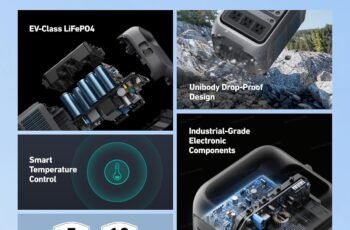
Anker SOLIX F3800: Product Overview
Can a large battery justify a $2,699.99 price when smaller power stations cost far less? The Anker SOLIX F3800 is aimed at shoppers who need serious appliance support, not just phone charging at a campsite. Its 3,840Wh storage and 6,000W dual-voltage output make it a credible home-backup and workshop option, while the included 400W bifacial panel gives you a way to recharge away from the grid. It looks worth considering if you value output and future expansion more than compactness.
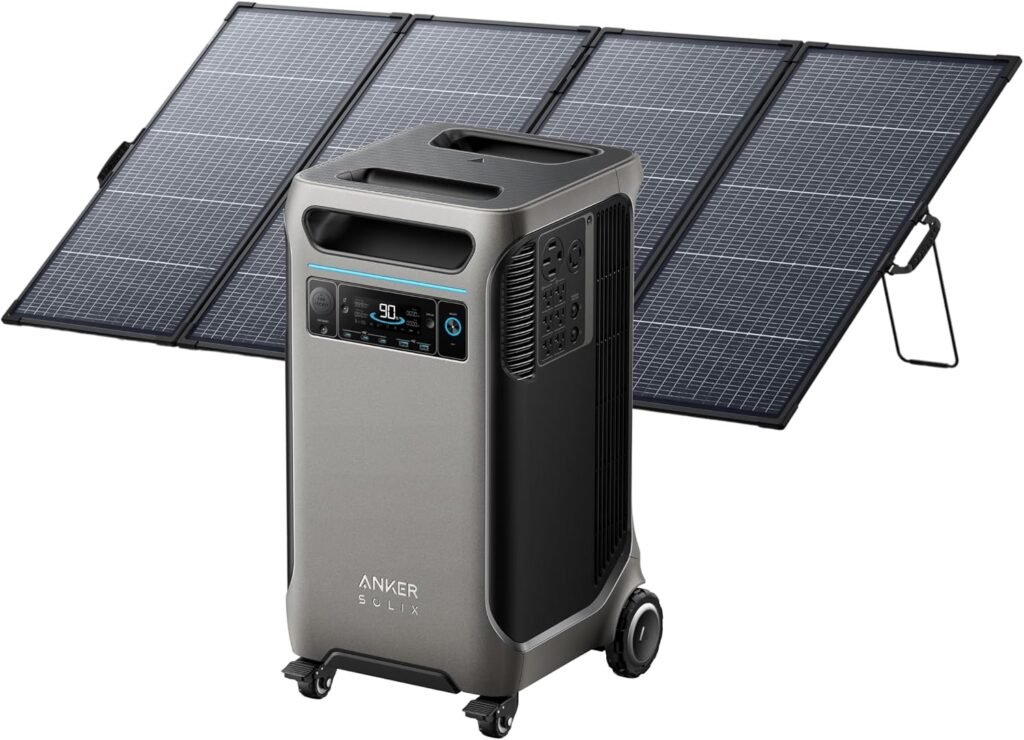
This bundle combines the Anker SOLIX F3800 power station with an Anker SOLIX PS400 400W bifacial solar panel. The two items are dispatched separately, so receiving one package before the other doesn’t necessarily indicate a missing component. The intended roles are broad: emergency household backup, high-demand camping, workshop power, and a modular household energy system that can grow later.
Anker describes the base storage as enough for a family’s needs for approximately one day. That is an estimate rather than a guaranteed runtime because a refrigerator, lighting circuit, cooking appliance, heater, or medical device can consume energy at very different rates. The box includes the power station, AC charging cable, MC4 solar charging connector, 400W panel, two 3m MC4 solar cables, a 0.5m MC4-to-XT-60 cable, and the user manual.
The early buying decision is straightforward: choose this system if you need high output and a route to much more storage. If you want a light weekend battery for occasional electronics, the F3800 is likely more capability and expense than you need.

Key Specifications and What They Mean in Practice
The core figures explain both the appeal and the price. The F3800 stores 3,840Wh, supplies up to 6,000W through its AC output, supports 120V/240V operation, and accepts 400W of solar input from the included panel. The panel is advertised with up to 23% conversion efficiency.
| Specification | What it means |
|---|---|
| 3,840Wh capacity | The amount of stored energy available before conversion losses and reserve limits |
| 6,000W AC output | The maximum stated power demand the inverter is designed to support |
| 120V/240V operation | Compatibility with a wider range of household equipment |
| 400W solar input | The included panel’s stated maximum generation under suitable conditions |
| Up to 23% efficiency | The panel’s claimed rate for converting sunlight into electricity |
Watt-hours and watts answer different questions. Watt-hours describe how much energy you have stored; watts describe how much power an appliance requests at a given moment. A refrigerator may cycle rather than run continuously, lights usually draw modest power, and tools can have short high-demand periods. Heating appliances, by contrast, can consume a large share of the stored energy quickly.
The 120V/240V design matters because some higher-demand household equipment requires more than the usual single-voltage camping output. Anker specifically presents the system as capable of powering a dryer, but advertised maximum output should not be mistaken for long runtime. Inverter losses, startup surges, weather, appliance cycling, and charging conditions all affect what you actually get.
To estimate your requirement, write down each appliance’s running wattage, multiply it by the hours you expect to use it, add a reserve for conversion losses, and compare the total with 3,840Wh. Then check startup demand separately; a device that briefly surges above its normal running figure may need more headroom even when its daily energy use appears modest.
400W Bifacial Solar Panel and Charging Performance
The included 400W Anker SOLIX PS400 panel is best understood as a way to extend off-grid use, not as a guaranteed continuous 400W generator. Its advanced monocrystalline solar cells and sunlight-trapping surface are specified to reach up to 23% conversion efficiency, while the advertised 1.5-times-faster charging claim depends on the conditions under which the comparison was made.
Actual input can change substantially. Sun angle, cloud cover, heat, shade, cable losses, and the reflective surface beneath a bifacial panel all affect generation. A clear, cool day with unobstructed exposure is a very different test from a hazy afternoon or a panel partly shaded by a tent, tree, or building.
The panel has three kickstand positions: 40°, 50°, and 60°. Use the lower angle when the sun is relatively high, select a steeper position when the sun sits lower, and change the angle as the day progresses if you want to chase stronger exposure. A bright, open surface beneath the rear of the panel may also help the bifacial design collect reflected light.
IP67 waterproof protection is useful for rain and outdoor conditions, but it isn’t permission to submerge the panel or leave every connection exposed in standing water. Keep cable joints positioned carefully and follow the manual’s connection guidance.
- Unfold the panel on a stable, unobstructed surface.
- Select the kickstand position that best faces the current sun angle.
- Connect the two 3m MC4 solar cables and the 0.5m MC4-to-XT-60 lead as directed.
- Connect the charging lead to the power station and confirm that charging is shown on its display.
- Check the observed input wattage rather than judging performance from the headline charging claim alone.
That final check is useful because it turns a marketing maximum into a measurable result for your location. If your regular solar site produces weak input, the panel may still help, but it won’t replenish the battery as quickly as the specification suggests.
Powering Appliances at 120V and 240V
The F3800’s biggest practical distinction is its dual-voltage design combined with a stated 6,000W AC output. A conventional small camping battery may handle electronics, lights, and selected tools but stop short of equipment designed for 240V. This system is positioned for a wider range of household and workshop loads, including the dryer example used in its product description.
Before connecting anything, read the appliance label or manual. Identify its normal running watts, look for a startup or surge figure, and leave sensible headroom below the system’s maximum rather than planning to operate continuously at the limit. A refrigerator, freezer, sump pump, kitchen appliance, or power tool may have a short starting surge even when its normal draw is much lower.
Output capability still doesn’t tell you how long the battery will last. A high-wattage appliance can be compatible with the inverter yet consume the stored energy rapidly. Conversely, a refrigerator may run for a much longer period than a constantly heated appliance because its compressor cycles on and off. Duty cycle is therefore as important as the label’s peak figure.
For a practical load plan, list the refrigerator, freezer, communications equipment, lights, and any pump you consider essential. Add their running watts for the likely overlap period, check each startup requirement, and estimate each device’s daily watt-hours. If a cooking or heating appliance is included, model it as a separate short-duration load rather than assuming it can run alongside everything else indefinitely.
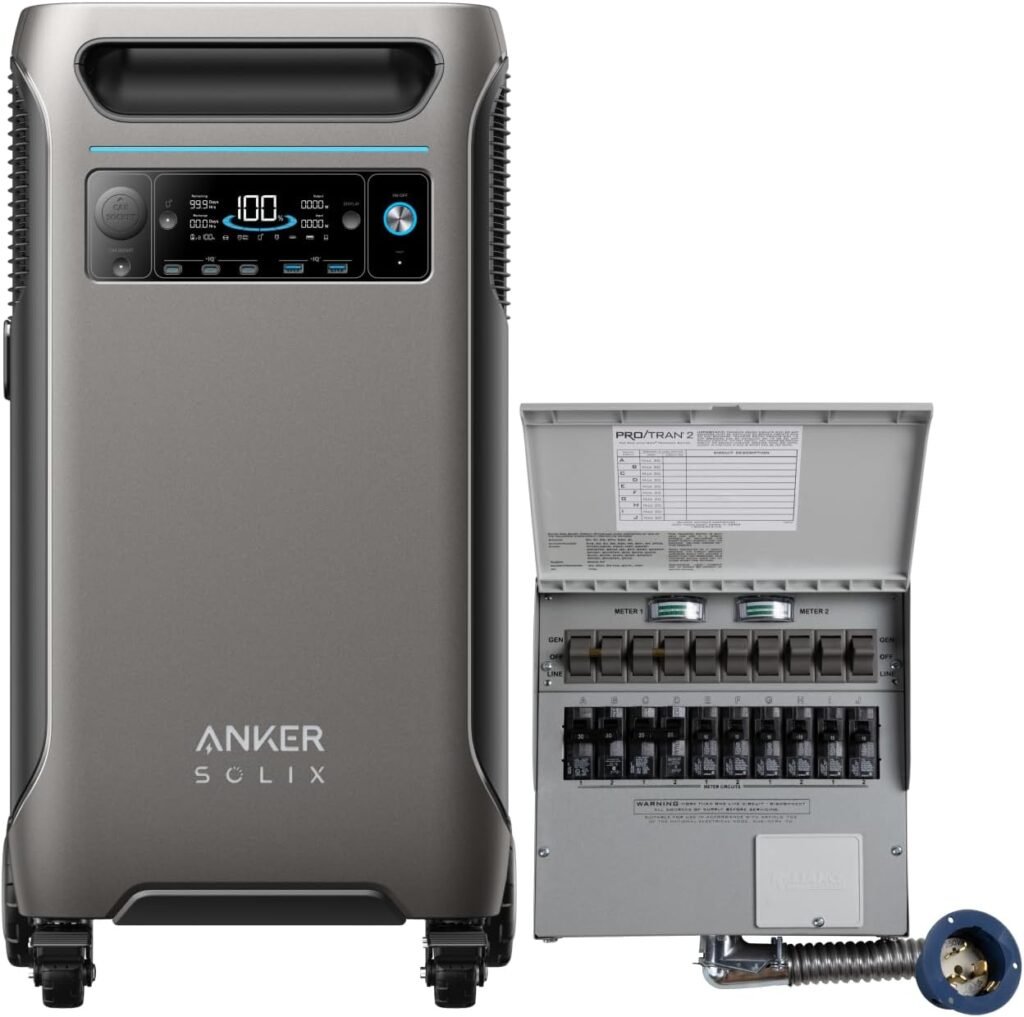
For fixed household circuits, don’t treat a portable power station as a substitute for an approved transfer arrangement. Determine whether your proposed setup needs a suitable transfer system, electrical work, or a qualified professional before connecting it to household wiring. The correct question is not only “can it run this appliance?” but also “how will it be connected safely and legally?”

Capacity Expansion for Longer Emergencies
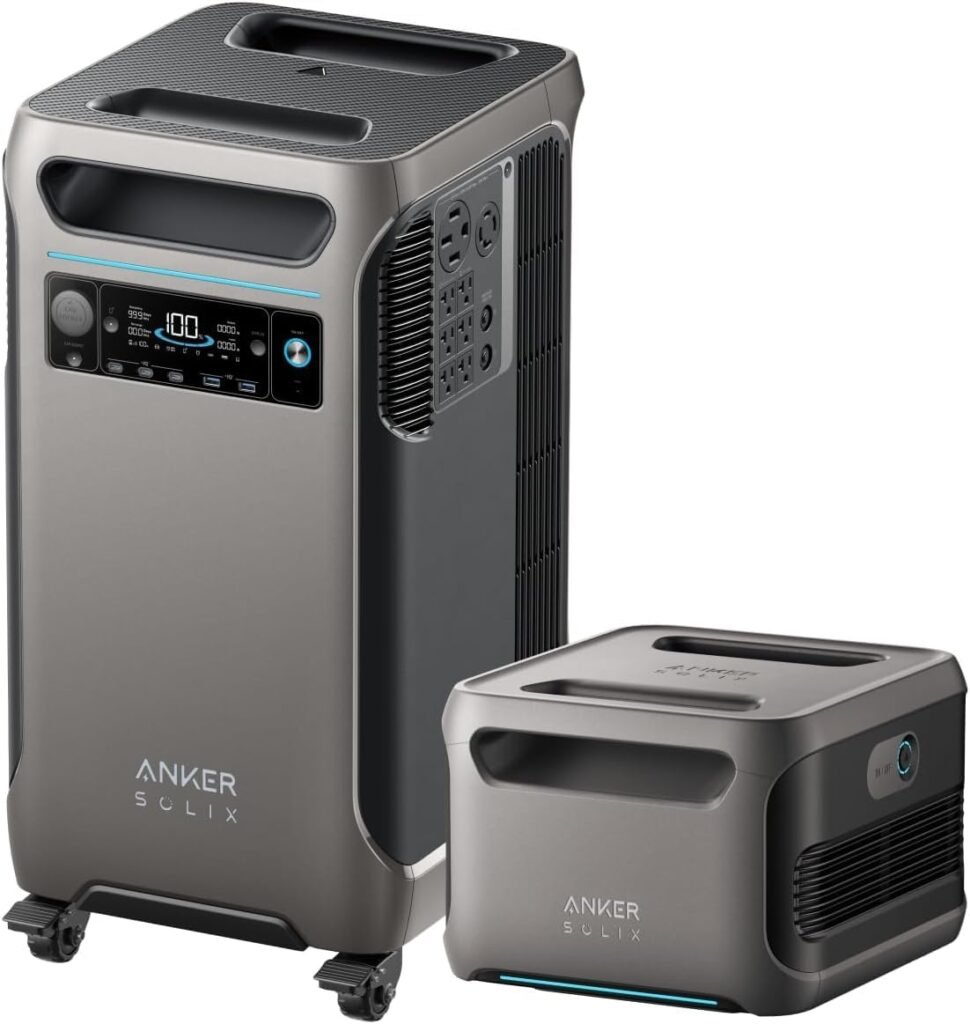
If 3.84kWh isn’t enough, the advertised expansion route reaches as much as 26.9kWh with up to six additional battery packs. That turns the base unit from a roughly one-day household estimate into part of a much larger reserve, but expansion is a financial and logistical decision rather than a free feature.
Anker also describes a larger configuration using a second F3800 and battery packs. The stated configuration can reach 12,000W of AC output and is presented as enough stored energy for a claimed two-week scenario. Treat that as a manufacturer scenario, not a universal promise: heating, cooling, cooking, water pumping, and medical equipment can change household consumption dramatically.
The attraction is modular growth. You can begin with the bundle, learn your actual outage consumption, and decide later whether more storage is justified. The trade-offs include the price of extra battery packs, the floor or storage space they require, the effort involved in managing a larger installation, and the time needed to recharge a much bigger bank from available solar input.
A sensible planning method is:
- List only essential circuits and appliances.
- Estimate their daily watt-hour use from real labels and likely duty cycles.
- Add a reserve for poor weather and reduced solar production.
- Compare that total with the base system and the expanded configuration.
- Confirm compatibility, expansion limits, and current accessory requirements before ordering extra equipment.
The $2,699.99 bundle price covers the starting system and panel, not every possible expansion component. If you already know that your emergency plan requires several days of heating, refrigeration, pumping, or medical support, price the complete configuration rather than assuming the base purchase will meet that need.
What Customers Are Saying
The supplied product information does not include the live listing’s current star rating or review count, so those figures cannot be reported accurately here without inventing data. As a result, this snapshot should not pretend to identify a verified majority opinion or assign weight to a review pattern that hasn’t been provided.
That limitation matters with a product sold as two separately dispatched items. Reviews about the F3800 power station and reviews about the 400W panel may reflect different delivery dates, setup experiences, and expectations. When you inspect the current listing, separate comments about battery output, appliance use, display behaviour, noise, and support from comments about panel positioning, weak sunlight, connectors, and charging input.
Give more weight to repeated observations than to a single dramatic anecdote. A buyer who has used the station through several outages provides a different type of evidence from someone reporting an impression made during first setup. Likewise, a camping user may praise solar convenience while a workshop owner focuses on high-load operation, and neither experience automatically predicts your household result.
Before purchasing, filter the current reviews by the use case closest to yours. Look for repeated comments about delivery timing, separate dispatches, cable setup, panel placement, charging in cloudy conditions, operating noise, display behaviour, and customer support. If a reviewer reports output or capacity below expectations, treat that as a signal to investigate conditions and setup rather than proof of a confirmed product defect.
Anker SOLIX F3800 Compared With Alternatives
The closest alternatives depend on whether you want a ready-made bundle or a separately built home-energy system. The EcoFlow DELTA Pro Ultra and BLUETTI AC500 are both relevant names to investigate, but the supplied product data doesn’t provide their current listing specifications or prices. It would be misleading to attach unverified figures to either competitor or imply that either one includes the same 400W bifacial panel.
Compared with the EcoFlow DELTA Pro Ultra, the F3800’s clear proposition is the combination of dual-voltage capability, high AC output, base storage, solar input, and a supplied panel in one purchase. You should compare the rival’s capacity architecture, home-backup integration, solar expansion, and the cost of reaching a similar stored-energy level rather than comparing the headline prices of unlike packages.
The BLUETTI AC500 is another modular design worth considering if you prefer to configure the battery capacity and solar hardware separately. That approach may suit you if you want a different expansion ecosystem or a lower initial commitment, but it can also mean more planning around batteries, cables, and charging equipment. The F3800 bundle is simpler if the included panel matches your needs from the outset.
Compare total ownership cost in a spreadsheet. Include the base station, extra batteries, solar cables, storage space, any transfer equipment, and possible professional electrical installation. An alternative may make more sense if it offers the home-integration options you need, a better-supported expansion path, or a more suitable balance between portability and capacity. The F3800 is strongest when one purchase needs to cover substantial output plus a credible route to larger storage.
Who Should Buy the Anker SOLIX F3800?
You should consider the Anker SOLIX F3800 if your priorities include outage preparation, demanding appliances, workshop equipment, serious camping, or future storage expansion. Its high-output design is especially relevant when a 1,000W-to-2,000W battery cannot comfortably cover the equipment you regard as essential.
It also suits you if you have a reliable place to position the panel in unobstructed sunlight and value outdoor charging. The panel’s IP67 protection is useful for changing weather, provided you still handle its connections sensibly. Buyers who expect to remain off-grid for longer periods may appreciate the option to add storage rather than replacing the original station.
Think twice if you want a lightweight weekend battery, have only modest electronics to power, or cannot accommodate the cost of future expansion. Paying for high output you never use is poor value, even if the headline specification looks impressive. You should also remember that the power station and panel may arrive in separate dispatches.
- List the appliances you genuinely need during an outage or trip.
- Calculate their combined running demand and check startup requirements.
- Estimate daily watt-hours using realistic duty cycles.
- Assess whether you can position the panel in useful sunlight.
- Compare the result with the base system and the larger expansion path.
This process prevents you from buying based only on the maximum output figure. If your list contains mostly low-draw electronics, a smaller system may be the more rational choice; if it includes pumps, tools, refrigeration, or higher-demand household equipment, the F3800’s design becomes easier to justify.
Price, Ownership Costs, and Overall Value
At $2,699.99, this bundle should be judged as a starting package containing the F3800 and 400W bifacial panel, not as the price of a fully expanded 26.9kWh household system. The value comes from three separate elements: stored energy, appliance output, and the ability to add batteries or another F3800 later.
A simple capacity view puts the initial price at approximately $0.70 per stated watt-hour of base storage ($2,699.99 divided by 3,840Wh). Use that only as a rough comparison. Capacity alone doesn’t measure inverter capability, dual-voltage usefulness, solar input, conversion losses, installation requirements, or the practical benefit of running a particular appliance.
The included panel improves the proposition if you expect recurring off-grid use or want to replenish the system during an extended outage. If you only want emergency storage that may sit unused for years, the panel’s value is less certain, especially if your property lacks a consistently sunny placement.
Expansion adds another layer of cost. You may need additional battery packs, suitable storage space, electrical integration, and potentially professional installation for household circuits. Price the complete plan before buying: base equipment, future batteries, solar accessories, and any safe connection hardware should all appear in the calculation.
Does the combination justify a premium over smaller alternatives? For a household that needs high output, 120V/240V support, solar charging, and a path beyond the base capacity, yes, the bundle has a coherent purpose. For light camping or occasional device charging, the premium is difficult to defend. Your appliance list and daily energy estimate should make that decision clearer than the price alone.
Pros and Cons
Pros
- High stated 6,000W AC output with 120V/240V operation for demanding household and workshop equipment.
- 3,840Wh base capacity provides a substantial starting point for emergency backup and off-grid use.
- Included 400W bifacial solar panel adds a practical renewable charging option.
- Expandable architecture can reach as much as 26.9kWh with additional battery packs.
- Bundle includes the principal AC and MC4 solar charging cables needed for setup.
Cons
- $2,699.99 is a substantial initial commitment, and full expansion costs considerably more.
- The advertised solar output and faster-charging claim depend on favourable sunlight and operating conditions.
- High-wattage appliances can still drain the stored energy quickly despite the strong inverter rating.
- The power station and panel ship separately, which may complicate delivery expectations.
- Household circuit integration may require additional equipment and professional electrical work.
Final Verdict
Key Takeaways
- The $2,699.99 bundle targets serious backup, workshop, and off-grid users rather than lightweight recreational use.
- The combination of 3,840Wh storage, 6,000W AC output, and 120V/240V operation supports a wider range of appliances than smaller power stations.
- The included 400W bifacial panel can extend off-grid use, but real charging input depends heavily on sunlight, angle, shade, and setup.
- Expansion to as much as 26.9kWh is useful for longer emergencies, though extra batteries, space, and installation can materially increase ownership cost.
- The power station and panel are dispatched separately, so plan for different delivery dates.
Frequently Asked Questions
Is the Anker SOLIX F3800 bundle enough for one day of home backup?
Anker describes the 3,840Wh base capacity as covering a family’s needs for approximately one day. Your actual result depends on appliance wattage, operating hours, duty cycles, startup demand, inverter losses, and whether you use high-consumption equipment such as heating or cooking appliances.
Does the bundle include the 400W solar panel?
Yes. The package includes a 400W Anker SOLIX PS400 bifacial solar panel, two 3m MC4 solar cables, and a 0.5m MC4-to-XT-60 cable. The power station and panel are dispatched separately, so they may not arrive together.
Can the F3800 power 240V appliances?
The product description states that it supports 120V/240V operation and provides up to 6,000W of AC output. Check the appliance’s running and startup requirements, leave headroom below the maximum, and consult a qualified professional before connecting household circuits.
Can you expand the Anker SOLIX F3800 later?
The stated expansion path allows up to six additional battery packs, reaching as much as 26.9kWh. Anker also describes a configuration using a second F3800 and battery packs for up to 12,000W of AC output. Verify current compatibility and expansion limits before ordering accessories.