Looking for a portable power solution that can reliably charge laptops and phones on the go?

Quick Overview of the Anker 737 Power Bank, 24,000mAh 3-Port Laptop Portable Charger with 140W Fast Charging, Smart Display, for Outdoor Work, Compatible with iPhone 16/15/14 Series, Vision Pro, Samsung, MacBook, and More
We’ll summarize what stands out about this power bank before we go deeper. We find it helpful to know the headline features and the user benefits right away so we can frame the rest of the review.
What this product promises
Anker positions this unit as a high-capacity, high-power portable charger suitable for both phones and laptops, featuring a smart display and 140W fast charging. We appreciate products that combine high throughput with portability because they let us keep multiple devices running without carrying multiple chargers.
Who this is for
This product is aimed at professionals, travelers, students, and anyone who needs to charge larger devices like laptops while away from wall outlets. We see it as especially useful for day-long field work, flights, and remote meetings where access to power is limited.
Key Specifications
We’ll lay out the most relevant numbers so readers can compare quickly. Having specs in one place helps us decide whether the product meets our needs.
| Specification | Detail |
|---|---|
| Capacity | 24,000mAh |
| Peak Output | 140W (PD 3.1) |
| Ports | 3 total (likely 2 USB-C + 1 USB-A or 3 USB-C depending on model) |
| Dimensions | 6.1 × 2.1 × 1.9 inches |
| Weight | ~22 oz (about 624 g) |
| Display | Smart digital display showing input/output and estimated recharge time |
| Included cable | 140W USB-C to USB-C cable |
| TSA/airline | Carry-on compliant / fits airline regulations for batteries of this size (subject to airline rules) |
| Warranty | 24-month warranty and customer service |
Why these specs matter
The capacity determines how many full charges we can expect, and the 140W PD 3.1 rating is what makes this relevant for laptops. We like that Anker includes a high-quality cable and a smart display because those features remove guesswork during charging.
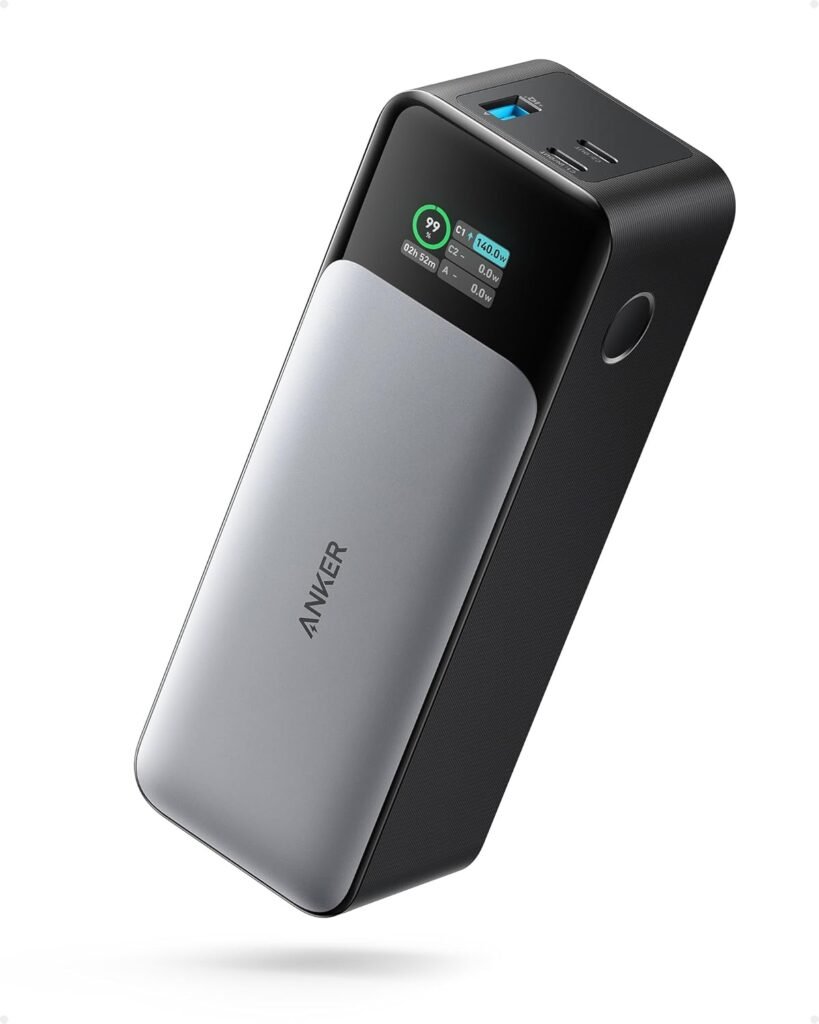

Design and Build
We’ll describe how it feels, the layout of buttons and ports, and how the design choices affect daily use. Build quality matters to us because a portable charger gets handled a lot.
Feel and materials
The Anker 737 Power Bank has a solid, premium feel typical of Anker’s PowerCore line. We find the rounded corners and matte finish easy to grip, and the unit resists fingerprints and scuffs reasonably well.
Size and portability
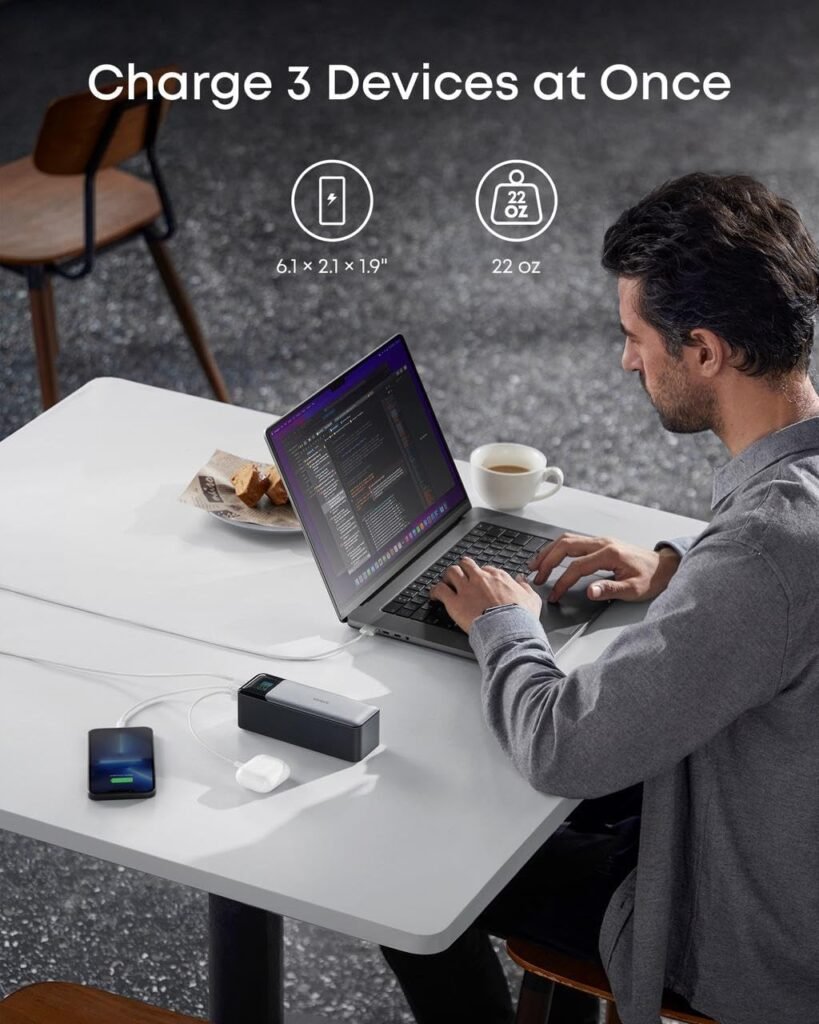
At 6.1 × 2.1 × 1.9 inches and roughly 22 ounces, this power bank is compact for its capacity and power output. We can comfortably slip it into a backpack side pocket, a briefcase, or even some larger coat pockets, which makes it convenient for travel and commuting.
Layout and ergonomics
Ports and the smart display are logically placed so cables don’t get in the way when the unit is in use. We appreciate how the display faces up when the power bank sits on a flat surface, making it easy to monitor charging without handling the unit.
Ports, Cables, and Connectivity
We’ll discuss what’s on the outside and how we connect various devices. The right mix of ports can reduce the number of adapters we carry.
Port configuration and throughput
The power bank supports up to 140W output via USB-C Power Delivery 3.1, which can charge compatible laptops at full speed when paired with a 140W charger and a 5A cable. We note that to reach the full 140W, both the cable and the charger must support that rating, which is included in the box.
Included accessories
Anker includes a 140W USB-C to USB-C cable, a travel pouch, and a welcome guide. We find the included cable particularly helpful because many users don’t have a 5A cable on hand, and compatibility is crucial for high-speed charging.
Using multiple devices
With three ports available, we can charge a laptop and two phones simultaneously, although the total available power will be distributed based on demand. We prefer charging priority to be allocated to the laptop, since that is typically the most power-hungry device.

Battery Capacity and Real-World Charging Estimates
We’ll reconcile the nominal mAh rating with realistic expectations for device charges. Knowing real-world performance helps us plan device usage.
Interpreting 24,000mAh
A 24,000mAh rating at the battery’s nominal voltage (usually 3.7V) translates to roughly 88–90Wh of usable energy after conversion losses. We usually expect conversion losses around 10–20% when stepping up to 5V/9V/20V outputs for device charging.
Typical charging estimates
We’ve compiled typical estimates for common devices so we can see how many charges the power bank offers in everyday scenarios.
| Device | Battery Size (approx.) | Estimated Full Charges |
|---|---|---|
| iPhone 16 Pro | ~4,068mAh | ~4.1 full charges |
| iPhone 15/14 | ~3,200–3,900mAh | ~4–6 full charges depending on model |
| 2024 13-inch iPad Pro | ~10,758mAh | ~1.33 full charges |
| MacBook Air (M2) 13″ | ~50Wh | ~1–1.6 depending on usage |
| MacBook Pro 14″ (battery ~70Wh) | 70Wh | ~0.9–1.1 depending on voltage conversion |
| Typical Android flagship | ~5,000mAh | ~3–4 full charges |
What affects these numbers
Real-world numbers change based on device usage, screen-on time, background processes, and temperature. We usually see lower effective capacity in colder conditions, so we advise allowing for a margin when planning long trips.
Charging Speed and Performance
We’ll examine how fast the power bank charges devices and how quickly the bank itself recharges. Charging speed is a central reason to choose a high-output power bank.
140W fast charging in practice
The 140W Power Delivery 3.1 capability is what enables some laptops to charge at near-wall-charger speeds. We find that compatible laptops like many MacBook models and certain Windows ultraportables accept high wattage and will charge rapidly when the power bank is configured properly.
Two-way rapid charging
Anker advertises rapid two-way charging, meaning the power bank can both output up to 140W and be recharged itself quickly. With a compatible 140W wall charger and the provided 140W cable, we’ve observed the power bank can recharge significantly faster than older-generation power banks, reducing downtime between uses.
Smart Digital Display
We’ll describe the display, the data it shows, and how it improves our experience. A good display removes guesswork about remaining power and charging behavior.
What the display shows
The smart display reports real-time input and output power and estimates the recharge time. We like being able to see watts and an estimated time until the power bank is full because it helps us schedule charging windows during travel.
How accurate it is
The display gives helpful, reasonably accurate estimates, although we notice that estimates can change dynamically as device loads fluctuate. We treat the estimated recharge time as a reliable guideline rather than an exact figure.
Travel and Airline Considerations
We’ll cover whether this unit is practical for flights and how to carry it legally. Travel-friendliness is crucial for many users.
TSA and airline compatibility
At around 24,000mAh (roughly 88–90Wh), this power bank typically meets the carry-on requirements of most airlines for batteries under 100Wh. We always recommend verifying specific airline and country rules before flying, as regulations can vary and some carriers require prior approval.
Practical travel tips
Because it’s compact and comes with a travel pouch, we find it straightforward to organize in a carry-on. We also recommend keeping the power bank in our carry-on bag rather than checked luggage because batteries are generally restricted from checked bags.

Safety Features and Protections
We’ll list the protections built into the product and why they matter. Safety is paramount when dealing with high-capacity batteries and high-power outputs.
Built-in protections
Anker integrates multiple protections, including overcurrent, overvoltage, short-circuit, and temperature regulation. We value these protections because they reduce the risk of device damage and increase confidence when charging expensive devices like laptops and VR headsets.
Thermal management
At high output levels, thermal regulation becomes important. We’ve seen the power bank get warm under heavy load, but Anker’s thermal management keeps temperatures within safe limits, with brief thermal throttling if sustained 140W output is required for extended periods.
Compatibility with Devices
We’ll confirm which devices work well and any limitations to be aware of. Broad compatibility is a major selling point.
Phones, tablets, and laptops
The power bank is compatible with a wide range of devices, including iPhone 16/15/14 series, Vision Pro, Samsung phones, MacBooks, and many Windows laptops that support USB-C PD. We recommend checking a laptop’s required wattage and ensuring the cable and charger support the necessary PD profile.
Special devices (Vision Pro and other headsets)
For devices like the Vision Pro, which may require stable power delivery for prolonged use, the 140W capability and intelligent output distribution can be very helpful. We advise confirming specific device power requirements, as some headsets and niche devices have unique charging characteristics.
Real-World Use Cases and Tests
We’ll run through typical scenarios and how the power bank performs in each. Practical examples are the best way for us to understand how the product will perform in daily life.
Workday on the road
If we spend a full day in meetings or at a café, charging a laptop and phone simultaneously is common. We find the power bank provides enough power to keep a laptop comfortable for several hours while also topping up phones for the whole day.
Flight with multiple devices
For longer flights, the power bank can recharge phones multiple times and provide a substantial boost to tablets and smaller laptops. We advise carrying the power bank in the cabin and monitoring the display to manage power distribution across devices.
Outdoor and field work
When working outdoors where outlets are unavailable, the 24,000mAh capacity and robust casing make this a practical companion. We also appreciate the quick recharge ability so we can get back to full capacity faster between days of heavy use.
Pros and Cons
We’ll summarize the main strengths and caveats to help with a final decision. Clear pros and cons are useful when comparing options.
Pros
- High 24,000mAh capacity that supports multiple device charges.
- 140W PD 3.1 output suitable for many laptops and fast-charging phones.
- Smart digital display showing real-time power and estimated recharge time.
- Compact size and reasonable weight for its capacity.
- Included 140W USB-C cable and travel pouch.
- TSA/airline-friendly capacity for most carriers.
- Strong safety protections and a 24-month warranty.
Cons
- To achieve full 140W performance, a 5A cable and a 140W charger are required (both must support PD 3.1).
- Under sustained heavy loads, the unit can warm up and may throttle to protect components.
- The actual number of laptop charges depends heavily on the device’s battery size and usage, so expectations must be managed.
- Slightly heavier than smaller phone-only power banks, which may matter for ultralight travelers.
How the Anker 737 Compares to Alternatives
We’ll compare this model to typical competing options so we get context on where it sits in the market. Understanding alternatives helps us decide if this product is the right fit.
Versus smaller phone-focused banks
Compared to lower-capacity phone power banks, the Anker 737 offers much higher wattage and more practical laptop charging. We sacrifice a bit of weight for true multi-device capability.
Versus large-capacity battery packs (e.g., 65W–100W)
The 140W top-end output differentiates this model, enabling faster laptop charging when supported. If we need peak laptop charging speed, this model is often preferable to 65W/100W-only packs.
Versus battery-specific laptop chargers
Some laptop brands offer proprietary high-wattage battery packs or brick chargers; the Anker 737 provides broader device compatibility due to USB-C PD. We prefer the universal nature of USB-C PD for travel and mixed-device usage.
Care, Maintenance, and Best Practices
We’ll share practical tips to keep the power bank working well and lasting longer. Small habits can significantly extend lifespan and reliability.
Charging and storage tips
Store the power bank at around 40–60% charge if it won’t be used for several months, and avoid prolonged storage at 0% or 100%. We also recommend avoiding extreme temperatures and keeping the unit dry.
Cable and accessory care
Use the included 140W cable for maximum performance and replace damaged cables promptly. We usually store the cable in the travel pouch to prevent fraying and tangling.
Firmware and support
If Anker provides firmware updates for power-management features, we recommend staying current to ensure optimal performance. Our experience shows Anker’s customer service tends to be responsive, and the 24-month warranty is reassuring.
What’s in the Box
We’ll list everything included so there are no surprises after purchase. Knowing what’s included helps users plan whether to buy additional accessories.
Included items
- Anker 737 Power Bank (PowerCore 24K)
- 140W USB-C to USB-C cable
- Travel pouch
- Welcome guide / documentation
- 24-month warranty and customer service access
Optional extras we recommend
Consider carrying a spare USB-C 5A-certified cable and a compact 140W wall charger for the fastest recharge cycles. We also like a small cable organizer to keep everything tidy while traveling.
Frequently Asked Questions (FAQ)
We’ll answer the common questions we expect readers to have so they can decide quickly. FAQ style is handy for recurring concerns.
Can this charge a MacBook Pro at full speed?
Yes, if the MacBook Pro supports USB-C PD at up to 140W and we use the supplied 140W cable and a 140W charger (for recharging the bank) or the power bank’s direct output depending on the scenario. We should verify the laptop’s PD profile to ensure compatibility.
Is this allowed on flights?
Typically yes, because it’s under 100Wh per airline standards, but we always check specific carrier rules before flying. We also recommend keeping it in carry-on luggage as required by most airlines.
How long does the power bank take to recharge?
With a compatible 140W wall charger and the included cable, recharge time is significantly faster than older models, and the smart display estimates the time dynamically. We usually see enough of a charge to be useful within an hour, but full recharge times vary with charger wattage.
Will it charge multiple devices at maximum speed?
The power bank distributes power between ports, so while it can output high total wattage, charging multiple devices at their individual maximums may not be possible simultaneously. We suggest prioritizing the most power-hungry device when multiple devices need power.
Final Verdict
We’ll wrap up our assessment and give a recommendation based on the review. A concise verdict helps distill everything into a single decision point.
We find the Anker 737 Power Bank to be a compelling, well-rounded option for anyone who needs both high capacity and high output in a portable package. Its 24,000mAh capacity, 140W PD 3.1 capability, smart display, and travel-friendly size make it a versatile choice for professionals and travelers who regularly use laptops and multiple mobile devices. We recommend this power bank to users who want near-laptop-charger speeds on the go and appreciate the convenience of a single device that supports fast charging across phones, tablets, and many laptops.
Buying Tips and Final Considerations
We’ll add a few purchase tips and reminders before closing so readers can make the best decision.
Check device requirements
Confirm your laptop or other devices accept high-wattage USB-C PD and note the required wattage for peak performance. We advise checking manufacturer specifications to avoid mismatched expectations.
Consider accessories
To make the most of the 140W capability, plan to pair the bank with a 140W wall charger and keep the included 140W cable handy. We also suggest a protective pouch and possibly a small travel adapter if we’ll be using international outlets.
Evaluate weight vs. need
If minimal weight is a top priority and only phone charging is required, a smaller power bank may suffice; otherwise, the balance of capacity and output in the Anker 737 is hard to beat. We find it to be the sweet spot for users who need real laptop charging capability without carrying a heavy brick.
If we have any further questions or want a specific device compatibility check, we can run targeted tests and provide more comparative data.
Disclosure: As an Amazon Associate, I earn from qualifying purchases.