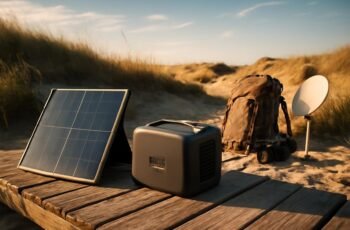
ALLWEI’s 256Wh power station targets lightweight off-grid use with a 300W pure sine inverter (600W surge) and LiFePO4 chemistry rated for ~3,000 cycles to 70% DoD. It supports AC, car, and up to 100W solar input, including dual-input charging. Outputs include one AC outlet, USB‑C PD 60W, USB‑A, and DC ports. Dual silent fans and a robust BMS emphasize safety, but the single AC socket and modest inverter ceiling raise practical trade-offs worth weighing.
Key Takeaways
- 256Wh LiFePO4 pack delivers roughly 200–220Wh usable; 3,000-cycle longevity with robust BMS and dual silent fans for safety.
- 300W pure sine inverter (600W surge) powers laptops, CPAPs, fans, small TVs; mini-fridges only if startup fits surge.
- Recharges via AC, car, or up to 100W solar; AC+solar can top up in about 2–2.5 hours; no solar panel included.
- Outputs include one AC outlet, USB-C PD 60W, USB-A QC 18W, two 5.5×2.1mm DC ports, and a regulated car socket.
- Lightweight 6.4 lb design with three-level lamp and SOS; tradeoffs are single AC outlet and modest 300W continuous capacity.
56WH, 300W Overview
How well does a 256Wh, 300W portable power station perform in real use? In practice, 256Wh translates to roughly 200–220Wh usable under typical inverter losses, yielding several laptop charges or a night of efficient lighting. The 300W pure sine output (600W surge) reliably runs laptops, CPAPs, fans, and small TVs; mini-fridges cycle-dependent may work if startup stays under surge. Weight at 6.4 lbs keeps mobility high. One AC outlet limits simultaneous high-draw appliances, but USB-C PD 60W offsets for modern laptops. For users seeking autonomy, it’s a credible short-duration hub—quiet, predictable, and suited to targeted, sub-300W workloads.
Detailed features
Building on its solid 256Wh/300W baseline, the ALLWEI unit focuses on balanced I/O and robust safety. It employs a LiFePO4 pack rated for roughly 3,000 cycles to 70% depth, guided by an enhanced BMS covering overload, overcharge, and short-circuit events. Dual silent fans stabilize thermals under sustained draw.
Connectivity is pragmatic: one AC outlet (pure sine, 600W surge), USB-C PD 60W, USB-A QC 18W, two 5.5×2.1mm DC ports, and a regulated car socket. Recharge paths include AC, 100W solar, and vehicle input, with AC+solar dual-charge reaching full in 2–2.5 hours. Integrated three-level lamp plus SOS increases field readiness.


Pros and Cons
This section weighs the ALLWEI 256Wh unit’s strengths—LiFePO4 longevity, robust BMS, fast dual-input charging, and PD 60W—against its constraints.
Key trade-offs include a single AC outlet, modest 300W continuous output, and reliance on a separately sold solar panel.
Suitability thus hinges on low-to-moderate load profiles and users prioritizing cycle life and recharge flexibility over multi-outlet AC versatility.
Pros
Notably, the ALLWEI 256Wh unit delivers a balanced feature set for its class: a 300W pure sine wave inverter (600W surge) paired with a long‑life LiFePO4 pack rated for ~3000 cycles and 10 years. Its BMS protections and dual silent fans bolster reliability under continuous light loads. Recharge flexibility stands out—AC, car, or 100W solar, plus AC+solar dual input for 2–2.5 hour top‑ups. Connectivity is pragmatic: PD 60W USB‑C, QC USB‑A, DC ports, car socket, and a clean sine AC outlet. At 6.4 lbs, it’s truly portable—empowering off‑grid work, travel, and emergency autonomy.
| Capability | Spec | Benefit |
|---|---|---|
| Inverter | 300W/600W | Clean AC for sensitive gear |
| Battery | LiFePO4, ~3000 cycles | Long service life |
| Recharging | AC/car/solar + dual | Fast turnaround |
| I/O | USB‑C 60W, DC, AC | Versatile device coverage |
Cons
Still, several trade-offs emerge on closer inspection. A single 300W AC outlet constrains multi-device autonomy and limits split-phase or redundancy. USB-C tops at 60W, inadequate for many power-hungry laptops. The 256Wh capacity and 300W ceiling preclude high-draw appliances and shorten runtime under sustained 200–300W loads. Solar recharging assumes full sun; no MPPT spec is stated, raising efficiency questions. Dual-input charging requires extra gear and logistics. No bundled solar panel adds cost. Limited DC port variety and only two 5.5×2.1 jacks restrict flexibility. Display granularity and state-of-charge precision are not detailed, complicating meticulous energy budgeting.
Concluding thoughts
Ultimately, the ALLWEI 256Wh power station delivers credible portable power with a LiFePO4 core, a 300W pure sine inverter, and balanced I/O that covers most sub-300W use cases.
Its 6.4 lb chassis, stable chemistry, and protective BMS inspire confidence for off-grid autonomy.
Recharging flexibility is a strength: AC, car, 100W solar, or dual-input acceleration to roughly 2–2.5 hours.
USB-C PD 60W and QC USB-A serve modern kits, while AC and DC ports handle essentials.
Tradeoffs remain: a single AC outlet, modest capacity, and no bundled solar.
Still, durability, silent cooling, and cycle life position it as practical liberation hardware.
Frequently Asked Questions
Can It Power a Wi-Fi Router During Outages, and for How Long?
Yes. With 256Wh and a 300W pure sine inverter, it can power typical routers (6–12W) for roughly 18–36 hours; include modem and inefficiency, expect 12–24 hours. Use DC where possible to minimize inverter losses.
Is the Power Station Tsa-Compliant for Air Travel Carry-On?
No. Like a kite tethered by strict skies, it exceeds TSA/IATA lithium limits. At 256Wh, it surpasses the 100Wh carry-on allowance and the 100–160Wh supervisor-approved range, therefore prohibited in both carry-on and checked baggage.
What’s the Noise Level of the Cooling Fans in Decibels?
Approximately 25–30 dB under typical loads, rising toward 35 dB at sustained high draw. Dual “silent” fans modulate with temperature. Not whisper-quiet in a dead room, but sufficiently unobtrusive for tents, vans, and late-night work.
Does It Support Pass-Through Charging for Devices While Recharging?
Yes, it supports pass-through charging. Ironic freedom: tethered yet empowered. Technically, LiFePO4 and BMS manage simultaneous input/output; expect reduced charge speed, minor inverter heat, and slightly accelerated cycle wear. Users should avoid max loads; balance AC/DC outputs to minimize thermal stress.
What Operating Temperature Range Is Recommended for Safe Use?
Recommended operating range is 14–104°F (−10–40°C); storage 14–113°F (−10–45°C). Below freezing, expect reduced output; above 104°F, derate loads and ensure airflow. Charging is safest at 32–104°F to preserve LiFePO4 longevity and autonomy.