Could this Anker SOLIX F3800 be the portable power station that actually replaces a small generator for our home and still fits our camping and RV needs?
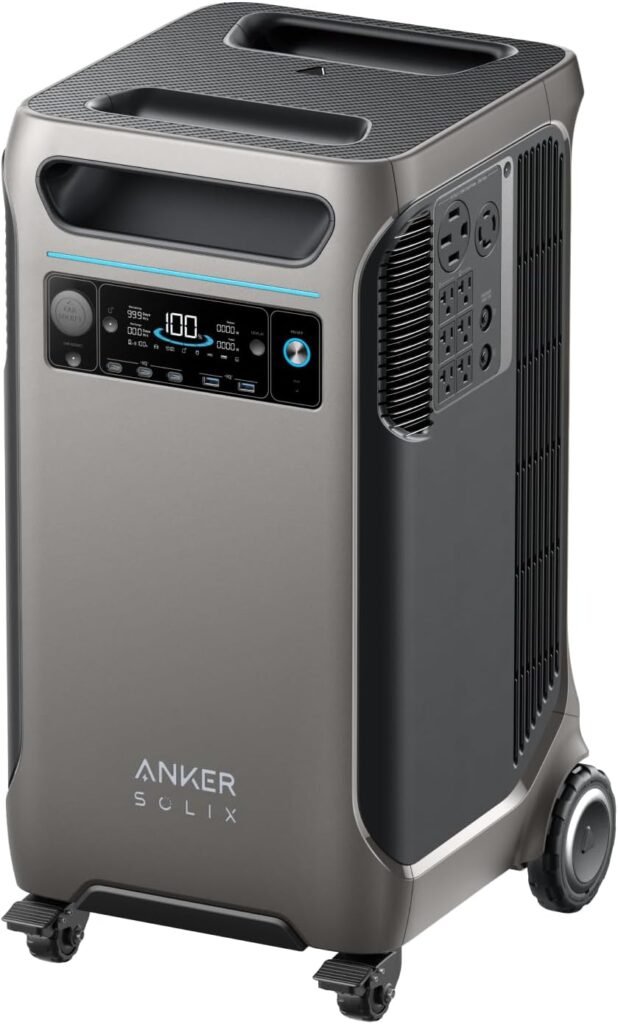

Overview of the Anker SOLIX F3800 Portable Power Station
We find the Anker SOLIX F3800 to be an ambitious, high-capacity power station aimed at people who want serious backup power without a gas generator. It combines a 3.84 kWh LiFePO4 battery pack with a 6,000W AC output and dual-voltage capability (120V/240V), which makes it unusually capable for both home backup and high-demand mobile uses like RVs and EV charging.
Renewed product status and what that means for us
Because this listing is for a renewed unit, we expect the product has been inspected, tested, and refurbished to work like new, often with some cosmetic wear. We recommend checking the seller’s renewal warranty and return policy so we can be sure the coverage fits our peace-of-mind expectations.
Key Features at a Glance
We like that the F3800 focuses on expandability, flexibility, and raw power. Its headline features—3.84 kWh base capacity, LiFePO4 chemistry, 6,000W AC output, dual-voltage support, and EV/RV-ready ports—address use-cases from prolonged home outages to powering heavy appliances.
Why these features matter to us
High capacity and a high continuous AC rating mean we can run multi-kilowatt appliances like dryers, HVAC components, and EV chargers. The LiFePO4 battery chemistry gives better cycle life and safety compared to many lithium-ion alternatives, which matters if we plan to rely on this device long-term.
Technical Specifications (Quick Reference Table)
We prepared a concise table to help digest the key specifications quickly. Note that some data points are drawn from the product description and general LiFePO4 characteristics; for any missing specifics, we suggest verifying with the seller or Anker.
| Specification | Detail |
|---|---|
| Product Name | Anker SOLIX F3800 Portable Power Station (Renewed) |
| Base Capacity | 3,840 Wh (3.84 kWh) |
| Expandable Capacity | Add up to 6 battery packs (up to 26.9 kWh) |
| Max Expansion (with extra units) | Another F3800 + up to 12 battery packs for extended capacity |
| Battery Chemistry | LiFePO4 (Lithium Iron Phosphate) |
| AC Output (Continuous) | 6,000 W |
| AC Output (Voltage) | 120V / 240V dual-voltage supported |
| EV Charging Port | NEMA 14-50 (up to 6,000W) |
| RV Ports | NEMA 14-50, L14-30 compatible |
| App Connectivity | Wi-Fi and Bluetooth control via Anker app |
| Included Accessories | AC charging cable, MC4 solar charging connector, user manual |
| Product Condition | Renewed |

Expandability and Scalability
We appreciate that Anker designed the F3800 with modular expansion in mind. The ability to add up to six battery packs to reach 26.9 kWh makes it a flexible choice if our needs grow or if we want multi-day backup without gasoline.
How the expansion benefits us practically
If our household needs spike—say prolonged grid outages or heavier electrical loads—the expansion option means we don’t have to buy a whole new system; we can incrementally increase capacity. Scalability also allows us to tailor cost to need: starter setup now, expand later.
Battery Technology and Lifespan
The F3800 uses LiFePO4 cells, which we favor for their stability, thermal tolerance, and long cycle life compared to many NMC (nickel manganese cobalt) chemistries. LiFePO4 tends to maintain usable capacity over thousands of cycles, offering a lower total cost of ownership for frequent use.
Safety and longevity considerations
We find LiFePO4 is less prone to thermal runaway and chemical instability, which is important for in-home and mobile installations. While exact cycle counts aren’t listed here, LiFePO4 typically provides a far higher effective lifespan than standard lithium-ion, making this unit a solid investment for long-term backup.
AC Output and Dual-Voltage Capability
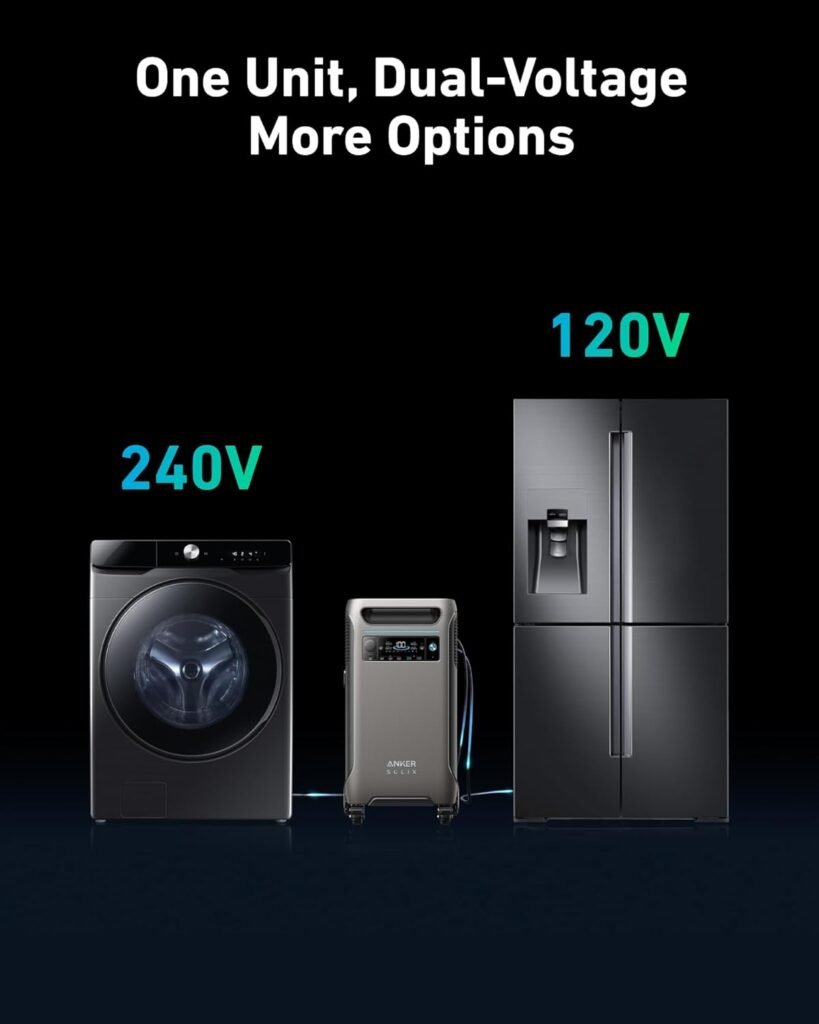
A 6,000W continuous AC output is a headline feature. The dual-voltage (120V/240V) capability is especially important because it removes the usual limitation of most portable stations that only provide 120V.
What 6,000W and 240V support enable for us
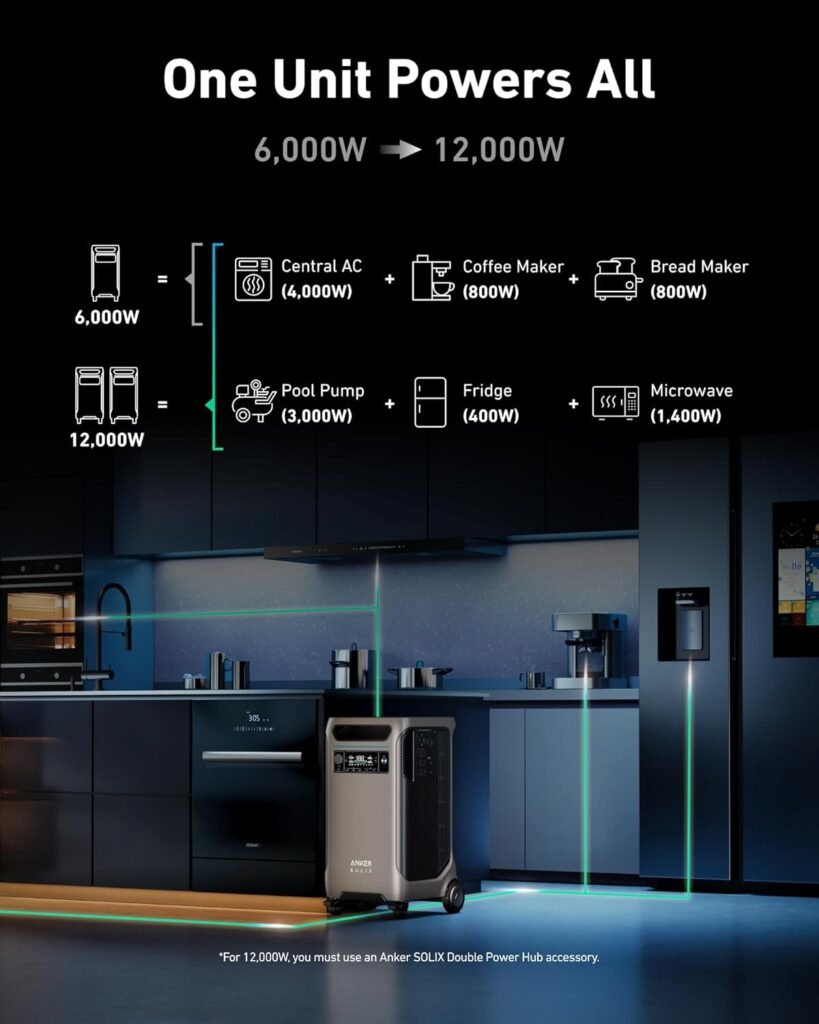
We can run high-draw appliances like electric clothes dryers, electric stoves (partial load), and multiple household circuits simultaneously. We can also parallel another F3800 for up to 12,000W if we need even greater capacity for whole-house or heavy induction loads.
EV Charging and RV Power
We like that Anker included a NEMA 14-50 port, which allows direct EV charging without special grounding accessories. The product states we can charge an EV at up to 6,000W, and we can also hook the unit to an RV through the NEMA 14-50 or L14-30 ports.
Practical implications for road trips and daily EV charging
For RVers, the F3800 can act as a silent shore-power substitute for appliances and climate control. For EV owners, a 6,000W feed is fast for AC charging on many EVs—suitable for topping up at campsites or supplementing home charging when the grid is out.
Charging Options and Times
The F3800 supports multiple charging paths: AC input, solar via MC4 connectors, and potentially vehicle or generator input depending on accessory support. Charging speed varies by method and available input power.
What to expect from charging performance
We recommend pairing the F3800 with appropriately rated solar or AC chargers to minimize charging time. Exact time-to-full will depend on whether we use a single AC charger, solar array size, or a faster dedicated AC input—confirm the maximum input wattage if fast recharge is critical.
Solar Charging and Off-Grid Use
An MC4 solar charging connector is included, signaling that the unit is prepared for direct solar input. With sufficient panels and favorable sun, solar can make the F3800 a dependable off-grid station for longer trips.
Planning a solar setup with the SOLIX F3800
If we rely heavily on solar, we should size our panel array and charge controller to match the power station’s maximum input capability. Solar makes the most sense if we pair the F3800 with a large inverter-rated array or multiple days of sun to replenish used capacity.
Intelligent Remote Control via App
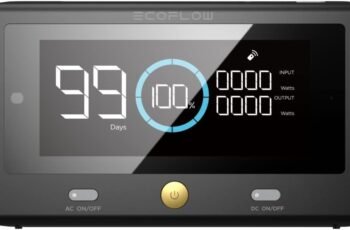
We appreciate the app-based controls that let us manage power use and sources remotely. The Anker app supports Wi-Fi and Bluetooth, enabling us to monitor power flows, set priorities, and potentially save on utility bills with intelligent scheduling.
How app control helps our daily use
Remote control makes it easy to switch inputs, schedule charging during off-peak rates, and watch battery health. This lets us conserve energy, see live stats, and tweak settings without being next to the unit.
Ports and Connectivity Overview
While the complete port roster can vary by region or version, core connectivity includes multiple AC outlets, a NEMA 14-50, L14-30, and likely DC and USB outputs for small devices. We should verify the exact port mix for the renewed model before purchase.
Why port selection matters to us
The variety of ports determines how many devices we can run simultaneously and which appliances we can plug in directly. The presence of RV and EV-standard ports removes the need for adapters or converters in many cases, simplifying real-world use.
Physical Design and Portability
Power stations at this capacity are inevitably heavy and bulky, and the F3800 is no exception; portability is relative. We expect it to be more portable than a permanently installed battery bank, but it will likely need wheels, handles, or a small cart for moving.
Moving and situating the F3800
We recommend placing it on a stable, ventilated surface indoors or in a sheltered outdoor location. Plan for a two-person lift or equipment to move it if necessary, and keep cables organized to avoid tripping hazards.
Noise and Operation
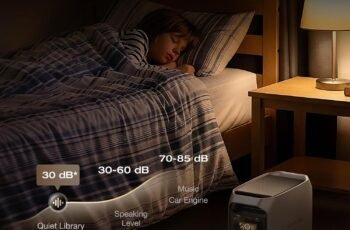
One of the perks of battery-based power stations is quiet operation compared to gas generators. The F3800 should be substantially quieter during normal operation, making it preferable for neighborhood outages and campsite environments.
Cooling behavior during high loads
At heavier loads the internal cooling fans will engage to manage temperature, but even then noise levels will usually be modest relative to combustion generators. Still, we suggest keeping the unit in a well-ventilated area to avoid frequent fan cycling.
Safety Features and Protections
We expect integrated protections for overcharge, over-discharge, overcurrent, short-circuit, and thermal management given the battery chemistry and intended use. LiFePO4’s inherent stability adds an extra layer of safety.
Practical safety steps we recommend
We encourage using the unit in dry, ventilated areas, avoiding exposure to extreme temperatures, and following Anker’s instructions for parallel and expansion setups. Always confirm grounding and connection instructions for EV and RV use to ensure safe operation.
Performance Examples: Estimating Runtimes
We prefer giving practical examples to illustrate capability. Runtimes are approximate and depend on real-world usage patterns and inefficiencies.
- LED lighting (50W total): ~76 hours (3840Wh / 50W = 76.8h)
- Refrigerator (150W avg): ~25 hours (3840Wh / 150W = 25.6h)
- Electric water heater (1,500W intermittent): Several hours of intermittent use; continuous use would drain in ~2.5 hours
- Dryers or washers (2,000–3,000W peak): Able to run in many cases due to 6,000W continuous capability; actual run time depends on duty cycle.
- EV charging at 6,000W: Theoretically ~0.64 hours per 1 kWh battery (i.e., 3.84 kWh would add around 2–3 miles per minute depending on vehicle efficiency), but practical EV charging behavior and vehicle acceptance vary.
Caveats on runtime calculations
We always remind ourselves that inverters and power conversion introduce losses, and appliance startup surges can be higher than steady-state draws. Real-world conditions and connected loads change outcomes; these numbers are illustrative.
Real-World Use Cases
We see the F3800 fitting several profiles: families preparing for multi-day outages, RV owners who want silent power, vanlifers with higher power needs, and small businesses needing short-term backup power.
Scenarios where the F3800 shines
If we need to run a refrigerator, some lights, a few small appliances, and occasionally a high-draw tool or dryer, the F3800’s combination of capacity and high continuous wattage makes it practical. It also simplifies EV and RV use with standard outlet compatibility.
Setup and First-Time Use
Out of the box we should inspect the unit and included accessories, charge it to full before first use, and register it in the Anker app. If expanded with extra battery packs, follow Anker’s step-by-step instructions for safe coupling.
Helpful tips for a smooth launch
Charge the battery fully before depending on it for a real outage, update firmware if an update is available, and familiarize ourselves with the app’s controls. Label cables and keep the user manual handy for quick reference.
Maintenance and Storage
LiFePO4 stations are relatively low-maintenance, but we should store the F3800 in a cool, dry location and maintain a partial charge if storing long term. Periodic top-offs every few months can prevent deep discharge.
Seasonal storage guidance
If we store the unit for extended periods, keep it at about 40–60% charge and check it every few months. Avoid storing in extreme heat or cold to preserve battery health.
Pros and Cons
We summarized the main advantages and trade-offs so we can weigh this purchase clearly.
Pros
- High base capacity (3.84 kWh) suitable for multi-hour to multi-day use
- Expandable up to 26.9 kWh for scalable backup
- 6,000W continuous AC output with 120V/240V support
- LiFePO4 battery chemistry for safety and longevity
- Direct EV and RV compatibility via standard outlets
- App-based intelligent control for remote management
Cons
- Renewed units may have variable cosmetic condition; warranty should be checked
- Size and weight reduce “carryable” portability compared to smaller stations
- Full charging times depend on input limits; fast recharge may require additional gear
- Expansion hardware cost adds up if we scale to maximum capacity
Comparison Notes (How it stacks up in the market)
We find the F3800 occupies a premium niche—more powerful and expandable than consumer-grade portable power stations and more convenient and quieter than a gas generator for many users.
Competitors and alternatives to consider
For smaller needs, compact Anker models or other brands’ 1–2 kWh units might be less costly. For permanent whole-house backup, integrated home battery systems (Tesla Powerwall, Enphase, etc.) may be a better long-term fit. The F3800 is aimed at a mobile-friendly, modular middle ground.
Who Should Consider the F3800?
We recommend this unit for households wanting robust, non-fuel backup without permanent installation, RV owners who want to run multiple appliances, EV owners seeking portable charging, and anyone who values long battery life and flexibility.
Who might want something else
If we only need occasional phone or laptop charging, or if we need a lightweight kit for backpacking, the F3800 is overkill. If we want a fully integrated, permanently mounted whole-house system, a dedicated home battery tied to an inverter and transfer switch may be preferable.
Frequently Asked Questions (FAQ)
We compiled common questions we expect buyers to ask, with concise answers.
-
Q: Can we use the F3800 indoors?
A: Yes, but in a ventilated, dry area. It does not emit combustion gases like gas generators, making indoor use safer, but keep it out of extreme temperatures. -
Q: How many battery packs can be added?
A: Up to six battery packs on a single F3800 for a maximum of 26.9 kWh as stated in the product details. -
Q: Can we charge an EV directly?
A: Yes, the unit’s NEMA 14-50 port is intended for EV charging up to 6,000W; follow vehicle and Anker guidelines. -
Q: Is it loud like a generator?
A: No. Battery power stations are much quieter; fans will make noise under heavy loads, but it’s far less than gas generators. -
Q: What does “renewed” mean for warranty and support?
A: Renewed items are refurbished; warranty and return terms vary by seller—check specifics before buying.
Price Considerations and Value
We see the F3800 as a premium investment for users who need significant portable wattage and long-term reliability. Renewed pricing can make this more accessible, but confirm the condition and warranty to ensure value.
Budget planning tips
If we plan to expand later, factor in the cost of battery packs and any accessories (parallel kits, carts, additional solar array capacity). Compare total system cost to other solutions to confirm alignment with needs.
Final Verdict
We feel the Anker SOLIX F3800 is a compelling option when we want a powerful, expandable, and relatively safe battery-based power solution for home backup, RV, and EV applications. Its 3.84 kWh baseline, LiFePO4 chemistry, and 6,000W continuous AC output stand out in the portable power market.
Our recommendation summary
If we need high continuous power and the flexibility to scale capacity over time—without relying on noisy combustion generators—the F3800 is worthy of serious consideration. For lighter-duty needs or ultra-portability, smaller alternatives will be a better fit.
Practical Buying Checklist
We put together a short checklist of items to confirm before we checkout:
- Verify the renewal warranty, return period, and seller reputation.
- Confirm total included ports and any required adapters for our appliances.
- Decide if we will expand with battery packs now or later and budget accordingly.
- If solar charging is planned, size the panel array and charge-controller capability to the F3800’s input limits.
- Ensure transport arrangements if we need to move the unit frequently.
We hope this detailed review helps us make an informed decision about whether the Anker SOLIX F3800 Portable Power Station fits our needs.
Disclosure: As an Amazon Associate, I earn from qualifying purchases.