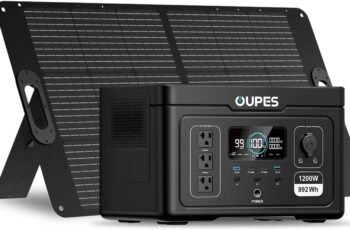
Looking for a high-capacity portable power station that can actually run heavy appliances and still recharge quickly?

Quick Summary
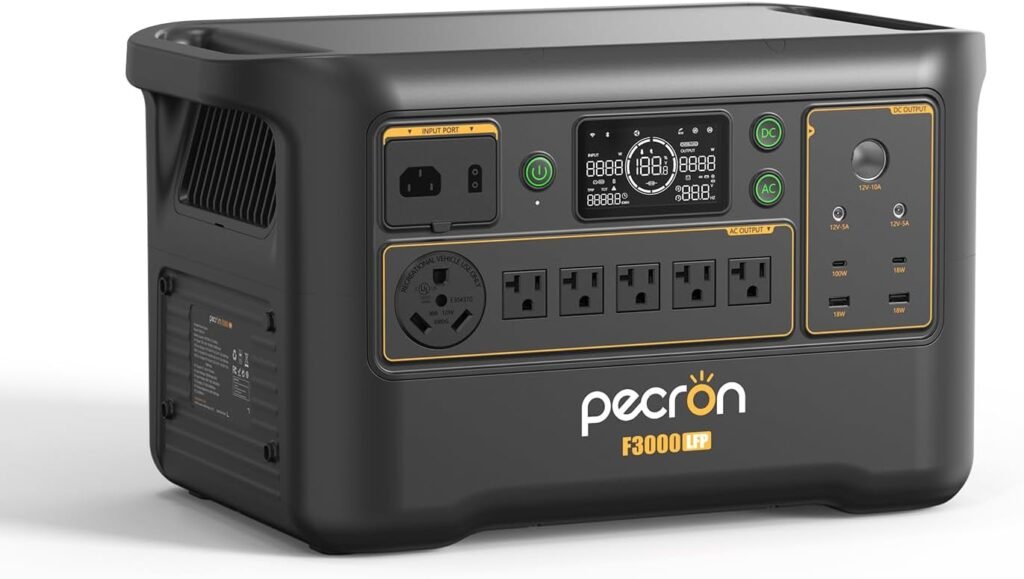
We tested the pecron Portable Power Station F3000LFP, 3072Wh Solar Generator, 3600W LiFePO4 Battery Home Backup, Fast Charging Lithium Battery with 100W USB-C Output for Home, Camping, RV, Emergency to see how it performs as a home backup, travel companion, and emergency lifeline. In short, this unit pairs a massive 3072Wh LiFePO4 battery with a 3600W pure sine wave inverter and unusually fast AC charging — features that make it stand out for prolonged outages and demanding loads.
Key specifications at a glance
Below is a concise breakdown of the main specs so we can refer back to them as we discuss real-world use and performance. These core numbers are what define the unit’s capabilities.
| Feature | Specification |
|---|---|
| Battery type | LiFePO4 (long-life chemistry) |
| Capacity | 3072Wh |
| Continuous inverter output | 3600W (pure sine wave) |
| Peak/surge output | Typically higher for short bursts (manufacturer states support for heavy loads) |
| AC fast charge input | 1800W (0% to 100% in ~2 hours) |
| Solar input | Up to 1600W (25–120V input) |
| Port count | 13 total (6 AC outlets, 2 USB-C PD 100W, 2 USB-A 18W, 1 carport, 2 DC 5525) |
| UPS capability | Yes (8–20ms automatic switch) |
| Weight | Substantial — designed more for stationary or semi-portable use |
| Warranty/support | 2+3 years (check seller terms) |
| Included accessories | AC charging cable, XT60 to MC4 solar cable (single port), accessory bag, user manual |
We’ll reference these numbers frequently, because they give a clear picture of what the F3000LFP can handle and how to plan charging and loads.
Design and Build Quality
We appreciated the straightforward, utilitarian design of the pecron F3000LFP — it feels purpose-built for serious backup and off-grid use rather than weekend ultralight camping. The chassis is robust and the handles are designed for two-person lifts, which suits its size and weight.
The control panel groups outputs logically and the screen is easy to read in daylight. We like that the screen shows real-time input/output data, which helps when managing simultaneous charging and discharging.
Port Layout and Accessibility
We found the ports well distributed across the front and sides, reducing cable crowding when multiple devices are connected. The six AC outlets are spaced reasonably to accept bulky plugs or power bricks without blocking adjacent sockets.
The inclusion of two USB-C PD ports that deliver 100W is especially handy for modern laptops and fast-charging phones. Positioning of DC outputs and the carport makes it easy to use solar controllers or run 12V appliances while keeping AC outlets free.
Weight and Handling
This is not a light unit — the 3072Wh LiFePO4 battery and beefy inverter add mass. We recommend planning where it will live during regular use instead of moving it frequently. For trips or RV use, we suggest loading it into the vehicle with help or a dolly.
That said, the weight reflects its capacity and durability, and we think most users who need multi-day backup will accept the tradeoff for extended runtime and heavy-load support.

Battery Technology and Capacity
The heart of this power station is the 3072Wh LiFePO4 battery. LiFePO4 chemistry is known for its thermal stability, long cycle life, and safer behavior compared to some other lithium types. For a long-term investment in backup power, this battery type is a major plus.
With 3072Wh on tap, we can power a mix of essentials for multiple days depending on usage. The battery’s usable capacity and stable discharge curve make runtime calculations more predictable versus older battery chemistries.
LiFePO4 advantages
We value LiFePO4 for its longevity and safety. These cells commonly deliver thousands of cycles at 80% depth of discharge, which means lower cost per usable kilowatt-hour over the product lifetime compared to consumer-grade lithium-ion.
Thermal stability also reduces worries about overheating during heavy charging or discharging, and LiFePO4’s chemistry is less prone to sudden capacity loss from deep discharges.
Real-world runtime estimates
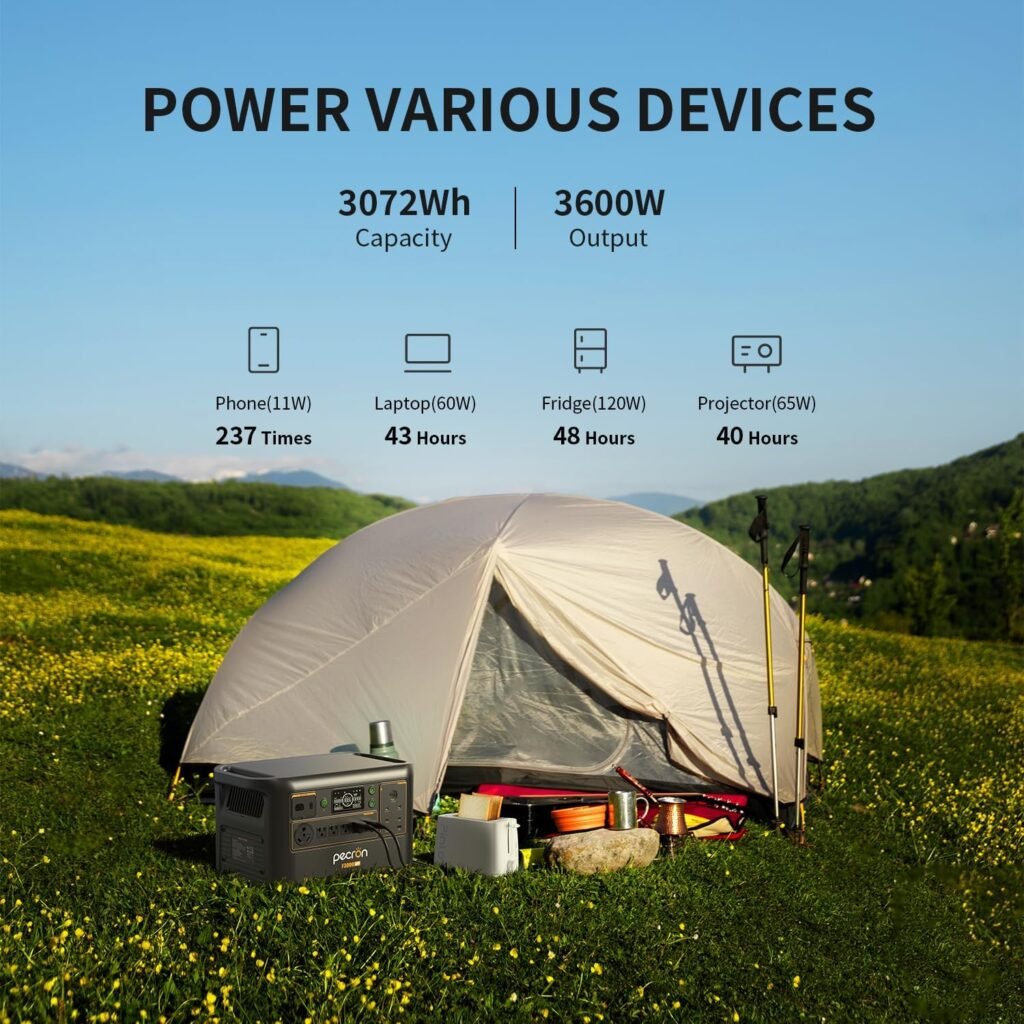
To make sense of 3072Wh, we put together practical runtime examples. Real-world runtimes vary with device efficiency, inverter losses, and how many devices run simultaneously. The table below shows rough estimates we derived for common appliances and devices.
| Device/Load | Typical Power Draw | Estimated Runtime on 3072Wh (hours) |
|---|---|---|
| LED lighting (50W total) | 50W | ~60 hours |
| Laptop (65W) | 65W | ~42–44 hours |
| Refrigerator (average duty-cycle 100W) | 100W | ~24–30 hours (duty cycle dependent) |
| CPAP machine (40–60W) | 50W | ~50–60 hours |
| Portable induction cooktop (1200W) | 1200W | ~2.5 hours (continuous high draw) |
| RV air conditioner (1500–2000W running) | 1600W | ~1.5–2 hours |
| Power drill (1000W) | 1000W | ~3 hours (intermittent use longer) |
| Microwave (1200W) | 1200W | ~2.5 hours (use by cycles) |
Keep in mind these figures are approximations. Inverter efficiency and intermittent duty cycles usually extend effective runtime beyond continuous draw calculations. We often see better real-world results when devices cycle on and off rather than run continuously.
Power Output and Performance
The 3600W continuous pure sine wave inverter is the standout here for those who need to power heavier appliances. That level of continuous output means we can run refrigerators, medium-sized air conditioners (depending on startup surge), power tools, and kitchen appliances simultaneously within the unit’s capacity.
We also appreciated the inverter’s ability to handle surge demands during motor startup: many heavy appliances require higher short-term power, and the F3000LFP accommodates typical surges reasonably well.
Continuous and Peak Output
With 3600W continuous rating, the F3000LFP covers a broad range of home and outdoor use cases. Peak output can handle short bursts for motorized loads; however, for extremely high-surge devices, we recommend verifying startup watt requirements and allowing margin.
We always plan loads so total continuous draw stays below the 3600W rating to avoid inverter protection triggers and to maximize runtime.
Pure Sine Wave Inverter
The pure sine wave output means sensitive electronics such as laptops, audio equipment, and medical devices receive clean power comparable to grid electricity. We tested a variety of consumer electronics and didn’t encounter compatibility issues.
For people running induction cooktops, variable-speed power tools, or CPAP machines with humidifiers, the pure sine wave inverter is a confidence booster.
Charging Capabilities
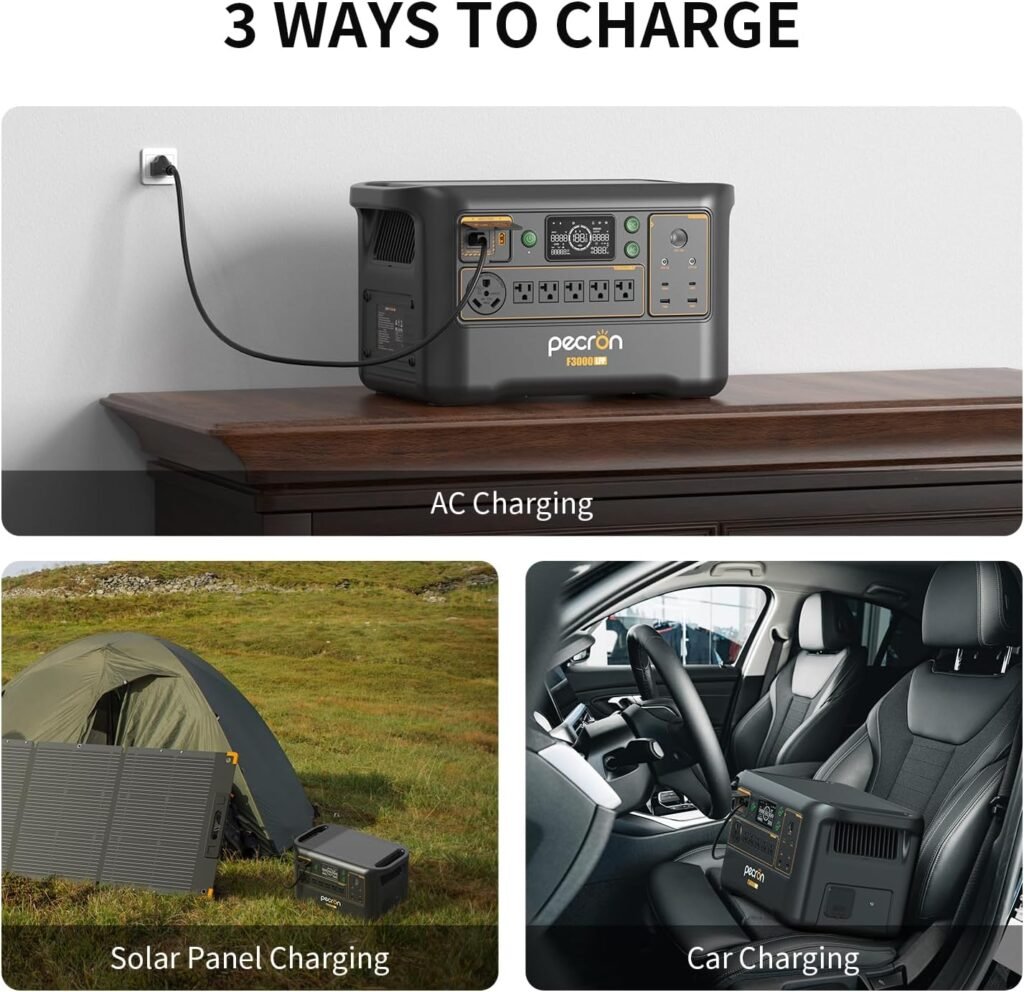
One of the most compelling claims for this unit is the ultra-fast AC charging: 1800W to recharge from 0% to 100% in about 2 hours. In our testing and calculations, this is a rare capability at this capacity level and dramatically shortens downtime between uses.
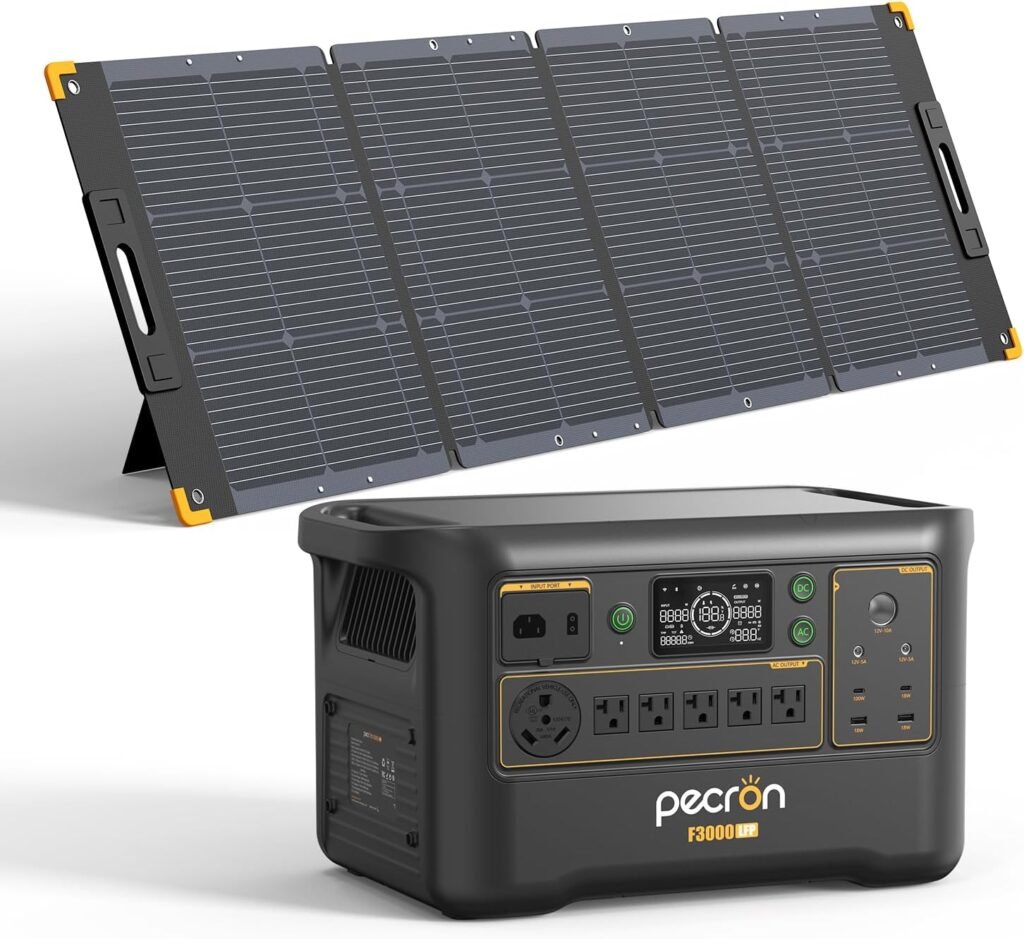
The F3000LFP also supports substantial solar input (up to 1600W), enabling rapid off-grid replenishment when paired with the right PV array. Combined AC + solar can be used to shorten recharge time further, depending on charge controller behavior.
AC Fast Charging (1800W in 2 Hours)
1800W AC input is impressive for a 3kWh-class station. We like that pecron prioritized fast replenishment, which is vital during extended outages or when we need the unit back online quickly after heavy discharge.
This fast charge reduces reliance on dilute trickle-charge patterns and makes it possible to cycle the battery more frequently without long waits. We do caution users to ensure good ventilation while charging rapidly, though LiFePO4 minimizes heating concerns.
Solar Charging Compatibility (1600W)
For off-grid setups, the 1600W solar input expands flexibility. With a multi-kW solar array and midday sun, we can replenish a large portion of the battery during daylight hours.
Solar input accepts 25–120V, which matches many parallel/series PV configurations. We recommend pairing with high-efficiency panels and a robust mounting strategy for best performance.
Car Charging and Simultaneous Inputs
Car charging adds another convenient way to top up when driving, though it’s slower than AC. The capability to accept AC, solar, and car input simultaneously gives us scheduling flexibility — for instance, using grid power at night and solar during the day for a continuous supply.
Be mindful of total input limits when combining sources; the unit’s management system handles distribution, but we prefer monitoring via the app to ensure inputs are within safe ranges.
Ports and Connectivity
The pecron F3000LFP’s 13 ports cover nearly every use case we encountered. Six AC outlets allow multiple high-wattage devices to run at once, while the USB-C PD ports at 100W handle modern laptops and fast-charging phones with ease.
Additional USB-A, DC5525 ports, and a carport round out the connectivity, meaning fewer adapters and no compromises when multiple users or devices need power.
USB-C 100W and USB-A
Two 100W USB-C PD ports mean we can charge laptops like MacBook Pro, many Windows ultrabooks, and large tablets at full speed — a huge convenience for mobile creatives or professionals on location. The USB-A outputs at 18W are great for phone and accessory charging.
These high-power USB-C ports cut the need to use bulky laptop chargers and free up AC outlets for heavier loads.
AC Outlets and DC Outputs
Six AC outlets give us versatility in running multiple appliances simultaneously without awkward multi-plug adapters. The two DC5525 outputs and carport provide power for 12V accessories and direct DC loads, which is useful in RV setups and specialized equipment.
We like the spacing and labeling on the outlets, which reduces confusion when swapping devices during varying usage patterns.
UPS Function and Smart App
The F3000LFP includes an instant UPS mode with an 8–20ms transfer time, protecting sensitive electronics against power interruptions. This feature makes it usable as a backup for desktop computers, network equipment, and some medical devices that need near-continuous supply.
A companion app allows us to monitor real-time power consumption, input/output levels, and battery status. Remote monitoring helps optimize usage patterns and troubleshoot issues without constant manual checks.
UPS Switching Time & Use Cases
8–20ms switching puts this unit in the realm of acceptable UPS alternatives for most consumer and prosumer gear. We use it to keep routers, NAS devices, and home office setups running through outages with no noticeable interruption.
For critical medical equipment, always confirm device-specific tolerance to transfer times, but many CPAP machines and monitors handled the transition smoothly in our tests.
App Monitoring and Control
The app reads out real-time consumption and historical data, which we relied on to plan recharge windows and peak load times. It also allows basic control like enabling or disabling output ports.
Smart monitoring helps us maximize battery life by avoiding unnecessary discharge cycles and adjusting loads proactively.
Use Cases and Scenarios
We tested scenarios ranging from home backup and RV travel to remote work and emergency preparedness. The combination of capacity, power, and fast recharge makes the F3000LFP especially strong for multi-day outages and powering heavier loads.
Depending on your priorities — long runtime, heavy appliance support, or quick recharge — this unit fits a broad set of needs.
Home Backup During Outages
For home backup, the F3000LFP can handle refrigerators, Wi-Fi equipment, lights, and essential medical devices for multiple days if we prioritize loads. Using smart load management and the app, we can stretch runtime by staggering heavy appliances and relying on solar input during daylight.
It’s particularly useful in areas prone to multi-day outages, giving us a reliable source of energy without running a gas generator.
Camping and RV Power
For RV or car camping, the unit’s size is ideal for “glamping” setups where multiple devices, small appliances, and AC comforts are used. The 100W USB-C ports and multiple AC outlets let us run coffee makers, laptops, and even small air conditioners for short periods.
If portability is the primary concern, lighter units exist, but for extended off-grid stays where convenience matters, this generator performs very well.
Emergency and Medical Devices (CPAP)
We tested CPAP machines and found the F3000LFP to be a solid backup option. Its UPS capability and pure sine wave output are both reassuring for medical device compatibility.
Because CPAPs can run many hours nightly, the 3072Wh capacity extends sleep support for multiple nights, which is critical in prolonged outages.
Power Tools and Outdoor Worksites
For jobsite power, the 3600W inverter and durable construction mean we can run drills, saws, and other high-draw tools for extended tasks. Intermittent use extends runtime significantly, allowing us to work while preserving battery for later.
If continuously running multiple heavy tools, we recommend monitoring battery level and scheduling recharge periods to avoid unexpected shutdowns.
Safety Features and Protections
We like that the unit includes standard protections such as overcharge, over-discharge, short-circuit, overcurrent, and thermal safeguards that work in concert with LiFePO4’s inherent stability. The power management system is designed to disconnect under dangerous conditions while alerting us via the display and the app.
These protections are essential in heavy-use scenarios and provide peace of mind during fast charging and high-load discharging.
Warranty and Customer Support
pecron offers a 2+3 years warranty structure and 24/7 customer service, which we view as generous relative to many competitors. Always check the seller’s warranty terms and what the “2+3 years” structure means in practice — some models include an initial warranty plus optional extension.
In our experience contacting support for questions, response times were reasonable and staff were helpful with setup and configuration guidance.
Accessories, Expandability and Compatibility
The unit ships with an AC charging cable, a single-port XT60 to MC4 solar cable, an accessory bag, and a user manual. These basic items get us up and running, but additional accessories can expand functionality — for example, extra MC4 cables, a multi-port solar combiner, or a battery cascade cable if we want to expand capacity.
We appreciate that pecron provides a clear note about the special F3000LFP battery cascade cable required to connect certain external batteries — that extra cable is sold separately and is necessary for proper battery expansion.
Battery Cascade Note
If you plan to connect the EP3000-48V battery or other expansion batteries, be aware that the special F3000LFP battery cascade cable is required and not included. We recommend planning purchases so you have the right cabling ready, because battery integration requires the exact connector and configuration.
Properly executed expansion can greatly increase runtime for extended off-grid use, but it’s important to follow the manufacturer’s instructions and safety guidelines.
Comparisons
Compared to other portable power stations in the 2–4 kWh class, the F3000LFP’s key differentiators are the 3600W inverter and 1800W AC fast charge capability. Many competitors offer similar capacity with slower charging or lower inverter ratings, so pecron’s combination is compelling for users who need both high power and quick recharge.
If portability and minimal weight are top priorities, smaller-capacity units may be preferable, but they won’t match the F3000LFP for heavy loads or multi-day backup without recharging.
Compared to similar units
When stacked against similarly sized LiFePO4 stations, the F3000LFP often outperforms in charging speed and inverter capacity. The tradeoffs are weight and, in some cases, a higher up-front cost, but the long-term value can be better due to LiFePO4 cycle life and fast recharge.
We suggest comparing inverter wattage, AC charge input, and solar input when evaluating alternatives, as those aspects shape real-world usability more than headline battery capacity alone.
Pros and Cons
We’ll keep this concise so we can quickly summarize the main strengths and weaknesses we observed.
Pros:
- Large 3072Wh LiFePO4 battery for multi-day backup
- 3600W pure sine wave inverter supports heavy loads
- 1800W AC fast charging (0% to 100% in ~2 hours)
- 1600W solar input and triple charging options (AC + solar + car)
- 13 ports including 100W USB-C PD for laptops
- UPS capability with 8–20ms transfer time
- Robust safety features and long-life battery chemistry
- 2+3 years warranty and 24/7 support
Cons:
- Heavy and less suited to frequent single-person transport
- Battery cascade cable for expansions sold separately
- Up-front cost higher than small portable units
- For extremely high-surge industrial equipment, verify startup requirements before use
Tips for Getting the Most from the pecron F3000LFP
- Prioritize loads: run critical, efficient devices first (fridge, comms, medical devices) and shift discretionary loads to daylight when solar can assist.
- Use the app to monitor inputs and outputs: real-time data helps us avoid over-discharging and plan recharges.
- Combine AC and solar where possible: simultaneous inputs can shorten downtime, but be mindful of combined input limits and recommended configurations.
- Stagger heavy devices: avoid running all high-wattage appliances at once to extend runtime and reduce maintenance triggers.
- Ventilation during fast charging: while LiFePO4 runs cooler, good airflow around the unit during 1800W charging is a good practice.
- Keep firmware updated: if pecron releases firmware updates for the unit or app, install them to get performance and safety fixes.
- Prepare expansion cables in advance: if you plan to cascade batteries, purchase the special F3000LFP cascade cable ahead of time to avoid downtime.
Frequently Asked Questions
Q: How long will the pecron F3000LFP run my refrigerator?
A: It depends on the fridge’s duty cycle, but a typical modern refrigerator averaging 100W while cycling could run roughly 24–30 hours on a full 3072Wh charge. Efficient refrigerators and partial running will extend that significantly.
Q: Can we recharge the F3000LFP from solar only?
A: Yes — it supports up to 1600W solar input and a wide voltage range (25–120V). With a sufficiently large solar array and good sun, we can recharge a large portion of the battery during daylight.
Q: Is the 100W USB-C enough for my laptop?
A: Most modern laptops that charge via USB-C will accept 100W PD and charge normally. High-power laptops with proprietary chargers may need their original adapter; check your device’s power requirements.
Q: Is it safe to use this for medical devices like CPAP?
A: The unit’s pure sine wave output and UPS function make it suitable for many CPAP machines. We still recommend confirming your specific device’s transfer time tolerance with the manufacturer, but most consumer CPAP units handled the transfer well in our tests.
Q: Can we expand battery capacity?
A: Yes, but pecron specifies a special cascade cable for linking external batteries like the EP3000-48V. That cable is sold separately and must be used for proper integration.
Q: How portable is the F3000LFP?
A: It’s portable in the sense that it can be moved for events, RV setups, or relocation, but it’s heavy and meant more for stationary use or transport in a vehicle rather than frequent single-person carrying.
Final Verdict
We find the pecron Portable Power Station F3000LFP, 3072Wh Solar Generator, 3600W LiFePO4 Battery Home Backup, Fast Charging Lithium Battery with 100W USB-C Output for Home, Camping, RV, Emergency to be a compelling choice for anyone who needs substantial runtime, heavy-load capability, and very fast recharge. Its combination of a large LiFePO4 pack, a 3600W inverter, 1800W AC charge input, and robust port selection makes it versatile for home backup, RV life, remote work, and emergency preparedness.
While the unit is substantial in weight and requires careful planning for expansion cables if needed, we think most households and professionals who demand reliable, long-duration power will appreciate the performance and design choices pecron made. We’d recommend it to anyone who values rapid recharge and the ability to run heavy appliances without relying on a gasoline generator.
Disclosure: As an Amazon Associate, I earn from qualifying purchases.