Looking for a reliable, portable power source that keeps our gear running whether we’re camping, traveling, or facing an unexpected outage?

Overview of the Anker SOLIX C300 DC Power Bank Station
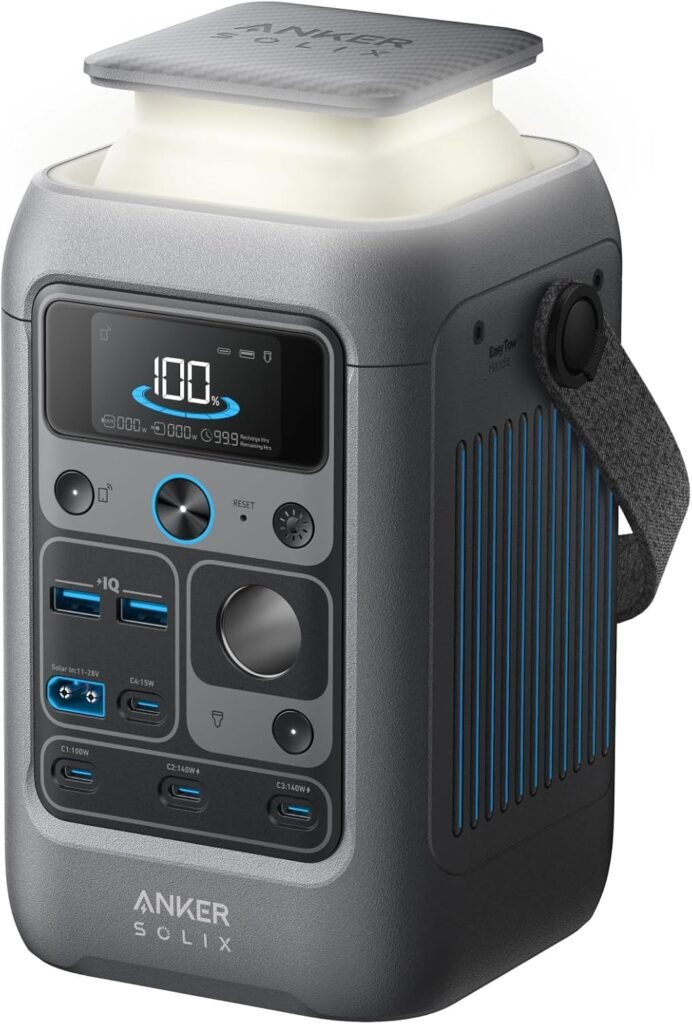
We think the Anker SOLIX C300 DC Power Bank Station, Outdoor 288Wh Portable Power Station, LiFePO4 Battery, 300W Solar Generator, for Camping, Traveling, and Emergencies (No Wall Charger Included) positions itself as a compact but capable option for users who need dependable off-grid power. With a 288Wh LiFePO4 battery and 300W output, it aims to balance portability and usable power for everyday devices and some light appliances. In this section we summarize the key selling points and what makes the C300 stand out at first glance.
Key Features at a Glance
We appreciate that the C300 focuses on longevity and practical performance rather than just flashy specs. It uses a LiFePO4 battery chemistry with a three-year guarantee and supports several charging methods, including fast USB-C PD charging and solar input. The design is roughly 30% smaller than similar power stations, so it’s easier to grab and go.
What’s in the Box
We like when the essentials are included. The pack contains:
- Anker SOLIX C300 DC Portable Power Station
- 60 cm 140W USB-C to USB-C charging cable
- Safety manual
- Warranty information
Note that no wall charger is included, and for the first activation you must recharge with an 18W or higher USB-C wall charger using specified ports (USB-C2 and USB-C3).

Detailed Specifications Table
We created a concise table to make specs easier to compare at a glance. This helps when we’re deciding if the C300 fits our needs.
| Specification | Detail |
|---|---|
| Battery Capacity | 288 Wh |
| Battery Chemistry | LiFePO4 |
| Rated Output (Continuous) | 300 W |
| Peak/Surge Output | (Not specified in product details) |
| USB-C Ports | 2× USB-C (140W two-way), 1× USB-C (100W), 1× USB-C (15W) |
| USB-A Ports | 2× USB-A (12W) |
| Car Socket | 1× 120W car socket |
| Recharging Options | Dual PD 3.1 USB-C (fast), solar panel (100W/60W recommended), car charging |
| Fast Recharge Claim | Up to 80% in 1 hour via dual PD USB-C |
| Weight & Size | ~30% smaller than similar rivals (exact weight not listed in product details) |
| Included Cable | 60cm 140W USB-C to C cable |
| Compatibility Notes | Not compatible with Anker SOLIX PS30, PS200, PS400 or 5V~3A USB-C panels |
| Warranty | 3-year guarantee on LiFePO4 battery (with product warranty info included) |
First Use and Activation Requirements
We need to follow a specific first-time activation routine to get the C300 working properly. The manufacturer requires an initial recharge using an 18W or higher USB-C wall charger, such as an Anker USB-C charger or a laptop charger. Crucially, only the USB-C2 and USB-C3 ports can be used for this initial charging. That’s an unusual but important step — if we skip it, the unit might not activate correctly.
We also want to highlight that the package does not include a wall charger, so we’ll need to supply our own 18W+ USB-C charger if this is a brand-new unit. The included 60 cm 140W USB-C to C cable will help for high-speed charging if our charger supports it.
Battery Chemistry and Lifespan: Why LiFePO4 Matters
We feel strongly that LiFePO4 is the right choice for long-term use. Compared with traditional lithium-ion chemistries, LiFePO4 offers:
- Greater cycle life, meaning more charge/discharge cycles before significant capacity loss
- Improved thermal stability and safety
- Better longevity under regular use and in varied temperature conditions
Anker’s 3-year guarantee for the LiFePO4 battery reinforces their confidence in durability. We also note the unit’s smart temperature control and impact-resistant design, which should contribute to extended lifespan when we use the C300 outdoors or on the move.
Performance and Charging Speeds
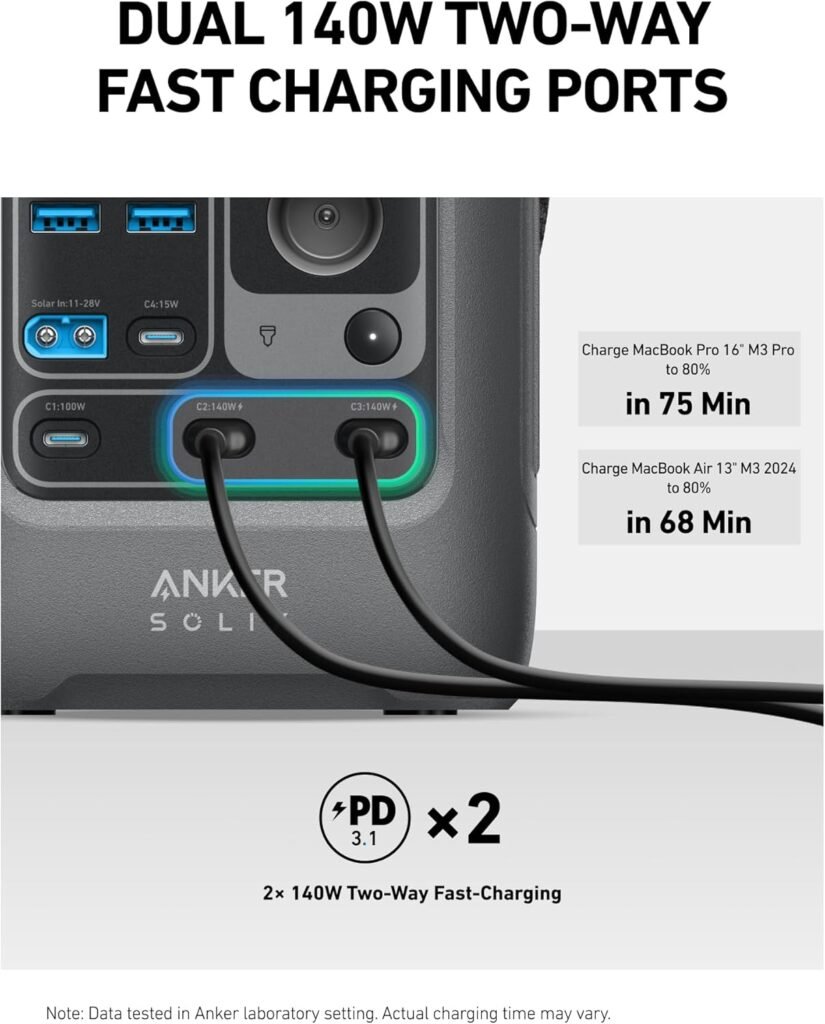
We’re impressed by the fast-charging emphasis. The C300 supports dual high-power USB-C ports (two 140W two-way USB-C ports) and claims fast recharge to 80% in one hour when using the dual PD 3.1 USB-C input. That’s a major advantage when we need to top up quickly between activities or before a trip.
Still, practical performance depends on the charger we use and whether we’re utilizing both PD inputs. For consistent fast recharge, we should:
- Use high-wattage USB-C chargers (or chargers that can deliver combined power through two USB-C inputs if supported)
- Use quality USB-C cables that handle high wattage (the included 140W cable helps)
- Ensure the ports used for initial activation and fast charging match the port labels (USB-C2 and USB-C3 for the first recharge)
Typical Device Charging and Run-Time Examples
While exact runtimes vary by device and load, we can estimate approximate usage from the 288Wh capacity:
- Smartphones: multiple full charges (often 10–20 full charges depending on phone battery size)
- Laptops: a few full charges for typical ultrabooks (approx. 1–3 full charges depending on battery size)
- Camera gear: many charges for mirrorless/DSLR batteries
- Mini-fridge: several hours depending on compressor efficiency and duty cycle
- CPAP machines: many models will run for several hours but confirm the wattage and heating needs (300W continuous output limits simultaneous high-draw appliances)
We must be cautious with power-hungry appliances: the C300’s 300W output is solid for small devices but not intended for heavy-duty appliances like large hair dryers, ovens, or major power tools.
Ports and Versatility
The C300’s port selection is practical for modern users. We like the variety because it reduces the need for adapters and helps us power multiple devices simultaneously.
- USB-C: Two high-power 140W two-way ports (capable of charging devices and possibly charging the unit), one 100W USB-C port, and one 15W USB-C port. This mix supports fast laptop charging, phones, tablets, and smaller USB-C devices.
- USB-A: Two 12W USB-A ports are handy for older devices or accessories.
- Car Socket: 120W car socket provides another option for powering automotive accessories or for recharging from a vehicle.
This range means we can charge cameras, laptops, phones, and run accessories like lights and small fans all at once, as long as we stay within the 300W continuous output limit.
Solar Charging and Off-Grid Use
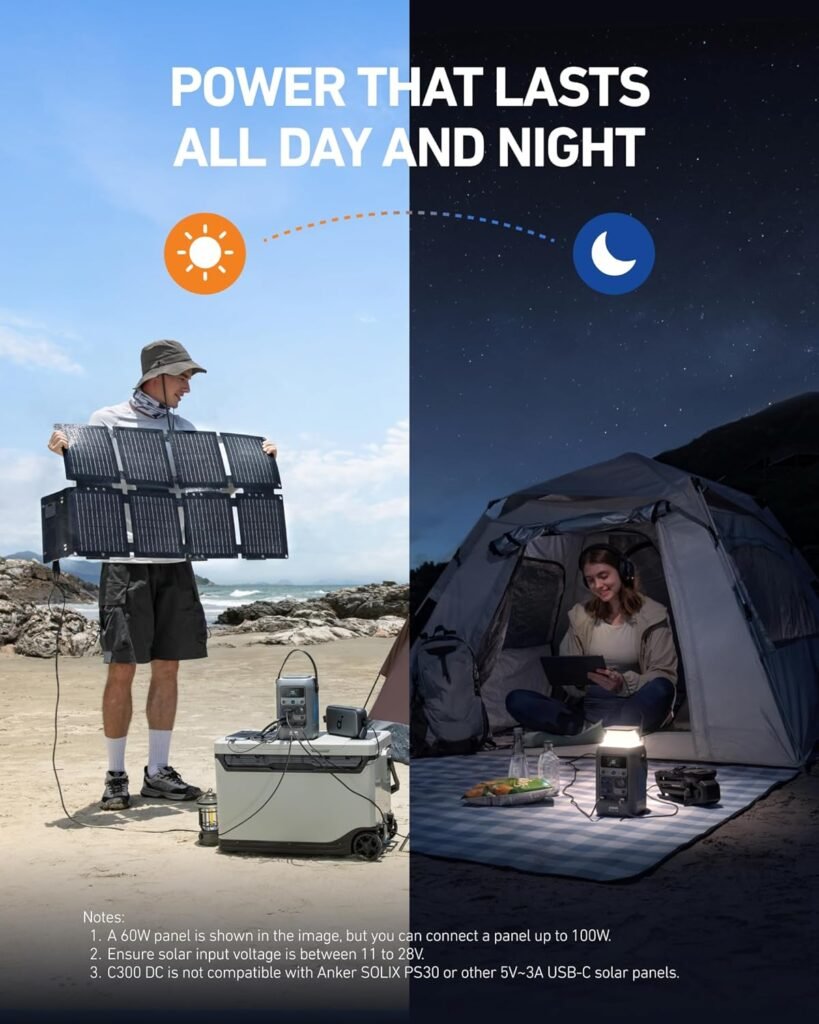
For longer trips where grid power isn’t available, the C300 supports solar charging and Anker recommends a 100W or 60W Anker Solar Panel. Solar input turns the power station into a practical solution for multi-day trips if we pair it with the right panels and managing expectations on daily energy usage.
Important compatibility notes:
- The C300 is incompatible with certain Anker SOLIX models (PS30, PS200, PS400) and other 5V~3A USB-C panels. We should confirm the panel specs before purchasing to ensure proper voltage/amperage match.
- Solar charging speed will depend on panel output, sunlight conditions, and the solar charge controller’s limits. With a 100W panel in ideal conditions, we can expect meaningful recharging across a sunny day, but it won’t match wall-charger speeds.
Solar Use Tips
We recommend these practices when using solar:
- Aim panels directly at the sun and adjust angle throughout the day for best results.
- Avoid partial shading; a small shaded cell can significantly reduce power.
- If relying mainly on solar, plan power usage conservatively and prioritize essential gear.
Portability and Design
Anker emphasizes a smaller footprint: the C300 is about 30% smaller than comparable units in its category. For us that means easier storage, carrying, and fitting into vehicle trunks or camper storage. The unit supports an optional strap (sold separately) which can make transport easier during hikes to basecamps or busier camping setups.
We also appreciate the inclusion of impact-resistant design features and smart thermal control to help the unit survive knocks and varied outdoor temperatures.
Safety and Durability Features
We place a premium on safety when dealing with batteries. The C300’s LiFePO4 chemistry is inherently more stable, and Anker adds smart temperature control to prevent overheating during heavy use or charging. Impact-resistant housing and the manufacturer’s warranty reduce worries about accidental drops or bumps on the trail.
We would still follow basic safety precautions:
- Keep the unit dry and avoid exposure to heavy rain unless it’s sheltered
- Store within manufacturer-recommended temperature ranges
- Use appropriate cables and chargers, especially when drawing high wattage
Use Cases and Real-World Scenarios
We like imagining real-life situations where the C300 becomes valuable. Here are practical scenarios where the C300 shines:
Camping
We can power lights, charge phones and cameras, run a small fan, and keep a mini-fridge or cooler operating for many hours. Solar recharge during the day helps extend our stay off-grid.
Traveling / Road Trips
The 120W car socket and USB-C fast charging let us keep laptops and devices powered while on the road. The smaller design makes it easy to stow in a trunk or under a seat.
Emergencies and Home Backup
For short power outages, the C300 can keep phones, routers, lights, and medical devices (like certain CPAP machines) operational. It’s not intended as a complete home backup but serves well for essential electronics and communications.
Photography and Field Work
Photographers and drone pilots can benefit from multiple high-wattage USB-C ports to top up cameras, drones, and laptops in the field. The fast charging helps between shoots.
Pros and Cons
We find it useful to present a balanced view so we can weigh pros and cons before buying.
Pros
- LiFePO4 battery with a 3-year guarantee for longevity and safety
- Fast recharge capability (up to 80% in 1 hour using dual PD USB-C input)
- Multiple high-wattage USB-C ports suitable for laptops and modern devices
- Compact design (about 30% smaller than similar units)
- Versatile port selection (USB-C, USB-A, car socket)
- Solar compatibility with recommended Anker 100W/60W panels
- Included 140W USB-C cable for high-speed charging
Cons
- No wall charger included — we must supply an 18W+ USB-C charger for first activation
- 300W continuous output limits running high-watt appliances
- Some compatibility limitations with certain Anker SOLIX panels and older USB-C panels
- Peak/surge power is not specified in the provided details, which may complicate expecting to run high-startup-load devices (e.g., some compressors)
How the C300 Compares to Alternatives
When we compare the C300 to other portable power stations in the 200–500Wh range, it holds a few advantages:
- LiFePO4 battery chemistry often outperforms alternative chemistries in cycle life.
- The array of high-watt USB-C ports is well-suited for modern users who rely on USB-C PD charging.
- The claim of 80% recharge in an hour with dual PD 3.1 is a strong advantage for quick turnarounds.
However, us choosing the C300 depends on our priorities:
- If we need higher-than-300W continuous output for heavy appliances, we’ll consider a larger unit.
- If we want a full home backup solution for extended outages, we may look at higher capacity, higher output options.
Practical Tips for Getting the Most Out of the C300
We’ve compiled a short checklist to maximize performance:
- Before first use, recharge with an 18W+ USB-C wall charger using USB-C2 or USB-C3 to properly activate.
- Use quality USB-C PD chargers and headphones to make use of the 140W two-way ports safely.
- If planning long off-grid trips, pair with a 100W or 60W Anker Solar Panel and keep an eye on solar conditions.
- Monitor total load to avoid exceeding 300W continuous output — consider power-hungry devices as single-use or stagger usage.
- Keep firmware updated if Anker supplies updates (check support resources).
- Store at recommended temperatures and avoid long-term full discharge to maximize battery life.
Charging Flow and Port Notes
We want to clarify how charging flows work on the C300 because port usage affects function:
- USB-C2 and USB-C3 are explicitly required for initial activation and can be used for recharging.
- The two 140W two-way USB-C ports enable both fast output to devices and fast recharging of the power station (when supported by appropriate chargers).
- The inclusion of a 140W USB-C to C cable supports high-wattage charging, so we should keep that cable handy for fast charging sessions.
Common Questions We Get Asked
We’ve answered commonly raised questions to help with purchasing decisions.
Can it run a CPAP?
It depends on the CPAP model’s power draw and whether a heater/resistance humidifier is used. Many CPAPs under 100W will run for several hours, but we must check the specific device wattage and consider any additional heating elements that increase draw. The 300W continuous output is a limiting factor if a device requires high startup power.
Can we charge the unit with any USB-C solar panel?
No — the C300 isn’t compatible with certain low-powered or specialized panels (like 5V~3A USB-C panels) and is incompatible with specific Anker SOLIX models (PS30, PS200, PS400). We should use recommended 100W or 60W Anker Solar Panels to ensure compatibility and optimal performance.
Is a wall charger included?
No. A wall charger is not included. We must use an 18W or higher USB-C wall charger for first activation. For fast charging to 80% in about an hour, higher-wattage USB-C PD chargers are recommended.
How many cycles will the LiFePO4 battery last?
Exact cycle numbers are not provided in the product detail snippet, but LiFePO4 batteries commonly support thousands of cycles compared to hundreds for other chemistries. Anker’s 3-year guarantee and LiFePO4 chemistry generally indicate solid longevity.
Maintenance and Storage Advice
We recommend these steps to keep our C300 in good condition:
- Store the unit at roughly 40–60% charge if you won’t use it for long periods.
- Avoid leaving it fully discharged for extended storage.
- Keep it in a cool, dry place; extreme heat or cold can affect battery health.
- Perform a periodic charge cycle every few months if not in regular use.
Final Verdict
We feel the Anker SOLIX C300 DC Power Bank Station is a compelling choice for adventurers and everyday users who need reliable, portable power without the bulk of larger stations. Its LiFePO4 battery chemistry, robust USB-C PD options, compact design, and solar compatibility make it a practical companion for camping, travel, field work, and short-term emergency backup. The need for an 18W+ initial charger and the 300W output ceiling are reasonable trade-offs given the unit’s size and target use cases. If our typical use cases include laptops, phones, cameras, lighting, and modest appliances, the C300 should meet our needs well.
If we need higher continuous output for heavy appliances or a full home backup solution, we might consider larger-capacity alternatives. But for most modern, portable power needs where durability and fast charging matter, the C300 looks like a strong, user-friendly option.
Disclosure: As an Amazon Associate, I earn from qualifying purchases.