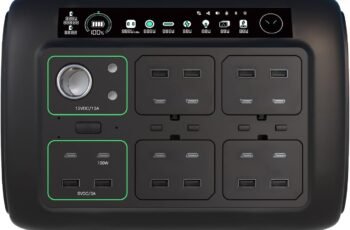
When you’re weighing a power station against a dual-battery system, you’ll weigh portability and immediate versatility against long-term reliability and rugged durability. You’ll find that power stations shine for spontaneous trips and emergencies, while dual-battery setups excel in vehicles and demanding environments. Each has its trade-offs in cost, maintenance, and deployment. Want to pin down which fits your plans, your transport, and the kind of uptime you can’t afford to miss? Consider what matters most to you as you weigh the choices.
What Is a Power Station?
A power station is a facility that generates electric power for distribution to homes and businesses. You’ll find them scaling from small backup generators to large utility plants that deliver thousands of megawatts. The facility converts a primary energy source—coal, natural gas, nuclear fuel, or renewables—into electricity, which travels through power lines to consumers as part of a grid. Its main job is to convert energy into usable electric energy to meet demand reliably. Power stations differ by energy source: fossil fuel plants burn coal, oil, or gas; nuclear plants use reactions for heat; renewables harvest sun, wind, water, or heat. Even small or portable stations store energy and provide flexible charging options without relying on the grid. A portable power station is a device that stores energy in a rechargeable battery and provides power when no traditional electrical outlet is available, offering multiple output ports and charging options for use in remote locations or emergencies.
What Is a Dual-Battery System?
A dual-battery system uses two batteries in your vehicle—a main starter battery and a secondary auxiliary battery—to keep essential starts reliable while powering extras. It includes a battery isolator and wiring so the auxiliary load won’t drain the starter, with the secondary battery often being a deep cycle type. In short, it defines how the two batteries work together and how they’re wired for independent operation and charging. The secondary battery is typically charged by the vehicle’s alternator, in-vehicle battery charger, or solar panel, which helps ensure a steady supply of power for fridges, camp lights, and other amenities without compromising engine starting. Lithium options are popular for rear-seat or tub installations due to their slim profile and space efficiency.
Definition and Scope
A dual-battery system pairs a secondary deep-cycle battery with your vehicle’s starter battery, installed side by side to power accessories while preserving engine-start power. You run non-essential loads off the secondary, so your engine-start battery stays ready. The secondary battery powers fridges, lights, and tools when the engine’s off, keeping you off-grid reliable. This setup protects starter power from depletion, reducing the risk of a failed start. It’s common in off-road, camping, and trade work to support long accessory use without draining the starter battery.
| Role | Battery Type | Benefit |
|---|---|---|
| Starter | Conventional lead-acid or AGM | Starts engine, runs essential electronics |
| Secondary | Deep-cycle | Powers auxiliary loads for extended periods |
| Isolation | Battery isolator or smart solenoid | Prevents cross-drain |
| System scope | Two-battery setup | Flexible, reliable power for accessories |
Components and Wiring
In a dual-battery system, you’ve got two batteries working together: a primary starting battery and an auxiliary deep-cycle battery, wired so the alternator charges both while preventing the auxiliary from draining the starter. You mainly rely on cables, fuses, terminals, isolators or voltage-sensitive relays (VSR), and solid grounding. Use high-quality, appropriately sized cables to handle current and minimize voltage drop, with ring terminals and heat shrink to secure connections and prevent corrosion. Fuses or breakers near battery terminals protect wiring and batteries from shorts or overloads. A VSR or isolator governs charging flow, making certain the auxiliary gets charged without compromising the starting battery. Grounding should be common, ideally at a single point, to reduce noise and guarantee reliable operation.
How They Are Charged and Maintained
To keep a portable power station charging efficiently, clean the charging ports regularly, use the charger and cables specified by the manufacturer, and avoid charging in extreme temperatures that can slow or halt the process. You’ll improve solar charging by keeping panels clean and angled toward sunlight. Use grounded AC outlets with original cables to prevent damage, and stick to manufacturer-approved chargers and input ratings. For dual-battery systems, avoid deep discharge and keep cycles consistent; store in cool, dry places away from moisture and direct sun. Monitor temperatures to stay within safe ranges. Regular resets or firmware updates can fix faults.
| Charging/maintenance tips | Why it matters |
|---|---|
| Clean ports | Prevents slow charging |
| Use correct cables | Safe, efficient transfer |
| Temperature awareness | Maintains speed |
Portability and Deployment Scenarios
Portability and deployment hinge on how compact, lightweight power stations stay ready for rapid setup, while dual-battery systems prioritize extended capacity at the cost of bulk and weight. You’ll find portable power stations designed for quick, plug-and-play use with built-in inverters and ports, reducing external gear and transport complexity. In contrast, dual-battery setups add separate units and mounting hardware, increasing footprint and heft, which limits mobility. When speed matters, small-capacity stations under about 1–2 kWh deploy fastest, delivering immediate power in remote or urban sites. Dual-battery systems suit semi-permanent or vehicle-integrated uses, offering scalable capacity but slower relocation. Terrain and environment support both: portable stations cope with diverse locales, while mounted batteries excel on RVs or trailers with rougher transport.
Power Output and Accessibility
Power output and accessibility hinge on how you tailor capacity to your needs and how quickly you can access power. You’ll notice that dual-battery systems can be sized for specific output, while portable power stations bring fixed ranges, typically 100–1300+ watt-hours. With dual batteries, you can sustain high loads via DC and inverter for AC, powering fridges, lighting, and appliances. Power stations deliver built-in inverters and multiple outlets, letting you run common electronics directly. Battery chemistry matters too: lithium iron phosphate kits and stations offer long cycles and stable delivery.
- Customizable output for exact needs
- Quick, versatile access across devices
- Built-in inverters simplify use
- Chemistry-driven durability and cycles
Installation and Upgrades
Installing and upgrading either solution has distinct demands: dual-battery setups require careful wiring, mounting, and often professional help, while power stations offer plug-and-play simplicity. You’ll deal with complex installation for dual batteries—extensive wiring, battery isolators or DC-to-DC chargers, permanent mounting, and space planning in a vehicle or trailer. In contrast, power stations come pre-assembled, needing no wiring and minimal setup. For dual systems, extra components like inverters may be required, increasing cost and installation effort, and you’ll lose flexibility if you must relocate. Upgrades lean toward dual batteries: easy expansion, bigger or additional batteries, and modular accessories. Power stations offer limited upgrades, with non-serviceable internal cells. Maintenance follows the same pattern: dual systems allow component swaps; stations favor replacement. Mobility favors stations; dual setups stay fixed.
Cost and Long-Term Value
When comparing cost and long-term value, dual-battery systems start with a higher upfront price but often pay off for frequent users through durability and expandable capacity.
1) You’ll face higher initial costs due to batteries, isolators, DC-DC chargers, inverters, wiring, and installation, but these elements build a resilient foundation.
2) Over time, dual-battery setups prove more cost-efficient for heavy users thanks to longer lifespan and easier component replacement rather than a full unit rewrite.
3) You gain protection from deep discharge and solar integration, which cuts ongoing energy expenses and supports smarter charging.
4) The system’s modularity lets you scale without discarding basics, whereas portable stations require new units for growth, increasing total spend.
Durability in Harsh Environments
You’ll want to compare how vibration-resilient designs, heat and dust tolerance, and robust component quality hold up in harsh environments. Dual-battery setups typically offer better vibration damping, tailored cooling, and modular parts for field repair. Portable power stations rely more on integrated protection and casing, which can limit rugged durability under real-world shocks and temperature swings.
Vibration-Resilient Design
Vibration-resilient design blends rugged construction with secure assemblies to keep power delivery steady in harsh environments. You rely on rugged battery models and shock-absorbent casings to minimize impact transmission during rough terrain. You’ll benefit from reinforced mounting brackets that limit movement and shield internal components from vibration-induced stress. You can trust cushioning materials inside portable power stations to protect cells from repeated shocks, while locking connectors and strain relief prevent loosening under vibration. Your electrical path stays intact with vibration-resistant ports, slack routing, and flexible conduits reducing fatigue. Sealed, reinforced casings prevent corrosion and micro-movements, preserving terminal integrity. With proper enclosures and mounts, reliability remains high even in demanding conditions.
- Rugged battery models and shock-absorbent casings
- Reinforced brackets and secure mounting
- Locking connectors and strain relief
- Sealed, vibration-resistant enclosures
Heat and Dust Tolerance
Heat and dust tolerance separates dual-battery systems from portable stations: automotive-grade design and active thermal management keep temperatures in check, while dust ingress is mitigated by sealed, rugged enclosures. You’ll encounter durable heat handling when built with quality components, capable of withstanding engine bay heat and outdoor exposure. Lithium or AGM packs endure sustained heat better in rugged environments due to robust engineering, while some portable units lack substantial heat shielding, risking performance in hot climates. Temperature sensors and adaptive charging in dual-battery setups help mitigate heat damage, unlike many portable units. Dust resistance comes from vehicle-installed setups with sealed, automotive-grade wiring, limiting ingress. Portable stations offer IP-rated cases, but outdoor use can expose them to ventilation challenges and dust exposure without extra protection. Durability is reinforced by modular components and easy replacements in dual-battery systems.
Robust Component Quality
Dual-battery setups are built to endure harsh environments, offering modular, repairable components and rugged mechanical design that portable stations often can’t match. You’ll appreciate the ability to swap a single battery, charger, or inverter without replacing the whole system, reducing downtime and extending service life in tough conditions.
- Modular components enable phased upgrades and exact power tailoring.
- Vehicle-grade construction resists vibration, shocks, and sustained operation in rough terrain.
- Automotive-grade sealing and wiring resist corrosion and field exposure.
- Easy on-site maintenance keeps you powered when access is limited.
In contrast, portable power stations rely on all-in-one designs that complicate repairs, heat management, and durability under continuous stress. This makes dual-battery setups inherently more robust for durability in harsh environments.
Typical Use Cases for Each System
When should you choose power stations over dual-battery systems? You pick power stations for outdoor recreation, travel, and emergency home use. They power lighting, cooking appliances, entertainment, and essential electronics like smartphones, cameras, GPS, laptops, and tablets. Mini-fridges and fans add outdoor comfort, and travelers benefit from charging car gadgets on road trips. In emergencies, they act as backup power for coffee machines, televisions, refrigerators, and lamps, with capacities ranging from small to high-wattage appliances. Recharge options are flexible: AC, car adapter, or solar panels. For professional or creative work, power stations support mobile offices, off-grid filming, strobes, video lights, and live streaming without generators. Dual-battery systems excel in vehicles, offering sustained auxiliary power, keeping the starter battery safe and ensuring vehicle reliability on long trips.
Choosing the Right Solution for Your Needs
Choosing between a dual-battery setup and a portable power station comes down to customization flexibility and your specific use-case needs. If you value tailoring components and upgrading over time, a dual-battery system offers more room to adapt; if you prioritize simplicity and portability, a power station may fit better. Think about where you’ll use power, what devices you need to run, and how much you’re willing to modify or upgrade over the long term.
Customization Flexibility
Customization flexibility matters most when you’re tailoring power to your exact needs. You’ll gain control with dual-battery setups, letting you tailor capacity and configuration, and expand with more batteries in parallel for higher amp hours.
1) Choose individual components—inverters, charge controllers, and ports—so you’re not stuck with a fixed package, adapting as your demands evolve.
2) Customize wiring layouts and vehicle integration to optimize how you manage 12V, USB, and AC loads across environments.
3) Upgrade modularly, starting small and growing over time without replacing the whole system, balancing cost and capability.
4) Prioritize reliable, high-quality components for rugged reliability, then swap or add parts as needs shift.
Use-Case Suitability
For most scenarios, portable power stations win on mobility and simplicity, while dual-battery systems excel when you need continuous, vehicle-integrated power and faster recharging. You’ll choose dual-battery setups if you’re vehicle-bound, want to harvest power on the move, and require rapid replenishment from the alternator with higher amperage. If you need flexibility or home use, a portable power station fits, offering plug-and-play installation and independent operation, though with slower recharging from solar or AC. Dual-battery systems empower 12V accessory power with efficient charging, and you can add inverters and monitors to tailor capability, but installation is permanent and less portable. Portable stations simplify setup and relocation, reduce wiring points of failure, and function at home or on trips, albeit with fixed capacity and modest input rates. Choose based on mobility versus sustained, vehicle-integrated power.
Frequently Asked Questions
How Long Can a Power Station Run Heavy Loads Continuously?
A power station can run heavy loads continuously for hours, depending on its capacity and load. You’ll get roughly 1–2 hours at 1000–1500W, 5–7 hours around 400–900W, or longer with efficient, lower-wattage devices.
Can a Dual-Battery System Power 24V Appliances?
Yes, you can power 24V appliances with a dual-battery system by wiring the batteries in series. About 2–3 devices, or higher-load items, can run efficiently, yet you’ll need a 24V-rated inverter and proper protection.
What Happens if a Component Fails in a Dual-Battery Setup?
If a component fails, you’ll lose part of the system’s protection or power. A failed battery, isolator, or BMS can cause undercharging, no-start conditions, or total outages, risking damage, safety issues, and abrupt loss of operation.
Are Portable Power Stations Repairable or Upgradeable?
Yes, portable power stations are repairable and upgradeable to some extent. You can disassemble, fix common faults, replace fuses or BMS parts, and apply firmware updates; upgrades are limited, but external modules and user-upgradable batteries sometimes work.
Which Option Is Safer for Overlanding in Extreme Heat/Dust?
Yes, portable power stations are safer in extreme heat and dust, because you avoid wiring failures and manage heat inside a protected unit. They’re reliable, predictable, and easier to shield from harsh environment than hardwired dual systems.
Conclusion
You stand at the crossroads, fingers buzzing with charge and choice. One path promises lightness and quick fixes, the other endurance and unyielding power. As you weigh portability against durability, a whisper of risk threads through the decision—what if the moment demands more than one source? In the hush before the next outage or adventure, your pick will either spark instant confidence or reveal a longer road ahead. The unseen variable awaits your final, decisive click.