Disclosure: As an Amazon Associate, I earn from qualifying purchases.
Have we ever wished a power outage felt like a minor inconvenience instead of a household emergency?
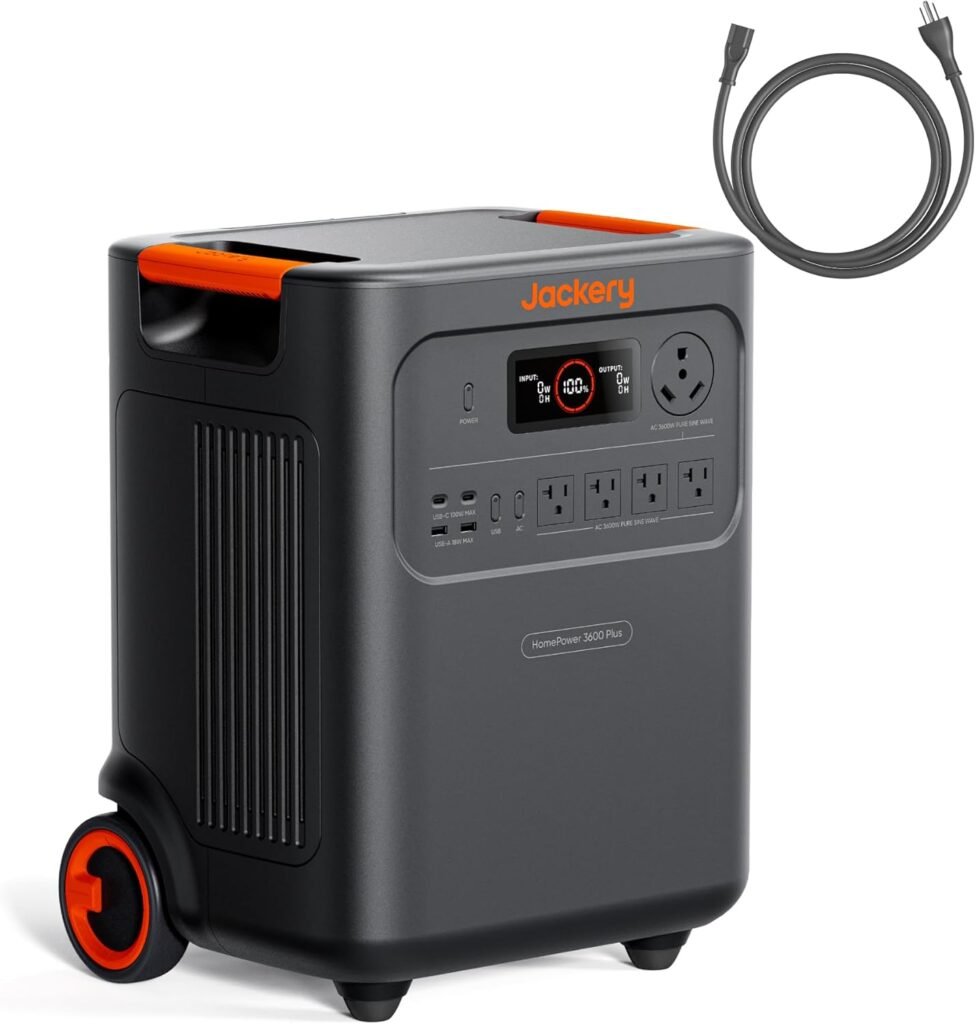

What Is the Jackery HomePower 3600 Plus Portable Power Station?
When we look at the Jackery HomePower 3600 Plus, we are really talking about a compact home backup system rather than just another “portable battery.” It is designed to keep a typical household running, not just charge a phone or run a camping fridge.
This unit combines high output power, a large battery capacity, and flexible charging options. It is aimed at households that want reliable, safe backup power without the complexity and costs of a permanent standby generator.
Key Specs and Features at a Glance
Sometimes it helps to see the essentials laid out clearly. We can use this quick table to get a feel for what the Jackery HomePower 3600 Plus offers before we go into the details.
| Feature | Specification / Benefit |
|---|---|
| AC Output Power | 3600W continuous (7200W in parallel) |
| Voltage | 120V standard, 240V available when run in parallel with another unit |
| Battery Capacity | 3584Wh base capacity |
| Expandability | Up to 21kWh per unit; up to 43kWh with multiple units |
| Battery Chemistry | LFP (LiFePO4) with ceramic membrane cells |
| Lifespan | Up to 6,000 cycles; around 10 years of typical use |
| Safety Performance | Withstands temperatures up to 302°F; operates in blizzards as low as -4°F |
| Charging Methods | AC, AC + DC hybrid, solar, gas generator |
| Fast Charging Time | 0–100% in about 2 hours via hybrid AC + DC |
| Other Charging Times | ~2.5h via AC, ~4h via solar, ~2.5h via gas generator |
| Portability | Luggage-style design with wheels and telescopic handle |
| Size / Weight Claim | Lightest 3.6kWh LFP power station; 34% smaller, 29.3% lighter than similar models |
| Use Cases | Essential home backup, worksite, RV, off-grid, emergency preparedness |
This overview tells us we are dealing with a serious piece of backup gear. In the next sections, we walk through how each of these specs translates into real-life use.

Design and Build Quality
Compact, Luggage-Style Form Factor
The first thing we notice is the design. The HomePower 3600 Plus is not a small gadget, but for a 3.6kWh LFP power station, it is impressively compact. Jackery states it is 34% smaller and 29.3% lighter than comparable models, and while we may not have each competitor on hand to verify, the difference feels noticeable.
The luggage-style design with integrated wheels and a telescopic handle makes a big difference in practical use. Instead of feeling like we are dragging around a heavy piece of industrial equipment, it feels much more like moving a suitcase or carry-on around the house.
This matters when we want to roll it from the garage to the kitchen, or from the living room to a bedroom during an outage. If we have ever hesitated to move a heavy power station because it was a chore, this design directly addresses that pain point.
Materials and Construction
The outer shell feels solid and built for everyday household handling. We get the impression that Jackery designed it for regular use, not just “for emergencies only” storage. The automotive-grade CTB (cell-to-body) technology contributes to its structural integrity, integrating the battery cells more tightly into the body to improve durability and vibration resistance.
We also appreciate the thoughtful layout of ports and controls. Everything is clearly labeled, grouped logically by function, and set up for quick plug-and-play use. We do not feel like we need a technician just to figure out where things go.
Battery Technology and Safety
LFP Chemistry for Longevity
The HomePower 3600 Plus uses LiFePO4 (LFP) battery cells, which we consider a strong choice for home backup. LFP chemistry is known for:
- Longer cycle life
- Better thermal stability
- Lower fire risk compared to many NMC batteries
With a rating of up to 6,000 cycles, we are looking at a product that can last roughly 10 years under typical home backup or hybrid use. Even if we used it very frequently—say, several times a week—it is designed to remain a long-term investment rather than a short-lived gadget.
Ceramic Membrane Cells and Thermal Safety
Where this unit stands out is its use of high-temperature-resistant ceramic membrane battery cells. These are tested at 302°F, which is a high benchmark for thermal stability. The goal here is to prevent “thermal runaway,” the chain reaction that can lead to overheating or, in worst cases, fires.
By resisting thermal runaway from both heat and overcharge, the HomePower 3600 Plus focuses heavily on safety:
- Better resilience in hot environments
- Reduced risk during high load usage
- Added safety under rapid charging conditions
For families thinking about keeping a large battery system in the home, this emphasis on safety can be very reassuring.
Weather and Temperature Tolerance
Jackery specifies that the HomePower 3600 Plus works reliably even in -4°F blizzards. That tells us we can expect the unit to keep functioning during winter storms, where many of us need backup the most.
Of course, like all batteries, extreme cold can reduce performance somewhat, but the fact that it is wired for this temperature range means we are not left in the dark when conditions are harshest.

Capacity and Expandability
Base Capacity: 3584Wh
With a 3584Wh base capacity, we can think of this unit as the “heart” of a modular system. On its own, 3.5kWh+ is enough to:
- Power a full-size refrigerator for many hours
- Run essential lighting and electronics overnight
- Support a few small appliances together (fans, router, laptops, etc.)
However, the real value appears when we treat this as part of a larger, expandable setup.
Expandable up to 21kWh per Unit
Jackery designed the HomePower 3600 Plus to be expandable up to 21kWh for each main unit. This is a very large amount of stored energy for a portable-style system.
To put that in perspective, many households use between 20–30kWh of electricity per day. With a fully built-out 21kWh configuration, we are potentially talking about powering key loads for multiple days without any recharging, depending on usage.
Up to 43kWh with Multiple Units
If we really want to go all in, we can connect multiple units and reach up to 43kWh of capacity. At that scale, we are essentially rivaling some whole-home battery backup systems—yet still with the flexibility and portability of modular units.
Jackery mentions that with the right configuration, the HomePower 3600 Plus can power a 3-person household for more than 2 weeks. To reach that kind of runtime, we would be using a combination of:
- Expanded capacity
- Careful energy management
- Possibly solar recharging during the day
But it illustrates the purpose: this is not just an overnight solution. It is built to keep life functioning during extended outages.
Output Power and Home Use
3600W Output, 7200W in Parallel
A continuous AC output of 3600W gives us plenty of room for typical household loads. That is enough to:
- Run a refrigerator and freezer
- Power lights and electronics
- Support a microwave or induction cooktop for short periods
- Run a washing machine or smaller space heater
When we connect two units in parallel, we can reach up to 7200W. This is where bigger loads—like larger heaters, power tools, or multiple major appliances—become feasible.
This kind of power output moves us from “emergency laptop charger” into legitimate home backup territory.
Dual Voltage: 120V & 240V (in Parallel)
Many U.S. homes have certain appliances that need 240V: dryers, some well pumps, certain large air conditioners, and more. The HomePower 3600 Plus addresses this by offering dual voltage functionality:
- 120V for standard outlets and common appliances
- 240V when using two units in parallel
That parallel setup is key if we want to run more demanding home equipment. It opens the door to:
- Supporting a 240V well pump (crucial for rural homes)
- Running an electric dryer (for shorter periods, if we choose)
- Possibly supporting certain HVAC components (subject to loads)
This dual-voltage capability expands what we can realistically power in a home backup context.

Plug-and-Play Operation
No Complex Installation Required
One of the barriers families often face with backup power is installation complexity. Jackery leans heavily into a “plug-and-play” approach with the HomePower 3600 Plus.
Paired with an appropriate manual transfer switch (MTS), we can power circuits in our home without:
- Major rewiring projects
- Specialized mounting systems
- Lengthy installation jobs
Instead, we connect the unit properly to the MTS, select which circuits we want to support, and then when the power goes out, we simply:
- Roll the unit into position
- Plug in and connect to the transfer switch
- Press “Power-On”
- Switch circuits over to the backup power
We keep normal house wiring intact; we are just temporarily powering selected circuits from the Jackery instead of the grid.
Everyday Use and Ease of Control
When power is on, we can still use the unit for everyday tasks: powering tools in the garage, running outdoor equipment, or supporting electronics during events.
Controls are straightforward: clearly labeled buttons, status indicators, and typically an integrated display that lets us monitor battery level, input, and output. This makes it easy to manage how much we are drawing and estimate how long the battery will last at current load levels.
We do not need to be electricians to operate it. That alone makes it far more approachable for many households.
Charging Options and Speed
Four Charging Methods
The HomePower 3600 Plus gives us four main ways to recharge:
- AC wall outlet
- Hybrid AC + DC
- Solar panels (optional, sold separately)
- Gas generator
This flexibility matters because outages and off-grid scenarios are unpredictable. Being able to recharge from different sources gives us resilience we would not have with a single charging method.
Fast Charging via Hybrid AC + DC (About 2 Hours)
Using both AC and DC inputs together, we can recharge the unit from 0–100% in roughly 2 hours. That is very fast for a system of this capacity.
In practical terms, this means:
- If we get a window of grid power between outages, we can recharge quickly
- If we have both AC and solar or another DC source, we can maximize uptime
We can think of hybrid charging as a way to “refuel” the battery as quickly as possible when we have multiple sources available.
Standard AC Charging (About 2.5 Hours)
If we are only using a regular AC wall outlet, we can still recharge in about 2.5 hours. This is still quite quick for 3.5kWh+ of capacity.
This mode is perfect for:
- Getting ready before a predicted storm
- Daily charging if we use the unit regularly for work or outdoor activities
- Topping off after partial use during shorter outages
Solar Charging (About 4 Hours)
When paired with the right solar array, Jackery states that the HomePower 3600 Plus can be recharged via solar in about 4 hours under good sun conditions.
That solar option is where this unit truly becomes a “solar generator” rather than just a battery:
- We can keep essentials running off the sun day after day
- We reduce reliance on fuel and grid power
- We can use it for off-grid cabins or RV applications as well
Of course, actual solar charging times depend on panel wattage, sun angle, geography, and weather. But having a system built to ingest solar efficiently is a huge advantage for long-lasting resilience.
Gas Generator Charging (About 2.5 Hours)
We can also use a gas generator to recharge in about 2.5 hours. This hybrid approach has a neat advantage:
- Instead of running the gas generator all day, we can run it for a few hours to charge the Jackery
- Then we shut off the generator and let the Jackery power the home quietly and cleanly
That means less fuel consumption, less noise, and less pollution. For those of us who already own a gas generator, the HomePower 3600 Plus can act as a “buffer” that smooths the rough edges of generator use.
Real-World Use Cases
Essential Home Backup During Outages
Our primary use scenario here is home backup. During a grid outage, we can use the HomePower 3600 Plus to keep:
- Refrigerators and freezers running
- Essential lights on
- Routers, phones, and laptops powered for communication
- Medical devices supported (within rated power and safety guidelines)
By choosing which circuits we power via the transfer switch, we can make sure we prioritize what matters: food preservation, safety, communication, and comfort.
With expansion batteries and possibly solar input, we can extend this comfort from a handful of hours to multiple days, and with the right setup, well beyond that.
Heating and Cooling Considerations
Heating and cooling loads can be large. The HomePower 3600 Plus may be able to handle certain:
- Space heaters (especially efficient electric models)
- Smaller air conditioners or mini-split systems (depending on their draw)
- Fans and ventilation systems
We do need to be mindful of power draw here. A 1500W space heater, used continuously, can drain the battery relatively quickly. But if we use heating wisely—spot heating, good insulation, layered clothing—we can make it work as part of a broader strategy.
Similarly, for cooling, fans and portable units can typically be supported more easily than whole-house central air. The 240V capability with parallel units opens more possibilities, but we still need to check actual load requirements.
Off-Grid and RV Use
While this product is framed primarily as home backup, its portability and solar compatibility make it a strong candidate for off-grid cabins or RV use:
- It can serve as a central hub for lights, appliances, and tools
- It integrates well with solar setups for long-term operation
- The wheeled design lets us reposition it as needed
In an RV context, workloads are often lighter than a full house, meaning the 3.5kWh+ base capacity can last a good while between charges—especially with solar.
Worksite and Professional Use
For those of us who work with tools on job sites, the 3600W output is substantial. It can support:
- Power tools such as saws and drills
- Jobsite lighting
- Charging for tool batteries and electronics
Instead of listening to a generator all day, we can run in near silence. If we charge the Jackery from grid or solar in between tasks, we can make it part of a stable, environmentally friendly work rig.
Usability and Everyday Experience
Interface and Monitoring
The control interface is designed to be intuitive. We typically get:
- A clear display showing remaining battery percentage
- Real-time input and output in watts
- Status icons indicating which ports are active
This makes it easier for us to:
- Track how much power we are using
- See how quickly we are recharging
- Plan our activities to match available power
When we see, for example, that our refrigerator is drawing 150W and our lights another 60W, we can quickly estimate expected runtime from the 3584Wh base capacity.
Noise and Comfort
One quiet bonus: battery-based power stations are far quieter than gas generators. There are no loud engines or exhaust fumes. At most, we hear internal cooling fans, which are orders of magnitude more tolerable than engine noise.
That makes a huge difference during long outages, especially at night. We can keep it in the living space without feeling like we are living inside a machine shop.
Mobility in and Around the Home
The wheels and telescopic handle encourage us to actually use the unit, rather than treat it as something that lives permanently in a corner. We can:
- Keep it in the garage or storage most days
- Roll it into the kitchen during an outage
- Move it near our office setup for quiet backup during remote work
This mobility also makes it easier to position near solar input, an RV hookup, or a transfer switch connection.
Advantages of the Jackery HomePower 3600 Plus
Strong Mix of Power and Portability
We rarely see this combination of high output power (3600W, 7200W in parallel) and real portability. Many stationary backup batteries are heavy, wall-mounted systems; many portable power stations are too small to power whole-home essentials. Here we get a middle ground designed with actual household needs in mind.
Serious Safety Engineering
Between LFP chemistry, ceramic membrane cells tested at 302°F, and a focus on thermal runaway prevention and cold-weather operation, the safety story is robust. For families and homeowners, that’s often the most important consideration when bringing a large energy storage system indoors.
Flexible, Fast Charging Options
The ability to charge from:
- AC
- Hybrid AC + DC
- Solar
- Gas generator
gives us options for many scenarios. We are not locked into a single energy source. The fast charging capabilities—2 hours with hybrid charging, about 2.5 with AC—mean we can capitalize on limited windows of available power.
Expandable System for Serious Backup
With expandability up to 21kWh per unit, and 43kWh with multiple units, we can scale our setup as our budget and needs grow. We might start with a single base unit, then add expansion units or a second main unit later, rather than having to commit all at once.
Considerations and Limitations
Initial Cost and Expansion Budget
We should recognize that a system of this caliber is an investment, especially if we plan to add expansion batteries or multiple units to reach 21kWh or 43kWh. We need to think through:
- How much backup capacity we truly need
- Whether we plan to integrate solar
- What loads we want to cover (essentials vs. near-whole-home)
For some households, a single HomePower 3600 Plus might be plenty. For others, the costs rise as we aim for extended autonomy and higher loads.
Not a Permanent Whole-Home Replacement
Even though it can support many household loads, this is not a full replacement for grid power or a large, permanently installed backup system. Very large, continuous loads—like central AC with high surge, electric resistance whole-house heating, or EV fast charging—are not what this system is primarily built around.
The HomePower 3600 Plus excels when we think in terms of strategic backup: keeping essentials running comfortably, with smart prioritization of what we power.
Solar Panels Sold Separately
While the product is positioned as a solar generator, we need to remember that solar panels are typically optional add-ons. To really get the full “independent power” experience, we will likely want to invest in a solar array sized appropriately to our energy needs.
That adds another layer of upfront cost, but it also adds real long-term value and resilience.
Who Is the Jackery HomePower 3600 Plus Best For?
Homeowners Focused on Preparedness
If we live in an area prone to storms, wildfires, grid instability, or rolling blackouts, this kind of system can provide a major sense of security. We can keep our home livable and safe, even during multi-day interruptions.
It fits homeowners who:
- Want robust backup without permanent generator installation
- Are comfortable managing which circuits get power during outages
- Value quiet, clean operation over fuel-only solutions
Families Wanting Safe Indoor Backup
Families with kids, elderly relatives, or anyone sensitive to noise and fumes often prefer battery systems. The emphasis on thermal safety, LFP chemistry, and high temperature resistance is particularly compelling here.
We get backup power that feels safe to keep indoors and integrate into everyday household life.
Remote Workers and Digital Households
Many of us rely on stable internet and power for work. The ability to keep routers, modems, laptops, monitors, and phones powered for extended periods can mean the difference between losing days of productivity or continuing almost as normal.
This system meshes well with a remote work lifestyle, especially when paired with a modest solar setup.
RV, Cabin, and Off-Grid Enthusiasts
For those of us who love to spend time off the grid, the HomePower 3600 Plus offers a flexible, powerful backbone. With solar input, we can build a compact yet capable power system that handles a mix of:
- Refrigeration
- Lighting
- Electronics
- Occasional high-load appliances
While more camper-focused Jackery models exist, this one brings true home-level power into mobile or off-grid spaces.
How It Compares Conceptually to Other Options
Without naming specific competing models, we can outline where this product generally stands:
-
Versus small portable power stations:
The HomePower 3600 Plus brings much more capacity and output. It is better suited for real home backup rather than just small-scale camping or gadget charging. -
Versus traditional gas generators:
We get quieter operation, no exhaust fumes, instant start, and indoor-friendly use. On the flip side, we need to manage battery capacity, and fuel-powered generators can run as long as we supply fuel. -
Versus permanent whole-home battery systems:
It is more portable, often easier to set up, and flexible in where we use it. Permanent systems can integrate fully with home wiring and solar infrastructure but generally require professional installation and a much higher upfront investment.
The HomePower 3600 Plus lands in a sweet spot: serious enough for real home backup, yet flexible, portable, and user-friendly.
Practical Tips for Getting the Most Out of It
Plan Our Essential Loads
Before an outage, we can list what we truly need to power:
- Fridge and freezer
- A few lights
- Router and communication devices
- Possibly a space heater or fan
- Any medical equipment
By knowing these essentials, we can:
- Size our battery setup better
- Avoid overloading the system
- Maximize runtime during outages
Pair with the Right Solar Setup
If we intend to rely on this long term, solar input is incredibly valuable. We can:
- Choose Jackery’s compatible solar panels, or
- Size a solar array that aligns with the charging specs
The idea is to make sure our panels can realistically recharge the unit in a reasonable time under typical sun conditions.
Keep It Charged and Tested
We will want to:
- Keep the unit topped up or at a healthy charge level when not in use
- Test it periodically to ensure everything works
- Familiarize ourselves with the user interface before an emergency
That way, when the power goes out, we are not fumbling with unfamiliar equipment.
Final Thoughts: Is the Jackery HomePower 3600 Plus Worth It?
If we are looking for a reliable, safe, and flexible backup solution that goes well beyond “small portable battery” territory, the Jackery HomePower 3600 Plus Portable Power Station offers a compelling package.
We get:
- 3600W continuous AC output, up to 7200W in parallel
- Dual voltage (120V, and 240V in parallel) for more serious home loads
- A 3584Wh LFP battery base, expandable all the way up to 21kWh per unit and 43kWh with multiple units
- High safety standards with ceramic membrane cells and long cycle life
- Plug-and-play home integration using a manual transfer switch
- Four flexible charging methods, including fast hybrid AC + DC and solar compatibility
- A genuinely portable, wheeled design that makes a large power system easier to live with
For households that value preparedness, safety, and quiet operation, and for those of us who want a system that can grow over time, this power station stands out as a strong, future-ready choice for essential home backup.