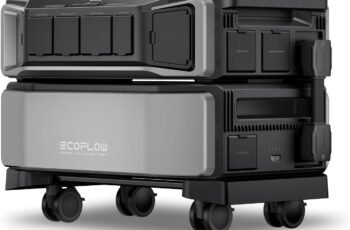
Take, for example, a home battery that can power lights during an outage. You’ll weigh the high energy density and efficiency against upfront costs and temperature sensitivity. It’s handy for portability and safety features, but environmental impacts and recycling questions linger. With trade-offs like longer lifespan versus performance in extreme heat, you’ll want the right chemistry and model to fit your needs—and that choice could change how you prepare for outages or trips off-grid.
Benefits of High Energy Density and Efficient Power Delivery
Lithium-ion batteries pack more energy into less space, delivering an essential edge for portable and stationary power stations. You’ll notice gravimetric energy densities around 150-220 Wh/kg, far higher than lead-acid’s 30-40 Wh/kg, letting you store more energy with less weight. LiFePO4 variants run about 130-140 Wh/kg, roughly four times lead-acid and competitive with many Li-ion options. Higher energy density means you can fit substantial power into compact packages, and better volumetric density makes efficient use of tight spaces in commercial and grid-scale setups. You benefit from higher per-cell voltages—up to 3.6 V—reducing cell counts and boosting high-power performance. Fast charge-discharge and smart battery management minimize losses, enhancing reliability and overall system efficiency. LiFePO4 batteries also provide extended lifespan and lower maintenance, contributing to long-term cost savings and safer operation during storage and use.
Portability and User Convenience at a Glance
You’ll notice how lightweight and compact these units feel, making them easy to carry and stash in a car or backpack. With plug-and-play setup and universal ports, you can charge devices and power essentials right away, no fuss. This combination of portability and accessibility sets the stage for practical, on-the-go use.
Additionally, many models offer rugged protective casing and long battery life, ensuring reliable performance in harsh conditions durability and battery life.
Lightweight and Compact
Lightweight and compact power stations make portability a practical reality: many units weigh from about 3 to 35 pounds, with typical 1000 Wh models around 13 by 9 by 9 inches. You’ll notice a broad range: sub-10-pound models exist for light-use scenarios, while larger units rely on handles or wheels to ease transport. Built-in folding or rigid handles simplify lifting, and some designs add wheels for rolling moves. Smaller boxes omit handles to stay ultra-light yet portable. You benefit from integrated features like wireless charging pads and multiple output ports, plus compact solar panels that stay light and grabbable. Storage in vehicles or backpacks becomes feasible, supporting quick setup anywhere. Tradeoffs show up in runtime and ports, yet overall mobility remains a core strength.
Easy Plug-and-Play
With multiple output options ready out of the box, plug-and-play convenience starts the moment you power it up. You’ll enjoy diverse ports—AC, USB-C PD up to 100W, USB-A, DC car, and 12V outlets—so laptops, phones, cooktops, and fans run simultaneously without adapters. Wireless charging pads add extra convenience for Qi devices. Pre-installed software with Wi-Fi lets you control ports and monitor battery from your phone, while firmware updates happen over the air. Remote access helps in emergencies or when you’re away. The interface in the app reduces guesswork about remaining juice and powers distribution. A compact, ready-to-use design means minimal setup, no extra gear, and instant deployment.
| Port variety | Quick charge | Wireless option |
|---|---|---|
| AC/USB-C/USB-A/DC | 100W PD on USB-C | Qi charging pad |
| Solar and car charging | App-based control | Remote monitoring |
| Plug-and-play readiness | Battery status at a glance | Low learning curve |
| Out-of-the-box usability | No extra assembly | Indoor-safe, quiet |
Portable Power Accessibility
Portable power accessibility means you can carry a station where you need it and plug in quickly without juggling gear. You’ll notice weight under 24 pounds, balancing capacity with manageability for solo transport. Foldable handles and extendable grips boost carrying ease, while wheels or attachments help roll it over uneven terrain or longer distances. Its compact cubic design and stackable architecture optimize packing in vehicles or backpacks, enhancing space efficiency. Smaller form factors improve convenience but may limit power and outputs. You get multiple ports—USB-A, USB-C, AC, DC—plus wireless charging for compatible devices and quick-charging protocols to speed cycles. Modular designs let you add packs or panels without sacrificing access. Recharge options include wall, solar, and car, supporting on-the-go versatility. Silent, emission-free operation keeps portability intact anywhere.
Safety Features and Battery Management Systems
Safety features and battery management systems are the backbone of lithium-ion power stations, guarding against overloads, short circuits, and overheating while keeping you informed in real time. You’ll benefit from layered protections that prevent damage and fires, plus real-time alerts to act before trouble grows. A robust BMS manages voltage, state of charge, and cell balancing, improving longevity and safety. With multiple thermal sensors and overheat limits, shutdowns occur before runaway conditions develop. Safety certifications (UL, CE, RoHS) validate these protections, so you can rely on consistent performance. Proper enclosure design helps contain any incident, reducing propagation risk. You should still follow manuals to understand limits and maintenance.
- Overload, short circuit, and temperature safeguards with real-time alerts
- Multi-layered BMS for charging control, balancing, and health monitoring
- Certified safety standards and heat-management design for user protection
Environmental Impact: Pros and Mitigations
You can see how reducing toxins in production and boosting recycling can cut overall environmental impact, especially as grids get cleaner. As you weigh mitigations, consider how smarter design and end‑of‑life strategies lower emissions and waste. This sets up a clearer path for sustainability across mining, manufacturing, and recycling stages.
Reduced Toxins Compared
Lithium-ion batteries typically contain fewer highly toxic metals than older chemistries like lead-acid or nickel-cadmium, which means they pose lower risks to environment and human health during normal use. You’ll notice reduced exposure from heavy metals, and fewer pathways for acute toxicity in everyday handling. Still, careful management matters because PFAS concerns and regulatory gaps exist, so monitoring at production and disposal remains important. While higher energy density means fewer cells and potentially less chemical volume, you’re not eliminating risk entirely. Mitigations focus on containment, proper recycling, and stricter controls to prevent release. Your choice supports lower direct toxin burden when used responsibly, and contributes to broader safety discipline across the lifecycle of these batteries.
- Fewer toxic metals compared with legacy batteries
- PFAS and regulatory vigilance require ongoing monitoring
- Emissions and disposal controls reduce environmental exposure
Recycling and Mitigation Needs
Recycling lithium-ion batteries presents distinct environmental benefits and notable mitigation needs. You’ll reduce emissions and energy use compared to mining, recover critical metals, and curb contamination. Yet disassembly remains technically complex due to varied chemistries, and improper handling risks short circuits, fires, or toxic gas releases. Most batteries end up in landfills, raising fire and environmental hazards, with hazardous classifications from ignition or heavy metal leakage. Fires at disposal sites have grown more common. You’ll also face regulatory gaps, since global recycling rates stay around 5%, far below potential. Effective recycling lessens habitat disruption and import dependence, boosting resilience. Innovations in pyrometallurgy, hydrometallurgy, and mechanical methods improve recovery, while policies push safer disposal and higher recovery efficiency.
| Recycling Challenges | Environmental Benefits |
|---|---|
| Disassembly risks | Emission reductions |
| Safety hazards | Resource conservation |
| Landfill fires | Contamination prevention |
| Hazard classification | Supply chain resilience |
| Policy gaps | Energy savings |
Economic Considerations and Total Cost of Ownership
Economic considerations and total cost of ownership weigh heavily on the decision to deploy lithium-ion power stations. You’ll face a higher upfront price, around $200–$500 per kWh, but enjoy lower replacement costs and simpler installation than lead-acid systems. Over time, maintenance stays modest, typically 2–5% of initial cost annually, and energy efficiency reduces bills. TCO over 10–15 years often lands between $600 and $1,200 per kWh, with lithium-ion roughly 2.8× cheaper per usable kWh than lead-acid. Savings from grid services and electricity use further improve economics, though upfront investment remains a consideration.
1) Higher upfront cost versus long-term savings
2) Maintenance and efficiency driving lower ongoing expenses
3) Recycling, disposal, and regulatory risks shaping total cost
Lifespan, Durability, and Longevity of Lithium-Ion Stations
As you weigh the economics of lithium-ion power stations, you’ll also want to understand how long they’ll actually last and how durable they remain under real-world use. Battery chemistry drives durability and lifespan: LiFePO4 delivers 10–15 years with 2000–7000 cycles, while standard Li-ion often provides 2–3 years or 300–1000 full cycles before noticeable capacity loss. Most wallets factor in cycle life by usage; daily cycling of LiFePO4 can exceed fünf years. Do not overlook warranties—LiFePO4 warranties often reach 5+ years, aligning with expected longevity. Durability hinges on cycles, DoD, and temperature management: partial charging, cooler storage, and advanced management systems extend life. High-frequency use trims lifespan; occasional use lengthens it. Solid-state variants show promise but remain emerging for now.
Operational Limits: Runtime and High-Wow Load Scenarios
Runtime and high-wow load scenarios reveal how long a lithium-ion power station can run on real-world power demands. You’ll see runtime hinges on capacity, efficiency, and how you split the load. Theoretical runtime = Wh ÷ load W, but usable energy sits around 85–90% due to inverter losses. DoD isn’t a major limiter for lithium, so you can safely approach full depth, yet real-world fluctuations still shift results. When devices vary, add their powers to get total load, then recalc. High-watt surges stress the system, potentially cutting runtime and triggering protections. Heat from rapid draws also trims capacity, while heavy single loads drain faster than modest, steady ones.
1) Consider both continuous and surge ratings to estimate practical runtime.
2) Expect shorter runtimes with high-watt appliances like vacuums or microwaves.
3) Account for initial charge and fluctuations for closer real-world accuracy.
Temperature Sensitivity and Environmental Requirements
Temperature sensitivity shapes how you use and store a lithium-ion power station. You’ll perform best in roughly 68°F to 77°F (20°C to 25°C), where chemistry peaks, but you must work within discharge ranges of -4°F to 140°F (-20°C to 60°C) and charging windows of 32°F to 113°F (0°C to 45°C) to avoid damage. Cold slows reactions, raises resistance, and can cause lithium plating if you charge below freezing, permanently cutting capacity. High temps near or above 140°F accelerate aging and raise thermally‑runaway risk, so cooling and ventilation matter. For storage, aim 59°F to 68°F (15°C to 20°C) in a dry, humidity‑controlled space to minimize degradation. Follow manufacturer ranges to protect safety, reliability, and warranty validity. Plan temperature‑aware handling for prolonged life.
Choosing the Right Chemistry and Model for Your Needs
Choosing the right chemistry and model means matching your priorities to the trade-offs between energy density, safety, cycle life, and cost. You’ll weigh higher energy for portability (LCO, NMC/NCA) against safer, longer-lived options (LFP) and cost considerations (cobalt content). For home storage or solar, LFP delivers safer, durable cycles, while NMC/NCA raise density for EVs but demand robust management. If you need peak power and speed, LMO offers high power but shorter life. Consider maintenance needs and regulatory standards when selecting a pack. Your choice shapes thermal management, cooling requirements, and overall system cost, so align chemistry with your use case and safety tolerances.
1) Compare energy density vs. cycle life for your application
2) Factor safety and cooling needs into installation plans
3) Weigh cobalt/nickel content against total cost and ethics
Frequently Asked Questions
How Do Lithium-Ion Power Stations Compare to Alternatives in Real-World Costs?
Lithium-ion power stations cost more upfront than generators or DIY setups, but run cheaper over time. You’ll pay for convenience and integration, with DIY/bare-bones options offering better value per watt, while whole-home systems stay pricey upfront.
Can I Safely Dispose of These Batteries After Use?
Yes, you can, but follow proper steps. Remove batteries carefully, tape terminals, store separately, and avoid trash. Use certified recycling centers or stores, and consult local guidelines to prevent fires, leaks, and environmental harm.
What Maintenance Is Required for Optimal Performance?
You should follow a strict maintenance routine: keep SOC between 20–80%, check BMS weekly, avoid frequent full discharges and fast charging, inspect for damage monthly/weekly, clean vents, monitor temps, store cool and dry, and test safety features regularly.
Do Warranties Cover Thermal Runaway Incidents?
No, warranties usually don’t cover thermal runaway. They rely on manufacturing defects, not misuse or external causes. You’ll need proof of defect, follow documentation steps, and expect exclusions for fire, overheating, or improper installation. Consider extended plans carefully.
How Scalable Are These Systems for Future Upgrades?
You can scale these systems considerably, thanks to modular designs and standardized interfaces. You’ll add capacity or power in increments, upgrade cells over time, and leverage automation, while planning space, controls, and grid integration for future expansion.
Conclusion
In short, lithium-ion power stations are a thunderstorm of energy—compact, mighty, and shockingly sleek. They sprint from zero to full at the whip of a switch, sip the energy you need, then slink away with whisper-quiet efficiency. Sure, they flirt with temp swings and price tags, but their century-fast charging, marathon runtimes, and safety nets outrun the risks like a superhero on rechargeable steroids. Pick the right chem, and you’ve basically bottled lightning.