Have we ever wished we could bring reliable, plug-and-play electricity anywhere we go—without the noise, fumes, or hassle of a gas generator?
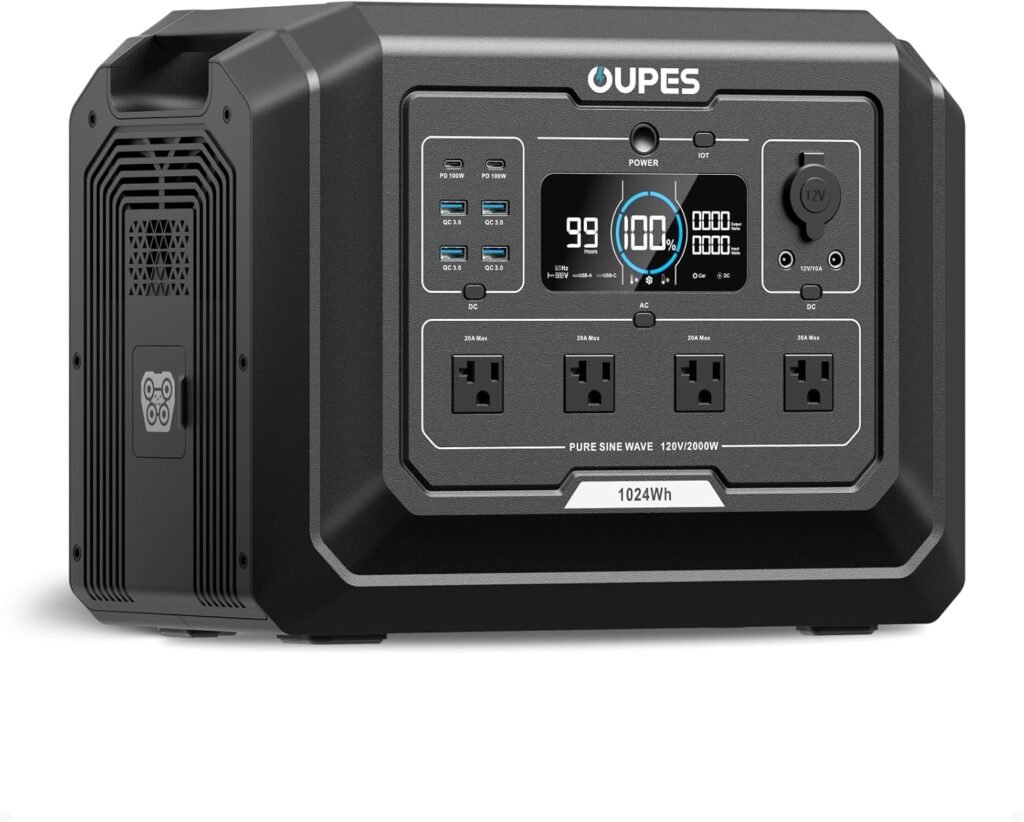

What Is the OUPES Mega 1 Portable Power Station?
The OUPES Mega 1 Portable Power Station is a high-capacity, solar-compatible power solution built around a 1024Wh LiFePO4 battery and a 2000W pure sine wave inverter (with 4500W surge). It is designed as a flexible power hub for home backup, camping, RV life, and mobile work setups.
We can think of it as a quiet, smart, and expandable “electric generator” that we charge from the wall, from solar panels, or even from both at the same time. Then we plug in our devices and appliances just as we would at home.
Key Specifications at a Glance
To understand what this unit actually offers, it helps to see the main specs side by side. This is where we get a quick sense of what kind of gear we can support and how it fits into our power plans.
| Feature | Specification |
|---|---|
| Battery Capacity | 1024Wh (expandable up to 5120Wh with B2 Extra Batteries) |
| Battery Chemistry | LiFePO4 (Lithium Iron Phosphate), 3500+ life cycles |
| Inverter Output | 2000W continuous, 4500W surge, pure sine wave |
| AC Recharge Time | 0–80% in about 36 minutes |
| AC + Solar Recharge Time | 0–80% in about 26 minutes (simultaneous input) |
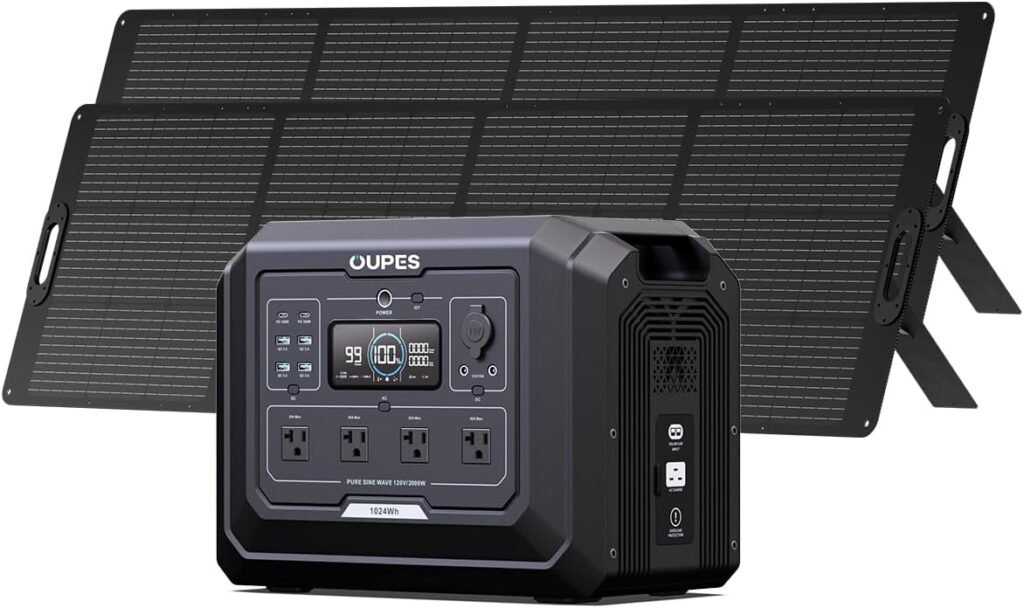
| Solar Input | Up to 800W via advanced MPPT controller |
| Solar Recharge (Example) | ~80% in about 61 minutes with three 240W solar panels |
| UPS Transfer Time | <20ms (uninterruptible power supply mode)< />d> |
| Outputs | Dual 100W USB-C PD, four QC3.0 USB-A, 12V DC ports, multiple AC outlets |
| Expansion | Supports up to two B2 Extra Batteries (no extra inverters needed) |
| Control | Bluetooth app for monitoring & management |
| Use Cases | Home backup, camping, road trips, pro work sites, emergency power, off-grid |
These core numbers show us this isn’t a small “phone-charger” type station. It sits in that powerful mid-range segment where we can run real appliances and even support a small home or workspace in an outage.
Design, Build Quality, and Portability
The Mega 1 is purpose-built for both home and field use, so its design focuses on durability and practicality more than on flashy aesthetics. We can carry it, set it down in a corner, and trust it to handle everyday bumps and movement.
We should expect a robust casing, reinforced corners, and a layout that keeps ports accessible without being easy to damage. It’s not going to disappear into a backpack, but for what it does, its form factor stays manageable for road trips, mobile offices, or moving it around our home as needed.
Size, Weight, and Everyday Handling
A 1024Wh LiFePO4 battery and a 2000W inverter inevitably mean some heft. We are trading compactness for serious capability and safety. The Mega 1 strikes a balance: big enough to support heavy loads, yet still reasonable to pick up and place in a car trunk, RV storage, or a corner of our home office.
Carrying handles and balanced weight distribution make it practical for two main scenarios: grabbing it quickly during an outage and hauling it between home, car, and campsite. We won’t treat it like a laptop bag, but we will move it confidently when we need to.
Build Materials and Durability
OUPES positions this unit for professional environments—film sets, emergency response, off-grid research. That tells us a lot about the build expectations. The casing, internal wiring, connectors, and cooling all need to withstand frequent use and high loads.
We can feel comfortable using it daily in a workshop, as a constant UPS under a desk, or in a van conversion. It’s not a delicate gadget; it’s more like a compact, portable power appliance built to live a hard-working life.
Battery Technology: Why LiFePO4 Matters
The Mega 1 uses LiFePO4 (lithium iron phosphate) cells, which is a big deal for safety, longevity, and reliability. While many older or cheaper stations use standard lithium-ion (NMC) chemistries, LiFePO4 is fast becoming the smart default for serious long-term use.
We benefit from this immediately in three ways: cycle life, thermal stability, and long-term capacity retention.
3500+ Life Cycles and Long-Term Value
A 3500+ cycle rating means we can charge and discharge the Mega 1 thousands of times before it drops to around 80% of its original capacity. For context, if we cycled it once per day, we would still have most of the battery capacity after many years.
That longevity matters because this is not a disposable piece of tech. By choosing LiFePO4, we are essentially investing in a power platform instead of a short-lived gadget. Even with heavy use—like daily off-grid living—we are spreading the cost over a very long service life.
Safety and Thermal Stability
LiFePO4 cells are known for superior thermal stability compared to typical lithium-ion. That means they are far more resistant to overheating and thermal runaway. For us, that translates into peace of mind, especially when:
- We run high loads like power tools or appliances
- We use it in warm environments or enclosed spaces
- We leave it connected as a UPS for sensitive electronics
This chemistry, combined with a smart BMS (battery management system), helps keep temperatures under control, protects cells, and reduces risk while delivering strong performance.
Intelligent Power Management and BMS
At the heart of any reliable power station is the BMS—the system that watches over cells, temperatures, and power flows. OUPES equips the Mega 1 with an advanced, proprietary BMS to manage all of this automatically.
We don’t need to fiddle with complex settings for basic safety; the system constantly monitors for risks like overcharging, over-discharging, short circuits, and thermal issues.
Automatic Protection and Cell Balancing
The BMS balances individual cells and keeps them within safe voltage and temperature ranges. This matters because any imbalance can reduce both usable capacity and life span over time.
With automatic balancing and smart control, we gain:
- Maximum usable capacity from each charge
- Consistent performance across thousands of cycles
- Reduced risk of cell damage or failure
We simply plug in, charge, and use, while the BMS quietly optimizes everything in the background.
Efficiency and Performance Over Time
An efficient power management system helps us get more real-world watt-hours out of each charge. Instead of losing energy to unnecessary heat or inefficient conversion, the BMS and inverter work together to regulate power and keep things running smoothly.
The result is a power station that feels dependable: it powers what we expect, runs quietly, and delivers roughly the same reliable performance even years into ownership.
Professional-Grade Power: 2000W Continuous, 4500W Surge
The real test for any power station is what it can actually run. With 2000W continuous output and 4500W surge, the Mega 1 can handle an impressive range of gear, from everyday devices to serious appliances.
We can think of 2000W as our steady limit and 4500W as the short-term cushion that handles startup spikes from motors or compressors.
Pure Sine Wave Output and Sensitive Electronics
Pure sine wave AC output mimics the quality of grid power. That matters if we want to run:
- Gaming PCs and workstations
- Routers, servers, NAS devices
- Audio/visual gear, cameras, and lighting
- Medical devices (where compatible and medically advised)
We reduce risks like overheating power bricks, noise in audio equipment, or strange behavior in sensitive electronics. Pure sine wave is the standard we want for serious, everyday use.
What 2000W Means in Real Life
To make this power rating more concrete, here are examples of typical loads we could run (not all at once, but within limits):
- Full-size refrigerator (100–200W running, higher peak at startup)
- Microwave (800–1200W)
- Coffee maker (800–1500W)
- Electric grill or hot plate (1000–1800W, depending on model)
- TV + router + laptop + lights (usually under a few hundred watts total)
- Power tools like saws or drills (check individual ratings)
We can mix and match loads as long as we stay under 2000W continuous. The 4500W surge allows the Mega 1 to absorb startup spikes from things like fridge compressors or some power tools without instantly tripping.
Revolutionary Fast-Charging Capabilities
One of the standout advantages of the Mega 1 is how quickly we can recharge it. This is not a “leave it on the wall overnight and hope for the best” type of device. It is designed to refuel rapidly and get back to work.
We gain huge flexibility from those short charging windows because we can top up between jobs, during short grid-on periods in an outage, or during limited solar windows.
AC Charging: 0–80% in About 36 Minutes
With a fast AC charging mode, the Mega 1 can go from empty to 80% in roughly 36 minutes. That’s extremely quick, especially for a 1024Wh LiFePO4 pack.
Practical benefits include:
- Rapid top-ups before heading out on a trip
- Quick recharges between storm-related blackouts
- Efficient use of grid power when rates are lower or time is limited
We don’t have to plan our life around long charging cycles. Instead, we plug in for less than an hour and have most of the capacity ready to go.
Combined AC + Solar: 0–80% in Around 26 Minutes
When we tap both AC and solar inputs together, the charging time is even more impressive: about 26 minutes to reach 80%. This hybrid input approach is especially powerful for:
- Off-grid cabins that occasionally run a generator plus solar
- RV setups where we have campground power and panels
- Emergency situations where every minute of grid uptime counts
The station is designed to safely handle both sources at once, maximizing power intake and minimizing downtime.
Solar Charging and MPPT Performance
The Mega 1 includes an advanced MPPT (Maximum Power Point Tracking) charge controller, which significantly improves solar charging efficiency compared to simpler PWM controllers.
With up to 800W of supported solar input, we can pair this unit with a substantial solar array for serious off-grid capability.
Up to 800W Solar Input
Handling up to 800W of solar means we are not limited to a small trickle-charge setup. We can build a proper portable or semi-permanent solar system that can:
- Quickly recharge the Mega 1 even under partial sun
- Provide near-continuous power for light to moderate loads
- Serve as the core of a small off-grid kit for cabins, RVs, or vans
For example, with three 240W panels (around 720W combined), we can reach about 80% charge in roughly 61 minutes under good sun conditions.
Real-World Off-Grid Potential
With enough solar and, ideally, expansion batteries, we can move beyond occasional backup into full or partial off-grid use. The station becomes a sort of power hub:
- Daytime: solar powers live loads and charges the station
- Nighttime: the station powers appliances and devices from stored energy
For camping or remote work sites, this means we can stay out longer without worrying about fuel, noise restrictions, or fumes from gas generators.
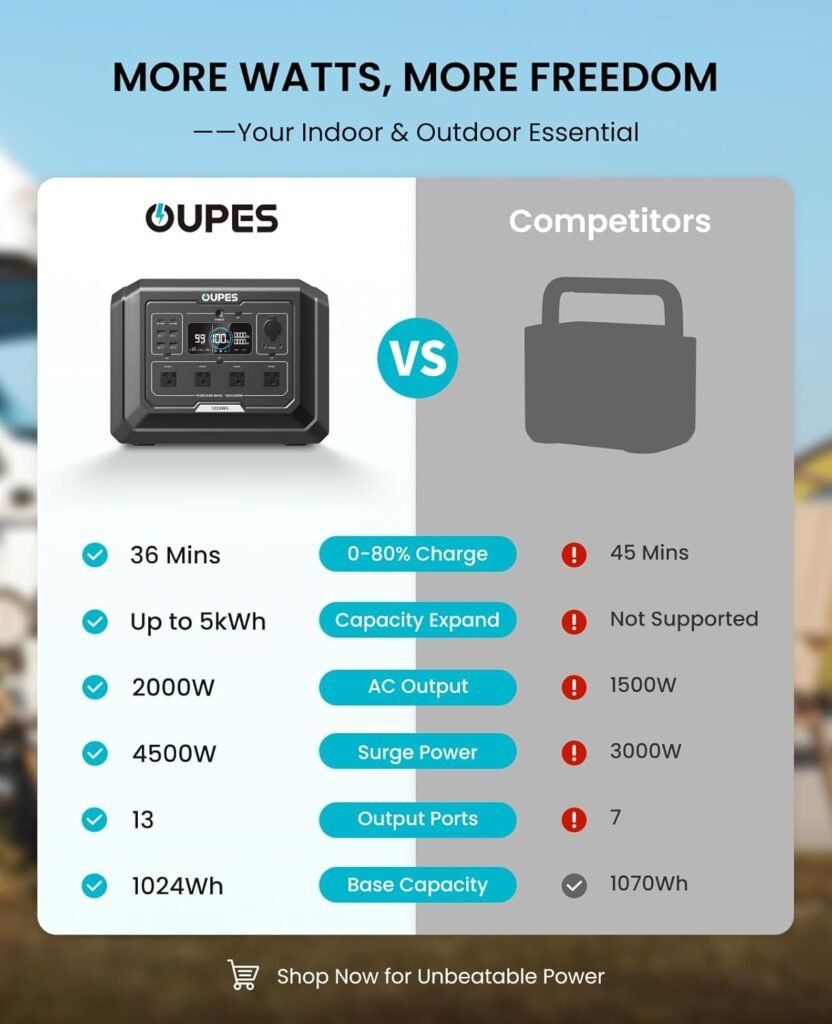
Expandable Capacity: Up to 5120Wh
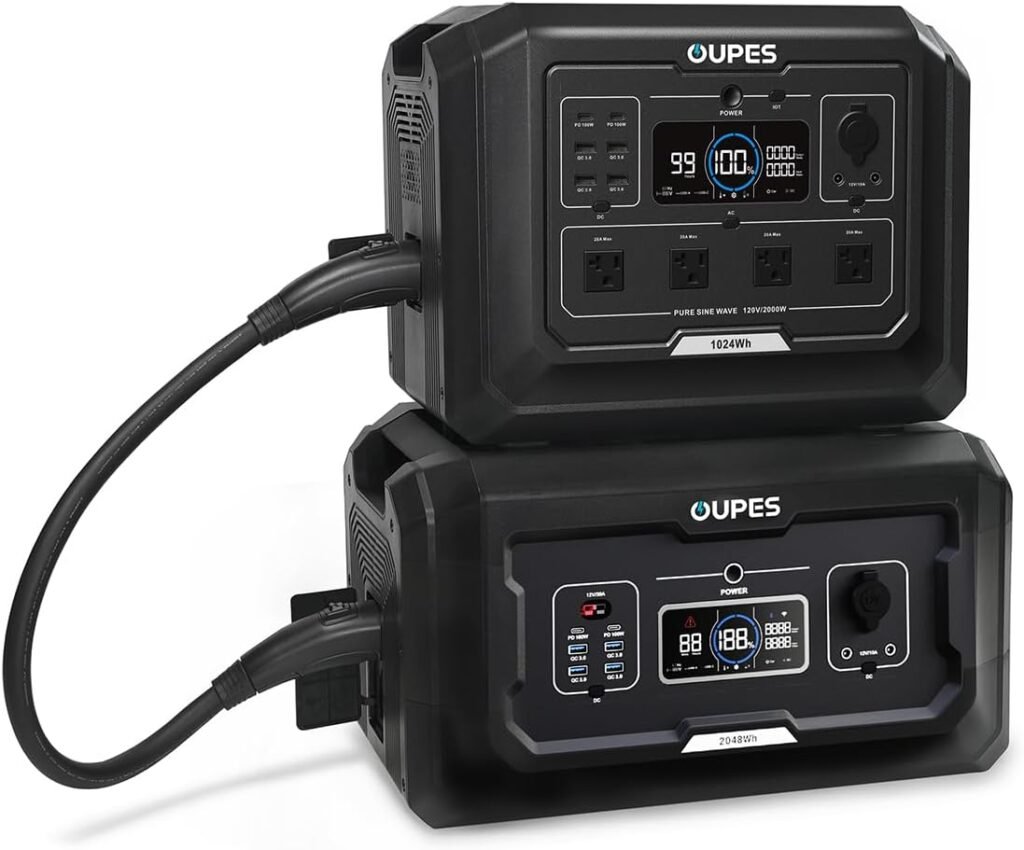
One of the most compelling features is the modular expansion capability. The base station starts at 1024Wh, but we can connect up to two B2 Extra Batteries to reach a total of 5120Wh.
This keeps our initial investment reasonable while giving us a clear, simple path to more capacity later if our needs grow.
Scaling Our Power Ecosystem
Instead of buying a new station every time we want more capacity, we simply add B2 Extra Batteries to the Mega 1. The system is designed to integrate them without extra inverters, complex wiring, or DIY work.
This scaling is ideal if we:
- Start with weekend camping and later move into RV or van life
- Begin with basic home backup and then want deeper outage resilience
- Expand from hobby-level off-grid setups to more full-time use
We keep the same familiar station at the core and just extend our battery bank.
Who Benefits Most from Expansion?
While anyone can benefit, expansion really shines for:
- Homeowners in areas with frequent outages or storms
- Remote workers who rely on electronics in off-grid locations
- Pros working on sets, events, or mobile workshops
- Off-grid cabins where capacity determines comfort and reliability
With up to 5120Wh, we can run a wide range of appliances for significantly longer, making the station much closer to a small, portable home power system.
UPS Functionality: Seamless Backup for Critical Devices
The Mega 1 is not just a portable battery; it can also function as a UPS (Uninterruptible Power Supply) with a transfer time under 20ms. That means that if grid power fails, it switches to battery power quickly enough that many devices won’t shut off or reboot.
This is especially valuable when we connect critical or sensitive gear that we do not want to lose power unexpectedly.
Protecting Data, Devices, and Workflows
Below a 20ms transfer time is fast enough for most electronics, such as:
- Desktop computers and workstations
- Network-attached storage (NAS) units
- Routers and modems
- Some medical and monitoring equipment (with proper approval)
We can keep our work session going, avoid corrupted files, maintain network connectivity, and keep essential devices powered during surges, brownouts, or complete outages.
Everyday UPS Use at Home or in the Office
In everyday UPS mode, the Mega 1 can sit under a desk or near our networking gear, quietly waiting in standby. During normal operation, it passes AC power through; during an outage, it switches to battery.
We get:
- Surge protection and voltage stabilization
- Backup runtime during brief or extended outages
- The comfort of knowing that even if the lights go out, our critical devices stay on
For anyone working from home or relying on always-on devices, this feature alone can justify making the Mega 1 part of our regular setup.
Output Ports and Device Compatibility
Versatility is at the core of the Mega 1. It’s built to power large appliances and small gadgets side by side, and it offers a diversified port layout to cover both AC and DC needs.
We can run everything from smartphones and laptops to fridges, TVs, and power tools with one centralized hub.
AC Outlets for Appliances and Tools
The premium pure sine wave AC outlets are our go-to for:
- Kitchen appliances (within the 2000W limit)
- TVs, monitors, sound systems
- Desktop PCs, printers, and work gadgets
- Power tools at construction or repair sites
The surge rating (4500W) ensures startup spikes are handled gracefully, while the continuous 2000W ceiling allows serious equipment to stay running reliably.
USB-C, USB-A, and 12V Outputs
The Mega 1 also includes:
- Dual 100W USB-C PD ports for laptops, tablets, and fast-charging phones
- Four QC3.0 USB-A ports for quick charging compatible devices
- Dedicated 12V DC outputs for car accessories, some fridges, and specialized gear
This mix means we do not need a separate power strip or a nest of adapters. We can plug in directly and tailor our setup to exactly what we are using that day.
Smart App Control and Monitoring
Modern power solutions benefit greatly from visibility and control, and the Mega 1 includes a Bluetooth-enabled app to give us real-time insight into how our system is performing.
We can see, at a glance, how much power we’re using, what’s coming in from solar or AC, and how much battery we have left.
Real-Time Data and Control
Through the app, we can typically:
- Monitor real-time input and output power (watts)
- Check battery percentage and estimated runtime
- Adjust certain output settings or operating modes
- Turn ports on or off in some configurations
This empowers us to make informed decisions, like when to reduce load, when to plug in solar, or when it’s safe to run another appliance.
Making the Most of Our Energy
Data leads to smarter usage. By tracking our patterns, we can:
- Identify power-hungry devices and manage them more carefully
- Plan around solar peaks for energy-intensive tasks
- Extend runtime during outages by trimming non-essential loads
We gain a clearer understanding of our power ecosystem instead of guessing and hoping we have enough charge left.
Use Cases: Where the Mega 1 Shines
The Mega 1 is versatile enough to serve in many roles, from everyday home backup to remote professional deployments. Thinking through specific scenarios helps us see whether it fits our lifestyle and work needs.
We can treat it as a multi-role power tool: backup, mobile supply, and core of a small off-grid system.
Home Backup Power and Emergencies
For home use, the Mega 1 shines as a compact but powerful backup solution. We can keep it charged, connected, and ready. When the grid fails, we can run:
- Refrigerators or freezers to prevent food spoilage
- Internet routers and modems
- Lights and small electronics
- CPAP machines or other critical (approved) medical devices
- Phones, tablets, and laptops
Adding expansion batteries and solar panels can extend how long we can comfortably ride out outages without running to a fuel station or dealing with noisy gas generators.
Camping, Road Trips, and RV Life
For travel and outdoor use, the benefits are clear:
- Silent, fume-free operation at campsites
- Power for induction cookers, electric coolers, fans, laptops, and projectors
- Recharging cameras, drones, and other gear on location
- Supplementing or replacing traditional RV power systems
Instead of being tied to hook-ups or worrying about generator hours, we gain more freedom to choose where and how we camp or park.
Professional Deployment and Field Work
OUPES specifically notes that the Mega 1 is engineered for professional deployment. This means it is well-suited for:
- Film and photo sets: lights, monitors, chargers, laptops
- Mobile offices: workstations, displays, networking gear
- Construction and maintenance sites: tools, lights, test equipment
- Emergency response: radios, medical support devices, laptops
The combination of rugged design, fast charging, high surge capability, and UPS functionality makes it a reliable work partner in the field.
Off-Grid and Remote Research
For off-grid research stations or remote projects, where consistent power is mission-critical, the Mega 1, paired with solar and expansion batteries, can become a compact, transportable power core.
We can run scientific instruments, communication gear, and computing hardware while maintaining a flexible configuration that can be moved or reconfigured as projects evolve.
Pros and Cons of the OUPES Mega 1
When we consider a power station like this, it helps to step back and weigh the advantages and limitations in one place. This makes our decision more grounded and realistic.
Main Advantages
There are several areas where the Mega 1 stands out:
- Fast charging: 0–80% in about 36 minutes via AC; about 26 minutes with AC + solar
- Expandable capacity: 1024Wh base up to 5120Wh with B2 Extra Batteries
- Strong output: 2000W continuous, 4500W surge, pure sine wave
- LiFePO4 battery: 3500+ cycles, safer and longer-lasting chemistry
- Robust UPS: <20ms transfer time, ideal for sensitive or critical devices< />i>
- High solar input: up to 800W with an advanced MPPT controller
- Rich port selection: high-speed USB-C PD, QC3.0 USB-A, DC, and multiple AC outlets
- Smart app: remote monitoring and control via Bluetooth
Taken together, these features create a very capable system with serious long-term value, especially if we use it frequently.
Potential Limitations
No power station is perfect for every scenario. Some trade-offs include:
- Weight and size: Powerful LiFePO4 systems are not ultra-light; we gain durability and safety at the cost of some portability
- Initial investment: The Mega 1, plus optional expansion batteries and panels, represents a significant up-front cost
- Solar panels not included: We need to budget or plan for compatible solar if we want full off-grid capability
- Finite output ceiling: 2000W is strong, but still not enough for some large electric heaters, central AC units, or very high-demand shop equipment
If we understand these edges, we can plan around them rather than be surprised later.
How It Compares to Traditional Gas Generators
Many of us may be weighing the Mega 1 against a gas generator. While exact models differ, some broad comparisons help clarify what we gain and what we give up.
We are essentially choosing between a quiet, low-maintenance electric system and a louder, fuel-dependent engine-based system.
Advantages Over Gas Generators
The Mega 1 excels in several key areas:
- Silence: It runs almost silently, making it suitable for indoors, campsites, neighborhoods, and night use
- Zero emissions at point of use: No exhaust fumes, making it safe for use inside homes, offices, and tents with appropriate ventilation
- Low maintenance: No oil changes, spark plugs, carburetors, or fuel stabilizers
- Instant start-up: Flip a switch or plug in; no pull-starting or priming
- Fine control and monitoring: Detailed app-based data, USB outputs, and smooth AC power
For many everyday and emergency uses, these factors are more impactful than pure maximum wattage.
Where Gas Still Has an Edge
Gas generators can still have higher peak output and effectively unlimited runtime as long as fuel is available. For very large loads—such as whole-house HVAC or heavy industrial tools—gas may remain the more practical option.
In long-term, large-scale power scenarios where fuel is plentiful and noise is not a concern, gas-based systems still have a role. The Mega 1 fits better in situations where noise, convenience, air quality, and versatility matter more.
Getting the Most Out of the Mega 1
To truly benefit from the Mega 1, we want to treat it not just as a backup box we hide away, but as a core part of our regular power routine. A few usage habits help us maximize its life and usefulness.
We can think of it as we would a favorite tool: something we keep charged, understand well, and use often so we know exactly how it behaves.
Best Practices for Battery Health
To extend life and maintain performance, we can:
- Avoid keeping it at 0% for extended periods
- Keep it topped up or moderately charged if we expect outages
- Use it regularly rather than letting it sit for years
- Keep it in a moderate temperature environment where possible
LiFePO4 is forgiving and robust, but a little care goes a long way in ensuring that 3500+ cycle rating translates into real-world years of dependable service.
Planning Loads and Runtime
Planning how we use the station during outages or trips helps maximize runtime:
- Prioritize critical devices (fridges, communication gear, medical-related equipment)
- Use lower-power alternatives where possible (LED lights instead of halogens)
- Avoid running high-wattage devices simultaneously when not necessary
- Take advantage of solar or AC charging opportunities whenever they arise
We can also learn our typical watt usage through the app, so next time we can predict runtime more accurately.
Who Is the OUPES Mega 1 Best For?
Not every power station fits every user. The Mega 1 is a strong match for some specific profiles, and understanding where we fit helps us decide if it’s our ideal choice.
We want to look at our current and near-future needs and see if they line up with the Mega 1’s strengths.
Ideal Users and Scenarios
The Mega 1 is especially well-suited for:
- Homeowners who want solid, scalable backup for outages without gas generators
- Campers, RVers, and van lifers wanting quiet, efficient power on the road
- Remote workers who rely on electronics and need UPS protection
- Professionals in fields like film, photography, events, and construction who need dependable portable power
- Emergency planners who want a clean, indoor-friendly solution with solar options
In these contexts, its combination of fast charging, LiFePO4 durability, expansion, and UPS functionality makes it an extremely compelling choice.
When We Might Want Something Else
We might look at different solutions if:
- We only need a tiny station for phones and a laptop once or twice a year
- We require extremely high continuous wattage for heavy industrial tools or whole-house loads
- Our budget strictly limits us to small-capacity or minimal-feature units
In that case, a smaller or more basic station might make more sense for now, with a potential step up to something like the Mega 1 later when our needs grow.
Final Thoughts: A Future-Ready Portable Power System
The OUPES Mega 1 Portable Power Station 2000W (Surge 4500W), 1024Wh LiFePO4 Battery Solar Generator presents itself as more than just a big battery in a box. It is a flexible, safe, and fast-charging power platform that we can grow with over time.
We gain rapid recharging, robust LiFePO4 longevity, strong AC and DC output, UPS protection, solar integration up to 800W, and modular expansion up to 5120Wh—wrapped in a design ready for both home and professional environments.
If we are looking for a power solution that can move seamlessly between home backup, outdoor life, and serious work, while staying quiet, clean, and smart, the Mega 1 stands as a powerful contender for becoming the center of our personal or professional energy ecosystem.
Disclosure: As an Amazon Associate, I earn from qualifying purchases.