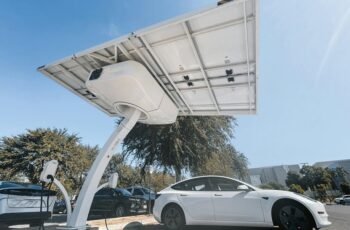
You probably don’t realize how much a sunny day can swing charging times—your power station might sip power when clouds drift in, then surge again as the sun peaks. As you plan, you’ll see that capacity, panel wattage, and sun angle all change the timeline, and variables like MPPT efficiency matter more than you expect. Stay with it as you weigh real-world numbers and strategies to shave hours off, because the answer isn’t one-size-fits-all.
Understanding Charging Time Ranges for Solar-Powered Stations
Understanding charging time ranges for solar-powered stations comes down to three core factors: capacity, solar input, and conditions. You’ll see small stations (300Wh–500Wh) typically charging in 4–6 hours with 100W panels under favorable sun, good for phones and short emergencies. If you can plug into AC, smaller units recharge faster, often in 1–2 hours. A 256Wh EcoFlow River 2 can hit full in about 3 hours with 110W panels. Move to medium systems (1000Wh–1500Wh), and expect roughly 4–8 hours with 200–400W arrays; a 1000Wh unit might finish in 4–6 hours, or 3 hours with 400W under perfect sun. Large stations stretch to 5–15 hours, rising with poor light, higher capacity, and weather. The power input and panel efficiency play a key role in this.
Key Factors That Influence Solar Charging Speed
Key factors that influence solar charging speed boil down to how much input power you can feed the battery, how strong the sun is, and the battery’s own limits. You’ll gain speed from higher wattage panels and more panels in parallel, boosting total input power, so check your power station’s panel limits to avoid damage. Direct sunlight between 11 AM and 2 PM yields peak generation, while seasonal shifts and cloud cover modulate the flow you receive. A larger battery requires more input energy, so expect longer charging, with losses adding 10–20%. MPPT controllers maximize what you harvest; PWM types waste potential. Efficient, safe charging relies on smart BMS integration, proper current limits, and maintaining ideal panel angles to sustain steady input throughout the day. Battery capacity also influences how long the charging will take, as larger batteries demand more input energy to reach full.
Real-World Examples: Battery Capacity vs. Solar Input
When you pair a battery with solar input, charging time hinges on both the capacity and the wattage you’m feeding it. Real‑world examples show how size matters: a 256Wh EcoFlow RIVER 2 charges in about 3 hours with a 110W panel, while a 1260Wh EcoFlow DELTA needs 4–8 hours with three 160W panels. A 2016Wh DELTA Max runs roughly 3.2–6.3 hours using two 400W panels. Xtorm’s 300W unit can hit full charge in about 2 hours under ideal sun, and the 600W model needs roughly 3 hours. Higher total solar wattage or parallel panel setups shorten times, but seasonal sun, shading, and wiring losses stretch them. Larger batteries demand proportionally more input to keep charging reasonable; small packs can outperform larger ones with multiple panels.
Calculating Charge Time: Basic Formulas and Adjustments
To estimate how long a solar-powered setup will take, you can start with the basic formula: charging time equals battery capacity divided by charge current. Then adjust for real-world factors like efficiency and DoD to get a tighter estimate. Finally, translate solar input into an approximate charging current and apply the same adjustments to refine your total time.
Charge Time Formula
Estimating charge time starts with a simple rule of thumb: Charge Time (hours) ≈ Battery Capacity (Ah) ÷ Charging Current (A).
You’ll refine this with practical units and losses. Use the Watt-Hour approach to standardize: Battery Capacity (Wh) ÷ Input Power (W). Remember efficiency losses; real times exceed the ideal estimate. Adjust for chemistry: lead-acid requires dividing nominal capacity by 0.85, lithium by 0.95. Depth of Discharge increases time, and a safety factor may apply for max DoD in lead-acid. Don’t forget the absorption stage; add time for the controller’s final saturation. Convert Ah to Wh when needed, and compute panel current as Wattage ÷ Panel Voltage. Use the adjusted current for your total time.
- Basic formula compatibility
- Unit standardization
- Efficiency and absorption adjustments
Practical Adjustments
Calculating charge time starts with a simple baseline: use the battery’s capacity in watt-hours and divide by the solar input in watts, then tighten the result with real-world losses and chemistry adjustments.
You’ll speed things up by optimizing panel tilt, facing true south or true north, and adjusting angles seasonally to maximize sun exposure. Avoid shade during peak hours, and consider elevating panels or tracking mounts to boost incident light. Cloud cover, haze, or dust can lengthen charging time, while high temperatures may lower efficiency. Lithium-ion cells charge faster and endure better than lead-acid, but health and age still matter. MPPT controllers optimize harvest, though they may throttle top-end speeds. Use higher wattage panels or multiple units in parallel/series to raise input, and match capacity to prevent under- or over-sizing. Plan for variability and monitor input.
How Weather, Sunlight, and MPPT Affect Output
Weather and sun angle directly steer your charging pace, as clouds, temperature, and season cause variability in input and total time. MPPT tech helps extract more power, smoothing those fluctuations and boosting efficiency under a wider range of light. With higher wattage panels and careful placement to limit shading, you’ll see shorter charging times even when sunlight isn’t perfect.
Sunlight Variability Effects
Sunlight variability directly shapes how fast a power station charges: higher irradiance speeds up generation, while clouds, shade, or low sun angles slow it down. You’ll see peak energy between 11:00 AM and 2:00 PM, with mornings and evenings delivering less. Seasonal changes matter too; winter can halve output compared to summer, lengthening charging times. Cloud cover and haze reduce irradiance, lowering efficiency but not stopping charging. Temperature affects both panels and batteries, and dirt or snow on surfaces further cuts absorption. Fixed angle setups lose efficiency as the sun moves, so adjust or track to stabilize output. Expect variability requiring flexible strategies as weather shifts.
- Peak vs. off-peak irradiance impacts charge rate
- Daytime duration and angle influence cumulative energy
- Cleaning and orientation minimally alter ongoing charging times
MPPT Efficiency Gains
MPPT efficiency gains come from how the controller continuously tunes the PV operating point to match real-time conditions. You’ll see typical energy conversion efficiency between 93% and 97%, outperforming PWM by up to 30% or more. In low light, cloudy, or rainy days, MPPT yields higher energy by adapting to reduced irradiance, converting excess voltage into usable current. Winter gains range from 20% to 45%, with summer around 10% to 15%, influenced by temperature and sun angles. Temperature lowers panel voltage, but MPPT converts that into charging current rather than waste. Real-time recalculation via algorithms like P&O or Incremental Conductance maintains peak power despite clouds or rapid changes. Integrating MPPT into controllers or inverters simplifies design and boosts overall system efficiency.
Comparing Solar, AC Wall, and Car Charging Experiences
When comparing charging methods for a 500Wh power station, AC wall charging is typically the fastest and most consistent, followed by solar charging, with car (12V) charging being the slowest and most situational. You’ll notice AC can reach 100–1000 W, delivering a full charge in about 1.5–6 hours, and even faster with turbo charging for high input wattage. Solar speeds vary from 25–87 W, influenced by panel quality and sunlight, yielding roughly 5–10 hours under ideal conditions. Car charging remains the slowest, at about 10–20 W, or 33–50 hours for a full 500Wh.
1) Consistency beats raw speed on cloudy days
2) Panel quality and sunlight dramatically shape solar charge time
3) Car charging is emergency-only, not for rapid recharge
Best Practices to Minimize Charge Time With Solar
To minimize charge time with solar, start with high-efficiency panels, since they convert more sunlight into usable power and reduce overall charging duration. Use mono panels for higher conversion efficiency, and pair them with MPPT technology to enhance voltage and current all day. Add solar charging optimization modules to boost input power up to 40%, shortening charging time significantly. Keep panels clean to maintain max absorption and avoid efficiency drops. Size panels relative to your power station capacity; larger wattage panels charge faster. Place panels at ideal tilt for your location, avoid shading, and adjust seasonally if possible. Face true south (NH) or true north (SH); consider tracking if feasible. Schedule charging at peak sun and deploy smart controllers for automatic starts.
Frequently Asked Questions
Can Solar Charging Continue During Heavy Cloud Cover?
Yes, solar charging can continue during heavy cloud cover, but output drops. You’ll extend charging times, potentially more than 50% longer, so plan extra time or use storage and supplementary charging when clouds persist.
Do Battery Chemistries Affect Solar Charging Speed Significantly?
Yes, battery chemistry greatly affects solar charging speed. You’ll charge faster with lithium-ion, while lead-acid and NiCad charge slower; charging strategies adapt to chemistry, optimizing voltage, current, and safety to maximize speed without damage.
How Does Panel Orientation Impact Real-World Charging Time?
Panel orientation dramatically changes charging times: aim perpendicular sun, adjust azimuth daily, and tilt seasonally. Imagine your panels as a sunflower following noon—optimal alignment powers faster charging, while misalignment stretches the process and wastes energy.
Is There a Risk of Panel Overheating During Fast Solar Charging?
Yes, there is a risk. If you overcharge or expose panels to heat, hotspots form, temperatures spike, and thermal runaway can occur, harming cells. Use proper cooling, ventilation, and monitoring to prevent overheating during fast charging.
Do Portable Solar Panels Scale Linearly With Charge Time?
Yes, they scale roughly linearly in ideal conditions, you’ll shorten time as you add more wattage, but not perfectly; real-world factors like sun, orientation, and the charger limit your gains.
Conclusion
Charging your power station with sunlight isn’t instant, but it’s reliable when you align panel capacity, sun, and battery size. Monitor peak sun hours, use MPPT, and optimize orientation for fastest results. Ready to maximize efficiency, you’ll see real gains by trimming losses and choosing the right pairing. So, are you leveraging the sun’s best window to power your next adventure? With smart setup, what seems slow becomes steady, and your energy independence grows.