Disclosure: As an Amazon Associate, I earn from qualifying purchases.
Are we looking for a versatile, high-capacity portable power station that can handle household loads, off-grid setups, and RV adventures?


Overview of the FOSSiBOT F3600 Portable Power Station, 5x120V AC Output 3600W/3840Wh LiFePO4 Battery Expandable to 11520Wh, Electrical Solar Generator for Garage, Home, Off-Grid Living, Camping, RVs
We want to summarize what this unit offers at a glance so we can quickly see whether it matches our needs. The FOSSiBOT F3600 positions itself as a heavy-duty, expandable LiFePO4 power station with high AC output, fast charging, and smart connectivity for monitoring.
Key highlights in plain terms
We appreciate that the F3600 combines a large battery (3840Wh) with a powerful 3600W continuous AC output and five 120V outlets, meaning it can run most household appliances. It also supports ultra-fast AC charging and solar input, has a robust BMS with UPS capability, and includes app-based monitoring for convenience.
Specifications Table
We like organized details, so we put the core specs into a table for quick reference. This table condenses the essentials so we can compare it easily to alternatives or match it with appliance needs.
| Specification | Detail |
|---|---|
| Model | FOSSiBOT F3600 Portable Power Station |
| Battery Type | LiFePO4 (Lithium Iron Phosphate) |
| Nominal Capacity | 3840Wh (Expandable to 11520Wh) |
| Battery Cycle Life | 4000+ cycles (to ~80% capacity) |
| Continuous AC Output | 3600W |
| AC Outlets | 5 × 120V AC |
| DC Output | 372W combined |
| USB Output | 196W total (including PD100W, QC3.0) |
| Special Ports | XT60 |
| AC Charging Power | Up to 2200W (adjustable 2200W–400W) |
| Full AC Charge Time | Approximately 2 hours 10 minutes (at 2200W) |
| Solar Input | Supported (power adjustable) |
| UPS Switchover | 10 ms |
| Safety | 9-layer BMS protections |
| Connectivity | Wi‑Fi and Bluetooth via Fossibot app |
| Warranty | 5 years + lifetime technical support |
Design and Build Quality
We value a durable, thoughtfully laid out system when we plan to rely on it in critical situations. The F3600 looks and feels built for both stationary and mobile use, with a sturdy casing and intuitive port layout.
We notice that ports are grouped in a way that keeps AC outlets separate from DC and USB outputs, which helps us manage cables and reduces clutter. The handle and form factor make it feasible to move between garage, RV, or home without an excessive workout.

Battery Technology and Expandability
We prefer battery chemistries that balance safety, long life, and stable performance. The F3600 uses LiFePO4 cells, which are widely regarded for their longevity and thermal stability.
LiFePO4 typically offers many more charge/discharge cycles than NMC or other chemistries, and here the product advertises 4000+ cycles to 80% capacity retention, which translates into years of heavy use before capacity diminishes significantly. The expandable capacity up to 11520Wh also means we can scale the system for longer outages or larger off-grid needs.
Why LiFePO4 matters to us
We like LiFePO4 because it tolerates deep discharge better and is less prone to thermal runaway, which improves safety in long-term installations like garages and tiny homes. For those who plan to cycle the battery daily (for example, off-grid solar setups), LiFePO4’s cycle life can make it more economical over time despite a higher initial cost.
Expandability in practice
We appreciate that the unit can be expanded to 11520Wh. That gives us flexibility: use the base unit for weekend trips and add expansion packs for extended off-grid living or multi-day blackouts. We recommend confirming how expansion modules connect (vendor-provided cables and mounting) and whether expansion affects warranty terms before purchase.
Power Output and Port Selection
We expect a versatile power station to support everything from phones to power tools. The F3600’s combination of 3600W AC output, substantial DC power, and modern USB options makes it a strong candidate.
The five 120V AC outlets allow us to run multiple appliances at once—microwave, refrigerator, power tools, or a combination of smaller loads. The additional DC and USB outputs mean we can charge laptops, phones, and 12V devices without sacrificing AC capacity.
AC output performance
We like that the unit provides 3600W continuous AC output, which covers most household needs including many power tools and kitchen appliances. For higher startup surge devices (e.g., some refrigerators or pumps), the inverter should handle brief surges, but we recommend checking specific motor start requirements to avoid overload.
DC and USB ports
We’re pleased to have modern charging options: PD100W for laptops and fast-charging phones, QC3.0 for quick USB charging, an XT60 for direct DC connections, and a healthy combined DC output of 372W. These options let us charge multiple devices efficiently without wasting inverter cycles on small DC loads.
Charging: Speed, Methods, and Practical Times
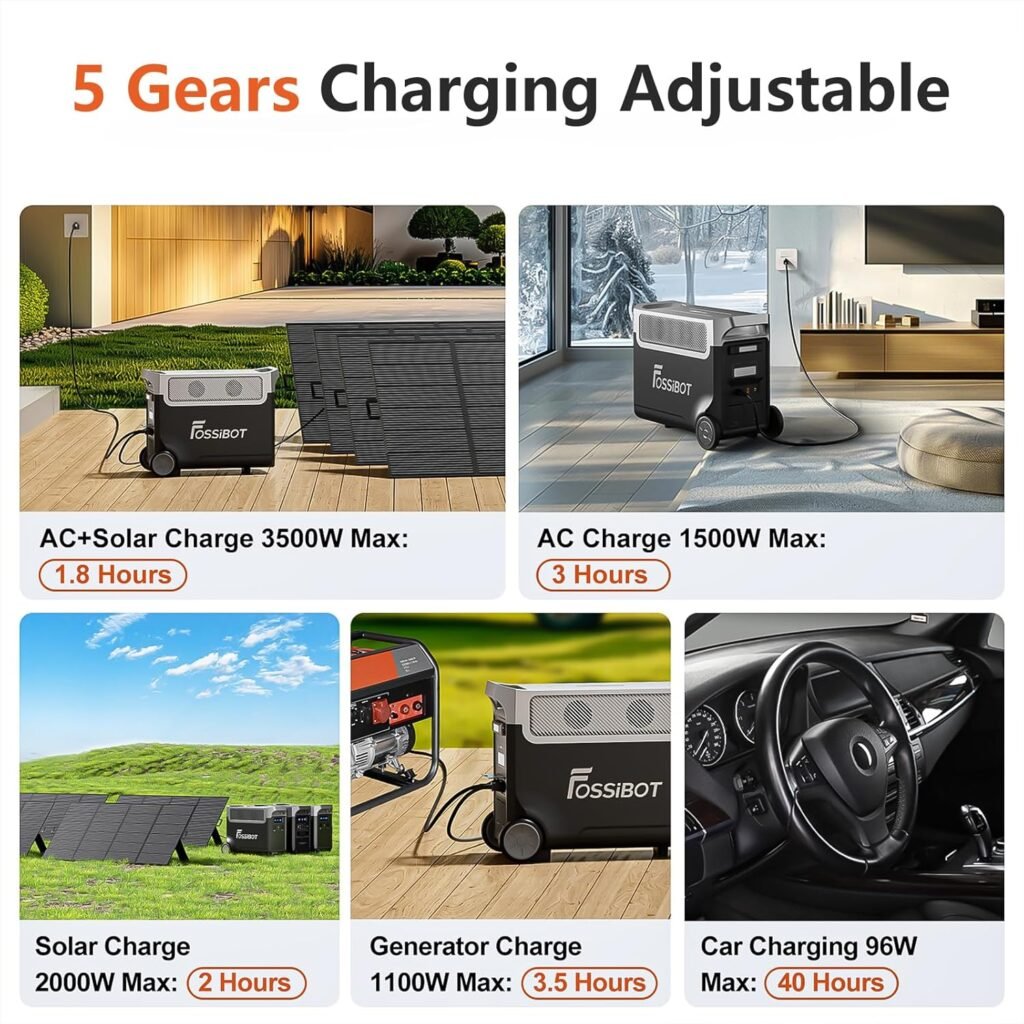
We want fast, flexible charging, and the F3600 offers ultra-fast bidirectional charging. It’s important for us to understand how quickly the unit can recharge from various sources and how to optimize charging under real conditions.
The advertised 2200W AC charging rate (full charge in about 2 hours 10 minutes) is notably quick for a unit of this capacity. With solar combined, charging can be quicker or more sustainable, depending on how we size our array.
AC charging (2200W) — what that means for us
At the maximum AC input, the F3600 can accept 2200W, allowing it to replenish from empty to full in roughly 2 hours 10 minutes according to the manufacturer. That’s ideal for emergency scenarios where grid power returns briefly and we want to top up the station quickly.
We also like that the charging power is adjustable between 2200W and 400W, which helps us adapt to limited circuit capacity or to avoid tripping breakers when other appliances are running.
Solar charging and compatibility
We appreciate that the unit accepts solar input and is compatible with home and portable solar systems. Exact solar charge rates will depend on panel wattage, charge controllers, and available sun, but with proper panel sizing we can supplement AC charging or run fully off-grid.
When pairing with solar, we recommend using high-quality panels and ensuring input voltage/current are compatible. If we plan multi-day off-grid use, we’ll size panels to provide enough average daily production to replace our consumption, factoring in weather variability.
Simultaneous charging and pass-through
We find that many scenarios require both input charging and output usage at once. The F3600 supports bidirectional charging and pass-through operation, which means we can charge the station while simultaneously powering loads—handy for extended use during an outage or while boondocking.
UPS Mode and BMS Safety Features
We prioritize safe, automatic switchover for appliances like routers, medical devices, or computers. The F3600 offers a 10ms UPS switchover that helps prevent data loss and maintain uptime for sensitive equipment.
The included 9-layer BMS protection features—covering overload, short-circuit, overvoltage, overcurrent, temperature protection, and more—give us confidence to operate the unit in varied environments without constant supervision.
UPS Mode: practical benefits
A 10ms switchover is fast enough for most electronic gear to continue operating seamlessly during a power interruption. We would feel comfortable connecting network gear, DVRs, and many home-office devices that might otherwise be vulnerable to abrupt power loss.
Smart BMS and safety
The multi-layered BMS safeguards the battery and connected devices. We like that the system monitors temperature, charge/discharge rates, and other parameters to protect against risky conditions, and that it integrates with the Fossibot app for alerts.
App and Connectivity
We appreciate remote monitoring to keep tabs on charge levels, temperature, and charge/discharge times without having to be physically present. The Fossibot app supports Wi‑Fi and Bluetooth, enabling us to monitor and adjust settings from a phone.
The connected app makes the unit more user-friendly for day-to-day management: we can track battery state of charge, view charging sources, and receive notifications if the system detects an issue. This is particularly useful for units installed in garages or remotely located cabins.
Real-world Performance Estimates
We like concrete run-time estimates to plan power usage. Below is an approximate table showing how long the F3600 can power common appliances using conservative assumptions. These are approximations—actual times will vary with appliance efficiency, startup surges, and how deeply we deplete the battery.
| Appliance | Typical Power Draw (W) | Estimated Runtime on 3840Wh |
|---|---|---|
| Smartphone (charging) | 10–20W | 150–350 hours |
| Laptop (charging) | 45–90W | 42–85 hours |
| LED TV (32″) | 40–80W | 48–96 hours |
| Refrigerator (average compressor) | 100–800W (avg 200W) | 19–38 hours (average) |
| Microwave (800–1000W) | 800–1000W | ~3.8–4.8 hours (intermittent use) |
| Electric Drill (1,200W peak) | 600–1200W | ~3–6 hours (intermittent) |
| Window AC (1500W running) | 1200–1500W | 2.5–3.2 hours |
| Well Pump (start surge) | 1000–2000W (surge) | Varies (handle startup if within inverter specs) |
| CPAP (without humidifier) | 40–80W | 48–96 hours |
We recommend planning for less-than-ideal efficiencies: use a safety margin of 10–20% for inverter conversion losses and start-up surges, and avoid depleting the battery to absolute zero to preserve cycle life.

Use Cases: Home Backup, Garage, Off-Grid, RV, Camping
We imagine multiple scenarios where the F3600 shines. For home backup, it can run essentials—refrigerator, lights, routers, and select appliances—during a power outage. In a garage, it can power tools and compressors for hours. For RVs and camping, it supplies AC and DC power without needing noisy generators. For off-grid living, expandability and LiFePO4 longevity make it a serious contender.
We like how the unit fits these varied roles because of its balance between capacity, output, and safety features. The ability to expand capacity gives us room to scale as our needs grow.
Setup and First-time Use
We prefer simple, clear setup steps so we can begin using gear without frustration. Out of the box, we recommend charging the unit fully via AC before first use, connecting any expansion packs according to the manual, and pairing the device with the Fossibot app for monitoring.
We also suggest performing a test run where we connect typical loads (fridge, router, phone chargers) and verify runtime and behavior before relying on it for critical applications. Confirm configuration of the UPS if we plan to protect sensitive equipment.
Maintenance and Storage
We aim to prolong the life of gear through proper maintenance. For the F3600, we recommend keeping the unit in a cool, dry place, avoiding prolonged exposure to extreme heat, and storing around a 40–60% charge for long-term storage if we won’t use it for months.
Periodically update the app/firmware if updates are provided, and store expansion batteries per the manufacturer’s guidelines. If we’re cycling daily (solar use), monitor temperature and charging patterns to ensure the BMS maintains optimal conditions.
What We Liked
We appreciate features that deliver real-world value. Here are the strengths that stand out for us:
- High continuous AC output (3600W) that handles most household loads.
- Large base capacity (3840Wh) with expandability to 11520Wh for scalable setups.
- LiFePO4 cells with long cycle life (~4000+ cycles) for long-term reliability.
- Ultra-fast AC charging (2200W) to recharge quickly when grid power returns.
- Robust safety features and a true UPS mode with 10ms switchover.
- Comprehensive port options including PD100W, QC3.0, and XT60.
- Smart app monitoring via Wi‑Fi and Bluetooth for easy oversight.
- 5-year warranty and lifetime technical support for buyer confidence.
What Could Be Better
We want to be transparent about limitations and areas we’d like improved:
- Weight and physical size of a unit this capacity are typically substantial; if portability is required, consider how we’ll move it frequently.
- Solar input ratings and MPPT details are helpful to see in full technical specs; we recommend verifying panel compatibility and charge controller specs for precise solar planning.
- For professional installers or complex systems, more detailed integration documentation (e.g., parallel/stacking instructions, expansion cable lengths) would be useful.
- Depending on outlet placements and layout, cable management may need attention for neat installations.
Who Should Buy This
We think the F3600 is well-suited for:
- Homeowners who want a serious backup system for outages without committing to a full home generator.
- RV enthusiasts and vanlifers who need reliable AC and DC power on the road.
- Off-grid hobbyists who want expandable capacity with long-life LiFePO4 chemistry.
- Contractors or garage users who need portable high-wattage power for tools.
- Anyone who values fast recharge times and app-based monitoring.
We’d be more cautious recommending it to those who need a lightweight, ultra-portable solution for brief day trips—there are smaller, lighter units better suited for that specific use.
Comparison with Alternatives (brief)
We find it useful to compare against a few common categories of competitors:
- vs smaller UPS-style power stations: The F3600 substantially outperforms in capacity and continuous output, but it’s heavier and more expensive.
- vs inverter-generator combos: The F3600 provides quieter, cleaner power without fuel, and instant UPS switching; generators provide indefinite runtime with fuel on hand but are noisy and require maintenance.
- vs other LiFePO4 power stations: The F3600 is competitive with others in its class on cycle life and expansion capability; specific features like the 2200W AC charge rate and 5-year warranty may tip the balance for us.
Troubleshooting and FAQs
We like having clear answers for common questions. Below are practical responses to issues we might encounter.
Q: How do we calculate runtime for our appliances? A: Add up the continuous wattage of connected appliances and divide the battery capacity (3840Wh) by that total. Factor in about 10–20% inverter/efficiency and avoid full depletion to preserve battery health.
Q: Can we use the unit while it’s charging? A: Yes. The F3600 supports pass-through operation and bidirectional charging, so we can run loads while charging from AC or solar.
Q: Is the UPS switch guaranteed for all devices? A: The 10ms switchover is fast enough for most electronics and routers, but extremely sensitive equipment may require dedicated UPS systems. We recommend testing our specific devices to ensure compatibility.
Q: How do expansion packs connect and how many are supported? A: The unit supports expansion up to 11520Wh. We recommend following the manufacturer’s instructions for proper cables, connectors, and sequencing, and confirming details in the manual or support resources.
Q: How do we size solar panels for this unit? A: Estimate daily energy use in Wh, then divide by average daily sun-hours to determine required panel wattage. Factor in system losses and desired recharge time. For faster recharge or full off-grid operation, larger arrays will be necessary.
Warranty, Support, and Buying Considerations
We value long warranty terms and responsive support, and the F3600 provides a 5-year warranty plus lifetime technical support. That reduces our risk if something goes wrong and indicates the manufacturer’s confidence in their product.
Before purchasing, we recommend verifying:
- Warranty registration process and what’s covered (battery degradation, electronics, shipping).
- Return policy and local support availability.
- Compatibility of expansion packs and accessories if we plan to scale capacity.
Final Verdict
We find the FOSSiBOT F3600 Portable Power Station to be a compelling option for those who need high continuous AC output, substantial base capacity, and the option to expand for longer runs. Its LiFePO4 chemistry offers long cycle life, the ultra-fast 2200W AC charging is a major convenience, and the UPS/BMS features contribute to safe, reliable operation for home, RV, garage, and off-grid use.
If we need a robust, adaptable power station that can grow with our needs and provide dependable performance during outages or off-grid stays, the F3600 deserves serious consideration. We recommend pairing it with a properly sized solar array and confirming expansion module details if we plan to push the system beyond the base 3840Wh. With thoughtful setup and sensible load management, this system can become the backbone of a portable or semi-permanent power plan.