Disclosure: As an Amazon Associate, I earn from qualifying purchases.
Have we ever wished we could bring reliable, quiet, clean power with us anywhere—without worrying about gas, fumes, or constant refueling?
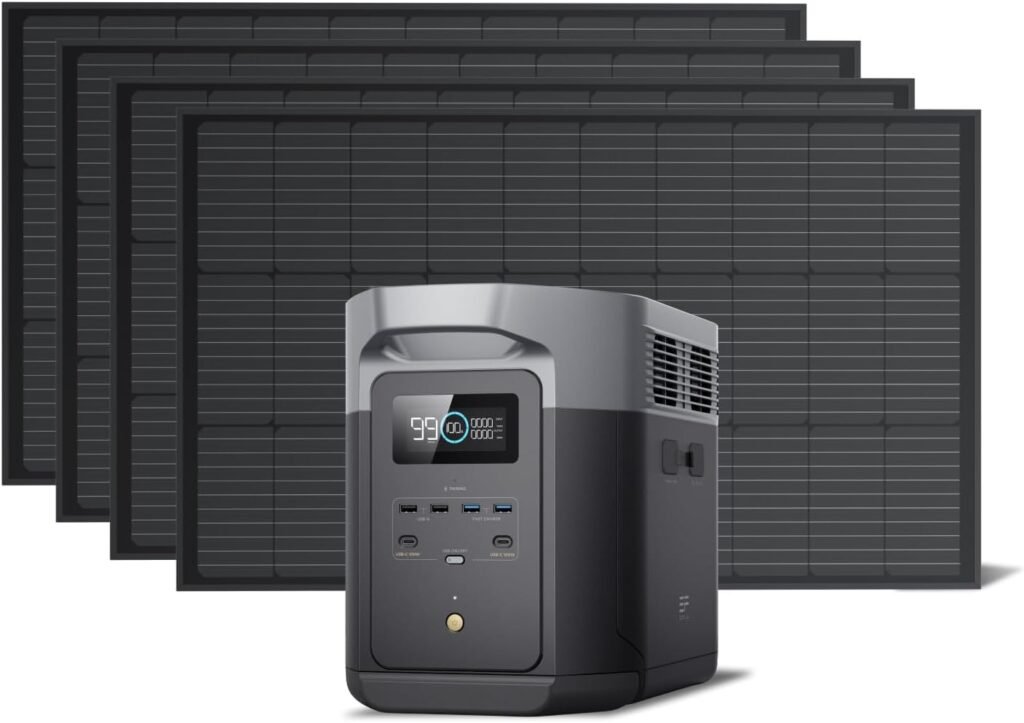

What Is the EF ECOFLOW Solar Generator DELTA 2 Max 2048Wh with 4×100W Solar Panels?
When we talk about portable clean energy, this system gives us a complete setup in one package: a powerful battery, fast AC charging, and four high-efficiency solar panels. It is designed for home backup, camping, RV use, and off-grid adventures where we want dependable power without the noise and hassle of a gas generator.
The kit combines the EF ECOFLOW DELTA 2 Max portable power station (2048Wh capacity, 2400W output) with four 100W 12V monocrystalline solar panels. Together, they give us a flexible, robust system that we can use almost anywhere the sun shines.
Key Features at a Glance
Sometimes it helps to see the most important details laid out neatly. The table below summarizes what this system offers us in terms of performance, durability, and connectivity.
| Feature | Specification / Benefit |
|---|---|
| Battery Capacity | 2048Wh (expandable with extra batteries, sold separately) |
| Battery Type | LFP (LiFePO4) with ~3000 full cycles to 80% capacity |
| Rated AC Output | Up to 2400W (pure sine wave) |
| Surge / X-Boost Capacity | Up to 3400W for certain high-wattage appliances |
| Solar Panels Included | 4 × 100W 12V monocrystalline PV modules |
| Solar Charge Time | Around 6.4 hours with 4 × 100W panels in good sun |
| AC + Solar Dual Charging | Up to 2400W input, 0–80% in about 43 minutes |
| AC-Only Fast Charging | 0–80% in about 1.1 hours |
| AC Outlets | Multiple standard AC outlets (country-dependent) |
| DC & USB Ports | Mix of USB-A, USB-C, and DC/car outputs (about 15 total outlets) |
| Weather Protection (Panels) | IP68 waterproof and dustproof solar modules |
| Typical Appliance Compatibility | Can run about 99% of common household devices |
| Best Uses | Home backup, camping, RVs, off-grid cabins, job sites, outdoor events |
By looking at this, we can already see the system is built for both high output and long-term durability, with a strong focus on real-world usability.
Design and Build Quality
When we handle a portable power station, we want it to feel solid and dependable, not flimsy or fragile. The EF ECOFLOW DELTA 2 Max feels like a serious piece of equipment built for frequent use.
The housing is rugged, with well-placed handles that help us lift and move it without awkward hand positions. Even though it is fairly heavy due to the large battery inside, the overall design distributes the weight in a way that makes carrying manageable for most adults.
The solar panels also show a thoughtful balance between durability and practicality. They use monocrystalline cells, which are known for higher efficiency and good performance in compact sizes. The rigid construction and IP68 rating mean we can mount them outdoors and not worry every time it rains or gets dusty.

Battery Capacity and LFP Chemistry
Battery chemistry is something we might not think about much at first, but it matters a lot for lifespan and safety. This unit uses LFP (LiFePO4) cells, which are widely considered one of the safest and most durable lithium battery technologies on the consumer market.
With a total capacity of 2048Wh, we have a sizable energy reserve for a wide variety of use cases. That is enough to run small and medium appliances for hours, support critical devices during an outage, or provide days of power for lighter loads like phones, lights, and laptops.
The standout detail is the 3000 full charge cycles to 80% capacity. To put that in perspective, if we used a full cycle almost every day, we would still have about 80% capacity after roughly eight years. With more typical use patterns, we are realistically looking at 10+ years of service life, which aligns nicely with ECOFLOW’s claims.
Fast Charging Performance
One of the frustrations with many battery systems is the wait time for charging. This setup is clearly designed to reduce that frustration by offering fast, flexible charging.
AC Fast Charging
When we charge with AC only, the DELTA 2 Max can go from empty to about 80% in around 1.1 hours. That is impressively fast for a battery of this size. For daily use or before a trip, we can just plug it in, and within a bit more than an hour, we are mostly topped up and ready.
This fast AC charging makes the system feel a lot less like a chore. We do not have to plan half a day around waiting for our power station to catch up; instead, we can charge it like we would a laptop, just on a larger scale.
AC + Solar Dual Charging
Where things get really interesting is when we combine AC and solar input. ECOFLOW’s dual charging technology allows up to about 2400W of combined input. Under these conditions, we can reach around 80% charge in roughly 43 minutes.
For home backup especially, this is significant. During a brief window of grid power in a longer outage scenario, or when we are running a generator in combination with solar, we can very quickly refill our battery reserve. It gives us flexibility when energy sources are limited or intermittent.
Solar Charging and Efficiency
The solar side of this kit is crucial for anyone who wants to rely less on grid power or who spends time off-grid. With four 100W panels, we have a maximum theoretical solar input of 400W, though real-world conditions will vary.
Solar Panel Efficiency
Each 100W panel features monocrystalline cells with a conversion efficiency of up to about 23%. That efficiency rating helps us extract more power from a smaller physical footprint, which is useful when roof space or mounting options are limited.
Under good sun conditions, ECOFLOW estimates we can fully charge the DELTA 2 Max in around 6.4 hours using all four panels. In practice, this will depend on our geographic location, season, panel angle, and weather, but it is a reasonable ballpark for planning.
Real-World Solar Use
Using 400W of panels, we are not only charging the station, we can also power light loads directly while the sun shines, with the battery topping up continuously. For RV trips, weekend cabins, or even backyard setups, this means we can often be net energy-neutral over a day with moderate consumption.
The key is managing expectations and loads: running power-hungry appliances continuously will drain the battery faster than 400W of solar can replenish it, but for mixed usage with periods of lower load, solar becomes a strong ally for staying off-grid longer.
Output Power and Appliance Compatibility
We usually care about two things with power stations: how long they last and what they can run. The DELTA 2 Max scores well in both, with a strong emphasis on being able to handle “almost anything” in a typical home.
2400W Continuous Output
With up to 2400W of continuous AC output, we can run most standard household appliances people typically worry about in an outage. This includes items like:
- Refrigerators and freezers
- Microwaves (within wattage range)
- Coffee makers
- Electric kettles (depending on their rating)
- TVs, gaming consoles, laptops, routers
- Power tools like drills, saws, and small compressors (model-dependent)
This level of output means we can keep day-to-day life functioning fairly smoothly during a blackout, especially when we prioritize what matters most.
X-Boost Up to 3400W
The X-Boost feature allows the station to power certain high-wattage devices (up to around 3400W) by intelligently managing voltage and output. This is not a license to run anything without thought, but it can give us extra flexibility for short-term use of bigger appliances.
For example, we might be able to run a high-wattage device like a larger power tool or specific kitchen appliances temporarily. It is always best to check the wattage of each item and ECOFLOW’s compatibility guidelines, but the broader point is that we are not as limited as many smaller stations that max out at 1000–1500W.
Ports, Outlets, and Connectivity
Having a powerful battery is only half the story. We also need enough outlets and variety to connect all our devices without constantly swapping cables.
Multiple AC Outlets
The unit offers multiple AC outlets (exact number and style can depend on the regional model), which allows us to connect several household devices at once. For home backup, we might plug in a refrigerator, a router, some lights, and a laptop all at the same time.
The pure sine wave output is important because it is friendlier to sensitive electronics than modified sine wave options. That means our laptops, TVs, and audio gear will generally run smoothly and safely.
USB, USB-C, and DC Ports
Alongside AC, we have a generous selection of USB-A and USB-C ports, as well as DC outputs (like a car-style 12V socket). This lets us charge phones, tablets, cameras, handheld radios, drones, and more without having to occupy an AC outlet.
Having fast-charging USB-C ports is especially useful since more laptops and tablets now use USB-C power delivery. It also simplifies cable management and reduces the need for bulky chargers.
Around 15 Total Outlets
Overall, the unit offers around 15 separate outputs. That means we can support a small family’s worth of devices or a work crew’s tools and electronics simultaneously. Instead of feeling like we have to ration each outlet, we can plug in what we need and focus on our tasks.
Durability and Waterproofing (Solar Panels)
Outdoors, gear gets exposed to more than just sunshine. Rain, dust, and general grime are all inevitable, which is why the IP68 rating of the solar panels stands out.
IP68 Rating
IP68 means the panels are both dust-tight and capable of withstanding immersion in water up to certain depths and times (under lab conditions). In real use, that translates into excellent resistance to rain, splashes, and dusty environments.
We still want to be sensible about installation and not leave connectors submerged or improperly sealed, but we can rest easier knowing that sudden showers or windy, gritty conditions will not immediately threaten our investment.
Rigid Construction and Mounting
These are rigid panels with pre-drilled holes, designed to work well with standard mounting hardware (sold separately). That makes it easier to:
- Mount them on RV roofs
- Attach them to sheds, tiny homes, or cabins
- Create ground-mounted frames or racks
By using common mounting techniques and accessories, we can integrate them into existing solar setups or future expansions without reinventing everything from scratch.
Ease of Setup and Everyday Use
When we get a complete solar generator kit, we do not want a complex science project. This system is set up so most of us can get running quickly with basic tools and a bit of planning.
Initial Setup
For a basic, temporary setup (like a camping trip or short stay in an RV):
- Place the DELTA 2 Max in a well-ventilated, dry location.
- Connect the solar panels using the provided cables, following polarity markings.
- Angle the panels toward the sun for maximum exposure.
- Plug in our devices and monitor the display to track input and output.
For a more permanent installation (home or RV roof), we will need proper mounting hardware, which ECOFLOW sells separately. With the pre-drilled holes on the panels, we can attach them to rails or brackets using standard fasteners.
Everyday Operation
Once everything is set up, using the system is straightforward. We connect our appliances or devices as needed, monitor the power levels, and adjust loads if we want to prolong runtime.
The built-in display shows:
- Remaining battery percentage
- Input power (from AC and/or solar)
- Output power (how much we are using)
- Estimated time remaining at the current load
This gives us clear, at-a-glance information to decide what to run and for how long.
Runtime Examples and Real-World Scenarios
Numbers on a spec sheet are helpful, but we often understand systems better by thinking through concrete situations.
Home Backup Example
Let us imagine a home outage where we want to keep essentials running:
- Refrigerator: ~150W average with compressor cycling
- Wi-Fi router + modem: ~20–30W
- A few LED lights: ~20–40W
- Laptop charging: ~50W
Altogether, our continuous draw might be in the range of 250–300W. With a 2048Wh battery, ignoring conversion losses and some buffer, we might expect around 6–7 hours of runtime. In real life, with some inefficiencies, we might see something like 5–6 hours. If we add solar input during daylight, that runtime can extend substantially.
Camping or RV Use
If we are using the system for camping or RV travel, loads are often lighter and more intermittent:
- LED string lights at night
- Occasional use of a portable fridge
- Phone and camera charging
- Laptop or tablet use
- Small fan overnight
In that case, a single full charge can last multiple days, especially if we use our 400W of solar during the day to top up. For many weekend trips, we may not even reach low battery if the weather cooperates and we are mindful of high-draw appliances.
Powering Tools and Gear
For work sites or DIY projects, the ability to run power tools without dragging long extension cords is a big advantage. Common tools like drills, circular saws, and small air compressors can often be powered within the 2400W limit, though we always want to check the nameplate wattage and startup surges.
Because the DELTA 2 Max can deliver high instantaneous power, it can handle many of the spikes that tools generate when starting up. That makes it more usable than smaller stations that trip off under sudden loads.
Environmental and Noise Advantages
One of the reasons many of us consider a solar generator system is to reduce noise and emissions compared to gasoline generators.
No Fumes, Less Maintenance
Because this is a battery-based system, we do not have exhaust fumes, oil changes, or fuel storage concerns. For indoor use, this is crucial: we can safely run the power station inside our home, RV, or tent (with ventilation for heat) because it does not produce combustion gases.
We still need to keep the unit in a dry, ventilated place and treat it with basic care, but maintenance is mostly about sensible storage and avoiding extreme environments, not engine servicing.
Quiet Operation
Battery systems are naturally quieter. While there may be some fan noise when charging or under heavy load, it is far less intrusive than a traditional generator. For camping, late-night use, or apartment living, this lower noise level makes a massive difference in comfort and neighbor relations.
Who This System Is Best For
Not every power solution fits every lifestyle, so it helps to consider who will get the most value from this particular kit.
Ideal Users
We see this product as especially suitable for:
- Homeowners who want a practical backup solution for short to medium outages
- RV owners who need reliable off-grid power without running a generator constantly
- Campers who appreciate clean, quiet energy for lights, cooking, and electronics
- Remote workers or creators who want to power gear in off-grid locations
- DIY enthusiasts looking for a portable power source for tools and yard work
If we fall into any of these categories and value a mix of fast charging, high output, and durable solar panels, this kit is likely to be a strong match.
Situations Where It May Be Overkill
On the other hand, if we only need to charge a phone and a flashlight occasionally, this system might be more than we need. A smaller power station with a single folding panel could be sufficient.
Also, for extremely high-demand, whole-house backup, especially for multiple days in bad weather without any grid support, we may want to pair this with additional batteries or consider a larger, more permanent home solar-plus-storage installation.
Advantages of the EF ECOFLOW DELTA 2 Max Solar Generator Kit
We find it helpful to summarize the core strengths so we can quickly see what stands out.
Long-Life LFP Battery
The LiFePO4 chemistry provides around 3000 full cycles before dropping to about 80% capacity. That puts it far ahead of many older lithium chemistries in terms of lifespan and reliability.
We are not just buying a gadget for a year or two; we are investing in a power solution that can realistically last for a decade with reasonable care.
High Output and Broad Device Compatibility
The ability to support up to 2400W output (and up to 3400W in X-Boost mode) lets us cover almost any standard household device we might reasonably want to run in an outage or while traveling. We do not have to be overly restrictive with appliance choices.
Having 15 outlets means plenty of room for our family’s or team’s devices, from kitchen appliances to electronics and tools.
Fast and Flexible Charging
AC fast charging and AC + solar dual charging are real quality-of-life features. Being able to reach 80% capacity in under an hour (or 43 minutes with combined input) means we can top up quickly whenever power is available.
In emergency scenarios, that can make a meaningful difference in how we manage an outage or short grid restoration windows.
Rugged, Waterproof Solar Panels
IP68-rated 100W panels give us confidence for outdoor mounting and use. We do not have to scramble to bring panels inside with every minor change in weather.
Pre-drilled mounting holes make it easier to integrate into common racking and mounting systems, allowing us to customize our install.
Considerations and Potential Limitations
No product is perfect for every situation. Here are some points we should keep in mind when deciding if this kit fits our needs.
Weight and Portability
With a 2048Wh LFP battery, the power station is not feather-light. It is portable enough for most adults to carry short distances using its built-in handles, but we should not expect the same ease as a small 300Wh battery.
If we frequently need to move it over long distances by hand, we may want to consider a cart or to position it more permanently and run extension cables instead.
Solar Output vs. Heavy Loads
While 400W of solar is solid for many uses, heavy, continuous loads like large electric heaters or full-size air conditioners will quickly outpace both the battery and the solar input.
For serious, long-term off-grid living with high demand, we would likely pair this station with additional solar capacity or battery modules, or we would look into a dedicated home solar installation.
Mounting Hardware Sold Separately
The solar panels include pre-drilled holes but not the actual mounting brackets or rails. We need to budget and plan for mounting components if we intend a permanent installation, especially on RVs or roofs.
This is fairly standard in the solar world but worth noting so we are not surprised when opening the box.
Tips for Getting the Most Out of the System
A few simple habits can help us extend the life and practicality of our solar generator.
Smart Load Management
We can stretch our runtime dramatically by prioritizing essential devices and turning off high-draw appliances when not needed. For example:
- Use LED bulbs instead of incandescent
- Limit use of electric kettles, toasters, and hair dryers
- Let the fridge cycle naturally rather than opening it constantly
By checking the output wattage on the display, we can get a feel for how each device impacts our total draw.
Optimized Solar Placement
With the solar panels, angle and orientation matter. Whenever possible:
- Point panels toward the sun’s path (south in the Northern Hemisphere, north in the Southern Hemisphere)
- Adjust tilt seasonally if we have a fixed installation
- Avoid shading from trees, antennas, or other obstacles
Even partial shading on one panel can noticeably reduce solar input, so planning placement is worth our time.
Sensible Storage and Maintenance
To prolong battery life, it helps to:
- Avoid leaving the unit in extremely hot environments (like a closed car in summer)
- Store it at a moderate state of charge if unused for long periods (often around 30–60%, check the manual)
- Use it regularly so the battery does not sit idle for months on end
Simple habits like these can help us preserve capacity over the long term.
Safety Features and Peace of Mind
Because we are dealing with substantial amounts of energy, safety features are important. While we always want to follow the official manual, the system includes standard protections such as:
- Overvoltage and undervoltage protection
- Overcurrent and short-circuit protection
- Temperature monitoring and thermal management
These internal safeguards, combined with the stable nature of LFP chemistry, help reduce risk and give us confidence in everyday use. Of course, we still need to use appropriate cables, avoid overloading outlets, and follow normal electrical safety practices.
How This Fits into a Broader Energy Strategy
For many of us, the EF ECOFLOW DELTA 2 Max with 4×100W panels can serve as a bridge between full grid dependence and a more resilient, flexible setup.
We might:
- Use it as backup power now, while gradually adding more solar capacity over time.
- Combine it with an existing rooftop solar system (in ways compatible with local regulations and safety guidelines).
- Treat it as a mobile extension of our home energy strategy, powering our RV, cabin, or work site as needed.
In a world where outages, storms, and grid instability are increasingly common, having a system that charges quickly and offers meaningful backup capacity is more than a nice-to-have; it is a tangible boost to our resilience.
Our Overall Impression
After looking closely at the EF ECOFLOW Solar Generator DELTA 2 Max 2048Wh with 4×100W 12V Solar Panels, we see a well-balanced combination of power, durability, and user-friendly design.
Key positives we notice:
- Long-lasting LFP battery with thousands of cycles
- Strong 2400W output, suitable for about 99% of typical household devices
- Very fast AC and AC+solar charging options
- High-efficiency, IP68-rated monocrystalline solar panels
- Ample outlets for a wide variety of devices
Points to weigh carefully:
- The station is substantial in size and weight due to its high capacity
- 400W of solar is excellent for moderate loads, but continuous heavy-power users may want more panels or additional batteries
- Mounting hardware for the panels must be purchased separately
For home backup, RV life, and serious camping or off-grid use, this kit offers a compelling mix of performance and longevity. It gives us a reliable, quiet, and clean alternative to gas generators, while still providing the power we need to keep modern life running when the grid is not there to support us.
If we value long-term durability, fast recharge times, and the flexibility to use our system both at home and on the road, the EF ECOFLOW DELTA 2 Max with 4×100W solar panels stands out as a strong, well-rounded choice.