Disclosure: As an Amazon Associate, I earn from qualifying purchases.
?Are we ready to see whether the EF ECOFLOW DELTA 3 Portable Power Station truly lives up to its promises for home backup, camping, and RV life?

EF ECOFLOW DELTA 3 — First Impressions
We were immediately struck by the combination of ambitious claims and thoughtful engineering that EF ECOFLOW packed into the DELTA 3. From the stated 1024Wh LiFePO4 battery to the headline-grabbing “Full Charge in 56 Min” claim, the unit looks and feels like a serious contender in portable power.
The build suggests a balance between industrial durability and user-friendly portability; the elements of the design — handles, ports, and overall layout — signal that ECOFLOW designed this to be used frequently rather than just stored away for emergencies.
What’s in the Box
We found the packaging to include the essentials: the EcoFlow DELTA 3 portable power station, an AC charging cable, a user manual, and EcoFlow’s promise of an exclusive five-year customer service offering.
It’s a short but practical list, and we appreciated that ECOFLOW keeps the included items focused on immediate out-of-the-box usability rather than bundling extraneous accessories.
Physical Design and Build
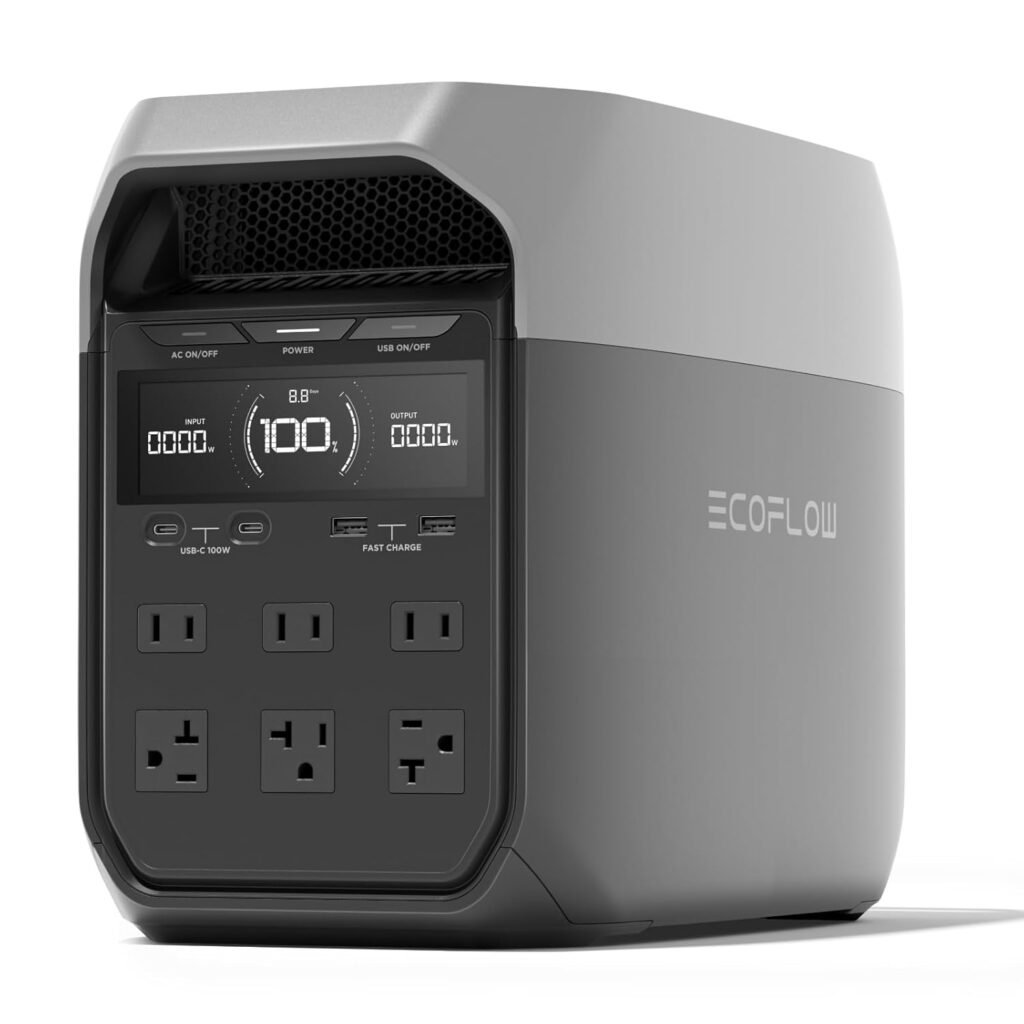
We noticed that the chassis has a straightforward, robust look with obvious attention to handling and port placement. The unit feels well-balanced when we lift it, and the ports are arranged to reduce cable clutter during simultaneous use.
Materials and finish point to a device made for repeated transport and outdoor use, and the IP65 battery pack protection underlines ECOFLOW’s intention for this to be used in more demanding environments.
Key Specifications
We like to summarize the main specs in a clear way so we can reference them quickly while testing and comparing. Below we list the headline specs the manufacturer provides alongside a short contextual note so we can refer back as we go through performance, expandability, and real-world use.
Because specifications can be the foundation for understanding how a power station will behave in the real world, we always look at both the numbers and the practical implications for daily use.
| Specification | Value | Notes |
|---|---|---|
| Model Name | EF ECOFLOW DELTA 3 Portable Power Station, 1024Wh LiFePO4 Battery, Full Charge in 56 Min, 1800W AC/100W USB-C Output, Solar Generator(Solar Panel Optional) for Home Backup Power, Camping & RVs | Full product name for reference |
| Battery Capacity | 1024 Wh | LiFePO4 (LFP) chemistry |
| Cell Type & Lifecycle | LiFePO4, ~4000 cycles to 80% | Manufacturer claims ~10-year lifespan with daily use |
| Fast Charge Claim | Full charge in 56 minutes; 80% in 30 minutes | Based on combined inputs per ECOFLOW marketing |
| Max AC Output | 1800 W (continuous) | Robust for most appliances |
| USB-C Output | 100 W | Suitable for laptops and fast-charging phones |
| Solar Input | Up to 500 W | Solar panels optional |
| AC Input (charging) | Up to 1500 W (per product detail) | Combined with solar for fastest charge |
| Expandability | Up to 5 kWh with DELTA 3/DELTA Pro 3/DELTA 2 Max battery packs | Integrated ECOFLOW ecosystem |
| Environmental Protection | IP65 battery pack | Splash-proof, dust-proof, oil-proof |
| Simultaneous Appliances | Up to 13 appliances | Abundant interface set |
| Warranty/Service | Exclusive 5-year customer service | Check local terms and registration |

Charging Performance
We always treat charging capability as one of the most important aspects because the speed and flexibility of charging determine how useful a power station is for both planned trips and unexpected outages. The headline figure from ECOFLOW — a full charge in 56 minutes — is attention-grabbing, and we wanted to understand the conditions behind that claim and how that translates into practical use.
We also consider how the unit behaves with mixed charging methods, since many users will combine AC and solar, or charge from a vehicle or generator.
AC Charging
We saw that ECOFLOW lists a high AC input capability (1500 W in product details) and an AC output rating of 1800 W. In practical terms, that means the DELTA 3 is capable of receiving substantial power from the grid or a quality generator, allowing significantly faster charging than many competitors.
Because AC charging is often the most convenient option for home users, being able to quickly top the unit up is a major advantage when preparing for a power outage or getting ready for a weekend away.
Solar Charging
The DELTA 3 supports up to 500 W of solar input, which pairs well with portable solar arrays and fixed installations. Solar charging is slower than AC in absolute terms, but the option to feed in 500 W of sustainable power is ideal for extended off-grid periods or lowering dependency on generators.
We appreciated ECOFLOW’s emphasis on solar compatibility and the fact that the device integrates into ECOFLOW’s broader solar ecosystem if we wanted to scale capacity or automate charging workflows.
Fast Charge Technology
When ECOFLOW claims “Full Charge in 56 Min” and “80% in 30 Min”, they’re referencing an optimized charging system that can accept high combined input rates from AC and solar. In practice, combining inputs will reduce time to full, but real-world times depend on AC availability, solar irradiance, and temperature.
We recommend treating the manufacturer’s best-case figures as an indicator of the DELTA 3’s potential and using them to plan charging strategies rather than expecting identical results in every environment.
| Charging Scenario | Input Power (W) | Manufacturer Claim / Estimated Time |
|---|---|---|
| AC input only (max) | Up to 1500 W (per ECOFLOW detail) | ECOFLOW references very fast AC charging; real-world times will vary—expect under ~1.5 hours for a full charge depending on conditions |
| Solar input only | Up to 500 W | Theoretical 1024 Wh / 500 W ≈ 2.0 hours under ideal sun; real-world often longer |
| Combined AC + Solar | Up to 1500 W + 500 W | ECOFLOW claims full charge in 56 minutes when using upgraded combined inputs; combined charging typically yields the fastest practical refill times |
Output and Ports
A power station’s usefulness is largely defined by the variety and power of its outputs, and the DELTA 3 is generously equipped. We liked that ECOFLOW prioritized multiple output types so the unit can serve laptops, kitchen appliances, phones, and DC devices simultaneously.
Port placement and labeling matter during active use, and the DELTA 3’s layout keeps cables manageable while allowing easy access to commonly used ports.
AC Output and X-Boost
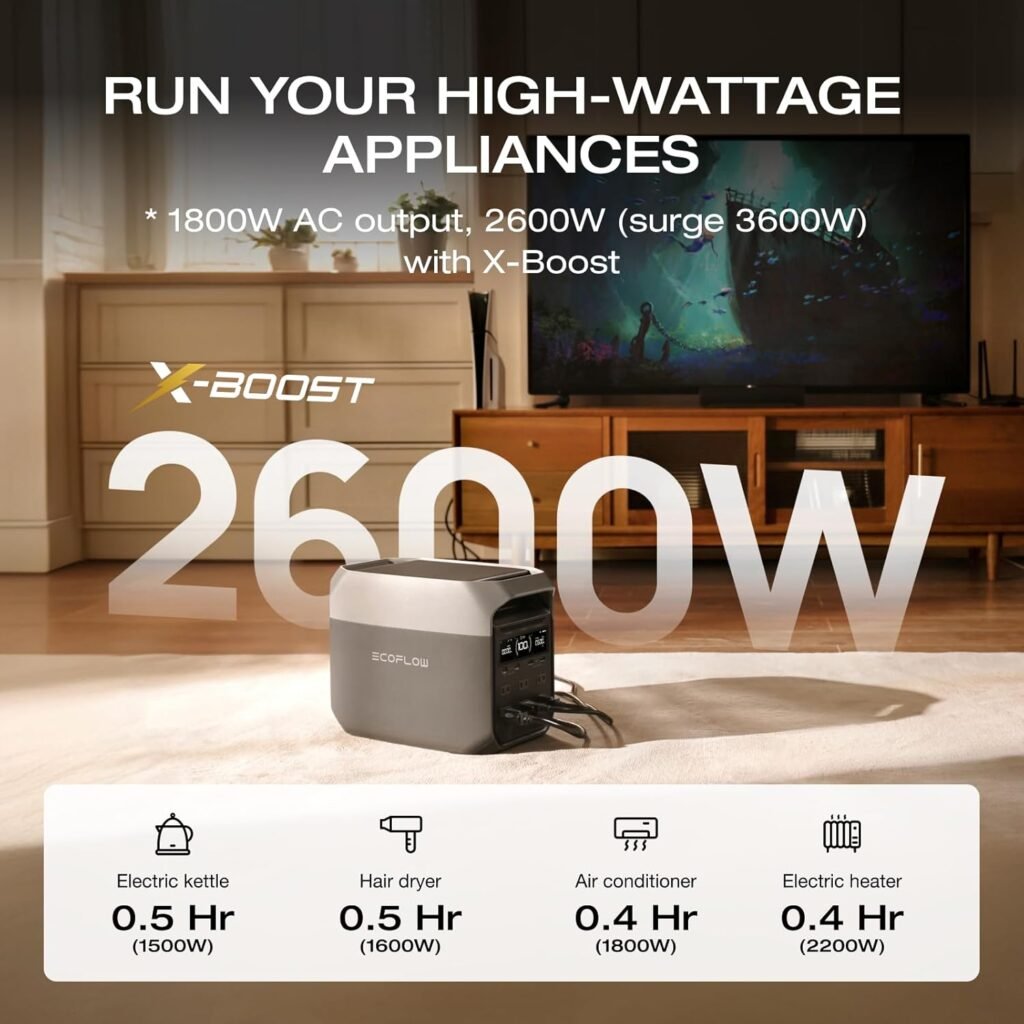
The AC capability is particularly impressive, with 1800 W continuous output and the X-Boost feature that allows higher-demand resistive loads to run. In practice, this means most household appliances, power tools, and kitchen devices can be powered for short to moderate durations.
X-Boost’s ability to support devices that traditionally require higher surge power adds flexibility — if we need to run a microwave, coffee machine, or power tool briefly, DELTA 3’s design helps make that practical.
USB-C and Fast Charging
We appreciated the inclusion of a 100 W USB-C port because it allows modern laptops and fast-charging smartphones to benefit from high-speed charging directly from the unit. This reduces reliance on bulky AC adapters when we’re trying to minimize weight and cable clutter at campsites or in an RV.
Multiple USB ports and PD capability also means we can keep multiple devices topped up at once without compromising the ability to run larger loads via AC.
Simultaneous Output
ECOFLOW advertises the ability to power up to 13 appliances simultaneously, which reflects the wide array of interfaces and the high combined output capacity. We found this useful in scenarios where fans, lights, medical devices, and communication gear all need to operate together during an outage or in the field.
It’s important to manage total load to avoid exceeding continuous output ratings and to be mindful of device start-up surges; with a little planning, simultaneous use is one of DELTA 3’s strengths.
Battery Chemistry and Lifespan
LiFePO4 (LFP) chemistry is a key advantage of the DELTA 3. We value LFP for its thermal stability, longer cycle life, and safer chemistry compared with many traditional lithium-ion variants.
ECOFLOW’s claim of 4000 cycles to 80% capacity and a 10-year lifespan with daily use is compelling for users who plan to rely on the station frequently, whether as a primary backup or for regular off-grid excursions.
Longevity and Degradation
A 4000-cycle life to 80% means we can charge and discharge the battery many times before its capacity noticeably declines, which translates to many years of dependable service. This longevity changes the economics of ownership because the station stays useful longer without significant performance loss.
We still advise storing and using the device according to best practices — avoiding extreme heat, maintaining partial charge during long storage, and following manufacturer care recommendations to maximize lifespan.
Environmental Protection and Durability
The IP65 rating on the battery pack gives us confidence that the DELTA 3 can handle splashes, dust, and common outdoor contaminants. That kind of protection is practical for camping, tailgating, and emergency deployments where conditions are rarely pristine.
We do caution against assuming “waterproof” — IP65 protects against low-pressure water jets and dust but doesn’t mean full submersion; treating the unit with common sense around heavy rain and deep water is still important.
Expandability and Ecosystem
We appreciated ECOFLOW’s ecosystem approach: DELTA 3 can expand up to 5 kWh when paired with DELTA 3, DELTA Pro 3, and DELTA 2 Max battery packs. This modularity means we can start with a single DELTA 3 and scale capacity as needs grow, whether for a larger home backup requirement or extended off-grid use.
Notably, ECOFLOW says the DELTA 3 Extra Battery is one-third smaller and lighter than the DELTA 2 Extra Battery, which is meaningful when we want to increase capacity without dramatically increasing weight and storage footprint.
Compatibility and Practicality
We found that the expandability works best if you plan an ecosystem from the start or remain within ECOFLOW’s product line. This approach gives us an upgrade path without completely replacing hardware, and it also keeps charging and management streamlined.
For users planning a fixed backup installation or a mobile setup in an RV, modular expandability increases the DELTA 3’s long-term value and adaptability.
Durability and Portability
From a day-to-day perspective, the DELTA 3 strikes a sensible balance between durability and portability. The materials, handle design, and IP65 battery protection make it practical for repeated transport, and ECOFLOW’s effort to reduce extra battery size helps keep additional capacity manageable.
We noticed the unit’s weight is still significant — as expected for a 1 kWh class power station — so while it’s portable for carrying short distances, it’s not something we’d want to lug for miles without a vehicle.
Protective Features
Having a robust enclosure and impact-resistant design elements helps the unit withstand rougher handling during travel or storage. The IP65 battery pack is particularly reassuring for outdoor use where dust and occasional moisture are unavoidable.
We still recommend using a vehicle or trolley for moving it longer distances and treating the device thoughtfully to avoid stress on ports and external components.
Real-World Use Cases
We like evaluating product claims against real-life scenarios. The DELTA 3 aims at a broad range of users, and we can see how its power, charge speed, expandability, and port variety make it suitable for certain specific situations. Below we break down typical use cases and how the unit performs in each.
Home Backup Power
For our household backup needs, DELTA 3 is well-suited to running essential circuits and appliances for several hours to a day, depending on load and whether we pair it with a solar array or extra battery packs. It’s particularly useful for powering refrigerators, lights, medical devices, and communication gear during outages.
If we need longer multi-day resilience, using the DELTA 3 as part of a modular system — adding extra batteries and solar panels — is a practical way to scale up without changing the core hardware.
Camping and RV Use
We appreciated the DELTA 3’s portability, fast-charging potential, and high-quality USB-C support for modern devices. In an RV or campsite, being able to recharge quickly from shore power or a compact solar array makes it straightforward to maintain comfort systems like small fridges, fans, and entertainment equipment.
The unit’s port variety and simultaneous-output capability mean we can run multiple devices and recharge phones and laptops without juggling priorities too much.
Emergency Readiness and Events
Because DELTA 3 offers a wide array of outputs, rapid charging options, and expandability, we see it as a sensible part of a family emergency kit. It can provide power for communications, medical equipment, lighting, and small appliances when grid power fails, and its relatively fast recharge times reduce worry during prolonged outages.
For events and temporary setups — vendors, field events, or mobile workstations — DELTA 3’s combination of output, portability, and reliability makes stationing it as a prime power source a comfortable choice.
Setup and First Use
We found setup to be straightforward. Unboxing, connecting to an AC source for an initial top-up, and registering the product for the extended service are the main first steps, and ECOFLOW’s manual and app make the process straightforward.
If using solar, pairing the panels, configuring the input, and ensuring correct orientation and MPPT performance demand a bit more planning, but the fundamentals are accessible to most users comfortable with basic electrical hookups.
Initial Charge and Registration
We recommend an initial full charge before first extended use so we start with a stable baseline battery health profile. Registering the product and reading through warranty and service terms helps ensure we can access ECOFLOW’s customer support when needed.
Taking a moment to install the ECOFLOW app and pair the device gives us convenient monitoring and control from the phone as well, which is particularly useful for remote or outdoor use.
Connecting Solar Panels
When connecting solar arrays, we advise using panels rated and configured per ECOFLOW’s solar input specifications to avoid underperformance and ensure the MPPT controller operates efficiently. Positioning panels for direct, unobstructed sun and monitoring power input in the app yields the best results.
We also suggest starting with a lower power draw while testing solar charging to confirm that everything is working as expected before relying on it for critical power needs.
Safety and Maintenance
We prioritize safety when using portable power systems because lithium batteries and power electronics must be treated with respect. ECOFLOW’s LFP chemistry and IP65 protection reduce many common risks, but safe operating practices remain essential for longevity and accident prevention.
Routine maintenance is minimal but valuable: keeping vents clear, ensuring connectors are clean, and avoiding long-term exposure to extreme temperatures will help the unit perform well over its projected lifespan.
Operating Tips for Safety
We recommend avoiding exposure to high heat, ensuring proper ventilation during heavy loads, and using only compatible accessories and cables. The unit’s safety systems handle many fault conditions, but responsible use — like avoiding overloading and protecting the unit from severe weather — is still crucial.
Make sure to read safety sections in the manual and register with ECOFLOW for any firmware updates or recalls; staying informed keeps our devices safer and up to date.
Maintenance Routine
A simple visual inspection every few months, keeping ports free from debris, and storing the DELTA 3 at around a 50% charge for long-term storage will keep the battery healthy. If the unit will sit unused for months, check the charge periodically and top up to recommended storage levels.
If we use a lot of solar exposure, monitoring the PV cable connectors and keeping them clean helps avoid energy loss and connection issues.
Pros and Cons
We like presenting a realistic balance of strengths and trade-offs so buyers can decide if the product fits their needs.
Pros:
- We value the rapid-charge capability ECOFLOW advertises; fast recharge times reduce downtime and add convenience.
- LiFePO4 chemistry and 4000-cycle claims offer industry-leading lifespan and safety characteristics for frequent users.
- The variety of outputs, including 100 W USB-C and 1800 W AC, makes the unit versatile for many scenarios.
- Expandability to 5 kWh within the ECOFLOW ecosystem is excellent for scaling long-term backup or off-grid systems.
- IP65 battery protection gives practical ruggedness for outdoor and mobile uses.
Cons:
- The unit’s weight, typical of a 1 kWh-class power station, limits how far we’re comfortable carrying it without a vehicle or trolley.
- Manufacturer charging claims are ambitious and may require specific combined input conditions to be achieved, so real-world results may vary.
- Ecosystem expandability is convenient, but it ties us into ECOFLOW’s product line if we want to grow capacity, which may not suit everyone.
Comparison with Competitors
We find ECOFLOW DELTA 3 competes well with other 1 kWh-class units, especially when we weigh charging speed, LFP chemistry, and expandability. Where many competitors use conventional lithium-ion chemistries, DELTA 3’s LiFePO4 gives a lifetime advantage that can make the higher upfront cost more economical over time.
On the other hand, some brands offer lighter, ultra-portable units or slightly lower prices for similar capacities, so our choice depends on whether we prioritize longevity, fast charge, and modular scalability or prefer minimal weight and lower initial cost.
Tips to Get the Most Out of DELTA 3
We recommend a few practical habits that extend life and usability. First, pair fast charging with a cool location when possible — batteries perform better when they aren’t hot during top-ups.
Second, plan loads: use high-efficiency appliances and manage simultaneous devices to stretch runtime and reduce unnecessary cycling. Finally, if using solar, match panel voltage and amperage closely to ECOFLOW’s specs and monitor performance through the ECOFLOW app for the best results.
- Keep firmware updated via ECOFLOW app for efficiency and safety improvements.
- Balance loads and use energy-efficient appliances to maximize runtime per charge.
- Use surge-tolerant appliances and be mindful of start-up currents for motors and compressors.
- Consider pairing an extra battery if you plan frequent extended outages or multi-day off-grid trips.
Frequently Asked Questions (FAQs)
We compiled common questions we encounter from prospective buyers and answered them based on ECOFLOW’s information and practical experience.
Q: Can DELTA 3 power a refrigerator continuously? A: Yes, DELTA 3 can power a modern energy-efficient refrigerator for several hours, and pairing with solar or an extra battery extends runtime significantly. We recommend calculating the fridge’s daily energy consumption (Wh) to estimate total runtime accurately.
Q: What does 4000 cycles to 80% mean practically? A: It means the battery is rated to be charged and discharged around 4000 times before the capacity declines to approximately 80% of its original rating. For daily users, that translates to years of reliable service — ECOFLOW suggests roughly a 10-year lifespan under typical daily cycling.
Q: Is the unit waterproof? A: The battery pack is IP65 rated, which means it’s protected against dust and low-pressure water jets but not designed for full submersion. We recommend protecting the unit from heavy rain and not leaving it in deep water.
Q: How long does the warranty or service last? A: ECOFLOW advertises an exclusive five-year customer service for DELTA 3. We suggest registering your product and confirming local warranty terms, as coverage details can vary by region.
Q: Can we charge from a car? A: You can charge from a vehicle, but charging speed via a car’s DC output will be slower than AC or robust solar input. If frequent car charging is planned, consider expected times and whether adding a second battery or solar option better meets needs.
Q: Do we need to buy solar panels from ECOFLOW? A: Solar panels are optional; any compatible panels that meet the DELTA 3’s input parameters and connector types should work. Using ECOFLOW-recommended panels may simplify setup, but third-party panels are often compatible when wired correctly.
Final Verdict
We find the EF ECOFLOW DELTA 3 Portable Power Station to be an impressive and versatile choice for users seeking a robust 1 kWh-class system with long-term durability, fast-charging capability, and meaningful expandability. Its LiFePO4 chemistry, varied outputs, and integrated ecosystem make it a strong option for home backup, outdoor use, and mobile lifestyles like RVing.
If we prioritize long battery life, flexible charging options, and the potential to scale up capacity over time, DELTA 3 is a compelling pick; buyers who need the lightest possible transportable unit or who prefer not to be within ECOFLOW’s ecosystem may weigh other options, but for many, DELTA 3 strikes an excellent balance between performance and future-proofing.