Disclosure: As an Amazon Associate, I earn from qualifying purchases.
Have we found a portable power station that can realistically replace a traditional generator for home backup and outdoor use?

Overview of EF ECOFLOW Portable Power Station DELTA 2 Max with Protective Cover, 2400W LFP Solar Generator, Full Charge in 1 Hr, 2048Wh Solar Powered Generator for Home Backup
We want to give a clear snapshot of what this product is and why it might matter to us. The EF ECOFLOW DELTA 2 Max is a high-capacity, lithium iron phosphate (LiFePO4 / LFP) portable power station that promises fast charging, long cycle life, and enough outlets to run most household devices.
We’ll summarize the key selling points: 2048Wh usable capacity, up to 2400W continuous AC output, and the ability to reach 80% charge in only 43 minutes using combined AC and solar inputs. The product includes a weatherproof protective cover and supports expandable capacity for extended outages.
What this review covers
We aim to cover design, battery technology, charging performance, real-world output, expandability, noise, portability, app features, safety, and how the unit performs in several typical scenarios. We will assess pros and cons and finish with practical recommendations.
We’ll be practical and candid about what the DELTA 2 Max does well and where it may not be the best fit.
Key specifications at a glance
We find it helpful to look at the specs in one place before getting into the details. The following table breaks down the most important technical points so we can reference them easily while discussing performance and real-world usage.
| Specification | Detail |
|---|---|
| Model | EF ECOFLOW DELTA 2 Max |
| Battery chemistry | LiFePO4 (LFP) |
| Usable capacity | 2048Wh |
| Continuous AC output | 2400W |
| Surge / X-Boost output | Up to 3400W with X-Boost |
| Solar input | Up to 1000W (combined) |
| Fast charge (AC + solar) | 80% in 43 minutes |
| AC-only fast charge | 80% in ~1.1 hours (approx. 66 minutes) |
| Cycle life | 3000 cycles to 80% capacity |
| Expandable capacity | Up to 6kWh (add up to 2 extra batteries) |
| Outlets | 15 outputs (AC, USB-A, USB-C, car port, etc.) |
| Weight | (Manufacturer listing: heavy — expect significant weight) |
| Protective cover | Lightweight, waterproof, wear-resistant bag included |
| Noise level | Starts at ~30 dB (very quiet) |
| App | EcoFlow app for monitoring and automations |
We’ll refer back to these specs when considering different use cases and when weighing trade-offs against competitors.
Design and build quality
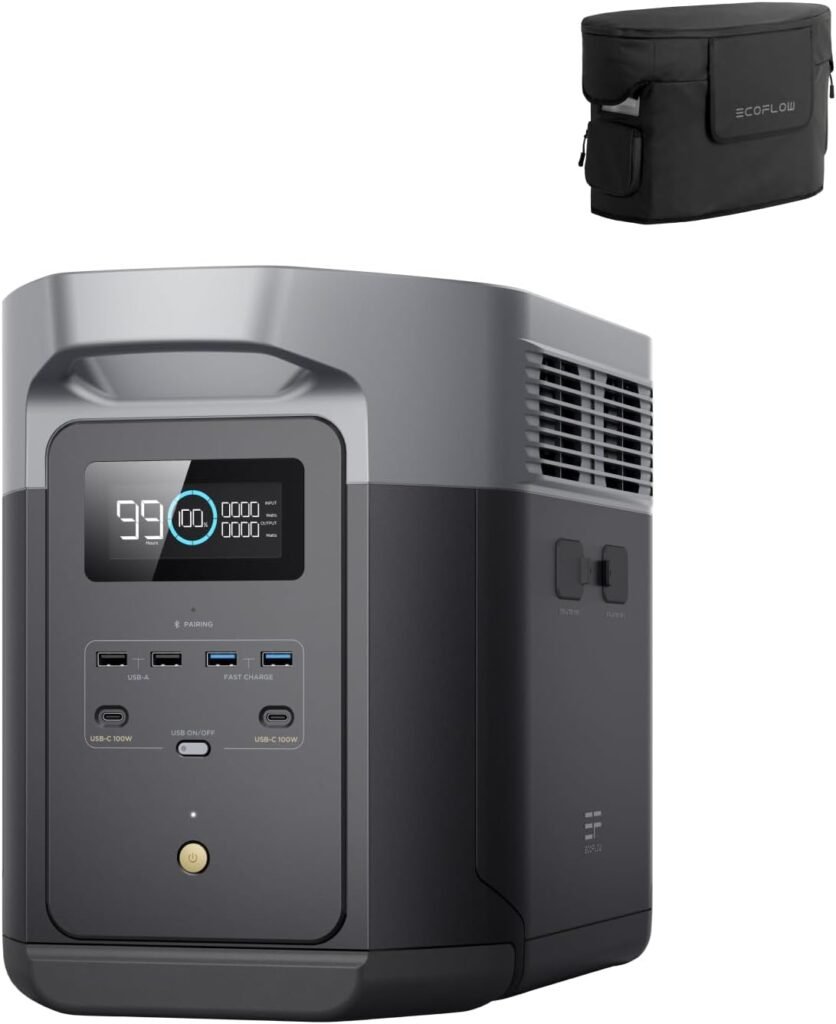
We appreciate products that feel thoughtfully designed and built to last. The DELTA 2 Max has a robust, box-like design with a built-in handle and a protective cover that adds durability and weather resistance for outdoor use.
We’ll note that the protective cover is described as lightweight, waterproof, and wear-resistant. That helps protect the unit from light rain and knocks while transporting it. The overall finish and materials give the impression of a product intended for regular moving between home, vehicle, and campsite.
Port layout and accessibility
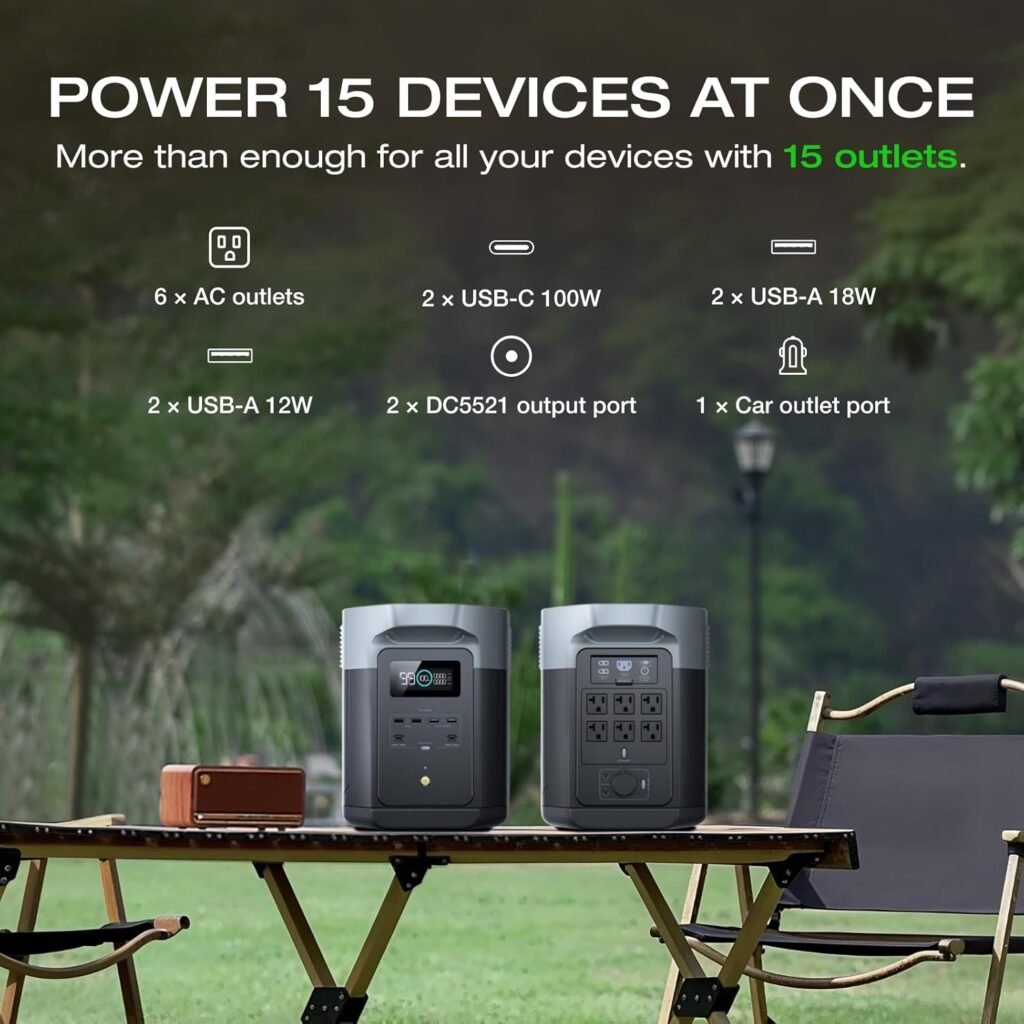
We like having plenty of convenient ports so devices can be plugged in simultaneously. The DELTA 2 Max boasts 15 outlets across AC, USB-A, USB-C, and 12V car ports, which is generous for most households and for multiple users in camping or worksite scenarios.
We’ll point out that the ports are clearly labeled and positioned for easy access. This reduces the need for extension cords and adapters in everyday use.
Protective cover features
We value accessories that extend the life of a product, and the weatherproof bag included with this model does just that. It’s made from water-resistant material and protects the unit from light exposure to the elements and bumps during transport.
We’ll mention that while the cover is helpful against rain and scuffs, it’s not a substitute for storing the unit indoors during heavy storms or extreme weather events.

Battery chemistry and longevity
We consider the battery chemistry to be one of the most important aspects of a portable power station. The DELTA 2 Max uses LiFePO4 (LFP), and that choice brings several real advantages for long-term ownership.
We’ll highlight that LFP batteries are known for thermal stability, long cycle life, and safety compared with many other lithium chemistries. This makes the DELTA 2 Max a stronger long-term investment.
Cycle life and lifespan expectations
We like that the manufacturer claims 3000 full charge cycles until capacity drops to 80%. That’s substantially higher than many competing products, which often use NMC chemistry and advertise only a few hundred to a thousand cycles.
We’ll convert that to user expectations: with 3000 cycles, even if we charged daily, the battery would last many years — the manufacturer suggests more than 10 years of use under normal conditions. Practically, that means lower total cost of ownership and less worry about replacing the battery pack.
Safety and thermal management
Safety matters when we store and transport hundreds or thousands of watt-hours. LFP cells are inherently thermally stable and less prone to thermal runaway than some alternatives.
We’ll also point out that the unit’s internal management system monitors temperature, voltage, and current to protect the battery, and the sturdy casing helps with heat dissipation during high-output use.
Charging performance and speed
We’re most interested in how fast the unit charges in realistic setups. The DELTA 2 Max emphasizes ultra-fast charging, enabled by combining AC and solar inputs or using AC alone at high power.
We’ll note the standout marketing claim: an 80% charge in 43 minutes when combining up to 1000W solar input with AC, and an 80% charge in about 1.1 hours using AC only. Those are impressive numbers that change how we might use the unit.
AC charging times
We appreciate a device that can recharge quickly from wall power, especially after a long outage or heavy usage. The DELTA 2 Max promises an 80% charge in roughly 1.1 hours via AC. That means the unit can get back to useful capacity fast during short windows of wall access.
We’ll underline that fast AC charging is particularly useful for daily use cases—like returning home from a trip with depleted charge—and for emergency preparedness where recharge windows may be limited.
Solar charging and MPPT performance
We value efficient solar input and this model supports up to 1000W of solar power combined with AC. When configured correctly, combining solar and AC inputs accelerates charging significantly.
We’ll highlight that the unit’s MPPT (maximum power point tracking) controller optimizes solar input across different conditions. In full sun with adequate panels, we can get dramatic improvements in recharge times, though real-world conditions (panel placement, shading, weather) will affect output.
Combined charging claims — what to expect
We want to be realistic about the “80% in 43 minutes” claim. It’s achievable under ideal circumstances—strong AC input plus substantial solar input—but results will vary with panel quality and environmental conditions.
We’ll caution that if solar panels are producing less than their rated output, the combined charge time will increase. Still, the speed is impressive for a unit of this capacity and advances practicality for off-grid or emergency uses.
Power output, outlets, and load handling
We look at continuous and peak output to understand what appliances the unit can reliably power. The DELTA 2 Max offers 2400W continuous output and supports up to 3400W via X-Boost mode for certain appliances.
We’ll explain that 2400W is enough for most household devices—refrigerators, microwaves (many mid-size), TVs, laptops, and power tools—while X-Boost allows brief surges for higher-wattage loads.
Outlets and port types
We like that the product includes a wide mix of outputs suited to modern needs: AC outlets for larger appliances, USB-A and USB-C for phones and laptops, and a car-style 12V port for accessories.
We’ll emphasize the convenience of multiple fast-charging USB-C ports that can support laptops and phones simultaneously, reducing the need for separate chargers during travel or tight setups.
Handling inductive and high-startup loads
We often worry about devices like refrigerators and pumps that have high startup currents. The DELTA 2 Max’s 2400W continuous output and X-Boost capability help in that regard, allowing many inductive loads to start and run smoothly.
We’ll note that for very high-power appliances like whole-house HVAC systems or large electric stoves, this unit is not designed to fully replace dedicated circuits or whole-house generators. However, it will support most single-circuit household needs during an outage.
Expandable capacity and modular options
We favor systems that can grow with our needs. The DELTA 2 Max supports expandable capacity from 2kWh to 6kWh by adding up to two additional battery packs. This makes it flexible for longer outages or heavier loads.
We’ll explain that the plug-and-play design simplifies expansion: we can add batteries without complex installations, adjusting capacity to our budget and energy requirements.
When expandable capacity matters
We see expandability as especially useful for families or small businesses that want to extend runtime without purchasing a much larger single unit initially. It also lets us buy incrementally: start with the 2048Wh unit and add batteries later.
We’ll point out that larger extended setups reduce the frequency of recharging and allow us to run multiple devices longer during extended grid failures.
Portability, weight, and transport considerations
We value portability, but we also recognize that higher capacity usually means more weight. The DELTA 2 Max is a substantial unit, and while it has a built-in handle and compact footprint for its capacity, it’s not something we’d want to carry long distances unassisted.
We’ll recommend planning transport with a vehicle or cart and avoid heavy lifting without help. The protective cover helps for short-haul transport and from minor impacts.
Suitability for camping and RV use
We think this unit is a strong candidate for car camping and RV trips where vehicle transport is available. Its quiet operation, powerful output, and solar compatibility make it friendly for overnight stays and boondocking.
We’ll remind readers to check weight and vehicle space before committing, and to consider mounting or securing the unit in transit to avoid damage.
Noise levels and night-time operation
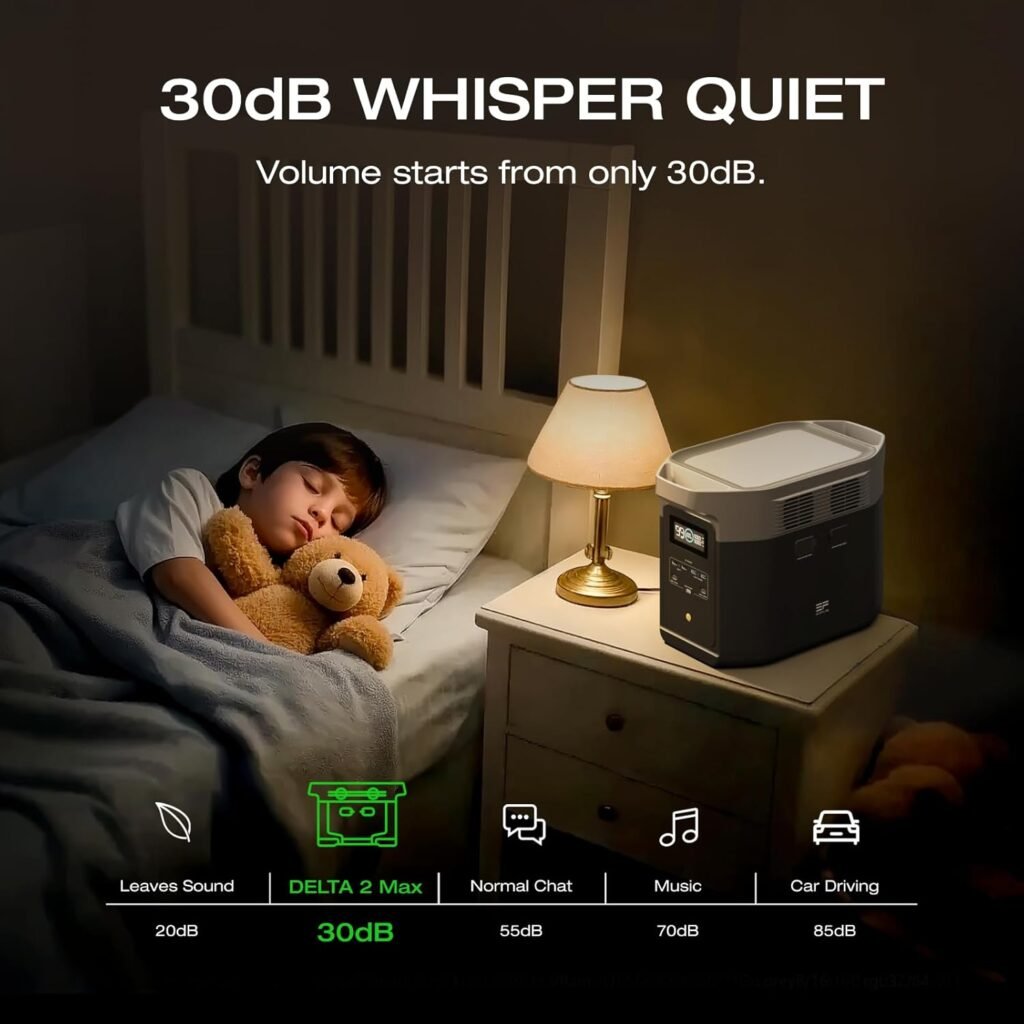
We care about quiet operation, especially when using a generator overnight. The DELTA 2 Max is very quiet, with volume levels starting around 30 dB, which is comparable to a quiet library or whisper.
We’ll say that this makes it well-suited for powering devices while sleeping or during calm outdoor evenings without disturbing others. Quiet operation is a major advantage over fuel-based generators.
Fan noise under heavy load
We’ll note that under heavy continuous loads, fans will speed up and noise increases somewhat, but it remains far quieter than combustion generators. For most household backup use, the noise level remains unobtrusive.
We’ll advise placing the unit on a surface that doesn’t amplify vibration and to avoid enclosed spaces that can reflect sound.
Weatherproofing and protective cover utility
We appreciate that the included protective cover is described as waterproof and wear-resistant. That adds a layer of protection when the unit is used outdoors or stored in garages and sheds.
We’ll clarify that while the cover helps against rain and scrapes, the power station itself is not rated as fully submersible or suitable for prolonged exposure to heavy storms. We should store it indoors for long-term protection.
Durability for outdoor use
We find the protective bag useful for occasional outdoor work and long-term wear. It helps protect ports and surfaces from dust, light precipitation, and sun exposure, which extends the life of the unit when used outside.
We’ll recommend removing the cover during heavy charging if the unit needs better airflow to cool, following manufacturer guidance.
Smart features and app functionality
We like battery systems that include intelligence for monitoring and control. The EcoFlow app provides real-time monitoring, charge planning, and power usage data that helps us manage energy consumption and set automations.
We’ll explain that the app allows firmware updates, monitoring of remaining runtime under specific loads, and toggling modes like X-Boost. These features increase convenience and can make energy use more efficient.
Automation and remote control
We value being able to set automations such as scheduled charging, enabling or disabling outputs, and receiving alerts. We’ll note that these features help us maintain the battery’s health and automate routines like daytime solar charging.
We’ll caution that app experiences vary by region and phone platform, but overall EcoFlow’s app is among the more polished offerings in the portable power space.
Safety, warranties, and customer support
We want reassurance that our investment is protected. The LFP chemistry contributes to inherent safety, and the device includes battery management safeguards against overcharge, short circuits, and thermal events.
We’ll recommend checking EcoFlow’s warranty terms for the DELTA 2 Max, as warranty coverage and length can change by region and retailer. Good customer support and clear return policies matter if anything goes wrong.
Practical safety tips
We’ll advise storing the unit in a stable, ventilated location while charging and avoiding placing anything on top of it. We’ll also recommend keeping the unit dry and away from combustible materials.
We’ll suggest using approved cables and solar panels to prevent damage and ensure safe operation.
Real-world use cases
We’ll describe several scenarios where the DELTA 2 Max is useful and what we can realistically expect in each situation. Practical examples help translate specs into everyday outcomes.
We’ll provide run-time estimates for common devices and scenarios so we have a better sense of how the unit performs in practice.
Home backup for essential circuits
We find the DELTA 2 Max very capable as a partial home backup. It can keep refrigerators, lights, Wi-Fi, and a few medical devices running for many hours depending on load and optional battery expansion.
We’ll explain that by pairing the unit with a proper transfer switch and prioritizing circuits, we can power essentials during short-to-medium outages without the noise and fumes of a gas generator.
Camping and RV use
For camping and RV travel, we like the unit’s quiet operation and solar compatibility. The DELTA 2 Max can run a small fridge, charge phones and laptops, and power lights and portable cooktops for overnight or several-day trips when paired with adequate solar capacity.
We’ll suggest balancing solar panel size and charging expectations relative to daily energy use to avoid draining the battery faster than panels can recharge it.
Emergency power for medical devices
We think the unit offers a reassuring backup for many medical devices like CPAP machines, oxygen concentrators (check wattage), and mobility equipment. However, users must confirm device draw and required continuous power before relying on it for critical medical equipment.
We’ll recommend consulting equipment manuals and potentially investing in a separate medical-grade solution for life-sustaining equipment if required.
Jobsite and mobile work
We like that the DELTA 2 Max can power tools and charge devices at remote worksites, and the X-Boost mode helps start many power tools that need brief surges. The quiet nature also makes it preferable for work in noise-sensitive areas.
We’ll remind readers to verify tool startup wattages and consider supplementing with extra batteries for prolonged jobsite use.
Comparison with key competitors
We often compare units to alternatives to determine value. The DELTA 2 Max competes with other high-capacity portable power stations from brands like Jackery, Bluetti, Goal Zero, and earlier EcoFlow models.
We’ll point out that the LFP battery chemistry and fast charging distinguish it from many competitors that still use NMC chemistry with shorter cycle lives and slower charge rates. The 2400W continuous output and expandability also put it in a strong position.
Strengths versus competitors
We see strengths in cycle life, fast charging, expandability to 6kWh, and a wide assortment of ports. These translate to greater longevity and flexibility than many similarly priced units.
We’ll highlight that some rivals may be lighter or cheaper up-front but often lack LFP longevity, expansion options, or equivalent charging speed.
Where competitors might be preferred
We admit that competitors may offer more compact options for lightweight camping or cheaper solutions for occasional use. If we only need a small power bank for weekend trips, a smaller, lighter unit might be more appropriate.
We’ll also note that full-length warranties and local support may vary by brand and region, and that should factor into buying decisions.
Pros and cons — summary
We like to summarize strengths and weaknesses succinctly so we can weigh them at a glance. The DELTA 2 Max brings many advantages, balanced by some real considerations.
We’ll list the core advantages and limitations to help finalize our view.
Pros
- Long-lasting LFP battery with ~3000 cycles to 80% capacity.
- Fast charging: 80% in ~43 minutes with combined inputs; ~1.1 hours with AC.
- 2400W continuous output, up to 3400W with X-Boost.
- Expandable capacity up to 6kWh with additional batteries.
- Quiet operation (~30 dB baseline).
- 15 outlets and a versatile port selection for multiple devices.
- Weatherproof protective cover included.
- EcoFlow app for monitoring and automations.
We’ll emphasize that these pros make it a compelling choice for long-term ownership, frequent use, and serious backup needs.
Cons
- Heavier and bulkier than smaller portable units, making solo transport harder.
- Not designed to run whole-house high-wattage appliances like central AC or electric stoves.
- Combined charging performance depends on solar conditions and panel quality.
- Upfront cost is higher than entry-level portable power stations.
We’ll remind readers that these cons are relative trade-offs for higher capability and longevity.
Pricing and value proposition
We consider value in terms of total cost of ownership rather than just upfront price. The DELTA 2 Max is priced at a premium compared with starter models, but its LFP chemistry and long rated cycle life often mean a lower effective cost per kWh over time.
We’ll argue that if we plan to use the unit frequently, invest in solar, or need reliable backup, the higher initial cost can pay off through longevity and better performance.
When the price makes sense
We think the purchase makes sense for homeowners, frequent campers, RVers, and small-business owners who want a quiet, durable, and expandable energy solution. If the unit will sit unused most of the time, the cost may be harder to justify compared with smaller options.
We’ll recommend budgeting for solar panels and possibly extra batteries if long runtime or independence from grid recharge is a priority.
Setup, maintenance, and tips for best results
We like practical tips to get the most from a product. Proper setup and maintenance will maximize the DELTA 2 Max’s performance and lifespan.
We’ll provide straightforward steps and suggestions based on common scenarios.
Setup tips
- Place the unit on a flat, stable surface with good ventilation.
- Register the product in the EcoFlow app and update firmware if prompted.
- Use recommended solar panels and cables to ensure reliable input.
- Keep the protective cover handy for travel but remove it during heavy charging if ventilation is limited.
We’ll recommend testing the unit under a few loads at home so we know how it behaves before an emergency.
Maintenance recommendations
- Store the power station in a cool, dry place when not in use.
- Charge it to around 50–70% for long-term storage and top up every few months.
- Avoid leaving it in hot vehicles for extended periods.
- Keep ports clean and inspect cables for wear regularly.
We’ll remind readers to consult the manual for manufacturer-specific care instructions.
Who should buy the DELTA 2 Max?
We want to help readers match the product to their needs. The DELTA 2 Max suits those who want a high-capacity, long-lasting, and fast-charging power station with quiet operation and room to expand.
We’ll list ideal user profiles to clarify fit:
- Homeowners preparing for frequent or extended outages who want quieter, cleaner backup than a gas generator.
- RVers and car campers who need reliable power and have vehicle transport for the unit.
- Small-business owners requiring reliable power for essential equipment during outages.
- Users looking for long-term value through LFP cycle life and expandable capacity.
We’ll caution that if someone only needs a lightweight unit for occasional phone charging, a less expensive, smaller model may be more appropriate.
Final verdict
We want a clear, balanced conclusion about whether this product is worth buying. Overall, we find the EF ECOFLOW Portable Power Station DELTA 2 Max to be a powerful, durable, and future-proof solution for serious portable energy needs.
We’ll reiterate that its combination of LFP longevity, fast charging, expandable capacity, and quiet operation make it an excellent long-term investment for homeowners, frequent travelers, and anyone who needs dependable off-grid power. The trade-offs—weight and higher upfront cost—are reasonable given the performance and lifespan.
Frequently asked questions (FAQs)
We like to answer common buyer questions so we can clear final doubts. These brief FAQs address typical concerns we expect people to have.
Q: Can the DELTA 2 Max run a full-size refrigerator?
A: Yes, for many refrigerators the unit can run them for hours depending on the fridge’s efficiency and duty cycle. Check the fridge’s starting and running wattage to estimate runtime accurately.
Q: How long will the battery last in normal use?
A: With the rated 3000 cycles to 80% capacity, the LFP battery should provide many years of reliable service—commonly over a decade with typical residential use.
Q: Can we expand capacity later?
A: Yes, expansion to up to 6kWh is supported by adding up to two extra battery packs in a plug-and-play fashion.
Q: Is the unit safe for indoor use?
A: Yes, because it is battery-powered and produces no exhaust, it’s safe to use indoors. Maintain ventilation during heavy continuous charging to manage heat.
Q: What are the best solar panels to pair with it?
A: We recommend using high-efficiency panels capable of contributing toward the 1000W combined solar input. EcoFlow-branded panels or other reputable panel brands with compatible connectors provide the best results.
We’ll suggest contacting EcoFlow support for compatibility confirmation if using third-party panels.
We’ve covered the DELTA 2 Max’s core strengths, real-world performance, and practical considerations. If you’d like, we can run specific runtime estimates for your devices or compare this model directly with a particular competitor to help decide which fits your needs best.