Disclosure: As an Amazon Associate, I earn from qualifying purchases.
Have we ever wished we could carry reliable, clean power with us wherever we go, without worrying about bulky panels or unpredictable weather?

Is the EF ECOFLOW 100W Flexible Solar Panel Worth Our Attention?
We see more of us wanting off-grid freedom, backup power, and eco-friendly solutions. This panel promises high efficiency, durability, and flexibility in a slim, lightweight design. In this review, we walk through how it actually performs, where it shines, and where we should set realistic expectations.
We will focus on how this 100W flexible panel fits into real-world use cases: from RVs and boats to cabins, camping setups, and backup power at home.
Key Features at a Glance
This product packs several strong features into a relatively compact form. Understanding these core points helps us decide if it suits our needs and our setup.
We break down the most important specs and capabilities here before going into detailed performance and user experience.
| Feature | Specification / Description |
|---|---|
| Product Name | EF ECOFLOW 100W Flexible Solar Panel |
| Rated Power | 100W |
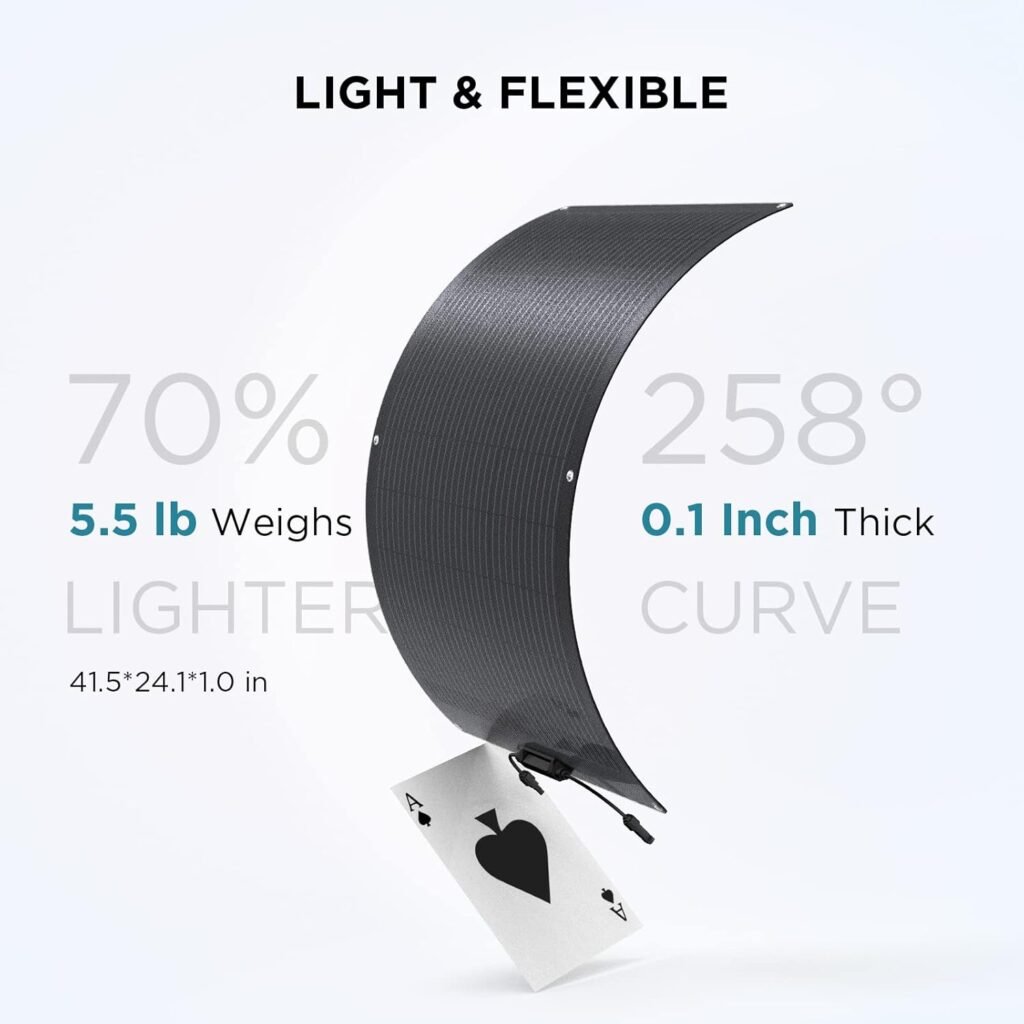
| Panel Size | 41.5 x 24.1 x 1.0 inches |
| Weight (Single Panel) | 5.1 lb |
| Daily Energy Production (Typical) | 400–500 Wh per day (or 35–45 Ah at 12V, depending on sun availability) |
| Solar Cell Efficiency | Up to 23% conversion efficiency |
| Waterproof Rating | IP68 (dustproof, waterproof, suitable for heavy rain and wind) |
| Mounting Options | Pre-cut eyelets for hooks; compatible with adhesives for surface mounting |
| Ideal Use Cases | Off-grid solar kits, RVs, boats, cabins, PV charging, EcoFlow Power Kits & Ecosystem |
| Flexibility | Flexible design to contour to curved or uneven surfaces |
Design and Build Quality
We usually judge a solar panel first by how it feels in our hands and how easily it fits our setup. This EF ECOFLOW 100W panel aims to be both durable and flexible, which is not always easy to achieve together.
We find that the physical design is particularly suited for mobile and irregular surfaces—perfect if we are not working with a flat rooftop.
Size, Weight, and Form Factor
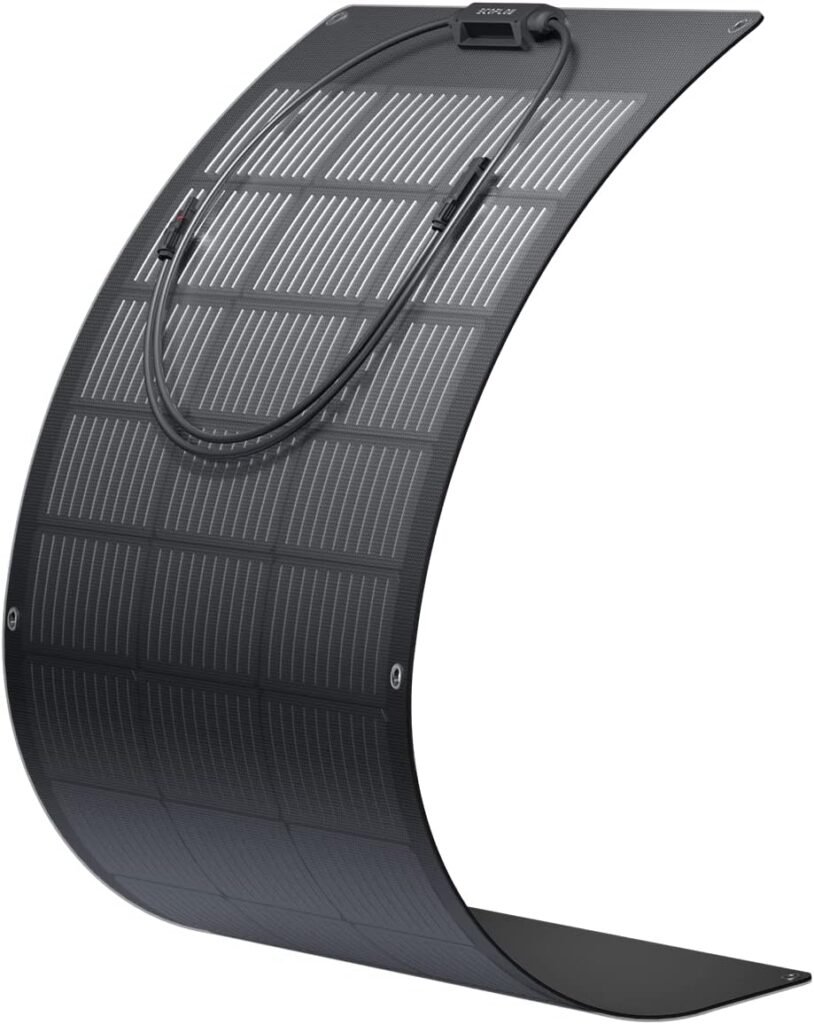
At 41.5 x 24.1 x 1.0 inches and only 5.1 lb, this panel is noticeably lighter and slimmer than many rigid 100W panels. That matters when we need to mount it on curved RV roofs, boat decks, or lightweight structures.
We appreciate that the thin profile helps reduce wind resistance and makes it easier to handle during installation. It also makes storage simpler if we are using it in a portable configuration.
Flexible Construction
The “flexible” part is not just a marketing term here. The panel can bend to fit mildly curved surfaces, such as the roof of an RV or the cabin of a boat.
We should still remember that “flexible” does not mean we can fold it sharply or step on it. It is best used on surfaces with gentle curves, where traditional rigid panels would either not fit or look awkward.
Build Materials and Durability
Even with its lightweight design, the panel feels robust. The cells are embedded in protective layers designed to handle outdoor exposure.
We get a sense that this panel is made to stay mounted long term, not just taken out for occasional use. The top layer and sealing give us confidence that it will hold up under sun, wind, and rain over time.

High Efficiency: What Does 23% Really Mean?
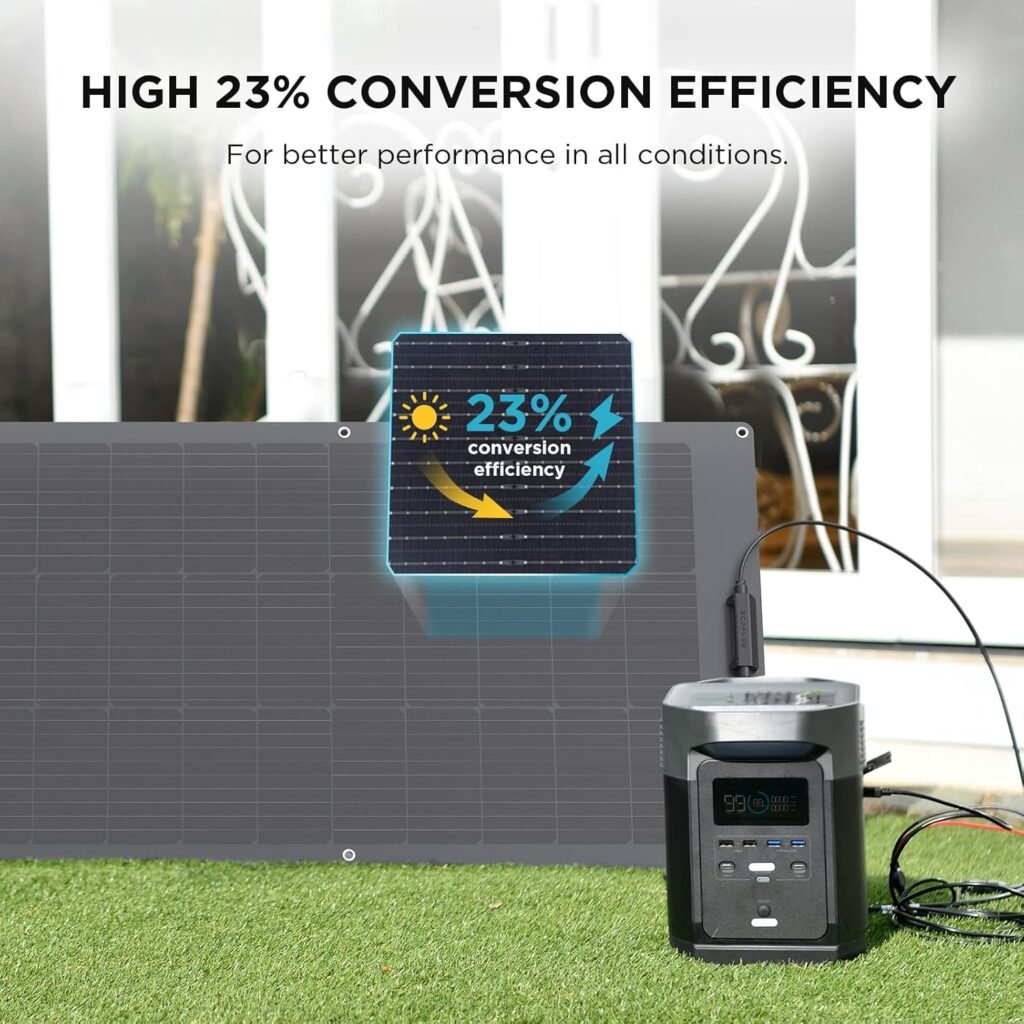
Efficiency is one of the biggest selling points of this panel, with a rated conversion efficiency of up to 23%. This is well above many older or budget panels, which often range around 17–20%.
We care about efficiency because higher efficiency means we get more power from the same amount of surface area, which is crucial when space is limited.
Real-World Daily Output: 400–500 Wh
According to the product details, we can expect roughly 400–500 Watt-hours (Wh) per day from this panel in good sun conditions. That equals about 35–45 Amp-hours (Ah) per day on a 12V system.
This estimate makes sense for many locations with decent sun, assuming we position the panel well and avoid shading. In real scenarios, we should think in terms of a range, not a fixed number, as clouds and positioning make a big difference.
Why Efficiency Matters for Small Systems
If we are working with a van, camper, small boat, or compact balcony, space is a precious resource. A more efficient panel means:
- We can achieve our power target with fewer panels.
- We can fit more power into tight or irregular spaces.
- We need to carry less weight for the same energy production.
For us, this is the kind of panel that makes sense when every inch of roof or deck space matters.
Weather Resistance and IP68 Waterproofing
Outdoor gear lives or dies by its ability to handle real weather. IP68 is one of the highest common ratings for dust and water resistance.
We want panels that can stay outside in the rain, wind, and dust without us constantly worrying about them.
What IP68 Means for Us
An IP68 rating indicates:
- Complete protection against dust and small particles.
- Protection against continuous immersion in water at a certain depth (specified by the manufacturer).
In practical terms, this panel is ready for:
- Heavy rain and wind.
- Dusty environments like desert areas or unpaved roads.
- Marine moisture and salty air (though we still want to rinse salt off occasionally for longevity).
All-Weather Convenience
Because the panel is designed for harsh conditions, we can mount it permanently on an RV roof or boat without worrying about every storm that passes through.
We still want to use common sense—secure mounting, avoiding areas that hold standing water—but knowing the panel itself is dustproof and waterproof adds peace of mind.
Compatibility with EcoFlow Power Kits and Ecosystem
One standout aspect of this panel is its integration with EcoFlow’s broader ecosystem—Power Kits, portable power stations, and other EcoFlow components.
If we already use EcoFlow gear, this panel becomes especially attractive as it is designed to work smoothly with their products.
Seamless Integration with EcoFlow Systems
EcoFlow markets a complete photovoltaic system, and that includes:
- Smart MPPT controllers built into many of their power stations.
- Easy plug-and-play wiring options.
- Monitoring via apps where supported.
Using this panel with an EcoFlow Power Kit or portable power station usually means minimal setup complexity, clear monitoring, and optimized charging performance.
Using the Panel with Other Systems
Even if we are not using EcoFlow batteries or inverters, this panel still works in any standard solar setup:
- Off-grid 12V or 24V systems with a compatible charge controller.
- Third-party battery banks and inverters.
- Custom DIY solar kits.
We just need to size the charge controller correctly and follow standard wiring practices, which we discuss later.
Mounting and Installation Options
Flexible panels give us more placement options than rigid ones, and this model takes advantage of that with pre-cut eyelets and a design that works well with adhesive mounts.
We appreciate the versatility here because every roof and project is a little different.
Pre-Cut Eyelets for Hanging and Securing
The pre-cut eyelets along the panel edges let us:
- Hang the panels temporarily with hooks, cords, or carabiners.
- Use screws with washers or bolts (with care) for more permanent mounting.
- Tie them down on tents, tarps, railings, or temporary frames.
This gives us quick deployment options, which is handy for camping or short-term setups.
Using Adhesives on Surfaces
For permanent or semi-permanent installations, we can use compatible adhesives to bond the panel to surfaces such as:
- RV roofs (EPDM, fiberglass, or metal, depending on adhesive choice).
- Boat decks.
- Cabin roofs or curved structures.
We should choose outdoor-grade, UV-resistant adhesive recommended for solar or RV use. We also want to leave a way for some airflow underneath if possible to help with cooling, although flexible panels typically sit closer to the surface.
Performance in Real-World Conditions
Numbers on paper are helpful, but what really matters is how the panel behaves when we take it out into the sun, clouds, heat, and partial shade.
We find that this panel’s high efficiency and quality construction give it solid performance across a range of conditions.
Sun Availability and Daily Output
The advertised 400–500 Wh per day assumes:
- Several hours of strong sunlight.
- Good orientation (ideally facing the sun).
- Minimal shading.
In an RV or boat scenario, we might get that range on sunny days, while cloudy conditions could cut production by half or more. That is true of any solar panel, so we plan our system with a margin for bad weather.
Performance in Sub-Optimal Light
The high-efficiency cells help the panel continue to produce usable energy even when conditions are less than perfect, such as:
- Morning and late afternoon light.
- Light cloud cover.
- Slightly off-angle positioning.
We will not get full 100W under these conditions, but we might still see a decent charge trickling into our batteries rather than almost nothing.
What Can We Actually Power with This Panel?
Turning daily energy output into real devices makes it easier to understand if this panel suits our needs. With around 400–500 Wh per day, we can support a modest set of essential loads.
We should think of this panel as a solid building block in a small-to-medium off-grid system, not as the only source for an entire large home.
Example Daily Usage Scenarios
Here are some rough examples based on typical consumption:
- Smartphone charging: ~5–10 Wh per full charge
- Tablet or small laptop: ~30–60 Wh per charge
- 12V fridge (efficient, small): ~200–400 Wh per day
- LED lighting (5–10 lights): ~30–80 Wh per evening
- Wi-Fi router / small devices: ~20–50 Wh per day
With roughly 400–500 Wh per day:
- We can often run a small 12V fridge, lighting, and charge several devices.
- For heavier loads like large laptops, fans, or small pumps, we may need to watch usage, but one 100W panel can still contribute meaningfully.
- For more demanding setups (microwave, AC, power tools), we would likely need multiple panels and larger storage.
Expanding with Multiple Panels
One strong point of using a 100W panel is expandability. We can:
- Start with one panel and add more later.
- Wire panels in series or parallel (depending on our controller and battery voltage).
- Build a scalable system that grows with our needs.
If we stack three of these panels, for instance, we are in the range of 1,200–1,500 Wh per day in good sun, which starts to support much more robust off-grid living.
Ideal Use Cases for This Flexible Panel
We like to match the right panel to the right scenario. This EF ECOFLOW 100W flexible panel stands out in several specific roles where its flexibility, efficiency, and waterproofing matter the most.
We list some of the most appropriate uses, along with why it performs well in each setting.
RVs, Vans, and Campers
The curved and often limited roofs of RVs and vans make flexible panels particularly attractive. With this panel, we get:
- Lightweight mounting that limits impact on vehicle weight and fuel efficiency.
- Ability to follow curved roof contours.
- Reduced profile and wind resistance.
We can create a clean, low-profile solar array that does not require heavy rooftop racks.
Boats and Marine Use
On boats, IP68 waterproofing and corrosion resistance are critical. Sailing or boating often means exposure to saltwater, spray, and harsh sun.
We like this panel for marine environments because:
- It is built to handle water and wind.
- It can be mounted on slightly curved surfaces, biminis, or decks.
- It works well as part of a silent, fuel-free charging system for batteries on board.
Off-Grid Cabins and Tiny Homes
For cabins, sheds, and tiny homes where roof space might be restricted or irregular, the flexible design again proves useful.
We can:
- Install panels on roofs that might not support heavy rigid panels.
- Add solar power with minimal structural changes.
- Pair the panel with EcoFlow Power Kits or other battery systems for a simple off-grid solution.
Emergency Backup and Portable Power
Because the panel is only 5.1 lb and relatively compact, it is also practical for:
- Emergency backup kits at home.
- Portable power setups with power stations during outages.
- Temporary installations at campsites or outdoor events.
We can hang it from temporary frames, attach it with hooks, or lay it out as needed during an emergency.
Installation Tips and Best Practices
Proper installation makes a huge difference in performance and longevity. Even a high-quality panel can disappoint if mounted poorly or wired incorrectly.
We share some practical tips to help us get the most from this panel.
Positioning and Orientation
To maximize output, we want to:
- Point the panel toward the sun as directly as possible.
- Minimize shading from trees, antennas, vents, or railings.
- Keep the panel surface as clean as we reasonably can.
If the panel is permanently mounted flat on a roof, output will be a bit less optimal than with a tilting mount, but the convenience often outweighs the small efficiency loss.
Cooling and Airflow
Solar panels get hot in direct sunlight, and heat can reduce their efficiency. With flexible panels that lie close to the mounting surface, airflow is limited.
We can help by:
- Avoiding dark, heat-trapping surfaces if possible.
- Leaving small gaps around the edges when using adhesives.
- Keeping the panel clean to avoid extra heat absorption from dirt.
Even small improvements in temperature can help maintain better performance over time.
Wiring and Charge Controllers
We always need a proper charge controller between the panel and our battery (unless we are plugging directly into a power station that has an internal controller).
We should:
- Size the controller based on the panel’s voltage and current.
- Use appropriate cable gauges to minimize voltage drop.
- Follow EcoFlow’s or our controller’s wiring diagrams carefully.
If we join multiple panels:
- Series wiring increases voltage, useful for higher-voltage controllers.
- Parallel wiring increases current, useful if we want to keep voltage lower.
In all cases, we match our controller’s supported input to our panel configuration.
Pairing with EcoFlow Power Stations and Kits
When we combine this panel with EcoFlow Power Kits or portable power stations, setup can become almost plug-and-play.
We think this is a strong advantage for us if we want a polished, integrated system rather than a fully DIY build.
Plug-and-Play Charging
With a compatible EcoFlow power station, we usually:
- Connect the panel to the power station’s solar input using the correct cable.
- Let the built-in MPPT controller optimize charging.
- Monitor input power and charge status from the power station’s screen or app.
This simplifies things considerably compared to sourcing separate controllers and wiring everything from scratch.
Smart Monitoring and Control
Many EcoFlow devices offer:
- Real-time monitoring of solar input (watts in).
- Battery state-of-charge and estimated runtime.
- App-based control and settings, such as charge limits.
Pairing this panel with those systems helps us see exactly what our panel is producing and adjust our habits or panel placement accordingly.
Pros and Cons of the EF ECOFLOW 100W Flexible Solar Panel
No product is perfect. We find that this panel has several strong advantages, along with a few limitations that we should keep in mind.
We summarize the main pros and cons so we can quickly see if it matches our expectations.
Advantages
-
High efficiency (up to 23%)
We get more output from a smaller area, which is key when roof space is limited. -
Lightweight and flexible
At only 5.1 lb, the panel is easy to handle and can be mounted on curved or delicate surfaces. -
IP68 waterproofing
We can leave it outside in serious weather without worry about dust and rain. -
Excellent compatibility with EcoFlow ecosystem
It integrates nicely with EcoFlow Power Kits and power stations for easier setup and monitoring. -
Multiple mounting options
Pre-cut eyelets and adhesive compatibility give us versatile installation possibilities.
Limitations
-
Requires careful handling despite flexibility
While it bends, it is not meant for sharp folds, heavy loads, or walking on it. -
Less airflow than rigid framed panels
Being mounted close to surfaces can mean higher operating temperatures, which may slightly reduce efficiency. -
Single 100W panel may be insufficient for power-hungry setups
Larger off-grid systems will likely need multiple panels to cover all loads comfortably.
Maintenance and Longevity
To get the longest life and best performance from this panel, we should treat it as serious equipment rather than a throwaway gadget.
The good news is that maintenance is minimal, and flexible design often results in fewer fragile points like glass.
Cleaning the Panel Surface
Keeping the panel clean ensures more sunlight reaches the cells. Over time, dust, pollen, bird droppings, and salt (for marine environments) can reduce output.
We can:
- Wipe the surface gently with a soft cloth and mild soapy water.
- Rinse with clean water afterward.
- Avoid abrasive materials or harsh chemicals that can damage the surface.
Regular, gentle cleaning every few weeks or after storms helps maintain strong performance.
Inspecting Mounts and Cables
We should occasionally inspect:
- Eyelets, hooks, or adhesive points to ensure they remain secure.
- Cables and connectors for any signs of wear, corrosion, or stress.
- The panel’s surface for cracks, deep scratches, or other damage.
Catching small issues early can prevent bigger failures down the road.
How This Panel Compares to Rigid Panels
We often ask ourselves: should we use flexible or rigid panels? Each type has its place, and the right choice depends on our priorities.
Comparing this EF ECOFLOW flexible panel with typical rigid glass panels helps us see when it stands out.
Advantages Over Rigid Panels
- Weight: At 5.1 lb, it is much lighter than most rigid 100W glass panels.
- Flexibility: It can conform to curved surfaces, which rigid panels simply cannot do.
- Low Profile: It sits close to the surface, which some of us prefer for aesthetics and aerodynamics.
These benefits are especially important for mobile or curved installations.
Trade-Offs Compared to Rigid Panels
- Cooling: Rigid panels usually have better airflow behind them due to their frames, potentially staying cooler and slightly more efficient in hot conditions.
- Mechanical Support: Glass and framing often offer more structural rigidity, which can be beneficial in some high-impact environments.
- Mounting Hardware: Rigid panels often come with more standardized mounting hardware and brackets.
For most RV, boat, and lightweight roof applications, we find the flexible design worth these trade-offs.
Who Is This Panel Best Suited For?
From everything we have seen, this panel is not trying to be a one-size-fits-all solution. Instead, it is optimized for certain users and setups.
We think the EF ECOFLOW 100W Flexible Solar Panel is an excellent choice for:
- RV, van, and camper owners who want light, flexible, low-profile panels.
- Boat owners who need highly waterproof, curved-surface-compatible solar.
- Off-grid cabin or tiny home owners with limited or irregular roof space.
- EcoFlow power station users who want seamless, integrated solar charging.
- People assembling modular systems who might add panels gradually and appreciate not having bulky glass units.
If we fall into one of these groups, this panel deserves serious consideration.
Practical Planning: Sizing Our System with This Panel
Before buying, we should always think about our overall energy needs and whether one or more of these panels will cover them.
Thinking in terms of daily Watt-hours makes planning more concrete for us.
Estimating Our Daily Energy Needs
We can list the devices we plan to power, estimate how long we use them daily, and multiply:
| Device | Power (W) | Hours/Day | Daily Use (Wh) |
|---|---|---|---|
| 12V Fridge | 40 W avg | 8 h | 320 Wh |
| LED Lights (5 total) | 5 W each | 4 h | 100 Wh |
| Smartphone (2 units) | 10 W each | 1 h | 20 Wh |
| Laptop | 60 W | 2 h | 120 Wh |
| Misc. USB Devices | 10 W | 2 h | 20 Wh |
| Total | 580 Wh |
In this example, a single 100W panel producing 400–500 Wh on a sunny day may not fully cover 580 Wh, but it gets us close. Adding a second panel would likely give plenty of headroom.
Matching Panels to Storage
We also want to size our battery bank accordingly. There is no point in producing 500 Wh a day if we cannot store it.
Roughly:
- A 12V 100Ah battery stores about 1,200 Wh (usable portion less, depending on chemistry and depth of discharge).
- If we expect 400–500 Wh a day from one panel, a 100Ah battery gives us some buffer for cloudy days.
Pairing this panel with an EcoFlow power station simplifies storage planning, as we can see the Watt-hour capacity directly in the product specs.
Our Overall Verdict on the EF ECOFLOW 100W Flexible Solar Panel
After looking at performance, design, installation, and real-world practicality, we see this panel as a strong option in the flexible solar category.
We especially appreciate its high efficiency, lightweight build, waterproofing, and seamless fit with EcoFlow’s broader ecosystem.
Strengths That Stand Out
- It offers impressive efficiency (up to 23%), squeezing more power out of a compact footprint.
- The IP68 rating and solid construction make it genuinely ready for outdoor, all-weather use.
- Its flexible, lightweight design makes it ideal for RVs, boats, and curved or delicate roofs.
- Integration with EcoFlow Power Kits and power stations lowers the barrier for getting a reliable, smart off-grid system up and running.
Reasonable Expectations and Final Thoughts
We do want to keep expectations realistic:
- One 100W panel is a great starting point or supplement, but not a full solution for heavy power users.
- Installation still demands care, especially with wiring, cooling, and surface preparation.
- While flexible, the panel still needs respectful handling to avoid damage.
For those of us seeking a high-quality, flexible solar solution that meshes beautifully with EcoFlow’s ecosystem—and that can stand up to tough outdoor conditions—the EF ECOFLOW 100W Flexible Solar Panel with High Efficiency Solar Modules, IP68 Waterproofing, Ideal for Off-Grid Solar Panel Kits, PV Charging, Power Kits & Ecosystem is a very compelling choice.
We see it as an excellent building block for reliable, portable, and efficient off-grid power, whether we are traveling, sailing, or simply preparing our home for the unexpected.