Disclosure: As an Amazon Associate, I earn from qualifying purchases.
Have we ever wished we could bring wall-outlet power with us anywhere, without the noise and fumes of a gas generator?
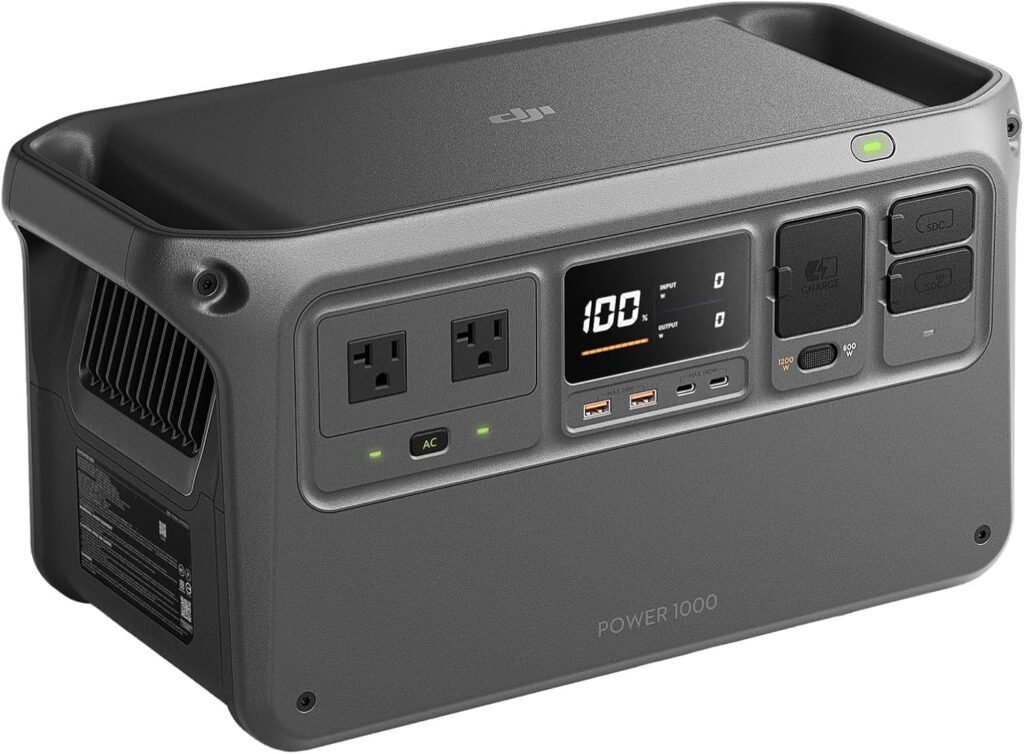

What Is the DJI Power 1000 Portable Power Station?
When we talk about the DJI Power 1000 Portable Power Station, we are talking about a serious power hub in a compact box. It is built around a 1024Wh LiFePO4 battery, delivers up to 2200W continuous AC power (2600W peak), and stays whisper-quiet at around 23 dB.
This unit is designed as a portable, all‑electric “power box” for home backup, camping, van life, and work sites. It gives us multiple AC outlets, dual 140W USB‑C ports, and solar-charging capability, all wrapped up in DJI’s familiar build quality and engineering.
Key Specifications at a Glance
Before we get into how it feels to use, it helps to see the basics in one place. This product packs a lot of features, and the numbers matter if we are planning actual real‑world scenarios like running a fridge or charging laptops.
Here is a quick breakdown:
| Feature | Specification / Detail |
|---|---|
| Product Name | DJI Power 1000 Portable Power Station |
| Battery Capacity | 1024Wh (watt-hours) |
| Battery Chemistry | LiFePO4 (Lithium Iron Phosphate) |
| AC Output (Continuous) | 2200W |
| AC Output (Peak) | 2600W |
| USB-C Output | Dual 140W USB-C fast-charging ports |
| Noise Level | As low as 23 dB (ultra-silent) |
| Recharge Time (AC, 0–80%) | Around 50 minutes |
| Recharge Time (AC, 0–100%) | Around 70 minutes |
| Recharge Time (Solar, 0–100%) | About 80 minutes (under optimal conditions, panel optional) |
| Typical Appliance Coverage | Capable of powering up to about 99% of common household appliances |
| Primary Use Cases | Home backup, camping, RV/van life, DIY work sites, photography/videography, travel |
| Brand | DJI (known for drones, imaging gear, and smart power solutions) |
We see right away that DJI is positioning this as a premium, high-output power station. It is not just for topping off phones; this is for running serious hardware.
Design and Build Quality
In our hands, the DJI Power 1000 feels like a thoughtfully engineered piece of equipment rather than a cheap battery box. The casing is solid, the handles feel secure, and the layout of ports and buttons is intuitive.
DJI has a long track record with demanding hardware—from drones to gimbals—and that experience shows up in the overall finish and robustness. The power station feels ready to be tossed into a car trunk, carried to a campsite, or parked next to a home workstation without looking out of place.
Port Layout and Usability
We appreciate that the controls and ports are clearly labeled and logically grouped. The AC outlets are separated from the USB and DC outputs, making it easier to plug in multiple devices without cables getting in each other’s way.
The display is another standout. It typically shows us input and output power, remaining battery percentage, and estimated run time. When we are managing power carefully—say during an outage or on a long boondocking trip—those real-time readouts are invaluable.
Battery Technology: Why LiFePO4 Matters
Inside the DJI Power 1000, DJI uses LiFePO4 (Lithium Iron Phosphate) cells. This chemistry is different from conventional lithium-ion in several meaningful ways.
LiFePO4 batteries generally last more charge cycles, handle higher temperatures better, and are more stable and less prone to thermal runaway. For us as users, that translates into better long-term reliability and safety.
Cycle Life and Longevity
Although exact cycle numbers can vary, LiFePO4 batteries typically deliver thousands of cycles before dropping to around 80% capacity. That means we can charge and discharge the DJI Power 1000 regularly for years and still get strong performance.
If we plan to use a power station frequently—such as for off-grid living, frequent travel, or nightly home backup—this longer lifespan becomes a big cost advantage over time.

Power Output: Running 99% of Household Appliances
One of the big claims here is that the DJI Power 1000 can power “99% of household appliances.” While no single box will truly cover every possible device, the 2200W continuous and 2600W peak output make this product highly capable.
That wattage range covers things like refrigerators, microwaves, CPAP machines, TVs, computers, power tools, and many kitchen appliances. We can bring a surprising amount of our home comfort with us—or keep many essentials running in a power outage.
Real-World Scenarios and Examples
To make this more concrete, here are some approximate examples of what a 1024Wh battery with 2200W output can handle. These are estimates and will vary with actual device draw and conditions:
- A 60W laptop: potentially 12–14 hours of power
- A 10W LED light: possibly over 70–80 hours
- A 500W blender: short bursts, dozens of cycles between charges
- A 900W microwave: several 5‑minute sessions per full charge
- A small 100W fridge: roughly 7–8 hours of active running time (often spread across more actual hours due to compressor cycling)
We do not want to max out the 2200W output constantly, but it is reassuring to know we have that ceiling when we need to start high-draw devices or run more than one appliance at the same time.
Fast Recharging: Back to 100% in About 70 Minutes
One of the standout features of the DJI Power 1000 is just how quickly it refills. Using grid power, we can go from empty to 80% in around 50 minutes, and to 100% in about 70 minutes.
This is particularly helpful when we have limited windows to charge—say we are at a hotel, coworking space, or a friend’s house, and we want to fully top off before heading back to the campsite or on the road.
Benefits of Rapid Charging in Daily Life
Fast recharging is not just a spec; it changes how we use the device:
- We can charge the power station during a quick stop and have enough power for an overnight camp.
- During rolling blackouts, we can rebuild a large portion of our capacity in between outage windows.
- On road trips, we can pair short charging stops with quick meals and still leave with a full battery.
We spend less time “waiting for the battery” and more time just using it as a tool that quietly supports whatever we are doing.
Solar Charging: Ready for Off-Grid Use
Even though the solar panel is optional, the DJI Power 1000 is clearly built with solar in mind. Under the right conditions, we can recharge this unit in roughly 80 minutes with a suitable solar panel setup.
Of course, we need good sunlight and compatible panels and wiring, but it is encouraging to know that the system is designed for efficient solar input. For those of us interested in more sustainable or off-grid living, this can make a real difference.
Why Solar Compatibility Matters
Solar charging means we are not tethered to wall outlets. It opens up a few important use cases:
- Long camping or van trips where we want to stay out for days or weeks
- Emergency situations where grid power may be unavailable but daylight is still reliable
- Remote job sites or filming locations without easy access to regular electricity
We like that DJI positions this unit as a true “solar generator” option, even though the panel is sold separately. It gives us flexibility to grow into solar over time if we are not ready on day one.
USB-C and Device Charging: Dual 140W Output
The DJI Power 1000 includes dual 140W USB‑C ports, and that is a big deal if we use modern laptops, tablets, or cameras. Many high-end devices now support USB‑C PD (Power Delivery), and 140W output puts this station among the more advanced chargers.
With two such ports, we can charge two demanding devices efficiently at the same time. That might be two 16‑inch MacBook Pros, or a gaming laptop and a tablet, or a laptop plus a camera battery charger.
Efficiency for Creators and Remote Workers
For content creators, photographers, videographers, or remote workers, the dual 140W USB‑C design is especially appealing:
- We can fast-charge laptops while also running lights or monitors from the AC outlets.
- We avoid carrying multiple large brick chargers.
- We can recharge cameras, drones, tablets, phones, and other gear all from one central hub.
This product clearly reflects DJI’s understanding of creators’ needs, given the brand’s roots in drones and imaging.
Ultra-Silent Operation: 23 dB Noise Level
Noise is an underrated factor when we choose a portable power station. A lot of products get pretty loud once their fans spin up under load or while charging. DJI Power 1000 stands out here with an ultra-silent operation of around 23 dB.
That is quieter than many refrigerators, and below most normal conversation levels. It is closer to a very quiet room at night or soft rustling leaves.
Why Quiet Matters in Real Use
Silent operation might sound like a nice-to-have, but it becomes essential in certain contexts:
- At night in a small apartment or bedroom, where we do not want a constant hum
- In a tent or RV, where the sound can feel amplified in the confined space
- On film sets, during audio recording sessions, or podcasting, where ambient noise is the enemy
- In shared spaces, where we want to be considerate of family, roommates, or neighbors
The fact that DJI got it certified by five SGS noise tests shows they took this feature seriously instead of treating it as an afterthought.
Safety and Reliability
When we are dealing with over a kilowatt-hour of stored energy and up to 2200W of output, robust safety systems are essential. While many power stations claim to be safe, not all are engineered at the same level.
DJI brings its heritage in aviation-grade reliability, which we find reassuring. Stable LiFePO4 chemistry, smart battery management, and multiple layers of protection all help reduce risk.
Protection Features We Can Expect
Though every brand names protections slightly differently, we typically see safeguards like:
- Overload and short-circuit protection
- Overcharge and over-discharge protection
- Temperature monitoring and automatic thermal shutoff
- Voltage and current regulation on different outputs
All these systems work together to protect both the power station and our connected devices. We can plug in our expensive electronics with more confidence.
Use Cases: Where the DJI Power 1000 Shines
The DJI Power 1000 is versatile enough to fit into many different situations. To really judge whether it is right for us, it helps to picture how we might actually use it day to day—or in emergencies.
Let us walk through a few likely scenarios.
Home Backup and Emergency Preparedness
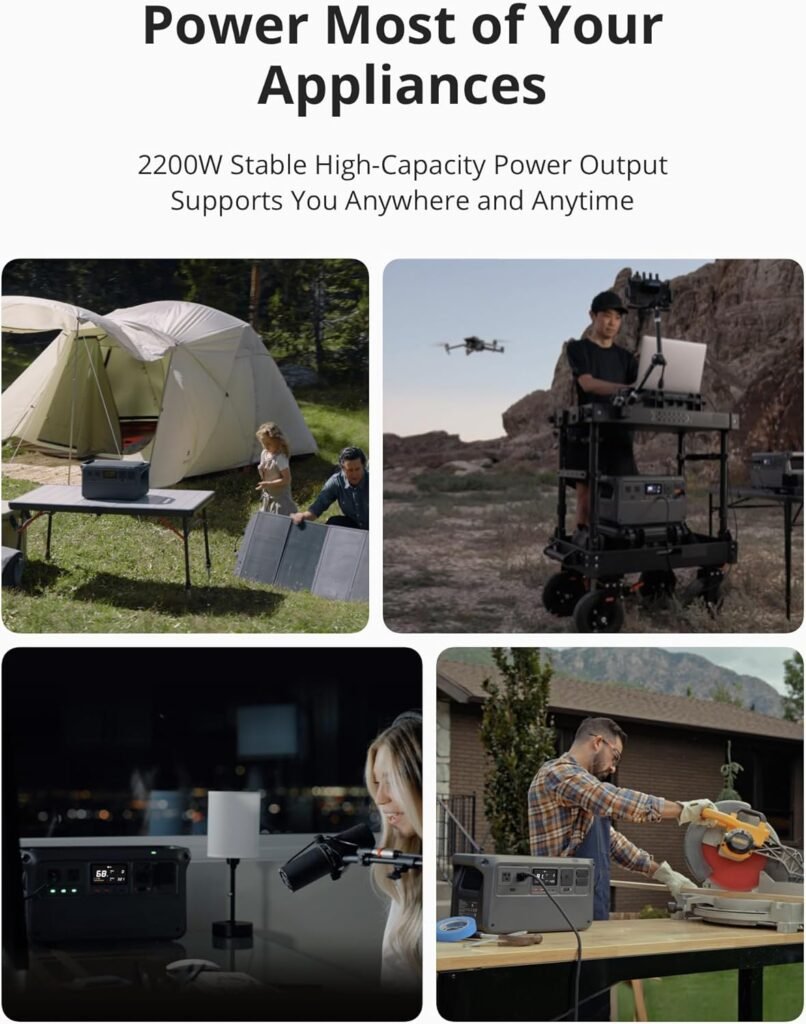
For many of us, the first reason to consider a power station is home backup. With a 1024Wh capacity and 2200W output, the DJI Power 1000 can cover lots of short-term needs:
- Keep internet routers, modems, and laptops running during power outages
- Run a CPAP machine or other critical low-to-mid power medical device
- Power a fridge or freezer long enough to protect food during shorter outages
- Charge phones, tablets, and small electronics for the whole household
We would not rely on it for days of whole-house backup by itself, but as a targeted emergency tool, it is very capable.
Camping and Overlanding
On the road and in the outdoors, comfort often comes down to having reliable power. The DJI Power 1000 is well-suited here:
- Run portable fridges, induction cookers, electric grills, and coffee makers
- Charge camera gear, drones, and laptops in the wild
- Power lights, speakers, and projectors for evenings at camp
- Recharge electric bikes or scooters within reasonable limits
Because it stays quiet, we can keep it near the tent or RV without disturbing the calm of our surroundings or other campers nearby.
Van Life and RV Travel
For van lifers and RV users, the DJI Power 1000 can act as either a primary system (for smaller builds) or a strong supplement to an existing house battery:
- Add flexible USB‑C and AC power without rewiring the entire rig
- Use it as a backup if our built-in system fails
- Take it outside the vehicle for external cooking setups or outdoor workstations
- Connect it to solar panels on the roof for daily recharging
The portability means we can lift it out of the van and bring it indoors or to another location easily.
Outdoor Work and DIY Projects
On job sites or in home workshops without convenient outlets, having 2200W of mobile AC power is incredibly useful:
- Run saws, drills, sanders, and other moderate-power tools
- Power lights, fans, or heaters in a workspace
- Support on-site laptops, printers, labelers, and test equipment
- Avoid dragging long extension cords from the house
We can keep the Power 1000 close to where we are working and reduce both cable clutter and trip hazards.
Content Creation and Field Production
Given DJI’s background, it is clear they thought about creators:
- Power lights, monitors, field recorders, and laptops during on-location shoots
- Charge drone batteries (including DJI drones), cameras, gimbals, and audio gear
- Maintain silent operation around sensitive microphones
- Combine AC and USB‑C outputs to run a full mobile editing station
For teams working remotely, it becomes a compact, quiet hub that keeps the workflow going all day.
User Experience: Daily Operation and Controls
We care a lot about how something feels to use, not just what the specs say. The DJI Power 1000 generally aims for a “set it and forget it” experience with minimal fuss.
The control interface is straightforward: power buttons for different output groups, a clear display, and ports that are easy to access. There are no confusing menus just to turn on a basic AC outlet.
Monitoring and Managing Power
When we are running multiple devices, the live display helps us avoid surprises. We can see:
- How many watts we are currently using
- How much input we are getting (when charging)
- How many hours are left at current draw
- Battery percentage remaining
That allows us to adjust which devices we keep on, or to decide whether we should start recharging sooner rather than later. It helps us treat power as a resource we can manage intelligently, especially when off-grid.
Port Selection and Connectivity
Modern power stations need to handle a wide range of plugs and voltages. The DJI Power 1000 covers the essential bases with AC outlets, USB‑C, and likely additional USB‑A and DC outputs (depending on the regional model).
The dual 140W USB‑C ports are the stars for many of us, but the AC outlets continue to be the main workhorses for large appliances, tools, and chargers that have not moved to USB‑C yet.
Balancing Old and New Devices
We appreciate that this unit straddles both worlds:
- Legacy: Standard AC outlets for older laptops, kitchen appliances, lamps, and tools
- Modern: High-watt USB‑C for new laptops, tablets, phones, cameras, and gaming gear
This mix lets us gradually upgrade our ecosystem without making any older gear obsolete overnight.
Portability and Handling
The DJI Power 1000 is a sizable unit—any 1024Wh power station with 2200W output will have some weight to it. While we do not have the exact weight here, it will not feel like lifting a laptop; it is more in the “carry with a good handle” category.
Still, it is far more manageable than lugging a traditional gas generator plus fuel, and we can take it indoors, upstairs, and into vehicles with much less hassle.
Storing and Transporting the Unit
For transport, the rectangular shape and sturdy handles help a lot. It fits well in car trunks, RV storage compartments, or under desks. We would likely want to keep it upright and secure it to prevent sliding when driving.
At home, we can store it in a closet, office, or garage. We might find it convenient to leave it plugged in near our home workstation so it stays topped off and ready for emergencies.
Efficiency and Heat Management
Efficiency is partly about how much of that 1024Wh we actually get to use. While no battery system is 100% efficient, DJI’s engineering and LiFePO4 chemistry usually mean solid real-world performance.
Heat is the enemy of both efficiency and longevity, so managing fan use and internal temperatures matters.
Quiet Cooling Strategies
The ultra-silent 23 dB rating suggests DJI found a good balance between necessary cooling and noise control. That likely means:
- Smart temperature-based fan control
- Efficient heat sinks and internal layout
- An emphasis on staying cool even when charging or discharging at high rates
This approach not only keeps the unit quiet but also supports longer battery life and stable operation under heavy loads.
Comparison With Traditional Gas Generators
Many of us grew up thinking of gas generators as the only option for “real” backup power. The DJI Power 1000 highlights how much things have changed.
With no fuel, no fumes, and no loud engine noise, we suddenly have a much more home- and neighborhood-friendly option. Of course, there are trade-offs in runtime and raw capacity, but for many modern households and travelers, the advantages are significant.
Benefits Over Gas Options
We see several clear benefits when we compare:
- Noise: Electric power stations are dramatically quieter, often nearly silent.
- Emissions: No exhaust fumes or carbon monoxide risk, so we can use them indoors.
- Maintenance: No oil changes, air filters, or stale fuel issues.
- Convenience: Instant start, no pull cord, and no need to store gasoline.
- Flexibility: Can be charged by wall outlets, car chargers, or solar panels.
For long-duration whole-house backup, gas or propane generators may still have a place, but for most everyday backup and mobile use, units like this feel far more practical.
Environmental Considerations
LiFePO4 chemistry and solar compatibility give the DJI Power 1000 a relatively favorable environmental profile compared with older generator solutions.
We still need to treat batteries responsibly, but we avoid the air pollution and ongoing fuel usage of combustion-based systems.
Reducing Our Footprint
If we are trying to operate more sustainably, this station helps in a few ways:
- Use renewable solar energy when possible
- Cut down on wasted fuel and emissions from idling generators
- Support energy-conscious habits through visible power usage data
We find that once we can see our energy consumption in watts and watt-hours, we naturally start making smarter choices about what we power and for how long.
Pros and Cons Summary
Every product comes with strengths and trade-offs. The DJI Power 1000 is no exception, though its pros stand out strongly for many modern users.
Strengths We Appreciate
- High output: 2200W continuous, 2600W peak, suitable for many appliances and tools
- Solid capacity: 1024Wh is a flexible middle ground for many tasks
- LiFePO4 battery: Long cycle life, stability, and better safety
- Fast charging: 0–80% in about 50 minutes, 0–100% in about 70 minutes by AC
- Solar ready: Around 80 minutes recharge with optimized solar input (panel optional)
- Dual 140W USB‑C: Excellent for modern laptops and gear
- Ultra-silent operation: Around 23 dB, verified by multiple noise tests
- Trusted brand: DJI engineering and ecosystem compatibility
Potential Limitations to Keep in Mind
- Not a full-house solution: 1024Wh is generous for devices but not for multi-day whole-home backup
- Likely heavy for some users: High-capacity LiFePO4 batteries are not featherweight
- Solar panel optional: We need to purchase compatible panels separately to take full advantage of solar
- Overkill for very light users: If we only charge phones and small tablets, this might be more capacity than we need
Knowing both sides helps us decide if it is the right match for our specific lifestyle and energy requirements.
Who Is the DJI Power 1000 Best For?
We find that this power station fits a few profiles especially well. If we see ourselves in any of these, the DJI Power 1000 is worth serious consideration.
Ideal User Profiles
- Frequent campers and overlanders who want near-home comfort on the road without noise or fumes
- Van lifers and RV travelers who need a reliable, flexible, secondary or primary power source
- Home users in outage-prone regions who want to keep essential devices running quietly indoors
- Content creators, photographers, and videographers who need silent, portable, high-watt power in the field
- DIY enthusiasts and workers who want to run tools and lights far from outlets
- Tech-heavy households with multiple laptops, tablets, drones, and cameras to charge
If our needs fit this mix, the blend of 1024Wh capacity, 2200W output, fast recharge, and quiet performance lines up very well.
Tips for Getting the Most Out of the DJI Power 1000
Once we own a power station like this, a few habits can help us get maximum value and lifespan. These are small things but can add up over years of use.
Practical Usage Suggestions
- Plan loads: Group high and low power devices intelligently so we do not overload or waste capacity.
- Watch the display: Keep an eye on watt usage and remaining hours to avoid unexpected shutdowns.
- Maintain charge: If we only use it occasionally, it is good practice to top it up every few months.
- Ventilation: Even at low noise levels, give the unit some space for airflow, especially under heavy loads.
- Combine with solar: If possible, pair it with a solar setup to unlock its full off-grid potential.
These practices help us treat the DJI Power 1000 as a long-term energy partner rather than just an oversized power bank.
Our Overall Impression
When we step back and look at the DJI Power 1000 Portable Power Station as a whole, we see a carefully designed, high-performance power hub that feels ready for both everyday use and emergencies.
Its 1024Wh LiFePO4 battery, 2200W continuous output, ultra-fast recharge capability, dual 140W USB‑C ports, and whisper-quiet 23 dB operation all work together to create a solution that is both powerful and pleasant to live with.
For those of us who value quiet, clean, flexible power—whether at home, on the road, or on set—this product offers a compelling mix of reliability, capability, and user-friendly design. It does not try to replace an entire grid; instead, it gives us dependable, portable electricity wherever life happens to take us.