Disclosure: As an Amazon Associate, I earn from qualifying purchases.
Can this compact power station actually keep our essentials running during outages, camping trips, and long travel days?

Product Overview
We find that the DaranEner Portable Power Station, 300W (Surge 600W) 192Wh(60,000mAh) Power Bank with 110V AC Outlet, LiFePO4 Battery for Home Emergency, Camping, Travel,& Outdoor Electronics(Option Solar Generator) is aimed squarely at people who want a lightweight, reliable backup without the complexity of a gas generator. We appreciate that it blends a modest 192Wh capacity with LiFePO4 chemistry and a pure sine wave inverter, giving us a balance of portability, safety, and compatibility with sensitive electronics.
Key Specs at a Glance
We like quick summaries when assessing gear, so this table shows the core specifications we check first when comparing portable power stations. We will refer back to these numbers as we get into real-world performance and use-case calculations below.
| Feature | Specification |
|---|---|
| Model | DaranEner Portable Power Station, 300W (Surge 600W) 192Wh (60,000mAh) |
| Battery Chemistry | LiFePO4 |
| Capacity | 192Wh (60,000mAh) |
| Rated Output | 300W |
| Surge Output | 600W |
| AC Output | 1x 110V pure sine wave outlet (advertised 2x in some listings) |
| USB Ports | 2x USB-A, 1x USB-C |
| DC Output | 1x DC carport |
| Weight | 5.5 lb |
| Solar Compatible | Yes (solar panel sold separately) |
| Safety | Built-in BMS, overvoltage/overload/short-circuit protection |
| Ideal For | Camping, home emergency backup, travel, outdoor electronics |
What the Numbers Mean for Real Use
We often translate watt-hours and surge ratings into practical runtime estimates so that we know what to expect when power is out or when we’re off-grid. Using the provided capacity and a conservative 85% conversion factor for inverter and internal losses, we can estimate how long common devices will run on a single full charge.
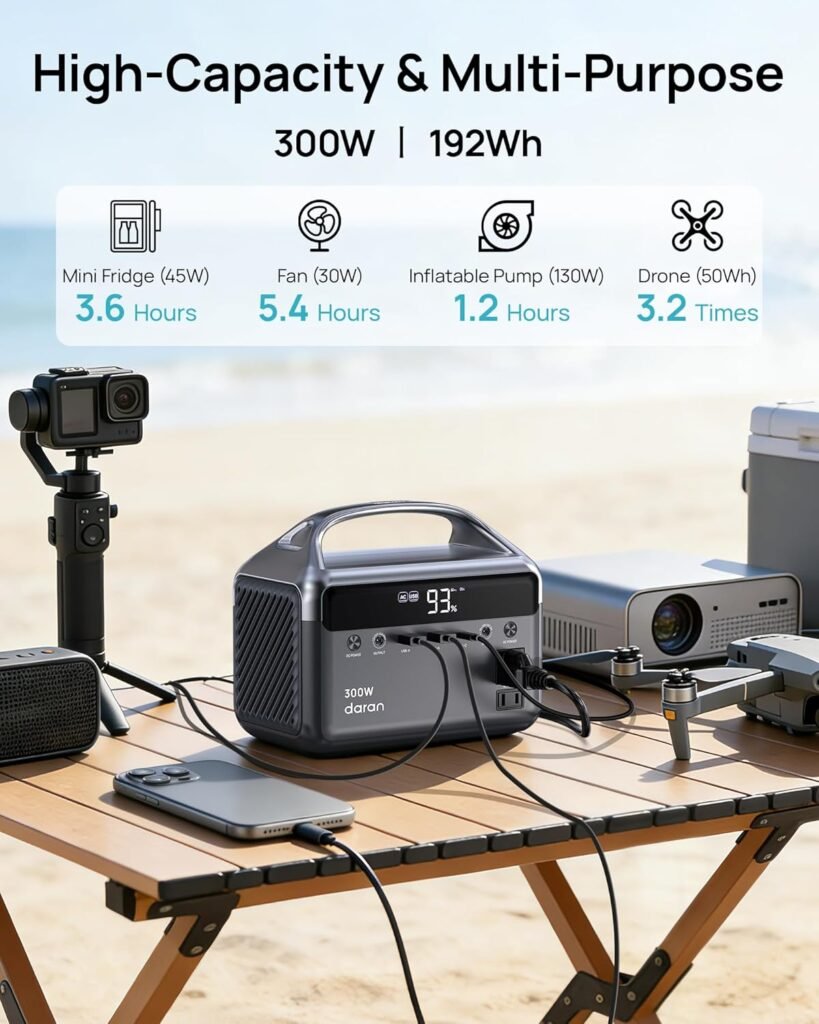
We should emphasize that these are estimates and actual run times depend on device efficiency, power draw variability, and environmental factors, but the basic math gives a useful planning baseline. For example, the provided examples show a 40W audio device running about 4.08 hours and a 45W mini-fridge about 3.6 hours when applying the 192Wh × 0.85 / load formula.
Runtime Calculation Examples
We want to give practical math so we can set realistic expectations for device runtimes and planning in emergency scenarios. Seeing the calculations helps us compare how different devices affect total runtime and whether the station meets our needs for specific use cases.
- 40W Audio: 192Wh × 0.85 / 40W = ~4.08 hours.
- 45W Mini Fridge: 192Wh × 0.85 / 45W = ~3.6 hours.
- Smartphone (average 15Wh per full charge): 192Wh × 0.85 / 15Wh ≈ 10.9 full charges.
- Laptop (typical 60W draw while working): 192Wh × 0.85 / 60W ≈ 2.7 hours.

Design and Portability
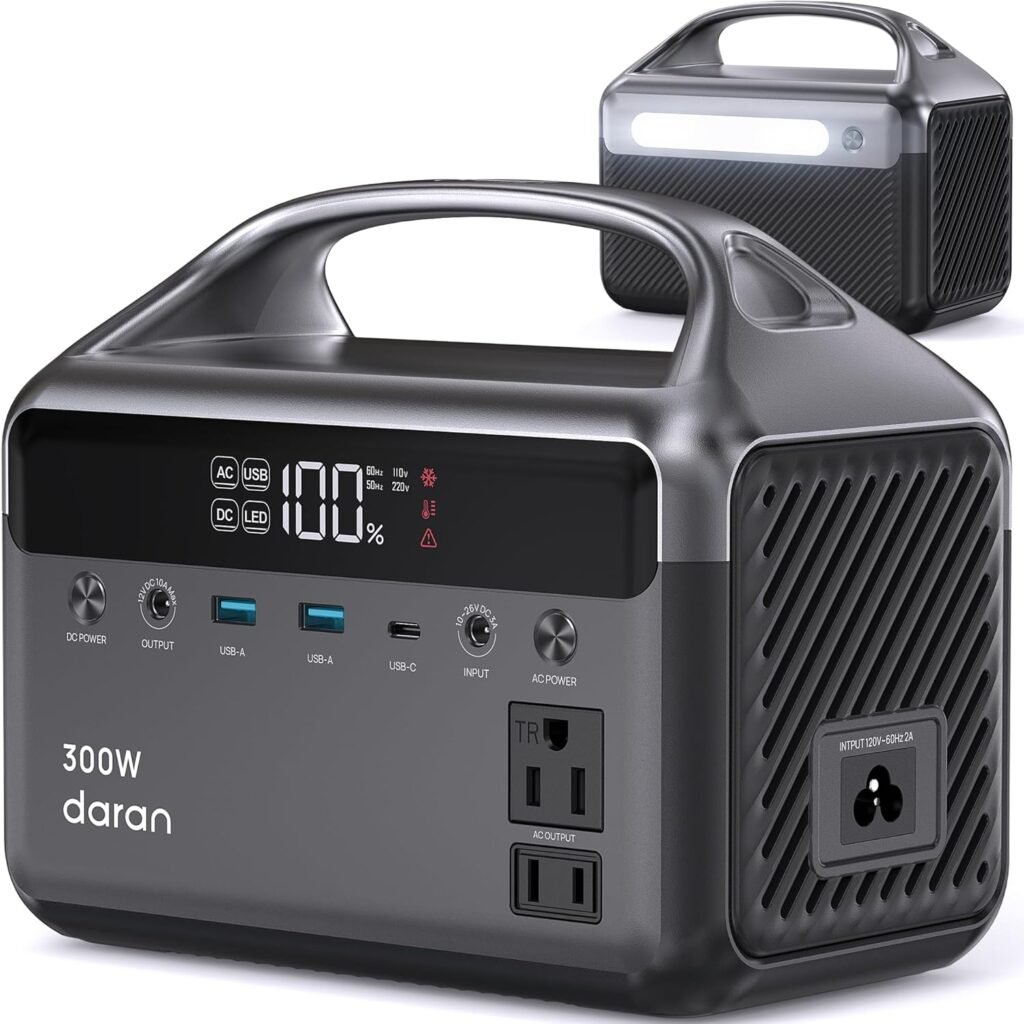
We notice right away that the 5.5 lb weight and compact footprint make the DaranEner station genuinely easy to carry in a car trunk, a camper, or even between rooms at home. The handle and rectangular shape are practical and unobtrusive, which is exactly what we want for a unit designed to be moved frequently.
We also appreciate that lightweight does not mean flimsy; given the LiFePO4 battery and integrated BMS, the form factor is optimized for portability without sacrificing necessary protection and usability. This approach makes it a realistic companion for short camping trips, tailgates, and a quick grab-and-go emergency solution.
Build Quality and Materials
We expect power gear to feel robust, especially when it will be carried into the field, and the DaranEner’s housing and connectors feel solid enough for regular outdoor use. We like that port labels and the layout are intuitive, which reduces fumbling when we need to connect devices in low light or under pressure.
We also appreciate the combination of a durable shell with heat management design elements; they help the unit remain cool during moderate cycles and give us confidence in long-term reliability. The LiFePO4 cells themselves are a positive sign for longevity compared with older lithium chemistries, and the exterior construction complements that lifespan.
Weight and Carrying Ease
We carry gear frequently, so 5.5 lb is a meaningful advantage for us compared with heavier 500Wh-plus units that can double or triple the weight. The single-handed portability and compact footprint mean we are more likely to take the unit on weekend trips rather than opt out because of bulk.
We also value a setup that does not require tools or additional cases to be transportable; the DaranEner fits easily into vehicle storage areas and backpacks designed for compact power stations. For people who prioritize mobility, that weight and size combination is really compelling.
Performance and Power Output
We pay attention to both continuous power (300W) and surge capacity (600W), because startup surges matter for some appliances with motors, compressors, or heating elements. The 600W surge gives us headroom for brief power spikes, but the 300W continuous rating is the key limiter for sustained runs.
We therefore recommend using the DaranEner for electronics, lighting, small appliances, and lower-draw devices rather than heaters, large blenders, or full-size refrigerators that usually exceed the 300W rating for extended periods. Knowing the difference between surge and continuous power helps us prioritize which devices to run simultaneously.
AC Outlet and Pure Sine Wave Output
We like that the station provides a pure sine wave AC outlet, which is essential for sensitive electronics like laptops, audio gear, and medical devices. Pure sine output reduces the risk of interference, overheating, or malfunction in devices that expect clean power.
We also value the fact that a pure sine inverter is generally more efficient and kinder to battery-life when powering certain loads, which means our devices behave as if connected to regular mains power. This feature also broadens the list of devices we can confidently power without worrying about compatibility.
Continuous vs Surge Power
We recognize that a surge rating is useful for dealing with initial inrush currents from motors or compressors, but it is the continuous output that dictates how long we can actually run a device. The DaranEner’s 300W continuous rating makes it clear that longer operation should be planned for devices that draw less than that threshold.
We prefer to plan device use with a safety margin (for example, keeping continuous draw under ~250W) to avoid triggering overload protections and to give the inverter and battery a more comfortable operating envelope. This helps us avoid sudden shutdowns during critical usage and extend the unit’s usable life.
What We Power in Practice
We commonly use the station to charge multiple phones, run small lights, power a laptop for a few hours, and occasionally keep a small 12V refrigerator or audio gear running. Given the 192Wh capacity, we can realistically expect a few hours of moderate mixed load usage if we manage outlets carefully.
We avoid using the station for power-hungry appliances like full-size refrigerators, electric kettles, or air conditioners, since these usually draw well above the continuous 300W rating and will quickly deplete the battery or trip protections. For most of our intended tasks—work-from-camp, emergency phone charging, lights, and small medical devices—the unit’s output and ports are well matched.
Battery Chemistry and Lifespan
We find LiFePO4 battery chemistry to be one of the cooler trends in portable power because it offers better thermal stability, a longer cycle life, and improved safety compared with many older lithium formulations. For us, that means the unit should still offer significant capacity after hundreds or even thousands of cycles, depending on how aggressively we use it.
We also appreciate that LiFePO4 tends to hold its capacity better when stored and is less prone to thermal runaway, which aligns with our need for a reliable emergency device that won’t degrade quickly if it sits in storage for months. Overall, the chemistry supports long-term ownership and regular usage patterns.
Battery Management System (BMS) and Safety Features
We prioritize products with a comprehensive BMS, and this DaranEner unit includes protection against overvoltage, overload, and short circuits, which gives us peace of mind when charging multiple devices. The BMS also helps balance cells and monitor temperatures, prolonging battery life while protecting our connected equipment.
We also value the fact that the unit provides a fume-free, quiet alternative to gas generators and that the combination of LiFePO4 chemistry and BMS reduces common failure modes seen in cheaper power banks. For emergency use or indoor charging needs, that safe operation is an important advantage.
Charging Options and Times
We like gear that gives multiple charging pathways, and the DaranEner supports AC wall charging, car charging via the DC port, and solar compatibility so we can adapt depending on available power sources. These options make the station versatile in urban, travel, and fully off-grid scenarios, though actual charging times will vary by method and conditions.
We caution that solar charging times are highly dependent on panel wattage, sun angle, and weather, so we treat solar as a flexible option rather than a guaranteed quick recharge. The station’s flexibility still matters: when grid power is available, a wall outlet will be the fastest recharge, while solar gives us long-term off-grid independence if we pair the right panel.
Wall Charging and Car Charging
We usually recharge via an AC wall adapter when staying put, which tends to be the fastest and most reliable method for getting back to full capacity. Using the car DC port is a helpful backup when driving between locations, though it is typically slower and less efficient than direct AC charging.
We recommend planning for overnight wall charging when possible and reserving car charging for situations where AC is not available or when we need partial recharges during travel. Both options provide convenience, but the wall charger is the go-to for speed and efficiency.
Solar Charging Compatibility
We like that the unit is solar-compatible, since pairing with a solar panel transforms it into a legitimate off-grid solution for extended trips or emergency scenarios. For planning purposes, we estimate solar recharge times under ideal conditions: with a 100W solar panel and an optimistic 85% conversion efficiency, 192Wh / (100W × 0.85) ≈ 2.26 hours of peak sun to theoretically replenish energy, but in practical terms we plan for much longer due to variability.
We therefore recommend pairing the station with a high-quality solar panel rated for actual real-world output (often more than 100W for quick recharges) and planning for a full sunny day to comfortably top up multiple charges. Solar is invaluable for independence, but we treat it as part of a realistic charging strategy that accounts for weather and panel performance.
Ports and Outputs
We appreciate the combination of two AC outlets, two USB-A ports, one USB-C port, and a DC carport, which allows us to charge multiple devices at once without reaching for additional adapters. This port mix reflects the typical needs of modern travelers and emergency kits, balancing legacy USB-A devices with USB-C for newer laptops and phones.
We use simultaneous ports frequently and find it especially helpful to have a dedicated AC outlet for laptops while USB ports keep phones and accessories topped off. The DC carport adds convenience for automotive accessories or for using a car adapter when needed.
USB and DC Ports
We like having both USB-A and USB-C because it lets us connect older accessories alongside newer, higher-power devices that can accept PD charging. The USB-C port is particularly useful for laptops and tablets that support USB Power Delivery, potentially enabling faster, more efficient charging compared with USB-A.
We also value the DC carport for powering car-specific devices or using DC car adapters, which expands the station’s utility during road trips and emergency evacuations. The multi-port approach reduces the need for power strips or multiple chargers and keeps our setup neat and efficient.
Simultaneous Charging
We often run multiple devices at once—phone charging, lights, and a laptop—so the ability to power up to six devices simultaneously is a practical advantage for us. Managing loads matters because while we can plug many devices in, staying within the continuous 300W limit is essential to avoid overloading the inverter.
We recommend prioritizing higher-draw devices and staggering use when necessary to stay within the unit’s sustainable output, such as charging phones and running lights while pausing laptop use during critical periods. This approach ensures continuous power availability without triggering protection circuits.
Use Cases
We find that the DaranEner station shines in specific roles: as a portable power source for short camping trips, as an addition to a home emergency kit for powering essentials, and as a travel companion for remote work sessions. Its light weight and safety features make it an attractive middle ground between tiny power banks and heavy-duty stations.
We avoid thinking of it as a one-size-fits-all solution; instead, we match the unit to our needs by asking, “Which devices do we need to keep running, and for how long?” When matched thoughtfully, it delivers excellent value and peace of mind.
Home Emergency Backup
We like having a compact, quiet solution for emergency phone charging, lighting, and powering small medical devices for a limited time during outages. The station’s fume-free operation allows indoor use, and the BMS reduces the likelihood of catastrophic failures when running sensitive equipment.
We recommend pairing it with essential items—LED lights, a small radio, and a charged phone—to create a minimalist emergency kit that covers immediate needs until power is restored. For longer outages, multiple stations or a larger inverter would be necessary, but this unit greatly improves short-term resilience.
Camping and Travel
We prefer lightweight and portable gear for weekend excursions, and this power station fits neatly into our packing list for tent camping, RV side trips, and day use at the beach. It powers small fridges, lights, and electronics without the noise and smell of fuel-powered generators.
We also like that solar compatibility means we can extend stays off-grid with the right panel and sunlight, transforming the unit from a convenience into a practical off-grid power hub when necessary. That flexibility is a big selling point for people who travel semi-regularly or who need reliable power away from outlets.
Digital Nomads and Remote Work
We often work in cafés, cabins, or in transit, and a compact, reliable battery that can keep a laptop and phone going for a few hours is a key enabler for productivity. The pure sine wave inverter and USB-C PD compatibility make it more useful than a basic power bank for our remote-office needs.
We do note that for full-day work sessions, we will need either multiple recharges or access to AC charging periodically, but for short bursts of focused work or emergency productivity it does the job well. The portability and quiet operation are particularly valuable in shared or public spaces.
Pros and Cons
We find it helpful to list strengths and weaknesses clearly so we can match the product to realistic expectations and avoid disappointments. The DaranEner station has compelling positives but also limits that matter depending on our usage patterns.
We weigh the overall fit based on intended use—if we want something ultra-portable for short tasks, it excels; if we want all-day power for heavy loads, we will need something larger.
Pros
We appreciate the lightweight form factor, LiFePO4 chemistry for longevity, pure sine wave output for sensitive electronics, and multiple ports for simultaneous charging. The 300W continuous output with a 600W surge offers enough flexibility for many common camping and emergency scenarios without the downsides of fuel generators.
We also like the sensible safety features, solar compatibility, and clear manufacturer maintenance tips (two full charge/discharge cycles at the beginning and periodic recharging every 1–2 months). These factors collectively make the unit a practical buy for many of our needs.
Cons
We recognize that 192Wh is not a large capacity for extended off-grid stays or for powering multiple high-draw appliances for long periods. The 300W continuous rating restricts use with heavier loads, so it is not suitable as a household replacement for longer-term outages.
We also note that solar recharges require additional investment in panels and that realistic solar recharge times will be longer than theoretical minimums; we should plan on that additional cost and setup complexity when aiming for true off-grid operation.
Maintenance and Best Practices
We follow the manufacturer’s pro tips: complete two full charge and discharge cycles after receiving the product, and recharge the battery generator every 1–2 months to maintain health during storage. These simple maintenance habits help preserve long-term capacity and ensure the unit is ready in emergencies.
We also recommend storing the station in a cool, dry place and keeping it away from corrosive environments or prolonged exposure to extreme temperatures, since these conditions accelerate capacity loss regardless of battery chemistry. Regular checks and sensible storage will extend the station’s useful life and reliability.
Storage and Long-Term Care
We like to keep the station at approximately 40–60% state of charge for long-term storage when feasible, as fully charged or fully depleted storage can stress battery cells over months. Performing a maintenance charge every 1–2 months, as suggested, is an easy habit that prevents deep discharge and preserves long-term health.
We also advise keeping firmware or software (if applicable) up to date and inspecting ports and connectors periodically for corrosion or wear, since clean connections equal reliable power delivery. These small steps reduce the likelihood of failures when we actually need the device.
Safety Considerations
We treat safety as a priority and appreciate that LiFePO4 chemistry and an integrated BMS lower risks compared with older lithium formulations and DIY setups. The built-in protections for overvoltage, overload, and short circuits are essential features for indoor use and for running sensitive electronics without worry.
We still recommend using caution: avoid exposing the unit to water, extreme heat, or heavy impacts, and follow manufacturer instructions for charging and discharging cycles. Careful use and respect for the device’s limits will keep it functioning properly and safely for years.
Comparison with Similar Models
We often compare specs like capacity, weight, output, and battery chemistry when choosing a station, and the DaranEner sits in a niche for ultra-portable LiFePO4-powered units around 200Wh. Compared with cheap lead-acid or older lithium-ion competitors, it offers better cycle life and safety, and compared with larger 500Wh-plus units it offers superior portability.
We see it as complementary rather than competitive with large-capacity stations: if our primary need is short-term portability and safety, it’s a strong pick; if our primary need is multi-day off-grid power for heavy loads, we recommend considering larger-capacity units. The choice depends on trade-offs between weight and run time.
Verdict — Who Is This For?
We recommend the DaranEner Portable Power Station for campers, road-trippers, light-duty off-grid users, and anyone building a compact home emergency kit who values portability and safety. The LiFePO4 chemistry and pure sine wave output make it especially attractive for powering sensitive electronics and for people who want a maintenance plan that supports long-term reliability.
We do not recommend it as a household-level backup for extended outages or for users who need to run high-wattage appliances continuously; those scenarios call for larger capacity and higher continuous wattage. For the defined niche of short-term portable backup and device charging, the unit offers excellent value.
Frequently Asked Questions (FAQ)
We compile FAQs based on common questions we encounter so we can answer them clearly and concisely for practical decision-making. Each answer is framed to help set expectations and give actionable guidance for typical scenarios.
Can this unit run a CPAP machine?
We find many CPAP machines run under the 300W continuous threshold, and because the DaranEner uses a pure sine wave inverter, it is compatible with many CPAP models. We recommend verifying the CPAP’s exact wattage and consulting the manufacturer to confirm true compatibility and runtime expectations.
How many times will it charge a smartphone?
We estimate that an average smartphone with a 15Wh battery can be charged approximately 10–11 times on one full charge of this 192Wh station when accounting for conversion losses. We advise using a phone’s charging profile and measuring actual use if precise counts matter for emergency planning.
How long does it take to recharge from solar?
We note that solar recharge time depends on panel wattage, angle, and sunlight; under ideal peak-sun conditions with a 100W panel and optimistic efficiency, theoretical recharge might be a few hours, but practical times are longer. We therefore plan for variable sunlight and consider larger panels or multiple panels for faster and more reliable recharging.
Is it safe to use indoors?
We consider it safe for indoor use because it is fume-free and uses LiFePO4 chemistry along with an integrated BMS, which reduces typical risks associated with fuels or older battery types. We still recommend following general safety guidance like avoiding exposure to moisture and keeping ventilation available during extended use.
Can it power a mini-fridge overnight?
We estimate a small 45W mini-fridge could run for roughly 3.6 hours on a full charge, so it would not power a fridge overnight without recharging or a larger battery bank. For overnight refrigeration, we recommend a larger capacity station or multiple recharge cycles through solar during the day.
What maintenance is required?
We follow the manufacturer’s guidance to perform two full charge/discharge cycles upon receiving the product and to recharge the unit every 1–2 months during storage to maintain health. We also inspect ports and keep the unit in moderate temperature storage to prolong battery life.
Final Thoughts
We find the DaranEner Portable Power Station to be a practical, well-balanced option for people who need reliable, lightweight power for short-term and mobile use, with the added benefit of LiFePO4 longevity and a pure sine wave inverter. We recommend it for campers, weekend travelers, and anyone building a compact emergency kit, while suggesting those with larger or longer-term power needs consider higher-capacity alternatives.
We encourage readers to match the unit’s 192Wh capacity and 300W continuous rating to their specific devices and use patterns, and to pair the station with the right solar panel or charging strategy if off-grid recharging is a priority. With thoughtful use and maintenance, it can be a dependable part of our everyday carry or emergency preparedness plan.