Like a steady campfire on a cold night, dependable power keeps van life comfortable and safe. In 2025, we’ve got compact 300W units for daily essentials and LiFePO4 heavy-hitters for fridges and tools, plus smart perks like MPPT solar, fast recharging, and UPS support. We’ll compare real usable capacity, weight, ports, and safety so you can match gear to your rig and budget—starting with portable solar kits and climbing to 2kWh workhorses…
Key Takeaways
- Match inverter output to your loads: 300W units for devices/lighting, 1000–2200W LiFePO4 models for fridges, tools, and limited off-grid AC use.
- Prioritize LiFePO4 batteries for van life longevity: 4,000+ cycles, 10+ years, with robust BMS protections and safer thermal performance.
- Consider recharge speed and inputs: fast AC charging, MPPT solar (100–400W), car charging, and pass-through/multi-source support to minimize downtime.
- Balance capacity and weight: 280–300Wh units are ultra-portable; 1000–2000Wh models add runtime but are heavy and pricier.
- Note model nuances: Jackery v2 lines offer rapid charging and UPS; budget 300W options (ZeroKor, ALLWEI) suit essentials but cap at ~300W continuous.
Portable Solar Generator and 300W Power Station with 60W Foldable Solar Panel


Looking for a compact, solar-ready setup that keeps essentials running off-grid? We like this 300W portable solar generator (ZeroKor R200) paired with a 60W foldable monocrystalline panel (~20.5% efficiency). It packs a 280Wh lithium battery, pure sine wave 110V output, and ports for two 300W max AC, DC 9–12.6V/10A, three USB-A 5V/3A, and a quick-charge USB. There’s USB-C support on the panel, too. At 5.08 lb, it’s van-friendly. Recharge via wall (~7–8 hours), car, or MPPT solar. BMS safeguards and auto cooling help longevity—keep charge 60–80%. Avoid loads over 300W. Junction box isn’t waterproof. Support is responsive.
Best For: Off-grid campers, van/RV travelers, and emergency home backup users who need a lightweight 300W power station with a 60W foldable solar panel for charging small electronics and essentials.
Pros:
- Compact 280Wh, 5.08 lb unit with pure sine wave AC and MPPT solar charging; multiple ports (2x 110V AC, DC 9–12.6V/10A, 3x USB-A, QC USB; panel adds USB-C)
- 60W monocrystalline panel (~20.5% efficiency) for better low-light performance; recharge via wall (~7–8 hrs), car, or solar
- Robust BMS protections and auto-cooling; responsive customer support with replacements/refunds reported
Cons:
- 300W output limit excludes high-draw devices (coffee makers, hair dryers, pumps)
- Solar junction box isn’t waterproof; needs dry conditions and good sun exposure
- Solar performance can vary; some users report panel issues and indicator quirks
Jackery Portable Power Station Explorer 300

Compact yet capable, the Jackery Explorer 300 suits van lifers who prioritize lightweight portability without giving up true AC power. We get a 293Wh lithium pack, two pure sine wave AC outlets (300W max, 500W surge), and quiet, maintenance‑free operation. At 7.1 pounds, it’s easy to stash and carry. Ports include PD 60W USB‑C in/out, Quick Charge 3.0, USB‑A, and a 12V car port—power up to six devices at once.
Recharging’s quick: hit 80% in about two hours using wall plus 60W USB‑C. It supports car and solar via Jackery’s SolarSaga 100 with MPPT. Note: it won’t run high‑draw appliances.
Best For: Van lifers, campers, and emergency preppers who want a lightweight, quiet, maintenance‑free power station for charging small devices and running low‑to‑moderate AC loads off‑grid.
Pros:
- Compact 7.1 lb design with 293Wh capacity and two pure sine wave AC outlets (300W max, 500W surge)
- Fast recharge to ~80% in ~2 hours via wall + 60W USB‑C; supports car and 100W solar with MPPT
- Versatile ports (PD 60W USB‑C in/out, QC 3.0, USB‑A, 12V car) and pass‑through charging for multiple devices
Cons:
- Not suitable for high‑draw appliances (e.g., induction cooktops, blenders, space heaters)
- Limited overall capacity for extended off‑grid use without solar or frequent recharging
- Solar panel sold separately; maximum solar input limits recharge speed compared to larger units
Jackery Explorer 1000 v2 Portable Power Station (LiFePO4, 1070Wh)

For van dwellers who want fast recharge times and long-cycle durability, the Jackery Explorer 1000 v2 stands out with its 1,070Wh LiFePO4 battery rated for 4,000+ cycles and a 1,500W AC output (3,000W surge). We can run fridges, electric pots, or small AC units, then recharge fast: default full in 1.7 hours, or 1-hour emergency charging via the Jackery App with ChargeShield 2.0. At 23.8 lbs with a foldable handle, it’s road-ready.
Ports are generous: three pure sine AC, two 100W USB-C, one USB-A, and a car port. Note: solar panels aren’t included and Jackery-only for solar.
Best For: Van lifers, campers, and emergency-preppers who need fast recharging, long-cycle LiFePO4 durability, and enough output to run appliances like fridges or small AC units.
Pros:
- 1,500W AC output (3,000W surge) with three pure sine AC outlets plus dual 100W USB-C for versatile, high-power use
- Fast recharging: default full in ~1.7 hours or 1-hour emergency charging via the Jackery App with ChargeShield 2.0
- Long lifespan LiFePO4 battery rated for 4,000+ cycles (70% capacity) and 10+ years of use
Cons:
- Solar panel not included and solar input is compatible only with Jackery panels
- App requires account management and controls some key charging features
- Heavier than ultra-compact units at 23.8 lbs and premium-priced for its class
ALLWEI Portable Power Station 300W (280Wh Solar Generator)
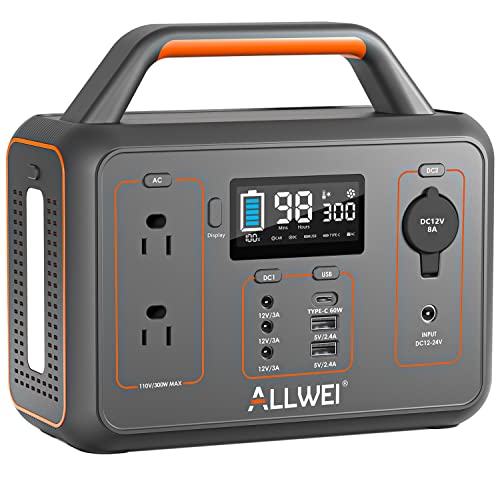
Quiet, pure-sine power in a 6.5-pound package makes the ALLWEI 300W (280Wh) a smart pick for van lifers who need dependable, lightweight energy for essentials. We like its balanced I/O: two AC outlets, USB-C PD 60W, two USB-A, three DC ports, and a 12V car socket—powering up to nine devices at once. The 300W continuous/600W surge handles laptops, cameras, routers, and even a small RV fridge or CPAP.
Expect roughly 238Wh usable (≈85% efficiency). Runtime = 238 ÷ device watts. Recharge via wall (5.5–6.5h), car (4.5–5.5h), or 100W solar (3–4h) with MPPT. The BMS, overload protection, LCD, and quiet fan inspire confidence.
Best For: Van lifers, campers, and emergency-prep users who need a lightweight, pure-sine 300W power station to run essentials like laptops, CPAPs, cameras, routers, and small fridges.
Pros:
- Balanced I/O: 2 AC, USB-C PD 60W, 2 USB-A, 3 DC, and 12V car socket; powers up to 9 devices simultaneously
- Fast, flexible recharging via wall (5.5–6.5h), car (4.5–5.5h), or 100W solar (3–4h) with built-in MPPT
- Quiet operation, pure sine wave AC, robust BMS and protections, compact 6.5 lb build with 1500 life cycles
Cons:
- 300W continuous/600W surge limit excludes higher-draw appliances and tools
- Real-world usable capacity (~238Wh at ~85% efficiency) may run larger devices for shorter durations
- Fan noise can be noticeable under heavy load or during charging
Jackery Explorer 2000 v2 Portable Power Station (2042Wh LiFePO4)

Delivering 2,042Wh of long‑life LiFePO4 power and a 2,200W AC output across three outlets, the Jackery Explorer 2000 v2 suits van lifers who need fast, dependable recharges between drives. We appreciate its 0–80% AC top‑up in 66 minutes (full in 102 via Emergency Super Charging) and quiet 30dB “Silent” mode that finishes in about five hours. Solar’s solid too—roughly six hours with 400W input. At ~40 lbs, it’s compact, stable CTB construction inspires confidence. UPS switching in 20ms keeps fridges and routers seamless. Pass‑through works well, and 100W USB‑C charges laptops fast. App control, SOS light, and robust LiFePO4 longevity round it out.
Best For: Van lifers, campers, and homeowners who need fast‑charging, quiet, and reliable backup power with UPS functionality and long‑life LiFePO4 cells.
Pros:
- Rapid AC charging: 0–80% in 66 minutes; full in ~102 minutes (Emergency Super Charging)
- Quiet operation with 30dB Silent mode; pass‑through charging and 20ms UPS keep devices seamless
- Robust 2042Wh LiFePO4 battery with long lifespan; 2,200W output across 3 AC ports plus 100W USB‑C
Cons:
- Heavy at around 40 lbs, limiting portability for some users
- Solar peak input (~400W) means roughly 6 hours to recharge in ideal conditions
- App connectivity can be finicky per user reports; premium price outside sales
Jackery HomePower 3000 Portable Power Station with Solar Panels
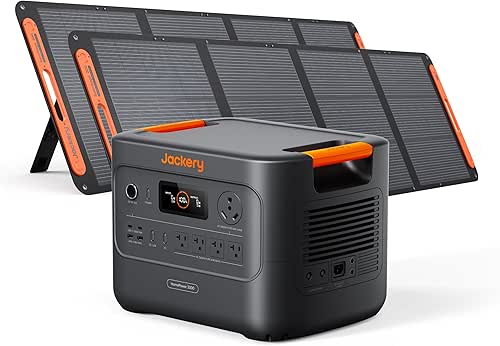
Serious van lifers who need home-grade power on the road will appreciate the Jackery HomePower 3000’s 3600W output (7200W surge) and 3072Wh LiFePO4 battery, plus a dedicated TT-30 RV port for easy campsite hookups. We get four AC outlets, USB-A/C, DC ports, and app control over WiFi/Bluetooth. It recharges in 1.7 hours via hybrid AC/DC or 2.2 hours on AC; two 200W panels can hit 80% in about 9 hours of good sun. The ≤20ms UPS keeps essentials running. At 59.5 pounds, it’s hefty yet compact. Expect 4,000 cycles to ~70% capacity. Note higher panel/accessory costs and separate shipments.
Best For: Serious van lifers, RVers, and homeowners needing a high-output, UPS-capable portable power station with fast recharge, app control, and RV-friendly TT-30 support.
Pros:
- 3600W continuous (7200W surge) with 3072Wh LiFePO4 battery and 4,000-cycle longevity
- Fast recharging: ~1.7 hours hybrid AC/DC or ~2.2 hours AC; solar to ~80% in ~9 hours with 2x200W panels
- Versatile outputs (4 AC, USB-A/C, DC, TT-30), ≤20ms UPS, and WiFi/Bluetooth app monitoring
Cons:
- Hefty at 59.5 lb; portability can be challenging for one person
- Solar panels and expansion accessories (splitters/cables) are pricier than many alternatives
- Solar performance varies with conditions; base kit limits solar input without added panels/adapters
EF ECOFLOW DELTA 3 Plus Solar Generator with 220W Bifacial Panel
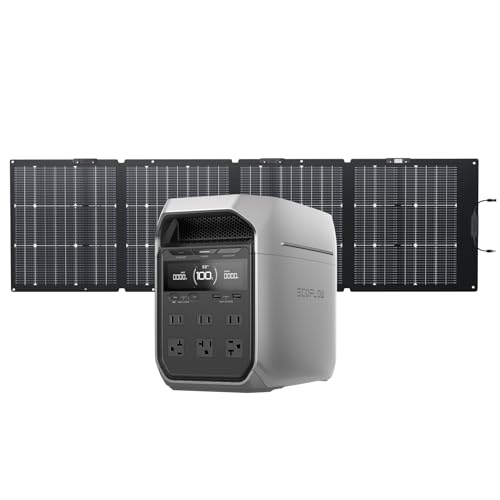
Need rapid solar refills and long-cycle durability for off-grid van living? The EF ECOFLOW DELTA 3 Plus with a 220W bifacial panel delivers. Its LFP battery lasts 4000 cycles to 80% (about 10 years), housed in an IP65-rated, rugged pack with built-in handles. We can take in up to 1000W solar via two independent 500W inputs, hitting 80% in about an hour. AC fast-charges to 80% in 40 minutes; hybrid and generator options match that. It powers 13 devices, with X-Boost handling resistive loads over 2200W. Expect quiet fans, clear UI, and expandable capacity—just mind weight, price, and conversion losses.
Best For: Off-grid van lifers, RV travelers, and home-backup users who want rapid solar refills, long-cycle LFP durability, and flexible high-wattage inputs for running multiple devices.
Pros:
- Fast charging: up to 1000W solar (80% in ~1 hr) and 1500W AC (80% in ~40 min), plus hybrid/generator options
- Long-life, safe LFP battery: 4000 cycles to 80%, IP65-rated pack, expandable capacity
- Versatile power: runs 13 devices, X-Boost handles >2200W resistive loads, two independent 500W solar inputs
Cons:
- Relatively heavy and bulky for frequent carry
- Premium price compared to smaller-capacity stations
- Real-world efficiency losses (~20%) and variable solar performance in partial sunlight
Portable Power Station 120W with AC Outlet (97.6Wh)

Compact yet capable, ZeroKor’s 120W, 97.6Wh power station suits minimalist van lifers who mostly top off phones, cameras, headlamps, and a small laptop. We get two 110V AC outlets (120W max), USB-A, QC USB, and USB-C ports, plus a 12–16.8V DC output up to 6A. At 2.2 lbs with a handle, it’s easy to stash. The LCD shows battery and output status; the LED flashlight offers reading and SOS modes. Recharge via wall, car, or a separate solar panel. Note the 120W cap—skip hair dryers and coffee makers. Built-in BMS and auto fan add safety. Warranty: 12 months. Includes all cables.
Best For: Minimalist campers, van lifers, and emergency backup users who need to charge phones, cameras, headlamps, and a small laptop without heavy appliances.
Pros:
- Lightweight 2.2 lb design with handle; compact 5.7 x 4.4 x 4.1 in form factor
- Versatile outputs: 2x 110V AC (120W max), USB-A/QC/USB-C, and 12–16.8V DC up to 6A
- Safety-first BMS protections, LCD status display, and built-in LED with reading/SOS modes
Cons:
- 120W AC cap can’t run high-draw devices like hair dryers, coffee makers, or toasters
- Small 97.6Wh capacity limits runtime for larger electronics
- Solar panel not included and charging can be slower depending on method/conditions
MARBERO Portable Power Station 88Wh (Solar Panel Optional)

Looking for an ultra-light, budget-friendly backup to keep essentials running between campsites? The MARBERO M82 packs 88Wh in a 2.29 lb body with an ergonomic handle, making it easy to stash and grab. We get 8 outputs—AC, DC, USB, and USB‑C PD—plus a car socket for small gear. It fast-charges 0–80% in about two hours, and it supports 30W/60W MARBERO solar panels.
In practice, we top off phones, tablets, and laptops, and briefly run a car fridge or inflator within its 80W (120W peak) limits. The flashlight (three levels + SOS) is excellent. BMS protections, rear cooling vents, and auto shutoff boost safety.
Best For: Campers, travelers, and emergency preppers who want an ultra-light, budget-friendly power station for phones, tablets, small laptops, and brief use of low-watt gear between charges.
Pros:
- Compact and lightweight (2.29 lb) with ergonomic handle; easy to carry and stash
- Versatile 8-port layout including AC, DC, USB, USB‑C PD, and car socket; can charge multiple devices at once
- Fast wall charging to 80% in ~2 hours; solar-ready with 30W/60W panels
Cons:
- Limited output (80W continuous, 120W peak) restricts use to small devices and short runs of appliances
- Modest capacity (88Wh) means frequent recharging on longer trips
- Some users report fan/noise under DC load and slower full charge to 100%
EF ECOFLOW DELTA 3 Max Portable Power Station (2048Wh LiFePO4)

For van lifers who want blazing-fast turnarounds and rock-solid capacity, the EF ECOFLOW DELTA 3 Max stands out with a 2048Wh LiFePO4 battery and X-Stream charging that races from 0–80% in about 1.13 hours. We can run fridges, microwaves, and power tools with up to 3400W X-Boost, and the ultra-quiet operation with sub-10ms transfer keeps sensitive laptops and medical devices steady. The durable, carry-friendly build is made for daily use over 10 years. Add optional solar for off-grid flexibility. With the app, we set charge priorities and schedules to save costs. Users praise fast charging, reliability, and EcoFlow’s strong support.
Best For: Van lifers, RV travelers, and home backup users who need ultra-fast recharging, high output for heavy appliances, and long-lasting LiFePO4 reliability with smart app control.
Pros:
- 2048Wh LiFePO4 battery with up to 3400W X-Boost powers most home and workshop appliances.
- Ultra-fast 0–80% recharge in ~1.13 hours; quiet operation with sub-10ms transfer for sensitive electronics.
- App-based monitoring and scheduling; optional solar input for flexible off-grid use.
Cons:
- Heavier unit (~44.8 lb) can be bulky for frequent carrying.
- Solar panels are optional and add to total system cost.
- Warranty specifics not clearly outlined; details may require checking EcoFlow’s policy page.
Factors to Consider When Choosing Portable Power Stations for Van Life
Before we pick a unit, let’s match power capacity to our daily watt-hour needs and weigh lithium battery chemistries for lifespan, safety, and cost. We’ll check inverter output limits to ensure they can start and run our heaviest devices, then compare charging speeds from AC, solar, and vehicle input. Finally, we’ll balance portability and weight so the station fits our van layout without becoming a burden.
Power Capacity Needs
How much power do we really need on the road? Let’s total our daily loads. List every device, note its wattage, and multiply by expected run-time to get watt-hours. For example, a 200W setup running 5 hours needs about 1,000Wh. Then factor in real-world losses: most stations deliver only 80–90% of rated capacity after inverter and BMS overhead, so size up accordingly.
Match inverter output to our simultaneous draw. Continuous wattage must meet or exceed what we’ll run at the same time—laptops, fridge, lights—not just brief surge. If we expect growth—adding a fridge, heater, or occasional AC—choose a system with higher continuous output, faster charging, or modular expansion. Planning headroom prevents overloads, short runtimes, and constant micromanagement.
Battery Chemistry Choice
So which battery chemistry should we trust in a van we live and work from? We lean toward Lithium Iron Phosphate (LiFePO4). It’s safer, more thermally stable, and resists thermal runaway better than typical lithium-ion (Li-ion). For off-grid, continuous use, that peace of mind matters.
LiFePO4’s real win is longevity: expect roughly 4,000+ cycles and around 10 years of service under normal use. Even after thousands of charges, many packs still hold about 70% capacity, so we replace less often and keep uptime high. That long cycle life can lower total cost over years of travel.
Trade-off? Energy density. LiFePO4 packs are usually larger or heavier for the same watt-hours. If space or weight is tight, note the difference—but for durability and reliability, LiFePO4 usually earns our vote.
Inverter Output Limits
With battery chemistry sorted, we need to match storage with the right inverter muscle. Inverter output limits set the maximum continuous AC wattage we can draw—typically 300W to 3000W for portable units—while separate surge ratings handle brief start-up spikes. We must keep our continuous loads at or below the inverter’s rated output to avoid overload and shutdown.
Plan for both steady and surge needs. Fridges, CPAPs, and lights are low, continuous draws; blenders or hair dryers hit hard at startup. If a 300W inverter offers 600W surge, it may start a small appliance but can’t run it continuously. Add concurrent loads together: laptop + fridge + lights must fit under the continuous rating. For van life, sizing continuous capacity and surge headroom keeps essentials running reliably.
Charging Methods Speed
Curiously, charging speed can make or break our van-life workflow. AC input is the headline metric: fast-wall recharge can push many stations to 80% in roughly 40 minutes to 2 hours, depending on the model and protocol. When shore power’s scarce, MPPT solar shines—by converting panel output efficiently, it trims losses and delivers steady charge. Expect about 3–6+ hours under full sun with 60–100W panels, faster with higher wattage arrays.
We also look for pass-through charging so laptops, fridges, and routers keep running while the pack refuels. Multi-input options—AC, 12V car, and solar—let us mix sources to cut downtime between drives. Finally, remember charging speed isn’t isolated from output specs: heavy continuous loads and conservative BMS settings can throttle effective recharge rates.
Portability and Weight
Portability starts with weight and size, because we carry these stations in tight spaces and move them often. Lighter units—about 2–8 pounds—are effortless to grab, pass through a sliding door, or stash while we rearrange gear. Once a power station climbs past 30–40 pounds, handheld movement becomes awkward and placement inside a van gets limited.
Compact dimensions help just as much. If a unit stays under roughly 10 inches on a side, it slides into shallow cabinets, under seats, or behind wheel wells without blocking other essentials. Weight usually tracks with capacity: more watt-hours mean more pounds, so we balance run time against liftability. We favor sub-10 kg (22 lb) models with integrated handles or foldable designs for quick relocations and grab-and-go tasks.
Safety and Protections
Even before we compare capacities, we make safety our first filter because a power station lives inches from our bedding and gear. We look for a robust battery management system (BMS) that guards against short circuits, over-current, over-voltage, overload, and overheating to protect both the unit and our devices.
We also want smart cooling—an automatic fan that ramps with battery temperature—to prevent thermal shutdown during high-load use. Clear labeling matters, too. Notes like “junction box not waterproof” remind us to keep the unit dry and avoid moisture-related hazards.
We verify protections include overload and short-circuit safeguards, plus temperature monitoring during charge and discharge. Finally, we follow safe usage rhythms: avoid long-term full discharge and stay within rated wattage to extend battery life and reduce failure risk.
Conclusion
With these power stations in our toolkit, van life feels less like roughing it and more like cruising with a silent co-pilot. From featherweight 300W champs to LiFePO4 workhorses, we’ve got plugs for every plan—coffee at sunrise, laptops at noon, lights at dusk. Trust real capacity, smart charging, and safety like a compass. Pick the right wattage, pack the right panel, and we’ll keep rolling—batteries full, spirits higher—chasing horizons without watching the battery bar blink.