Tailgating in 2025 demands power that’s quiet, dependable, and easy to carry, and we’ve narrowed the field to standout stations that truly perform. We’ll compare real-world wattage, fast charging, port variety, and solar readiness, plus note build quality and weight for stadium treks. From compact 300W units to near-1kWh workhorses, we’ll match options to grills, TVs, and speakers without the generator noise. Let’s find the sweet spot for your setup—starting with a surprising frontrunner.
Key Takeaways
- Prioritize LiFePO4 models for long cycle life (3,000–4,000+ cycles), safer chemistry, and dependable performance for frequent tailgating.
- Match continuous wattage to your gear and account for surge loads; X-Boost-like features help with resistive appliances.
- Choose fast-recharge systems: AC turbo charging or high solar input (up to 1000W) keeps the party powered all day.
- Look for multiple ports: several AC outlets, 100–140W USB-C PD, car ports, and pass-through power for multi-device setups.
- Consider UPS-ready units (<20ms switchover) for seamless music, TVs, and fridges, balanced with portability and weight.
EF ECOFLOW DELTA 3 Plus Solar Generator with 220W Bifacial Panel
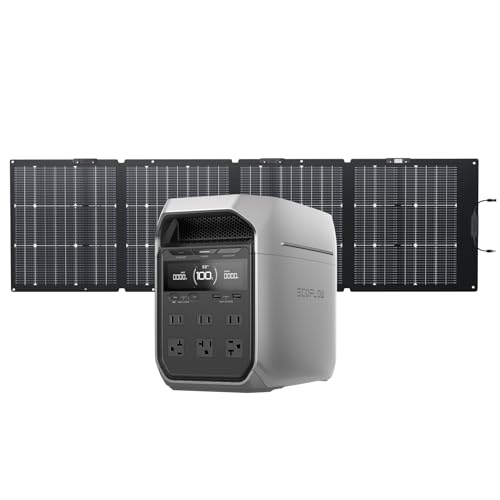

Looking for a tailgating powerhouse that sips quietly and charges blisteringly fast? We’d pick the EF ECOFLOW DELTA 3 Plus with its 220W bifacial panel. It inhales up to 1000W of solar across two independent 500W inputs, hitting 80% in about an hour via sun, or 40 minutes on 1500W AC. The LFP battery delivers 4000 cycles to 80% and a 10-year lifespan, wrapped in an IP65, handle-equipped build. Power 13 devices at once; X-Boost tackles resistive loads over 2200W. It’s quiet, intuitive, and expandable—perfect for fridges, speakers, and screens. Downsides? It’s heavy and pricey, but efficiency and speed win.
Best For: Tailgaters, campers, and home-backup users who want ultra-fast solar/AC charging, long-life LFP safety, and enough output to run multiple devices quietly.
Pros:
- Blistering recharge: up to 1000W solar (80% ~1 hr) or 1500W AC (80% ~40 mins), plus hybrid and alternator options
- Long-life LFP battery (4000 cycles to 80%, 10-year lifespan) with IP65-rated, durable, portable build
- Versatile power: 13 devices at once, X-Boost for >2200W resistive loads, two independent 500W solar inputs, expandable capacity
Cons:
- Heavy for frequent carry
- Premium price compared to smaller-capacity units
- Real-world efficiency losses (~20%) mean planning extra capacity for longer outages
GRECELL 300W Portable Power Station (230.88Wh Solar Generator)

Tailgaters who want a compact, plug-and-play power hub without the generator noise will appreciate the GRECELL 300W (230.88Wh) for its pure sine wave AC output and versatile ports. We get 330W continuous (600W surge), enough for laptops, lights, speakers, projectors, and a mini-fridge under 330W. It offers six outputs: one AC, USB-C PD 60W and 18W, two USB-A QC, and a car port. At 7.3 pounds, it’s easy to pack. Recharging is flexible via wall, car, or the 40W solar panel with MPPT. The upgraded BMS and dual silent fans add safety. Note: heating appliances can overload; real-world output trails ratings slightly.
Best For: Tailgaters, campers, and travelers who need a compact, quiet, plug-and-play power source for small-to-medium devices under 330W with flexible recharging options.
Pros:
- Pure sine wave AC with 330W continuous (600W surge) supports laptops, lights, speakers, projectors, and small fridges
- Versatile I/O: 6 outputs including USB-C PD 60W, PD 18W, dual USB-A QC, AC outlet, and 12V car port
- Lightweight (7.3 lbs) with MPPT-enabled solar input and upgraded BMS with dual silent cooling fans
Cons:
- Not suitable for high-draw heating appliances; single AC outlet limits simultaneous AC devices
- Real-world usable capacity/output can be lower than rated due to conversion losses
- Input charging is limited, so full recharges can be slow, especially with the 40W solar panel
VTOMAN FlashSpeed 300 Portable Power Station (230Wh, 300W)

Need a compact, budget-friendly unit that still pushes a true 300W with laptop-class USB‑C? We like the VTOMAN FlashSpeed 300. It packs a 230Wh LiFePO4 battery with 3,000 cycles and a robust LifeBMS for up to 10 protections. At about 7 lb with a carry handle, it’s tailgate-ready.
You get six outputs: 1x 110V/300W AC, 1x USB‑C PD 100W, 3x USB‑A (up to 18W), and 1x DC5521, plus a 3‑mode camping light. Recharge in roughly 2.5 hours via the 90W AC adaptor, or use car, solar, or USB‑C PD. Package includes AC, car, USB‑C/C, USB‑A–C cables, and a manual.
Best For: Budget-conscious campers, travelers, and remote workers who want a lightweight LiFePO4 power station with true 300W AC output and 100W USB‑C for laptops.
Pros:
- True 300W AC inverter plus 100W USB‑C PD handles most laptops and small appliances
- Long‑life 230Wh LiFePO4 battery with ~3,000 cycles and robust LifeBMS protections
- Compact ~7 lb design with handle, six outputs, and fast ~2.5‑hour AC recharge
Cons:
- Single AC outlet limits simultaneous high‑draw devices
- 230Wh capacity may be modest for longer trips or power‑hungry gear
- Solar panel not included; solar charging speed depends on sun and panel quality
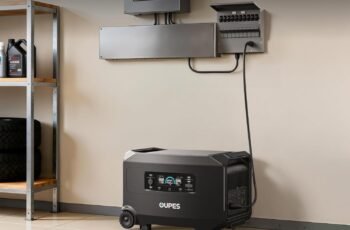
OUPES Exodus 1200 Portable Power Station (992Wh, 1200W)

Want a lightweight LiFePO4 workhorse that keeps the party powered without breaking a sweat? We like the OUPES Exodus 1200: 992Wh capacity, 1200W continuous (3600W surge), and only 23 lbs. It runs mini-fridges 25+ hours, charges phones 60+ times, and starts tough loads like drills or microwaves. With 10 outlets—three pure sine AC, 140W USB-C PD, USB-A, and car ports—everyone plugs in.
Tailgaters will appreciate UPS backup (<20ms) for laptops and projectors, rapid 2-hour AC recharging, 240W solar input, and pass-through power. The LiFePO4 pack delivers 3,000+ cycles, robust protections, FCC/CE certifications, and a 5-year warranty. Compact, reliable, and road-ready.
Best For: campers, RVers, tailgaters, and homeowners who need a lightweight LiFePO4 power station with strong 1200W output, fast recharging, UPS backup, and ample ports for devices and small appliances.
Pros:
- 992Wh LiFePO4 battery with 3,000+ cycles; lightweight 23 lbs and compact for travel
- 1200W continuous/3600W surge with 10 outlets (3 pure sine AC, 140W USB-C PD, USB-A, car), plus pass-through and <20ms UPS
- Fast 2-hour AC recharge and up to 240W solar input; 5-year warranty and FCC/CE certified safety
Cons:
- 240W max solar input limits very fast off-grid recharging compared to higher-end units
- 1200W continuous output may be insufficient for large space heaters, full-size microwaves, or high-draw power tools
- No mention of expandable battery capability; capacity fixed at 992Wh
ALLWEI Portable Power Station 300W (280Wh Solar Generator)
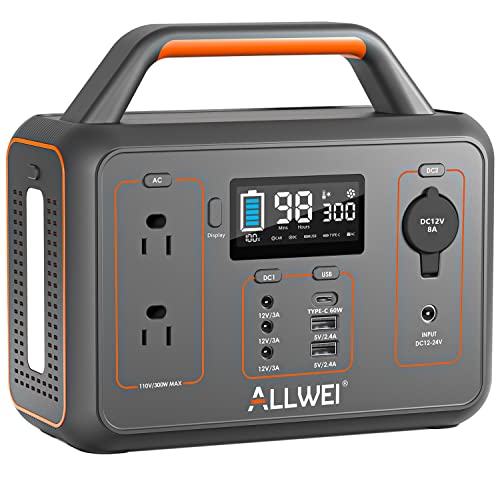
Compact yet capable, the ALLWEI Portable Power Station 300W (280Wh) shines for tailgaters who need quiet, reliable power for essentials without hauling a heavy rig. At 6.5 pounds and 9 x 4.7 x 7.8 inches, it’s easy to stash and carry. We get 2 AC outlets, USB-C PD 60W, 2 USB-A, 3 DC ports, and a car socket—up to nine devices at once.
Plan around 280Wh x 85% efficiency for runtime; keep AC loads at or below 300W (600W surge). Charging’s flexible: wall (5.5–6.5h), car (4.5–5.5h), or 100W solar (3–4h) via MPPT. The BMS, silent fan, and 3-level LED/SOS boost safety and utility.
Best For: Tailgaters, campers, and emergency backup users who need a lightweight, quiet power station to run small essentials (phones, laptops, CPAP, cameras, mini-fridges) within a 300W limit.
Pros:
- Versatile outputs: 2 AC, 60W USB-C PD, 2 USB-A, 3 DC, and car socket; power up to 9 devices simultaneously
- Fast, flexible recharging via wall (5.5–6.5h), car (4.5–5.5h), or 100W solar (3–4h) with built-in MPPT
- Portable and quiet: only ~6.5 lb with smart fan and 3-level LED/SOS; 1500 life cycles and robust BMS protections
Cons:
- 300W continuous/600W surge limits high-draw appliances and power tools
- 280Wh capacity means shorter runtimes for larger devices; real-world efficiency ~85%
- Solar panel not included; fan noise can appear under heavier loads
Jackery Portable Power Station Explorer 300 (293Wh)

Tailgaters who prize quiet, clean power in a truly portable package will appreciate the Jackery Explorer 300’s sweet spot of size and capability. At 7.1 pounds with a 293Wh lithium battery, it’s easy to carry and gentle on sensitive electronics thanks to pure sine wave AC. We get two AC outlets (300W, 500W surge), a 60W USB-C PD port, Quick Charge 3.0, USB-A, and a 12V car port—powering up to six devices.
Recharging’s quick: wall plus USB-C hits 80% in about two hours. It supports pass-through charging and 100W SolarSaga panels with MPPT. Great for fans, routers, TVs, laptops—just not high-draw appliances.
Best For: Tailgaters, campers, and emergency preppers who want quiet, clean, truly portable power for laptops, routers, fans, and small electronics without handling gas or maintenance.
Pros:
- Lightweight 7.1 lb design with 293Wh capacity and pure sine wave AC for sensitive electronics
- Fast recharge to ~80% in ~2 hours via wall plus 60W USB-C PD; supports pass-through charging
- Versatile ports (2 AC, USB-C PD 60W, QC 3.0, USB-A, 12V car) and solar-ready with MPPT for 100W panels
Cons:
- 300W output (500W surge) can’t run high-draw appliances like induction cooktops or blenders
- Solar panel not included; adds cost for off-grid setups
- Limited capacity means shorter runtimes for TVs or multiple devices compared to larger stations
VTOMAN Jump 600X Portable Power Station (299Wh, 600W)

Quiet power on a budget? The VTOMAN Jump 600X brings 600W output (1,200W surge) from a compact 299Wh LiFePO4 pack that lasts up to 3,000 cycles to 80%. We like its Supersafe LIFEBMS protections and true pass-through charging—perfect for tailgates where gear stays plugged in.
It runs up to nine devices at once: 2 AC outlets, 2 DC5521 ports, 12V car port, 3 USB-A (QC 3.0 up to 18W), and a 60W USB-C PD for laptops. Regulated 12V keeps CPAPs and fridges steady. Need more juice? Expand to 939Wh with the extra battery. At ~13.2 lb, it’s portable, covered by a 2-year warranty, and includes car/AC chargers.
Best For: Budget-minded campers, RVers, and emergency-prep users who want a compact, long-life LiFePO4 power station with 600W output, regulated 12V, and true pass‑through charging.
Pros:
- Long-lasting LiFePO4 battery with up to 3,000 cycles to 80% and comprehensive LIFEBMS protections
- Versatile I/O: 2 AC outlets, multiple DC/USB ports including 60W USB-C PD; can power up to 9 devices simultaneously
- Expandable from 299Wh to 939Wh with optional extra battery; supports pass-through charging and regulated 12V for CPAPs/fridges
Cons:
- 299Wh base capacity may be limiting for high-draw or multi-day use without the extra battery
- 60W USB-C PD is modest for power-hungry laptops compared to higher-PD competitors
- Batteries are not user-replaceable; extra battery sold separately adds cost and weight
Portable Power Station 600W 293Wh with 120V AC and 100W PD

If you want a lightweight powerhouse for game-day setups, this 600W/293Wh unit stands out with a pure sine wave 120V AC outlet and a blazing 100W USB‑C PD port that fast-charges laptops and cameras between plays. Weighing just 7.7 lbs, it’s easy to tote from trunk to table. Seven outputs cover everything: 1 AC, 1 PD 100W USB‑C, 1 PD 24W USB‑C, two Fast Charge 3.0, a car port, and a DC port. The grade‑A lithium pack supports over 1,500 cycles, protected by a smart BMS and a clear LCD. Remember: hold AC three seconds. Recharge monthly. Car charger cable not included.
Best For: Tailgaters, campers, and emergency-prep users who need a lightweight 600W power station with 120V pure sine AC and 100W USB‑C fast charging for laptops and small appliances.
Pros:
- 600W pure sine wave AC (1200W surge) plus 100W USB‑C PD charges laptops and high‑draw devices fast
- Lightweight 7.7 lbs with 7 versatile ports (AC, 2× USB‑C, 2× QC3.0, car port, DC) for multi-device setups
- Durable 293Wh grade‑A lithium battery with >1500 cycles, smart BMS, and clear LCD status display
Cons:
- Limited to devices totaling under 600W; not suitable for high‑power appliances
- Car charger cable not included
- 293Wh capacity may be modest for extended off‑grid use without recharging
EHOM Portable Power Station 350W (EP350)

Need a lightweight, fast-charging hub for small setups? We like the EHOM EP350: a 299Wh, 350W (700W peak) portable power station that’s ideal for tailgates, campouts, and quick backups. It fast-charges via NitroGo up to 300W—80% in 55 minutes, full in about 1.25 hours.
We can power six devices at once using 120V pure sine AC, two USB-A (18W each), two USB-C (65W/100W), and a 12V car port. The built-in MPPT accepts up to 200W solar. It weighs 14 pounds, includes a bright LED (strong/warm/SOS), LCD status, BMS protection, and a 5-year warranty. Box includes AC/car cables and support.
Best For: Campers, tailgaters, and homeowners needing a lightweight, fast-charging portable power source for small-to-midsize devices and short blackout coverage.
Pros:
- Fast NitroGo charging: 80% in 55 minutes, full in ~1.25 hours; multiple recharge options including up to 200W solar with MPPT
- Versatile outputs: 120V pure sine AC, 2x USB-A (18W), 2x USB-C (65W/100W), 12V car port; powers up to six devices simultaneously
- Portable and durable design with clear LCD, bright multi-mode LED, BMS protection, and 5-year warranty
Cons:
- 299Wh/350W limits run time and appliance size; not suitable for high-draw devices beyond brief peaks
- Only one AC outlet may require a power strip or careful device management
- Solar panel not included; maximum solar input capped at 200W
Bailibatt 300W Portable Power Station (257Wh)

Tailgaters who want ultra-portable power without the noise will like the Bailibatt 300W (257Wh). Weighing about 4–5 pounds, it’s easy to stash and carry. With dual 120V pure sine wave AC outlets, USB-A/USB-C, and 12V DC (120W), we can run up to eight devices as long as we stay under 300W total. It’ll handle laptops, phones, cameras, and small coolers for a game-day session.
We like the clear LCD, quiet operation, and safety from the premium BMS with overload and short-circuit protection. Long-press the AC button to toggle 110V output. Expect 1,500+ cycles. Note: no car or solar charging accessories included. One-year warranty.
Best For: Tailgaters, campers, and travelers who need a lightweight, quiet 300W power station to run essentials like laptops, phones, cameras, and small coolers for a few hours.
Pros:
- Lightweight and compact (about 4–5 lbs) with dual 120V pure sine wave AC, USB-A/USB-C, and 12V DC outputs
- Can power up to eight devices simultaneously under 300W; clear LCD and quiet operation
- Premium BMS with overload/short-circuit protection; 1,500+ cycle lifespan
Cons:
- No car charging cable or solar accessories included
- Limited to 257Wh capacity and 300W output—won’t handle high-draw appliances
- Conflicting listed weight (3.6 vs 4.6 lbs) may cause expectations mismatch
Factors to Consider When Choosing Portable Power Stations for Tailgating
Before we pick a unit, let’s match our power output needs and battery capacity to the gear we’ll run and how long we’ll tailgate. We’ll check the ports and outlets for compatibility, plus recharge options like AC, car, or solar to keep the party going. Finally, we’ll weigh portability—size, weight, and a good handle—so it’s easy to haul from the trunk to the lot.
Power Output Needs
How much power do we really need to keep the party humming?
Let’s total the continuous running wattage for our tailgating gear—mini-fridge, TV, speakers, slow cooker—and pick a power station whose continuous output meets or exceeds that sum. Then we check surge wattage. Blenders, air pumps, and induction cooktops can spike well above their running draw, so a healthy surge rating (for example, 1200W) gives us headroom for startup bursts, especially for motors and compressor-based coolers.
If we’ll plug in multiple appliances, we’ll want several AC outlets and to keep the combined load under the unit’s continuous rating. We should also balance output needs with portability: higher output models often pair with bigger batteries and heavier frames, which can make hauling to the lot tougher, even if they handle peaks easily.
Battery Capacity
Capacity sets the rhythm of our tailgate, because watt-hours (Wh) determine how long we can run gear between charges. Battery capacity is the total energy stored, measured in Wh or kWh, and it directly limits runtime. For longer gatherings, we should size capacity to cover essentials—mini-fridge, lights, and fans—for the full event plus a safety buffer.
Real-world usable capacity is lower than the label. With conversion losses, we typically get about 70–85% of the nominal figure. That means a 1000Wh unit often yields 700–850Wh to our devices.
As a rule of thumb, 900–1000Wh supports multiple devices for extended tailgates; 200–300Wh suits lighter loads or shorter windows. If we’ll recharge during the day, pair capacity with fast AC or solar input to stay topped up.
Port and Outlets
What good’s a big battery if we can’t plug everything in? Ports make or break a tailgate. Let’s count both the number and types: AC for TVs and blenders, USB-C PD for fast-charging phones and laptops, USB-A for accessories, and DC/car ports for coolers or inflators. We also check maximum continuous wattage and surge capacity so fans, TVs, and small appliances run without tripping.
Distribution matters. Multiple AC sockets plus at least one high-watt USB-C PD and several USB-A prevent bottlenecks when friends plug in at once. Regulated 12V outputs protect sensitive 12V gear and keep fridges steady.
Finally, we balance outlet variety with portability. A compact station with thoughtful port layout fits under a table, rides easily, and still powers the party.
Recharge Options
Where will we juice back up when the party runs long? Let’s prioritize power stations with multiple recharge paths. Most give us AC wall, 12V car, and solar inputs, so we can refuel at home, on the drive, or in the lot. Input speed matters: some models hit 80–100% in 40–70 minutes when fed 800–1000W from AC or AC plus solar—perfect for last-minute top-offs.
For daytime lots, solar matters. Look for higher solar input (often 60–240W) to meaningfully replenish between games. We also weigh battery chemistry: LiFePO4 packs last longer and run cooler, ideal for frequent tailgates.
Finally, pass-through charging is clutch. It lets us keep blenders, speakers, and coolers running while the station recharges, minimizing downtime and maximizing party time.
Weight and Portability
We’ve covered how to recharge on the fly; now let’s make sure the power station won’t be a burden getting to the lot. Weight drives usability. Units under 10 pounds slip through crowds and up stadium steps without drama. Around 20 pounds, we’ll want a shoulder strap or even a small dolly, especially if we’re also hauling coolers and chairs.
Compact dimensions matter, too. Boxes in the 9–12 inch range tuck into tight hatch areas and under tables, keeping aisles clear. A built-in handle or molded grip makes true one-handed carries possible, speeding setup and pack-out.
Remember the trade-off: higher wattage generally means heavier gear because of larger batteries and beefier electronics. For quick sessions, 200–300Wh models optimize portability; longer parties may justify the extra weight.
Noise and Cooling
How quiet is quiet enough when you’re parked two spots from the band? We should expect most power stations to stay whispery at light loads, then ramp fan noise as we plug in grills, speakers, or fast chargers. That’s normal—the fans dissipate heat. What matters is how smart the cooling is.
Look for multi-point temperature sensing and automatic fan control to keep noise low until it’s truly needed. Continuous output and surge ratings drive heat: units with 600–1200W peak bursts need robust airflow to avoid thermal throttling and sudden volume spikes. Battery chemistry helps, too. LiFePO4 typically tolerates heat better and lasts longer, reducing how hard cooling has to work.
Finally, airflow matters. Give vents space, avoid direct sun, and don’t block intakes with coolers or camp chairs.
Safety Features
Safety isn’t a bonus—it’s the baseline when we’re running grills, TVs, and speakers off a battery a few feet from the tailgate. We look for LiFePO4 (LFP) chemistry first; it’s inherently more stable and typically delivers 3,000–4,000 cycles to 80% capacity, reducing risk over years of use.
Next, we want a robust Battery Management System. A good BMS guards against over-charge, over-discharge, short circuits, and unsafe temperatures. Automatic charging cutoffs and auto-shutdown add another layer, preventing overcharging and limiting thermal runaway during long sessions.
We also check for UL, CE, and FCC certifications to confirm compliance with electrical and fire-safety standards. Finally, independent protection—active cooling fans, smart heat management, and thermal sensors—helps the station stay within safe operating temps, even under heavy loads or in hot sun.
Budget and Warranty
Ultimately, budget and warranty go hand in hand, and we should weigh them as a single value equation. Let’s compare total cost against warranty length—most units land between 1 and 5 years—to estimate long‑term value and likely replacement costs. Battery chemistry matters, too: LiFePO4 packs typically deliver ~3000–4000 cycles, while standard Li‑ion offers fewer, so longer cycle life should align with stronger warranty assurances.
We should verify whether coverage includes the power station and accessories like charging cables or solar panels to avoid gaps. Calculate price-to-capacity within the warranty window to see how much runtime per dollar we’ll actually get during tailgates. Finally, read the fine print: transferability, exclusions for misuse, firmware update requirements, and manufacturing defect terms can make or break real-world protection.
Conclusion
With the right portable power station, we’ll keep the pregame vibes strong—from sizzling grills to booming speakers—without breaking a sweat or the noise meter. These quiet, efficient units pack serious wattage, fast charging, and versatile ports, so we’re never hunting for an outlet. Let’s match capacity to our gear, prioritize LiFePO4 longevity, and consider solar for all-day play. Pick the right one, and our tailgate runs smooth as a well-oiled playbook—and just as thrilling. Game on.