Most fridges don’t need massive wattage—what they demand is clean surge handling and stable uptime. If we pick wrong, compressors can trip, food warms, and batteries drain faster than specs suggest. We’ll walk through three power stations that stay quiet, protect your fridge, and keep runtime honest. Each balances LiFePO4 safety, UPS-style transfer, and real-world surge control. Let’s see which one fits your kitchen—or your next outage—without overpaying.
Key Takeaways
- Choose LiFePO4 units with high usable Wh (2–3kWh+) to run fridges longer and retain capacity over thousands of cycles.
- Prioritize ≤20 ms UPS transfer to protect compressor startups and avoid temperature spikes during grid hiccups.
- Match output and surge: at least 2000W continuous with 4000–7200W peak covers fridge startup reliably.
- Favor fast, dual-input charging (AC + solar 2000W+) to rapidly refill and sustain longer outages.
- Top picks: OUPES Mega 1 (expandable), EcoFlow Delta 2 Max (fast charge, solar), Jackery HomePower 3000 (strong UPS, capacity).
OUPES Mega 1 Portable Power Station (1024Wh LiFePO4)


Looking for a fridge-ready power station that’s safe, fast to recharge, and quiet? We like the OUPES Mega 1. Its 1024Wh LiFePO4 battery, expandable to 5kWh with the B2, powers refrigerators, CPAPs, and essentials with 2000W continuous and 4500W peak. You get 4×120V/2000W AC outlets, 2×100W USB-C, 4×18W USB-A, DC5521, and a car port. Recharge quickly: 1400W to 80% in ~50 minutes, or use 700W to preserve longevity. Accepts up to 2200W hybrid AC+solar with 800W MPPT. It’s ~58 dB, 27.8 lb, and compact. UPS kicks in ~20ms. App control, cables included, 5-year warranty.
Best For: Power users who need a safe, quiet, fast‑recharging portable station that can reliably run refrigerators and other high‑draw essentials at home, on the road, or off‑grid, with room to expand capacity.
Pros:
- 2000W continuous (4500W peak) with 4×120V AC outlets; handles fridges, CPAPs, and small appliances
- Rapid recharge: 1400W to 80% in ~50 minutes; accepts up to 2200W hybrid AC+solar with 800W MPPT
- Long‑life LiFePO4 battery, UPS ~20ms, app control, and 5‑year warranty
Cons:
- Base 1024Wh may be limiting for multi‑day outages without adding the B2 expansion
- ~58 dB isn’t silent in quiet rooms and active cooling may be noticeable
- Solar panels not included; full 2200W input requires additional gear and ideal conditions
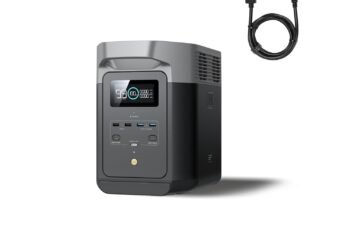
EF ECOFLOW DELTA 2 Max Solar Generator with 400W Panel

If you need a fast-charging, fridge-ready powerhouse that’s still manageable to move, the EF ECOFLOW DELTA 2 Max with the 400W panel stands out. We get 2048Wh of durable LiFePO4 power, 2400W output (X-Boost 3400W), and 15 outlets to run a full-size fridge plus essentials. It charges absurdly fast: 0–80% in 43 minutes using dual AC+solar (up to 2400W), or 1.1 hours via AC. The 400W IP68 panel hits up to 23% efficiency; add a second to halve solar time to about 2.6 hours. At 50.6 lb, it’s portable for its class. Expect 3000 cycles, a 5-year service plan, smart app controls, and strong support.
Best For: Homeowners, RVers, and campers who need a fast‑charging, fridge-capable portable power station with long battery life and app control for outages or off-grid use.
Pros:
- Extremely fast charging: 0–80% in 43 minutes with dual AC+solar; 1.1 hours via AC alone
- High power and capacity: 2048Wh LiFePO4, 2400W output (X-Boost 3400W), 15 outlets, powers 99% of household devices
- Durable and efficient solar: 400W IP68 panel up to 23% efficiency; add a second to cut solar charge time to ~2.6 hours; 3000 cycles and 5-year service
Cons:
- Heavy at 50.6 lb, which can be cumbersome for frequent carrying
- Full-speed dual-input charging requires additional solar/AC setup and ideal conditions
- Price may be high for casual users who don’t need high output or rapid charging
Jackery HomePower 3000 Portable Power Station with Solar Panels
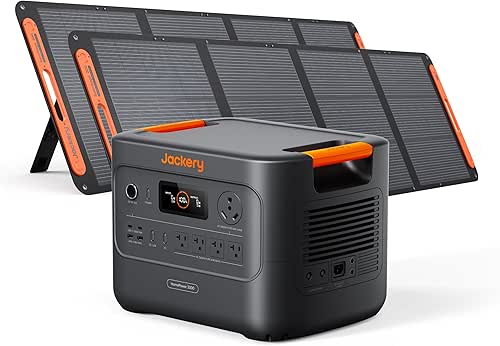
Need whole-home peace of mind during outages or RV trips? We like Jackery’s HomePower 3000 (JHP-3000C) for its 3600W output (7200W surge) and 3072Wh LiFePO4 battery. It’ll keep a refrigerator running 1–2 days (about 36 hours), plus fans, WiFi, and lights. The ≤20ms UL-certified UPS makes switchover seamless. Recharge fast: 1.7 hours hybrid AC/DC or 2.2 hours via AC. With two SolarSaga 200W panels, expect up to 80% in about 9 hours of sun.
We appreciate the TT-30 RV port, four outlets, USB-A/C, DC, app monitoring, and 4,000-cycle lifespan. Note the 59.5-pound weight and pricier panels/expanders, though 30% tax credits may apply.
Best For: Homeowners and RVers who want a high-capacity, fast-charging portable power station for seamless outage backup and off-grid trips, with app monitoring and RV-friendly outputs.
Pros:
- Strong 3600W output (7200W surge) with 3072Wh LiFePO4 battery and ≤20ms UL-certified UPS for seamless backup.
- Fast recharge: 1.7 hours hybrid AC/DC or 2.2 hours via AC; app control with WiFi/Bluetooth monitoring.
- Versatile ports including TT-30 RV, 4 AC outlets, USB-A/C, and DC; 4,000-cycle lifespan for long-term reliability.
Cons:
- Heavy at 59.5 pounds, reducing portability for frequent moving.
- Solar expansion and accessories (panels, splitters, cables) can be pricey compared to third-party options.
- Solar charging to 80% can take up to ~9 hours with 2x200W panels, and performance varies with sunlight.
Factors to Consider When Choosing Portable Power Stations for Refrigerator
As we choose a power station for a fridge, we should match power output capacity and surge wattage handling to the refrigerator’s running and startup needs. We’ll also weigh battery chemistry lifespan and usable watt-hours to ensure reliable runtime over years of cycles. If we want seamless backup, we’ll check UPS transfer speed so the compressor doesn’t cut out during outages.
Power Output Capacity
Why does power output capacity matter so much? Because our refrigerator isn’t forgiving if power dips. We need a power station whose rated continuous output matches or exceeds the fridge’s running load with headroom. For most homes, that means targeting 1,500–2,000W continuous, with full-size fridges better served by 2,000W or more. We should confirm our fridge’s running watts and ensure the unit can sustain that without cutting out.
We also want accurate manufacturer specs and an inverter that maintains efficiency under steady loads. High-discharge LiFePO4 batteries help deliver stable power and deeper usable capacity, improving uptime during outages. Pairing a robust inverter with LiFePO4 chemistry reduces voltage sag and keeps compressors humming. In short, prioritize reliable continuous watts and proven, efficient delivery.
Surge Wattage Handling
Stable continuous watts keep the fridge running, but startup is the real stress test—surge wattage decides if the compressor kicks on or the inverter trips. Surge wattage is the maximum instant power a station can deliver, above its continuous rating, to cover motor startups and other spikes.
We should match the power station’s surge capacity to the refrigerator’s startup needs. Check the fridge label for starting amps or watts, then confirm the station’s peak output in watts exceeds that number. Compressors can demand several thousand watts for a split second even if running draw is modest.
If surge is too low, the inverter may trip and the fridge won’t start—no initial cooling and food risk. We prefer models with generous surge headroom over running watts for reliable starts.
Battery Chemistry Lifespan
Longevity matters, and battery chemistry sets the pace. When we’re choosing a power station for a fridge, LiFePO4 stands out for lifespan. It typically delivers about 3,000–5,000 full cycles before capacity declines to roughly 80%–70%, far beyond many other chemistries. That cycle depth translates to years of dependable backup, especially if outages are frequent or we top up daily.
How we use it matters. Shallower discharges (for example, cycling between 30%–80%) preserve capacity and stretch life. Temperature control helps too—LiFePO4 lasts longer in moderate ambient conditions, so we should avoid extreme heat and cold during operation and storage.
Finally, we should verify manufacturer cycle ratings and warranty terms. Strong warranties and transparent cycle counts signal long-term reliability for refrigerator duty.
Usable Watt-Hours
How much runtime do we really get? Usable watt-hours (Wh) answer that. They tell us how much energy a power station can actually deliver before a recharge, unlike nominal capacity. For refrigerators, that real number matters because inverter inefficiencies, DC-AC conversion losses, and compressor startup surges shave down what’s available.
We should look for higher usable Wh to stretch runtime during outages, especially when solar or grid charging isn’t possible. Pair that with the fridge’s duty cycle: average draw over time, not just the surge. If a unit can handle surge wattage and has sufficient usable Wh, our fridge stays cold longer.
Battery chemistry plays a role, too. LiFePO4 typically holds capacity over hundreds to thousands of cycles, preserving usable Wh and consistent runtime over years.
UPS Transfer Speed
When the grid blinks, how fast a power station flips to battery matters. UPS transfer speed is the handoff time from wall power to inverter output, and for refrigerators, faster is safer. We look for specs listed in milliseconds—ideally 0–20 ms—so the compressor never stalls and food stays cold.
A shorter transfer minimizes temperature rise and reduces the chance of nuisance resets. Some models market “seamless” or automatic UPS, meaning the inverter keeps critical loads powered without perceptible interruption.
Speed isn’t about battery size; it’s driven by internal relays, inverter topology, and protection circuitry. Solid-state designs and well-tuned firmware often react quicker than relay-only systems. When comparing units, verify the stated ms rating and real-world behavior reported by users, then match it to your fridge’s tolerance.
Charging Input Options
Why obsess over charging inputs? Because how we refill a power station determines whether our fridge stays cold through outages and trips. We want multiple ways to recharge: AC wall outlets for convenience, solar panels for off‑grid days, car or battery charging on the move, and hybrid solar+AC when speed matters.
Look for dual‑input capability. Models that combine solar and AC can jump from 0–80% in roughly 43–50 minutes. Input capacity matters, too: units that accept 2000–2400W refill dramatically faster than those capped at 700–1400W.
If we’ll lean on solar, check real solar intake: panel wattage, MPPT optimization, and system limits (some handle 400W+). Smart charging features and apps that prioritize solar when available help cut grid use and stretch clean energy.
Portability and Noise
Fast charging gets us ready, but carrying the unit to the fridge and living with it nearby matters just as much. Weight varies a lot: many LiFePO4 stations span roughly 27 to 60+ pounds, so we should check specs and think about who will move it. Handle design and compact dimensions make a big difference when navigating kitchens or tight pantry corners.
Noise matters, too. Compact models typically run around 50–60 dB—about a quiet conversation or household fan—so we can keep one near the fridge without dominating the room. Higher-capacity units are heavier, yet efficient inverters and cooling often keep them hushed, which we’ll appreciate at night. Look for fanless or low-speed cooling modes and UPS-style transfer (around 20 ms) to avoid audible hiccups during switchover.
Conclusion
We’ve weighed watts, watched runtimes, and welcomed whisper‑quiet winners. Whether it’s OUPES’s expandable endurance, EcoFlow’s speedy, dual‑source stamina, or Jackery’s steady, silent strength, we’re confident these picks keep coolers cold and chaos controlled. They balance safety, surge, and serene operation, so food stays fresh and lights stay lit. As we plan for outages or off‑grid escapes, let’s choose dependable, durable power that’s calm, clean, and cleverly capable—power that protects our perishables and our peace of mind.