When the lights go out, reliability becomes our north star. We’ve rounded up the 10 best portable power stations for 2025 that balance capacity, safety, and fast recharging without the hype. From compact 88Wh units to 300W workhorses with LiFePO4 cells and solar-ready MPPT, we focus on true sine-wave output, pass-through charging, and real-world runtimes. If you’ve wondered which models actually keep essentials running during outages, let’s cut the noise and find what truly works next.
Key Takeaways
- Prioritize LiFePO4 models with 3,000+ cycles for longevity, safety, and stable performance during repeated outages.
- Match capacity and inverter output to needs: 200–300Wh for essentials; 1,000–2,000Wh+ for fridges, pumps, and multi-room coverage.
- Look for fast AC recharge (0–80% in under 1 hour) and high solar input with MPPT for resilient off-grid refueling.
- Ensure pure sine wave inverters, low harmonic distortion, and adequate surge headroom to safely run sensitive electronics and motor loads.
- Favor versatile I/O: multiple AC outlets, 60–100W USB‑C PD, 12V car port, and true pass-through charging for seamless device uptime.
Portable Power Station with 40W Foldable Solar Panel (146Wh)
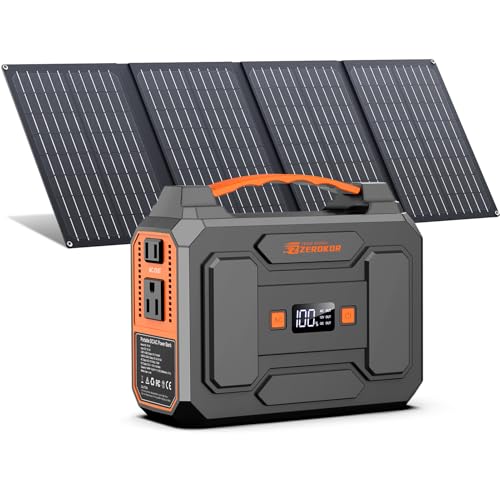

If you want a lightweight backup for small essentials during short outages, this 146Wh ZeroKor R100 kit—paired with a 40W foldable solar panel and built-in MPPT—is a smart pick. We like its 100W max output with two 110V AC outlets, DC 10A port, dual USB-A, QC USB, and USB-C (up to 9V/2A). At 3.3 pounds, it’s easy to stash. Charge via wall, car, or DC5521 solar; the monocrystalline panel is 20.5%+ efficient with 10 connectors. It’ll handle phones, tablets, cameras, and laptops, not high-heat or >100W loads. Recharge every two weeks, keep 60–80%, and rely on the BMS protections.
Best For: Campers, RVers, and homeowners who need a lightweight, solar-capable backup to power small essentials (phones, tablets, cameras, laptops) during short outages or off-grid trips.
Pros:
- Compact 3.3 lb design with 146Wh capacity and built-in MPPT for efficient solar charging
- Versatile outputs: 2× 110V AC (100W max), DC 10A, dual USB-A, QC USB, and USB-C
- 40W monocrystalline foldable panel (20.5%+ efficiency) with 10 connectors; charges via wall, car, or solar
Cons:
- 100W max continuous output limits use to low-power devices; not for high-heat or motorized appliances
- Solar recharging speed depends heavily on sun; 40W panel is modest for faster top-ups
- Requires maintenance charging every ~2 weeks and keeping battery at 60–80% when stored
Powdeom 300W Portable Power Station (296Wh)

Looking for a light, fast-recharging backup you can grab in a hurry? Powdeom’s 300W (296Wh) station weighs just 7.7 lb, yet delivers two pure sine wave AC outlets plus seven DC/USB ports (PD 65W, PD 27W/QC 3.0, two USB, car, two DC). It tops up from 0–100% in about two hours with up to 165W input (AC + PD), or via car or a 60W panel.
We like the clear LCD for watts, percentage, and time remaining, the comfy handle, and the 3-mode LED. It’ll run laptops, CPAP, fans, mini-fridges, and small tools. BMS safeguards, 12-month warranty, model PEP-S300.
Best For: Campers, travelers, and homeowners who need a lightweight, fast-recharging 300W backup to power essentials like laptops, CPAPs, fans, and mini-fridges during trips or outages.
Pros:
- Rapid 0–100% recharge in ~2 hours with up to 165W dual input (AC + PD)
- Versatile outputs: 2 pure sine wave AC outlets plus 7 DC/USB ports including PD 65W and QC 3.0
- Portable 7.7 lb design with clear LCD, comfy handle, and 3-mode LED light
Cons:
- 296Wh capacity limits runtime for higher-draw appliances
- 300W continuous output may not support larger devices or power tools
- Solar recharging depends on a separate panel (recommended ~60W) and good sun conditions
GRECELL 300W Portable Power Station (230.88Wh Solar Generator)

Compact yet capable, the GRECELL 300W (230.88Wh) shines for anyone who needs a grab-and-go backup for essentials during short outages. We like its 330W continuous (600W surge) pure sine wave AC output for laptops, routers, lights, fans, and CPAPs under 330W. The six ports cover most needs: 1 AC, USB-C PD 60W and 18W, two USB-A QC, and a 12V car port. At 7.3 pounds, it’s easy to tote. Charging’s flexible via wall, car, or solar with built-in MPPT; note typical input caps around 150W. The upgraded BMS and dual silent fans inspire confidence, though heating appliances can overload it.
Best For: Short outages, camping, and travel where you need a lightweight, grab-and-go power source for essentials like laptops, routers, lights, fans, and CPAPs under 330W.
Pros:
- 330W continuous (600W surge) pure sine wave AC with versatile ports including USB-C PD 60W for fast laptop/phone charging
- Compact and portable at 7.3 lb with built-in MPPT for efficient solar recharging
- Robust safety suite (BMS with overload/overcharge/short-circuit protection) and dual quiet cooling fans
Cons:
- Single AC outlet limits simultaneous high-draw AC device use
- 230.88Wh capacity suits short-term needs; not ideal for longer outages or power-hungry gear
- Input charging typically capped around ~150W, so full recharges aren’t ultra-fast with some chargers
MARBERO Portable Power Station 88Wh (Solar Panel Optional)

Small outages demand lightweight, grab-and-go power, and MARBERO’s 88Wh M82 fits that role with eight outputs and fast 0–80% wall charging in 2 hours. We like its 2.29 lb build, carry handle, and compact 6.5 x 4.6 x 3.1-inch footprint. Despite the size, it offers AC, DC, USB, and USB-C PD plus a car socket, and it can charge devices while the unit tops up.
Expect 80W continuous, 120W peak—fine for phones, tablets, small laptops, lights, and a car fridge in a pinch. The flashlight (three levels plus SOS) lasts up to 68 hours. BMS protections, cooling vents, and auto shutoff boost safety. Solar-ready with MARBERO’s 30W/60W panels.
Best For: Campers, travelers, and emergency backup seekers who need a compact, lightweight power station for phones, small laptops, lights, and brief use of low-watt appliances.
Pros:
- Ultra-portable 2.29 lb design with carry handle and compact 6.5 x 4.6 x 3.1-inch footprint
- Versatile I/O: 8 outputs (AC, DC, USB, USB-C PD, car socket) and pass-through charging while topping up
- Fast wall charging to 80% in 2 hours; built-in flashlight with up to 68-hour runtime and SOS
Cons:
- Limited power: 80W continuous, 120W peak—won’t run high-draw appliances
- Some users report slower full charge, fan noise under DC load, and occasional long-term reliability concerns
- Small 88Wh capacity means shorter runtimes for devices like car fridges or compressors without solar input
Jackery Portable Power Station Explorer 300 (293Wh)

For renters, students, and anyone who needs a grab-and-go backup during brief outages, the Jackery Explorer 300 hits a sweet spot of portability and utility. We get 293Wh, two pure sine wave AC outlets (300W max, 500W surge), and a clean, quiet package at 7.1 pounds. Ports include PD 60W USB-C in/out, USB-A, QC 3.0, and a 12V car port—powering up to six devices.
Recharging’s quick: to 80% in about two hours using wall plus PD USB-C, or via car or a SolarSaga 100 panel with MPPT. It runs routers, fans, TVs, and laptops, supports pass-through charging, and avoids high-draw appliances. Accessories included; solar panel sold separately.
Best For: Renters, students, campers, and commuters who need a lightweight, grab-and-go backup for brief outages or off-grid use to power small electronics and essentials.
Pros:
- Compact 7.1 lb design with 293Wh capacity and two pure sine wave AC outlets (300W max, 500W surge)
- Fast recharge to 80% in ~2 hours via wall + 60W USB-C PD; solar-ready with MPPT; pass-through charging
- Versatile ports (PD 60W USB-C in/out, USB-A, QC 3.0, 12V car) power up to six devices quietly with clean output
Cons:
- Not suitable for high-draw appliances (e.g., induction cooktops, blenders, space heaters)
- Solar panel sold separately; 100W panel recommended for meaningful solar recharge
- 293Wh capacity limits runtime for TVs or multiple devices during extended outages
Anker SOLIX C1000 Portable Power Station (1056Wh, 1800W)

Need rapid, reliable backup without a bulky setup? We like the Anker SOLIX C1000 Portable Power Station for its compact punch: 1056Wh capacity, 1800W output, and 2400W SurgePad to start 99% of appliances. Its LiFePO4 battery delivers up to 3,000 cycles for a 10-year lifespan.
Recharging is a standout. With AC, it jumps to 80% in 43 minutes and reaches full in under an hour; the Anker app manages UltraFast settings. Solar is robust too—up to 600W for a full recharge in about 1.8 hours.
It’s 15% smaller than typical 1kWh units, packs 11 ports, and arrives with essential cables and a solar connector.
Best For: Homeowners, RV travelers, and campers who need a compact, fast-recharging 1kWh-class power station that can start most household appliances and provide reliable outage backup.
Pros:
- UltraFast AC recharge to 80% in 43 minutes (full in under 1 hour) plus up to 600W solar input for ~1.8-hour solar refill
- 1800W output with 2400W SurgePad to power/start 99% of common appliances
- Long-life LiFePO4 battery rated for 3,000 cycles over 10 years, in a 15% smaller body with 11 versatile ports
Cons:
- Full-speed UltraFast recharge settings require using the Anker smartphone app
- 1056Wh capacity may be limiting for multi-day off-grid use without consistent recharging
- Optional solar panels not included; adds cost if you want solar charging
Jackery Explorer 2000 v2 Portable Power Station (2042Wh, 2200W, LiFePO4)

Powering through multi-day outages gets easier with the Jackery Explorer 2000 v2, a 2042Wh LiFePO4 unit that delivers 2200W across three AC ports and a 100W USB‑C PD for fast laptop charging. We like that it weighs about 40 lbs yet runs fridges, sump pumps, TVs, coffee makers, lights, and fans. AC recharges hit 0–80% in 66 minutes (full in 102) using Emergency Super Charging via the app, or go silent at 30dB for a full in 5 hours. UPS switching is 20ms and UL1778 certified. Expect 10-year battery life, CTB construction, pass-through charging, and solar in about 6 hours.
Best For: Homeowners, campers, and small businesses needing a quiet, fast‑charging, UPS-capable LiFePO4 power station to run essentials like fridges, pumps, and electronics during outages or off-grid trips.
Pros:
- Fast AC recharge: 0–80% in 66 minutes (full in ~102) with Emergency Super Charging; 100W USB‑C PD for laptops
- Reliable power and safety: 2200W output across 3 AC ports, 20ms UL1778‑certified UPS, LiFePO4 longevity (up to 10 years), CTB construction
- Quiet, flexible operation: <30 dB silent mode, pass‑through charging, solar input can refill in about 6 hours
Cons:
- Heavy at ~40 lbs, limiting portability for some users
- Solar charging at 6 hours assumes ~400W panels and ideal sun; panels not included
- Only three AC outlets may require a power strip for multi‑device setups
VTOMAN Jump 600X Portable Power Station (299Wh, 600W)

Looking for a compact outage-ready unit with long battery life and true pass-through charging? The VTOMAN Jump 600X delivers 600W (1,200W surge) from a 299Wh LiFePO4 battery rated for 3,000 cycles to 80%, safeguarded by LIFEBMS against overcharge, over-discharge, over/under-voltage, over-current, short-circuit, and high temps. We can power up to nine devices at once, including CPAPs and car fridges, thanks to regulated 12V outputs, 2 AC outlets, 2 DC5521, a 12V car port, 3 USB-A (QC 3.0), and a 60W USB-C PD for laptops. It expands to 939Wh with an extra battery, weighs ~13.2 lb, and includes a 2-year warranty.
Best For: Campers, RVers, and homeowners who want a compact, outage-ready power station with long-lasting LiFePO4 battery life, true pass-through charging, and enough ports to run essentials like CPAPs, car fridges, and laptops.
Pros:
- Durable LiFePO4 battery rated for 3,000 cycles to 80% with comprehensive LIFEBMS protections
- Versatile outputs (2 AC, regulated 12V DC, USB-A QC 3.0, 60W USB-C PD) and pass-through charging for up to 9 devices
- Expandable from 299Wh to 939Wh with optional extra battery while staying relatively lightweight (~13.2 lb)
Cons:
- 600W AC output may be limiting for high-draw appliances beyond brief 1,200W surge
- 60W USB-C PD is modest for power-hungry laptops that prefer 100W
- Extra battery for expansion is sold separately, increasing total cost
VTOMAN FlashSpeed 300 Portable Power Station (300W, 230Wh)

For small essentials during brief outages, the VTOMAN FlashSpeed 300 stands out with a 300W inverter and a 230Wh LiFePO4 battery rated for 3,000 cycles. We like its compact 7 lb build, sturdy handle, and Supersafe LifeBMS protections. You get six outputs: one 110V/300W AC, three USB-A (up to 18W), one USB-C PD 100W for laptops, and a DC5521. It recharges in about 2.5 hours via the 90W AC adapter, or by car, USB-C PD, or optional solar. A three-mode camping light helps during blackouts. It’s ideal for phones, routers, cameras, and small laptops, backed by strong user reviews and a manufacturer warranty.
Best For: People who need a compact, safe, and fast‑recharging power station for phones, small laptops, routers, cameras, and short outdoor trips or brief home outages.
Pros:
- Long-life LiFePO4 battery (≈3,000 cycles) with Supersafe LifeBMS protections for safer, durable use
- Versatile ports including 100W USB‑C PD and 300W AC; can power/charge up to six devices simultaneously
- Fast recharge (~2.5 hours with 90W AC) plus car, USB‑C PD, and optional solar charging
Cons:
- 230Wh capacity limits runtime for higher-draw devices and longer outages
- Single 300W AC outlet; not suitable for appliances needing higher wattage or multiple AC plugs
- Solar panel not included, and real-world solar charging can be slow in weak sunlight
ALLWEI Portable Power Station 300W (280Wh Solar Generator)
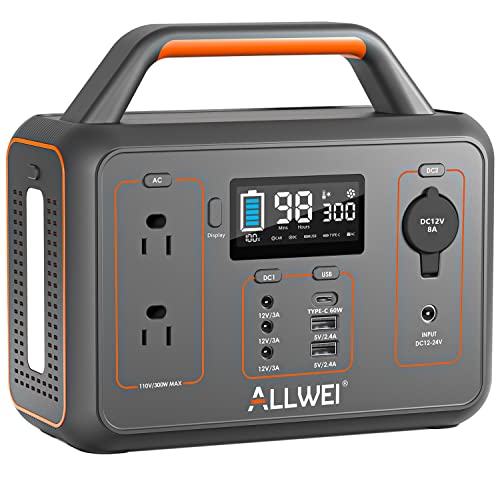
Compact yet capable, the ALLWEI Portable Power Station 300W (280Wh) suits anyone who needs a lightweight backup for essentials like a CPAP, phones, and a laptop during short outages. We appreciate its 6.5-pound build, 9 x 4.7 x 7.8-inch footprint, and pure sine wave 110V AC. With 2 AC outlets, USB-C PD 60W, 2 USB-A, 3 DC ports, and a car socket, it powers up to nine devices. Expect roughly 280Wh x 0.85 divided by your device’s watts for run time. Recharge via wall (5.5–6.5h), car (4.5–5.5h), or 100W solar (3–4h) using MPPT. BMS protections, quiet fan, 1,500 cycles.
Best For: Campers, RVers, and homeowners needing a lightweight, 300W backup to run essentials like CPAPs, phones, and laptops during short outings or brief power outages.
Pros:
- Versatile ports: 2 AC outlets, 60W USB-C PD, 2 USB-A, 3 DC, and car socket power up to 9 devices
- Compact and light (≈6.5 lb) with pure sine wave 110V AC and quiet cooling fan
- Flexible recharging: wall (5.5–6.5h), car (4.5–5.5h), or 100W solar (3–4h) via built-in MPPT
Cons:
- 300W continuous/600W surge limits heavy appliances and high-wattage tools
- 280Wh capacity fits short-term needs; not ideal for extended off-grid use without solar
- Fan noise under higher loads and need to manage total watt draw to avoid overload
Factors to Consider When Choosing Portable Power Stations for Power Outages
Before we pick a unit, let’s match power capacity to our essential loads and check that the output ports fit our gear. We’ll look for a high-quality inverter, fast and flexible recharge options, and a battery chemistry with a long cycle life. With these factors set, we can shortlist the best models for reliable outage backup.
Power Capacity Needs
How much power do we really need when the lights go out? We start by estimating watt-hours (Wh) for essentials. Higher Wh or kWh delivers longer runtime for the same load, but bigger batteries add weight and reduce portability. Next, we match inverter-rated continuous watts to what we’ll run at once. A 300–600W unit covers phones, LED lights, routers, small fans, or a CPAP; 1000W+ handles more appliances but depletes faster.
We also account for surge. Appliances with motors or compressors draw a higher startup wattage, so the station’s surge rating must exceed the highest peak on our list. Finally, we leave capacity margin for inverter and battery losses. For longevity, we weigh battery chemistry: LiFePO4 offers thousands of cycles, improving reliability and lowering lifetime cost.
Output Port Variety
When a blackout hits, why limit what we can power? We should look for a power station with a broad mix of outputs so we’re not stuck juggling adapters. Multiple AC outlets cover small appliances and medical gear like CPAP machines. USB-A handles legacy gadgets, while USB-C PD (60W–100W) fast-charges laptops, tablets, and phones—often replacing bulky bricks. Dedicated PD or quick-charge ports let us optimize speed when several devices are plugged in.
We also value multiple 12V car sockets and DC5521 outputs to run car coolers, routers, and other low-voltage gear at the same time. The goal is balanced coverage: enough AC for essentials, ample USB variety for modern and older devices, and DC ports for continuous, efficient power across our household priorities.
Inverter Type Quality
Port variety only matters if the power is clean and consistent, so we should check the inverter type and build. Pure sine wave inverters deliver cleaner, more stable power than modified sine wave models, which matters for laptops, CPAPs, and other sensitive electronics. We should verify low total harmonic distortion, ideally under 3–5%, to reduce voltage distortion and risk of damage.
Next, look at continuous versus surge ratings. A 300W continuous inverter with a 600W surge can handle startup spikes from devices like mini fridges. Matching these ratings to our load prevents brownouts and shutdowns.
Efficiency also counts. Inverters operating around 85–95% waste less energy, extending runtime. Finally, insist on built‑in protections: overload, over‑temperature, and short‑circuit safeguards protect both the station and our gear.
Recharge Speed Options
Why does recharge speed matter during an outage? Because every minute without power limits what we can run. Recharge time depends on input watts versus current battery capacity: the higher the input, the faster the fill. Some units hit 0–80% in under an hour on AC, but topping off to 100% can still take 1–2 hours or more. Models that accept multiple inputs (AC plus USB-C PD, or wall plus solar) often shave time, though gains vary by charge management.
Pass-through charging helps, letting us power devices while the station recharges, but loads effectively slow the refill. For solar, wattage and good MPPT matter—60–100W panels can deliver meaningful input in strong sun. We should match recharge options to our outage profile and device demands.
Battery Chemistry Lifespan
Fast recharging gets us back online, but how long a station holds up over years comes down to its battery chemistry and cycle life. LiFePO4 stands out for longevity, often delivering about 3,000 cycles to 80% capacity. That’s a big gap versus many Li-ion or Li-polymer packs, which commonly reach 1,000–2,000 cycles before notable fade, depending on brand and protections.
We should weigh cycles against our outage frequency and replacement timelines. More cycles mean better long-term value and less capacity anxiety after heavy use. A good battery management system matters, too. By guarding against over-charge, over-discharge, over-current, and overheating, the BMS slows degradation and preserves usable capacity.
LiFePO4 also handles heat more gracefully, keeping performance stable in off-grid and emergency scenarios.
Safety Features Set
How do we know a power station will stay safe under stress? We start with a strong Battery Management System (BMS). It should guard against short circuits, over-current, over-voltage, overload, and overheating, protecting our devices and extending battery life. We also favor LiFePO4 cells for their superior thermal stability and long cycle life—often 2,000–3,000+ cycles—so performance stays predictable under heavy use.
Auto-stop charging matters too. When the battery tops off, the unit should cut input to prevent overcharging, especially during solar-plus-wall or car charging. Temperature protection is non-negotiable, and we like silent cooling—dual fans or well-designed passive paths—to keep temps in check during fast charging or high-wattage loads. If pass-through charging is offered, protections must still prevent overload and maintain stable output.
Conclusion
When the lights take an unscheduled vacation, these portable power stations keep our essentials humming without breaking a sweat. We’ve balanced capacity, weight, ports, and price to help us stay connected, caffeinated, and calm. With LiFePO4 longevity, true sine-wave AC, fast USB-C, and solar-ready MPPT, they’re ready for polite emergencies and weekend wanderings alike. Choose the watt-hours you need, confirm surge headroom, and mind recharge speed. With the right pick, outages become brief intermissions—not grand finales.