As outages grow more common and energy costs shift, we’ve tested the latest portable power stations to see which ones truly support home life in 2025. We focus on real capacity, continuous wattage, UPS performance, LiFePO4 longevity, recharge speed, and app reliability. From compact 1 kWh units to expandable 2–3 kWh workhorses, we highlight strengths, drawbacks, and value. Let’s compare what actually matters—before you invest in the wrong backup.
Key Takeaways
- Prioritize LiFePO4 batteries for safety, 3,000+ cycle longevity, and 5-year warranties across leading 2025 models.
- Match capacity and output to needs: 1–1.5kWh for essentials; 2kWh+ and 1800–2400W for whole-room and appliance coverage.
- Seek fast recharge: 60–90 minute AC top-ups, solar inputs 500–1000W, and combined AC+solar for sub-1.5-hour replenishment.
- Verify ports and UPS: multiple AC outlets, high-watt USB-C, RV/car ports, and ~20ms UPS for seamless outage protection.
- Consider portability: sub-30 lb for grab-and-go; heavier 2kWh units add wheels/handles but deliver higher sustained power.
Anker SOLIX C1000 Portable Power Station (1056Wh, 1800W)


If you want fast, reliable backup power without a bulky footprint, the Anker SOLIX C1000 stands out. We get 1800W output with 2400W SurgePad to handle 99% of appliances, plus a 1056Wh LiFePO4 battery rated for 3,000 cycles over 10 years. It’s 15% smaller than typical 1kWh units yet packs 11 ports for home backup, RVs, outages, and camping.
Charging’s a highlight: 80% in 43 minutes and a full charge in under an hour via AC, managed in the Anker app. Solar’s strong too—600W input for a full solar charge in 1.8 hours. In the box: power station, solar connector, AC and car cables, user guide.
Best For: Homeowners, RV travelers, and campers who want a compact, fast-recharging 1kWh-class power station with enough output to run nearly all common appliances during outages or off-grid trips.
Pros:
- UltraFast AC recharging: 80% in 43 minutes, full in under 1 hour via app-controlled charging
- 1800W output with 2400W SurgePad to power 99% of household appliances
- Long-life 1056Wh LiFePO4 battery rated for 3,000 cycles over 10 years; 15% smaller with 11 versatile ports
Cons:
- Smartphone required to manage UltraFast recharging features via the Anker app
- Optional solar panel not included, despite solar-ready design
- 1056Wh capacity may be limiting for multi-day, high-load backup without solar or frequent recharges
EF ECOFLOW DELTA 2 Solar Generator with 220W Panel

Serious about fast, flexible home backup? The EF ECOFLOW DELTA 2 with the 220W bifacial panel delivers 1800W output (2700W surge) from a 1024Wh LFP battery that’s expandable to 3kWh. We get 15 outlets for AC, DC, and USB, app control, and 7x faster AC charging. Solar input hits up to 500W, and the included 220W foldable panel (ships separately) pairs well for daily topping off.
We like the 3000+ cycle LiFePO4 longevity, solid BMS, and clear display. Downsides: about 58 lb and watch cable lengths for solar placement. It’s great for fridges, tools, Starlink, and emergency home circuits.
Best For: Homeowners, RVers, and campers who want fast-charging, flexible backup power with solar integration and long-life LFP batteries for running essentials like fridges, tools, and internet gear.
Pros:
- 1800W output (2700W surge) with 15 outlets and app control covers diverse devices and home essentials
- Long-life 1024Wh LiFePO4 battery (3000+ cycles) with expandable capacity up to 3kWh
- Fast AC recharge and up to 500W solar input; 220W bifacial foldable panel included
Cons:
- Heavy at about 58 lb, reducing portability for frequent moves
- Solar/connection cable lengths can limit panel placement without extensions
- Panel ships separately; occasional packaging inconsistencies (e.g., missing manual) reported
EF ECOFLOW DELTA 2 Portable Power Station (1024Wh)

Looking for a fast-charging, home-ready power station that can actually run most appliances? The EF ECOFLOW DELTA 2 packs a 1024Wh LiFePO4 battery, 1800W AC output (2700W surge), and 15 outlets into a 27-pound, 15.7 x 8.3 x 11.3-inch body. It sprints from 0–80% in 50 minutes (full in ~80), supports up to 500W solar, and expands to 3kWh with extra batteries.
We like its 3000+ cycle LFP longevity, smart BMS, and quiet, fume-free operation versus gas. It powers 90% of household devices—mini-fridges, tools, fans, lights—great for outages, RVs, and off-grid. Included: unit, AC cable, manual, 5-year customer service. Price and fan noise crop up, but performance impresses.
Best For: Fast-recharge home backup, camping/RV users, and off-grid setups needing a portable, expandable power station that can run most household appliances.
Pros:
- 0–80% charge in ~50 minutes via AC; supports up to 500W solar and expansion to 3kWh
- 1800W AC output (2700W surge) with 15 outlets powers 90% of household devices
- Long-lasting LiFePO4 battery (3000+ cycles) with smart BMS; quiet, fume-free operation
Cons:
- Price can be high compared to smaller-capacity units
- Fans may be audible under heavy charge/discharge based on user reports
- At ~27 lb, portability is good but still substantial for frequent carry
EF ECOFLOW DELTA 2 Max Portable Power Station (2048Wh, 2400W)

Need fast, quiet whole‑home backup without gas or fuss? We like EcoFlow’s DELTA 2 Max: a 2048Wh, 2400W LFP powerhouse that scales to 6kWh with two add‑on batteries. It runs 99% of household devices, surges to 4800W, and X‑Boost handles up to 3400W. At as low as 30 dB, it’s night‑friendly.
Charging’s a highlight: hit 80% in about 1.1 hours on AC, or in 43 minutes combining AC with up to 1000W solar. The LFP battery lasts 3000 cycles to 80% (about 10 years), backed by a 5‑year service plan. At 50.6 lb, it’s portable enough, with 15 outlets and an excellent app.
Best For: Homeowners, RVers, and preparedness-minded users who want fast‑charging, quiet, expandable whole‑home backup without gas maintenance or fumes.
Pros:
- Rapid recharge: ~80% in 1.1 hrs AC or ~43 mins with AC + up to 1000W solar
- Robust power: 2400W continuous (4800W surge), X‑Boost up to 3400W, 15 outlets
- Long-life LFP battery: ~3000 cycles to 80% (about 10 years) with quiet 30 dB operation and 5‑year service
Cons:
- Heavy at 50.6 lb; portability can be challenging for one person
- Base 2048Wh may require extra batteries (up to 6kWh) for extended outages, adding cost
- X‑Boost reduces voltage for some loads; not all high-wattage devices will perform optimally
Jackery Explorer 2000 v2 Portable Power Station (2042Wh LiFePO4)

Built for homeowners who want fast, quiet backup without fumes, the Jackery Explorer 2000 v2 pairs a 2042Wh LiFePO4 battery with a 2200W output across three AC ports and 100W USB‑C PD. We like its rapid “Emergency Super Charging” to 80% in 66 minutes (full in 102), plus a 5‑hour ultra‑quiet charge at ~30dB. Solar can refill in about 6 hours with 400W panels. It weighs about 40 lbs, yet the CTB build feels solid and safe. The 20ms UL1778‑certified UPS keeps fridges, sump pumps, and lights running seamlessly. Pass‑through works well, the app’s handy, and sales often land around $900–$1,100.
Best For: Homeowners and campers who want a fast‑charging, quiet, fumes‑free backup power station with seamless UPS for outages and reliable LiFePO4 longevity.
Pros:
- Rapid AC charging: 0–80% in 66 minutes (full in ~102) plus 5‑hour ultra‑quiet mode (~30 dB)
- 2042Wh LiFePO4 with 2200W output (3 AC ports) and 100W USB‑C PD; supports pass‑through and 20ms UL1778‑certified UPS
- Durable CTB construction, app control for monitoring/outputs, and solar recharge in ~6 hours with 400W
Cons:
- Heavy at ~40 lbs, limiting portability for some users
- Solar recharge speed assumes 400W panels and good conditions; panels not included
- Typical price still high outside sales, with best deals usually $900–$1,100 only during promos
OUPES Mega 1 Portable Power Station (1024Wh LiFePO4)

Serious about fast, expandable home backup without the noise or fumes? We like the OUPES Mega 1: a 1024Wh LiFePO4 station that scales to 5kWh with the B2 extra battery. It delivers 2000W continuous (4500W peak) across 4×120V AC ports, plus 2×100W USB-C, 4×18W USB-A, two DC5521, and a car outlet. Charge up to 2200W (AC+solar), with 1400W fast charge hitting 0–80% in ~50 minutes, or select 700W to favor longevity. An ~20ms UPS keeps devices running. At 27.8 lb, 15.1×9.1×11.6 in, and ~58 dB, it’s indoor-friendly. App control, 800W MPPT, and a 5-year warranty seal it.
Best For: Home backup and off-grid users who want fast charging, quiet indoor-friendly operation, and expandable capacity from 1kWh to 5kWh with strong 2000W output.
Pros:
- 2000W continuous (4500W peak) with 4×120V AC plus rich USB/DC ports covers most household and camping devices
- Rapid, flexible charging: up to 2200W (AC+solar), 0–80% in ~50 minutes, or 700W slow charge for battery longevity
- LiFePO4 safety and longevity, 5-year warranty, app control, and ~20ms UPS for seamless outage protection
Cons:
- Base 1024Wh capacity may be limited for long outages without the extra B2 battery
- ~58 dB fan noise can be noticeable in very quiet rooms
- Solar panels and expansion battery are optional add-ons, increasing total cost
EF ECOFLOW River 2 Max Portable Power Station (499Wh)

Looking for a compact backup that charges in just an hour? We like the EF ECOFLOW River 2 Max for its 499Wh LiFePO4 battery, X-Stream AC recharge in 60 minutes, and up to 1000W output to run essentials. At 13.3 lbs and 10.6 x 10.2 x 7.7 inches, it’s easy to move, quiet, and emission-free.
It powers up to 11 devices via 300W AC outlets, USB-C, and more, delivers pure sine wave power, and supports pass-through and UPS use. Add a 220W solar panel for a 2.3-hour recharge. The long-life LiFePO4 chemistry, advanced BMS, 5-year service, and strong reviews seal the deal.
Best For: Users who need a compact, fast-charging portable power station for camping, RVs, home backup, and multi-device use with quiet, clean operation.
Pros:
- 60-minute AC recharge (X-Stream) and optional fast solar (≈2.3 hours with 220W)
- 499Wh LiFePO4 battery with long lifespan, pure sine wave output, and advanced BMS
- Lightweight (13.3 lbs), powers up to 11 devices, supports pass-through and UPS
Cons:
- 300W AC outlets limit high-draw appliances despite 1000W surge capability
- Solar panel not included; optimal 220W input adds extra cost
- 499Wh capacity may be insufficient for extended off-grid or heavy-duty use
Anker SOLIX F2000 Portable Power Station (PowerHouse 767)
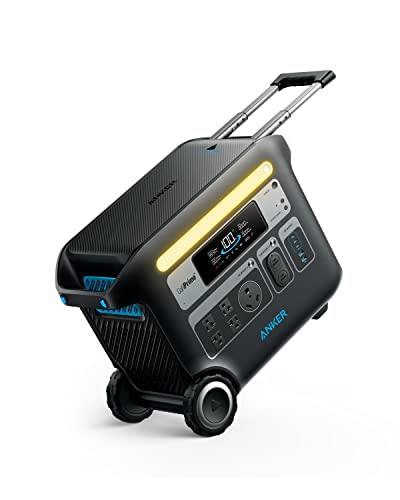
Need a powerhouse that can safely run big appliances and recharge fast? We like Anker’s SOLIX F2000 (PowerHouse 767): a 2048Wh GaNPrime LiFePO4 station delivering 2400W continuous (2800W peak) with SurgePad boosting high-wattage loads up to 3600W. It packs 13 outputs—4 AC, 3 USB-C, 2 USB-A, 2 car outlets, plus an RV port—yet stays quiet and indoor-friendly. HyperFlash recharges 0–80% in about 1.5 hours. Durability impresses: 3,000+ cycles, InfiniPower longevity, and a 5‑year warranty.
Notes: in UPS/bypass mode, AC output caps around 1440W; the 30A port can be finicky. Wheels/handle ease 67.3‑lb mobility. Solar- and generator‑top‑up friendly.
Best For: Home backup, RVs, and campers who need a fast‑recharging, quiet, high‑output power station to run large appliances and multiple devices safely.
Pros:
- 2400W continuous (2800W peak) with SurgePad up to 3600W for high‑wattage appliances
- Fast recharge: HyperFlash to 80% in ~1.4–1.5 hours; solar compatible
- Long lifespan LiFePO4 (3,000+ cycles), InfiniPower durability, and 5‑year warranty
Cons:
- UPS/bypass mode limits AC output to ~1440W, not a true online UPS
- 30A RV port can be finicky/inconsistent in some scenarios
- Heavy at 67.3 lb despite wheels and handle
Enphase IQ PowerPack 1500 Portable Power Station
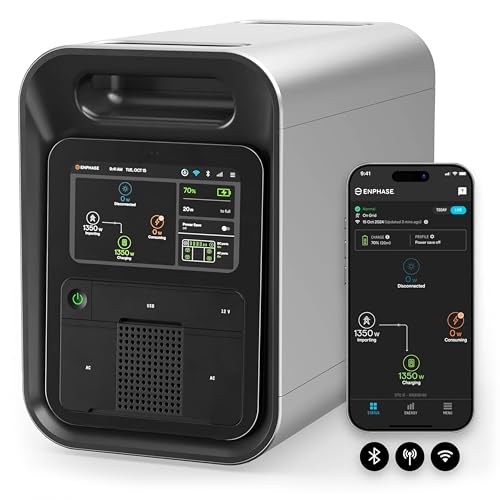
Prefer rock-solid, grid-like power in a portable form? The Enphase IQ PowerPack 1500 delivers 1500 W continuous with a 1500 Wh LiFePO4 battery and three IQ8 microinverters for clean, stable output. We get 11 ports: four 120 V AC (3000 W surge), four USB-A, two 60 W USB-C, and a 12 V car port. It recharges fast—under 75 minutes from AC, ~4 hours via two IQ portable panels, or ~14 hours from a vehicle.
We like the 7-inch color touchscreen, Enphase App control, and 4G/Wi‑Fi/Bluetooth. It switches to backup in under 10 ms, runs indoors/outdoors, weighs ~45.9 lb, and includes a 5‑year/2,500‑cycle warranty.
Best For: Power users who want fast-recharging, grid-quality portable power for home backup, camping, RVs, and job sites with robust app control and outdoor-ready reliability.
Pros:
- 1500 W continuous/3000 W surge with LiFePO4 battery and three IQ8 microinverters for clean, stable power
- Rapid AC recharge (<75 minutes) plus solar (~4 hours with two panels) and vehicle (~14 hours) options
- Rugged indoor/outdoor design, 7″ touchscreen with 4G/Wi‑Fi/Bluetooth, and 5-year/2,500-cycle warranty
Cons:
- Heavier than many competitors at ~45.9 lb, reducing portability for some users
- 1500 Wh capacity may be limiting for prolonged whole-home backup without solar input
- Requires proprietary ecosystem components (e.g., Enphase app/solar panels) to unlock all features
OUKITEL P2001 Plus 2400W Portable Power Station with 200W Solar Panel
For households that want fast, dependable backup with solar included, the OUKITEL P2001 Plus pairs a 2048Wh LiFePO4 battery with a 2400W inverter and a bundled 200W panel to keep essentials running through outages. We like its rapid recharge: 1800W AC hits 80% in 1 hour, or combine solar + AC up to 2300W for 80% in 50 minutes. With EPS, it switches to battery in 0.02 seconds. Ports are generous—4 AC, USB-A QC 3.0, four USB-C (to 100W), DC, and a car socket—powering most appliances. It’s 22.33 kg and ships in separate boxes. Five-year warranty inspires confidence.
Best For: Households and campers needing fast, dependable backup power with included solar, robust port selection, and near‑instant EPS switchover during outages.
Pros:
- Rapid recharge: 80% in 1 hour via 1800W AC, or 80% in 50 minutes with solar + AC up to 2300W
- Long-life LiFePO4 battery (>3500 cycles, ~15 years) with 5-year warranty and comprehensive BMS/MCU protections
- Versatile outputs (4 AC, USB-A QC 3.0, four USB-C up to 100W, DC, car socket) to power most home and outdoor gear
Cons:
- Heavy at 22.33 kg; not ideal for frequent hand-carry over long distances
- Power station and solar panel ship in separate packages, adding delivery complexity
- Included solar is 200W, which may be slow for full off-grid recharging without additional panels
Factors to Consider When Choosing Portable Power Stations for Home
As we compare options, we’ll weigh power output and capacity against battery chemistry lifespan to ensure reliable runtimes and long-term value. We’ll look at charging speed options and port selection versatility so you can keep essentials and gadgets running without bottlenecks. We’ll also factor in weight and portability to balance home backup needs with ease of moving the unit.
Power Output and Capacity
Power is the backbone of any portable power station decision, and we should match two numbers to our needs: output and capacity. Continuous power output (in watts) tells us what we can run at once—many home units sit between 500W and 2400W. Bigger draws like window ACs or fridges with compressors often need the top end and a healthy surge buffer.
Peak or surge wattage handles the initial spike from motors and compressors. Look for labels like “2400W surge” or features such as SurgePad that briefly raise usable output without tripping.
Capacity, measured in watt-hours (Wh), dictates runtime. Expect 500–1000Wh for light use and 2000–3000Wh for longer outages. If we anticipate extended backups, choose models with expandable battery packs to increase total capacity.
Battery Chemistry Lifespan
Why does battery chemistry matter so much for home backup? Because it dictates how long the station lasts and how consistently it delivers power. LiFePO4 (LFP) stands out: we typically see 3000+ charge cycles to 80% capacity, while many standard Li-ion packs land around 500–1000 cycles. That’s a major longevity gap for households cycling during outages and routine top-ups.
When brands advertise “3000+ cycles to 80%,” they’re using an end‑of‑life threshold; real-world usefulness often extends well beyond 1000 cycles with gradual decline. LFP’s stable capacity retention makes it a reliable pick for repeated home use.
Still, heat management matters. Poor cooling or high ambient temperatures can shorten lifespan on any chemistry. We look for thoughtful thermal design and clear cycle-life specs tied to test conditions.
Charging Speed Options
How fast do you need to recover capacity between outages or daily use? We look at charge metrics like percent per hour and time-to-80%/100%. Top AC fast-charging units hit 0–80% in about 43–50 minutes and 0–100% in roughly 80 minutes. Some pair high-watt AC with refined solar input to sustain that 43-minute sprint to 80% in real scenarios.
Solar capability matters if grid power’s limited. With 500–1000W solar input, expect substantial recharges in 1.5–2 hours under ideal sun. Multi-source charging (AC + solar) can combine wattages to beat single-input limits and trim full-charge times.
We also weigh LiFePO4 chemistry and the BMS. Efficient thermal management and conservative charge curves protect cycle life while enabling rapid recharges without stressing cells.
Port Selection Versatility
Need one box that can handle everything from a fridge to phones? Let’s prioritize port versatility. We want a balanced spread of AC outlets for appliances, plus USB-C and USB-A for devices, and 12V/DC ports for routers, inflators, or RV gear. Match the number and type of ports to what we’ll run simultaneously.
Power matters as much as plugs. Choose a unit with strong continuous output—ideally 1800–2400W—and solid surge capacity to start compressors and motors. Clear wattage limits help us assign essential loads safely.
On inputs, we prefer stations that accept AC, solar, and car charging, with the option to combine inputs for faster top-ups. A UPS or bypass mode keeps critical devices on during outages without manual switchover, preserving uptime.
Weight and Portability
A portable power station’s weight can make or break daily usability, so we should match mobility to our routine. Most models land between 13–58 pounds, and heavier units usually deliver more watt-hours and higher continuous power. That trade-off matters when we’re moving a station between rooms, stairs, or the car.
If we relocate often, we should target sub-30-pound models or units with integrated wheels and ergonomic handles. Compact options around 13 pounds are easy to grab-and-go, while high-capacity systems can exceed 60 pounds and may require two hands or a dolly. Wheels and telescoping handles help mid-to-heavy units double as practical home backups and occasional camping companions. Ultimately, we should balance energy needs against how far—and how often—we’ll actually carry the station.
App Control Features
Mobility isn’t the only convenience—we should also look at how well a station’s app keeps us informed and in control. Strong app control lets us monitor state of charge, input/output watts, and tweak settings from the couch or away from home. Real-time status graphs, power flow diagrams, and alerts for low battery or overcurrent help us act before lights flicker.
We should check onboarding, too. Some models need pairing or activation during setup to unlock full controls. Compatibility matters: look for solid iOS/Android support, reliable push notifications, and options for automation routines, not just basic toggles.
Finally, consider reliability. If connectivity drops or critical firmware and settings require online access, usability suffers. We prefer apps with responsive interfaces and essential functions available offline.
Conclusion
When the lights take an unscheduled vacation, the right power station turns a hiccup into a hush. We’ve compared LiFePO4 workhorses—fast charging, high output, UPS-ready—so we can coast through blips and longer “quiet hours” without drama. Whether it’s a compact C1000, a versatile DELTA 2 family, or a burly F2000, we’ve got options that scale with our needs. Let’s pick the resilience that fits our home, and let outages become merely polite pauses.