If we’re eyeing portable power stations to top up an EV in 2025, three models stand out for balanced output, battery longevity, and recharge speed. We compare the EF ECOFLOW Delta 3 Classic, DABBSSON 2000L, and OUPES Mega 1 using real-world UPS behavior, solar buffering, and multi-source charging. We’ll cover why LiFePO4 chemistry matters, what continuous wattage really buys you, and how each unit handled actual EV top-ups—plus one surprising limitation.
Key Takeaways
- EF ECOFLOW Delta 3 Classic: 1024Wh LiFePO4, 1800W AC (2600W X-Boost), <10ms UPS; 0–80% in 45 minutes; ideal for home backup and EV top-ups.
- DABBSSON 2000L: 2048Wh, 2200W AC (3300W P‑Boost), 800W solar, 1500W AC fast charge; robust 4000+ cycles and strong RV/camping performance.
- OUPES Mega 1: 1024Wh, 2000W continuous (4500W peak), expandable to 5kWh; hybrid AC+solar up to 2200W; light 27.8 lbs and versatile ports.
- Size for 1800–2400W continuous output to avoid EVSE brownouts; ensure surge capacity exceeds steady-state EV charger draw.
- Prioritize LiFePO4, fast UPS transfer, high MPPT solar input, and app controls; expandability and pass-through charging improve real-world EV charging flexibility.
EF ECOFLOW DELTA 3 Classic Portable Power Station
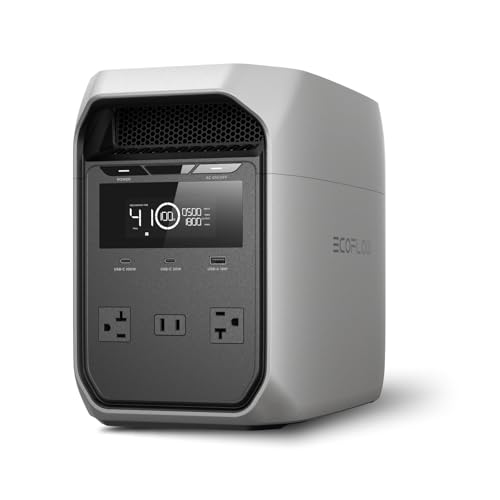

Looking for a compact, fast-charging station that can top up an EV in a pinch and still handle home essentials? We like the EF ECOFLOW DELTA 3 Classic: a 1024Wh LiFePO4 unit with 1800W AC output (3600W surge) and X-Boost up to 2600W. It jumps 0–80% in 45 minutes via X-Stream AC and supports fast solar recharging in about 2.5 hours with a 500W panel. With <10ms UPS, it protects sensitive gear. The app lets us schedule charging, set backup modes, and optimize solar buffering. It’s quiet, durable, and versatile, though heavier and pricier; keep firmware updated for best performance.
Best For: Home backup users, campers, and EV owners who want a compact, fast-charging LiFePO4 power station with strong output, UPS protection, and app-enabled solar buffering.
Pros:
- 1024Wh LiFePO4 battery with 1800W AC (3600W surge) and X-Boost up to 2600W handles refrigerators, microwaves, and power tools.
- Ultra-fast charging: 0–80% in 45 minutes via X-Stream AC; ~2.5 hours with a 500W solar panel; <10ms UPS for sensitive electronics.
- Robust app control for charging schedules, backup modes (Storm Alert, Self-Powered), and efficient solar buffering.
Cons:
- Heavier than some alternatives, making frequent transport less convenient.
- Higher cost compared to smaller-capacity competitors.
- Firmware updates can be inconsistent and may require user attention.
DABBSSON 2000L Solar Generator, 2048Wh Portable Power Station
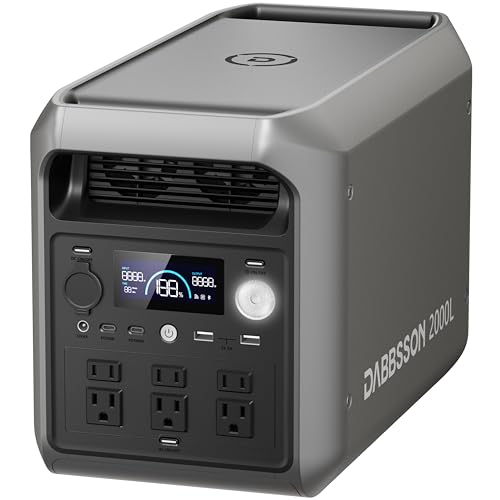
Need a compact, fast-charging station that can top up an EV in a pinch and still run heavy appliances? The Dabbsson 2000L packs 2048Wh of semi-solid LiFePO4, 2200W AC output (P-Boost 3300W), and 6 AC outlets in a 41 lb, UL94‑V0 build with a handy LED light. We like its 1500W AC fast charge—80% in 1.5 hours—and up to 800W solar with MPPT. It supports passthrough charging, a 15 ms EPS, and quiet modes. The app-controlled, AI-driven BMS adds 56+ protections and 4000+ cycles for 10+ years. It reliably powers fridges, CPAP, tools, and trims EV range when needed. Five-year warranty included.
Best For: Campers, homeowners, and RV users who need a compact yet powerful, fast-charging battery that can run heavy appliances and provide emergency EV top-ups with reliable UPS-like backup.
Pros:
- 2200W AC output (P-Boost 3300W) with 6 AC outlets powers fridges, tools, and CPAPs; supports 12 devices simultaneously.
- Ultra-fast charging: 1500W AC to 80% in ~1.5 hours; up to 800W MPPT solar; supports passthrough charging.
- Durable semi-solid LiFePO4 battery with 4000+ cycles, AI-driven BMS, 56+ protections, and 5-year warranty.
Cons:
- At ~41 lbs, it’s portable but still heavy for frequent carry without a cart.
- 2048Wh capacity limits EV “top-ups” to only a small range boost.
- Solar input capped at 800W may constrain rapid off-grid recharging in poor sun.
OUPES Mega 1 Portable Power Station (1024Wh LiFePO4)

For drivers who want a compact, fast-charging bridge between home power and roadside top-ups, the OUPES Mega 1 stands out with 2000W continuous output (4500W peak) and a 1024Wh LiFePO4 pack expandable to 5kWh. We like its four 120V AC ports, dual 100W USB-C, four USB-A, DC5521, and car outlet—enough for tools, laptops, and small appliances. Fast-charge hits 0–80% in ~50 minutes at 1400W, or choose 700W to extend battery life. It supports up to 2200W hybrid AC+solar with 800W MPPT, a 20ms UPS, and quiet ~58 dB operation. At 27.8 pounds, it’s portable, app-enabled, and covered by a 5‑year warranty.
Best For: Drivers, campers, and home users who need a compact, fast-charging power station with 2000W output, UPS backup, and expandable capacity for versatile off-grid or emergency use.
Pros:
- 2000W continuous (4500W peak) with diverse ports: 4×120V AC, dual 100W USB‑C, 4×USB‑A, DC5521, and car outlet
- Fast, flexible charging: 0–80% in ~50 minutes at 1400W; up to 2200W hybrid AC+solar with 800W MPPT; optional 700W longevity mode
- LiFePO4 longevity, quiet ~58 dB operation, app control (WiFi/Bluetooth), 5-year warranty, and expandable to 5kWh
Cons:
- 1024Wh base capacity may be limited for extended outages without the extra battery
- 27.8 lb weight is portable but still hefty for frequent carrying
- Solar panel not included; maximum charging rates require additional gear and proper conditions
Factors to Consider When Choosing Portable Power Stations for EV Charging
Before we pick a unit, let’s match battery capacity to our EV’s kWh needs and guarantee the output wattage can sustain the charger’s continuous draw. We should compare charging speeds (AC, solar, car input) against our timelines and balance portability and weight for real-world carry and storage. Finally, we’ll prioritize built-in protections—BMS, temperature control, surge and short-circuit safeguards—for safe, reliable roadside charging.
Battery Capacity Needs
How much battery do we really need to make EV top-ups practical? Battery capacity, measured in watt-hours (Wh), dictates how long a power station can sustain a load. Higher Wh means longer runtime between recharges. For routine convenience charging, we should target several hundred Wh up to about 1024Wh. For road trips or larger EVs, 2000Wh or more gives meaningful buffer.
Let’s size it. Estimate the session energy in kWh, multiply by 1,000 for Wh, then add overhead. Because real-world usable capacity is lower than nominal, we assume roughly 80% usable on LiFePO4 in daily use. So if we want 1.0 kWh delivered, we plan for 1,000 Wh ÷ 0.8 ≈ 1,250 Wh. Prefer systems with expansion batteries to grow capacity without replacing the base unit.
Output Wattage Requirements
What output wattage actually makes an EV top‑up work instead of trip a breaker? We need the power station’s continuous output to meet or exceed the charger’s input, not just the peak spec. Most portable-friendly Level 2 setups draw 120–240V at 16–40A, so we target 1,800–2,400W continuous to cover common scenarios without brownouts.
If we’ll power anything else—HVAC, space heaters, or other high-load devices—while charging, we step up to 2,000W+ continuous so the system doesn’t throttle or fault. Surge ratings still matter: inductive loads and charger inrush can spike, so we want a surge capacity comfortably above steady-state draw.
Finally, we verify clean, stable output. Some EVSEs expect UPS-like behavior, low ripple, and a pure sine waveform to maintain safe, reliable charging.
Charging Speed Options
So, how quickly can we get meaningful miles back into the pack? Charging speed hinges on how fast the station both outputs to the EVSE and refills itself. For refills, we look at maximum input wattage and protocols. Units that accept 1000–2200W AC or 1500–2000W solar can go from 0–80% in roughly 30–60 minutes (often 45–50 minutes on LiFePO4) under ideal conditions.
Multi-source charging matters. Models that combine AC + solar (or car) shorten downtime and keep capacity available during outages. Fast-charging modes and Boost profiles also help, provided they’re thermally managed.
Real-world results vary with panel efficiency and sun. We also value UPS features or 10–20 ms transfer times to keep critical devices live when the grid drops while the station recharges or buffers.
Portability and Weight
Speed only helps if we can actually carry the station to the car or campsite, and that’s where portability and weight set the limits. Most portable units land between 27–41 lbs (12–18 kg), especially when they pack larger LiFePO4 batteries and multiple ports. Higher-capacity models—think 1024Wh—extend runtime but add bulk, which affects airline travel, trunk space, and single-person lifts.
We look for well-designed handles, compact shells, and balanced weight distribution; those details decide whether a “portable” box feels manageable over 50 yards. Modular or stackable systems help too, letting us split the load instead of muscling one heavy block.
Remember the trade-off: lighter stations often deliver lower continuous wattage, which can cap EV-adjacent loads and slow on-the-go top-ups. Choose the lightest unit that meets your wattage needs.
Safety and Protections
How do we judge a power station’s safety when it’s feeding an EV? We start with the battery management system. We want layered protections: thermal monitoring, overcharge and overdischarge limits, and fast short‑circuit response. These keep cells within safe operating windows during long charging sessions.
Next, we verify seamless AC transfer. A UPS or sub‑10–20 ms switch helps protect onboard EVSE electronics from interruptions and brownouts that can trip faults. Chemistry matters, too: we prioritize LiFePO4 for stability and long cycle life—commonly 2,000–4,000+ cycles—so performance stays predictable.
We also check high‑temperature control: intelligent fans, heat sinks, and derating curves that prevent thermal runaway and power sag. Finally, we confirm third‑party safety certifications and fire‑resistant enclosures (e.g., UL94‑V0) match real construction and intended use.
Solar and Expandability
When we plan for solar, we’re really sizing two things: how fast we can refill and how long we can run. Solar input capability dictates refill speed; higher inputs—think 1500–2200W—let us bounce back between charging sessions during good sun. Multiple solar ports (e.g., 2× 500W) plus high MPPT efficiency help capture more watts from parallel arrays, maximizing real-world harvest.
Expandability is our runtime lever. Adding extra batteries or modules grows total kWh, extending off-grid EV top-ups without grid help. Chemistry matters: LiFePO4 offers longer cycle life and tolerates frequent deep cycles, which solar-driven charging often demands.
We also value integrated UPS and pass-through charging. These keep the station charging from solar while powering accessories or a low-amp EVSE, improving reliability and uptime.
Conclusion
If you’ve been waiting for a sign, this is it—we’d bet the grid on these three. Delta 3 Classic sprints from 0–80% like lightning, Dabbsson 2000L muscles through 2200W like a tiny power plant, and OUPES Mega 1 expands like it’s defying physics. Together, they’ll juice your EV, keep essentials humming, and laugh at outages. Let’s stop worrying about plugs and start owning power—because portable, fast, and reliable is no longer future talk. It’s now.