We’re seeing portable power stations evolve fast in 2025, bringing EV owners real on‑the‑go charging with LiFePO4 longevity, high output, and smart expandability. From dual‑voltage heavy hitters to lighter backup options, the right pick depends on capacity, recharge speed, and how you travel. We’ll compare standout models, highlight 240V readiness, solar performance, and UPS use, and flag what truly matters for road trips and emergencies—so you can decide with confidence next.
Key Takeaways
- Choose high-capacity, expandable stations (4–6 kWh base) that scale to 26–48 kWh for meaningful EV range boosts and multi-day resilience.
- Prioritize true 120V/240V output with NEMA 14-50 for direct EV charging and RV compatibility without extra inverters.
- Look for fast recharge: 240V input refills in ~1.8–2.7 hours; support multiple charging methods and robust solar input.
- Ensure LiFePO4 batteries, 3,000–4,000+ cycles, ~30 dB quiet operation, IP-rated durability, and 5-year warranties.
- Verify app control, UPS capability (<10 ms), abundant ports, and dual-unit pairing up to 12,000W for whole-home or split-phase needs.
Dabbsson 2000L Solar Generator Portable Power Station (2048Wh)
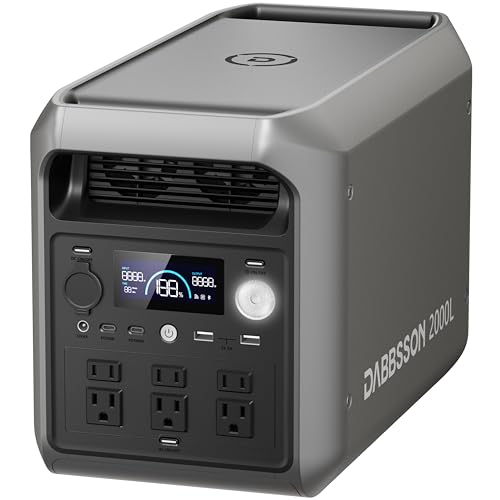

If you want a compact EV trip companion that fast-charges and keeps essentials running, the Dabbsson 2000L stands out with 2048Wh of semi‑solid LiFePO4 storage, 2200W AC output (P‑Boost to 3300W), and 1500W AC recharging to 80% in about 1.5 hours. We like its 11.2 × 18.3 × 8.9 in, 41 lb build, UL94‑V0 shell, built‑in handle, and LED light. It powers up to 12 devices: six AC outlets, 100W/30W USB‑C, two USB‑A, a car port, and DC5521. Expect 4000+ cycles, 10+ years, 56+ protections, 15 ms EPS, app control, MPPT solar to 800W, passthrough charging, and a 5‑year warranty.
Best For: EV road-trippers, campers, and home backup users who want a compact, fast-charging power station with high output and reliable long-term performance.
Pros:
- 2048Wh semi-solid LiFePO4 battery with 4000+ cycles and 10+ years lifespan; 2200W AC output with P-Boost to 3300W.
- Ultra-fast recharging: 80% in ~1.5 hours via 1500W AC; up to 800W MPPT solar; supports passthrough charging.
- Portable yet robust: 11.2 × 18.3 × 8.9 in, 41 lb, UL94-V0 fire-resistant shell, 6 AC outlets, dual USB-C (100W/30W), app control, 15 ms EPS.
Cons:
- 41 lb may still be heavy for frequent solo carrying despite compact size.
- 800W max solar input limits recharge speed compared to some higher-end peers.
- EPS at 15 ms may not be suitable for the most sensitive, zero-interruption equipment.
Anker SOLIX F3800 Portable Power Station (3840Wh, 6000W)

Serious EV drivers who need true 120V/240V versatility and direct EV charging will zero in on the Anker SOLIX F3800. We get 3.84kWh base capacity, expandable to 26.9kWh with six batteries; add a second unit plus 12 packs for two weeks of power. The 6,000W AC output and dual-voltage support handle homes, RVs, and EVs; pair two units for 12,000W.
Direct EV charging via NEMA 14-50 at 6,000W needs no grounding accessories. RVs plug into NEMA 14-50 or L14-30 and run all appliances. Control and monitor with the Anker app over Wi‑Fi or Bluetooth. EV‑class LFP cells, InfiniPower, 10‑year lifespan, 5‑year warranty. Included: AC cable, solar cables, MC4, manual.
Best For: Homeowners, RVers, and EV drivers who need high-output 120V/240V power with expandable capacity and direct EV/RV compatibility for backup, travel, and off-grid use.
Pros:
- 6,000W AC output with true 120V/240V support; pair two units for up to 12,000W
- Expandable from 3.84kWh to 26.9kWh (or more with dual-unit setup) for extended outages
- Direct EV charging via NEMA 14-50 and RV-ready ports (NEMA 14-50, L14-30) with app-based control over Wi‑Fi/Bluetooth
Cons:
- Base 3.84kWh may be limited without add-on batteries for multi-day outages
- High total cost when expanding capacity with extra batteries or a second unit
- Large, heavy system may be cumbersome for frequent transport despite portability features
EF ECOFLOW DELTA 2 Portable Power Station (1024Wh LiFePO4)

Looking for a fast-recharging, road-ready power hub for EV adventures? The EcoFlow DELTA 2 delivers 1024Wh of LiFePO4 capacity with 3000+ cycles, a robust BMS, and 15 outlets. We get 1800W AC continuous (2700W surge) at 120V, plus 100W USB-C. Its headline: 0–80% in 50 minutes, 0–100% in 80 via wall power, or up to 500W solar for quiet, green charging. At 27 pounds, it’s portable yet substantial.
We can expand to 3kWh for longer trips or outages, powering 90% of appliances—fans, fridges, tools, and more. In the box: unit, AC cable, manual, and a 5-year customer service promise.
Best For: Road-trippers, campers, and home backup users who want fast AC/solar recharging, strong 1800W output, and long-lasting LiFePO4 reliability with expandable capacity.
Pros:
- Blazing AC recharge: 0–80% in 50 minutes; solar up to 500W for quiet, green charging
- 1800W continuous (2700W surge) powers 90% of appliances; 15 outlets including 100W USB-C
- Durable LiFePO4 battery with 3000+ cycles and expandable capacity up to 3kWh
Cons:
- 27 lb weight is portable but hefty for frequent hand-carrying
- Full 3kWh expansion and solar setup add cost beyond base unit
- Fan noise and cable length (e.g., XT60 extensions) can be minor usability annoyances
GROWATT HELIOS 3600W Portable Power Station (3686Wh LiFePO4)
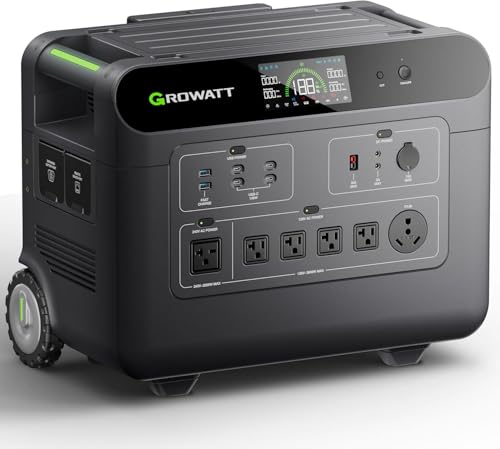
Packing a 3,686Wh LiFePO4 battery and 3,600W AC output (4,500W with Watt+), the Growatt HELIOS 3600 stands out for EV drivers who want ultra-fast recharging and true whole-home backup. We can fast charge at up to 3,600W in 1.5 hours, or refuel via 2,000W solar in about 2.8 hours. With 16 ports, 120V output, UPS under 15ms, and TOU controls in the Power Strategy app, it’s EV-, home-, and RV-ready. Two units with split-phase unlock 240V and up to 36kWh, supporting 4–7 days of autonomy. It’s 51 lb, cold-starts to -22°F, carries a 5-year warranty, and supports 30% tax credit eligibility.
Best For: EV owners, homeowners, and RV/camping users who need ultra-fast charging, robust off-grid/backup power, and scalable whole-home capability.
Pros:
- 3,686Wh LiFePO4 with 3,600W AC output (4,500W Watt+) and 16 ports, including RV-friendly outputs.
- Ultra-fast recharge: 3,600W AC in ~1.5 hours or up to 2,000W solar in ~2.8 hours; UPS <15ms and TOU controls via app.
- Scalable to 240V and up to 36kWh with two units and split-phase; operates down to -22°F; 5-year warranty and 30% tax credit eligibility.
Cons:
- Heavy at 51 lb; portability can be challenging despite wheels/handles.
- App setup and UI/translation issues reported; occasional charging hum.
- 120V single-unit output; 240V requires a second unit and split-phase connector.
Anker SOLIX F2000 Portable Power Station (PowerHouse 767)
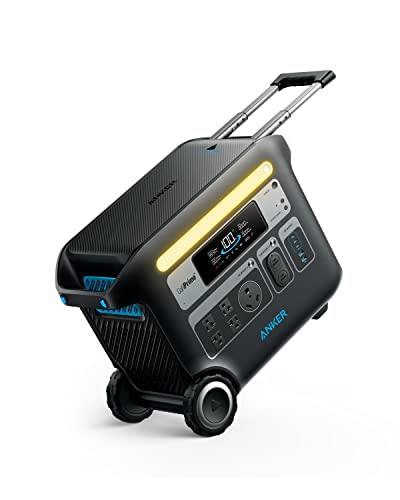
If you need a high-capacity, fast-recharging hub for road trips and home backup, Anker’s SOLIX F2000 (PowerHouse 767) stands out with 2048Wh, 2400W continuous output, and HyperFlash that charges 0–80% in about 1.5 hours. We like its LiFePO4 longevity (3,000+ cycles), quiet operation, and 5-year warranty. With 13 outputs—4 AC, 3 USB-C, 2 USB-A, 2 car outlets, and an RV port—plus SurgePad to handle up to 3600W surges, it covers appliances and tools. Portability’s decent with wheels and a handle. Note the UPS caveat: bypass mode limits AC to ~1440W. Use solar or vehicle charging, monitor via app, and plan sensitive loads accordingly.
Best For: Road trippers, RV owners, and homeowners who need a high-capacity, fast-recharging, quiet portable power station with long battery life and versatile outputs.
Pros:
- 2048Wh capacity with 2400W continuous output (up to 3600W with SurgePad) powers appliances and tools
- HyperFlash recharges 0–80% in about 1.5 hours; LiFePO4 battery with 3,000+ cycles and 5-year warranty
- 13 ports including 4 AC, 3 USB-C, 2 USB-A, 2 car outlets, and an RV port; wheels and handle for portability
Cons:
- UPS/bypass mode limits AC output to ~1440W, not a true online UPS
- Heavy at 67.3 lbs; may be cumbersome without using wheels/handle
- Some reports of app quirks, 30A/RV port inconsistencies, and occasional support responsiveness concerns
EF ECOFLOW DELTA Pro 3 Portable Power Station (4096Wh, Expandable)

Serious EV drivers who want true home-level backup on the road will zero in on the EF ECOFLOW DELTA Pro 3 for its 4096Wh LFP battery and 4000W/120V–240V output that can surge to 6000W (and scale to 12,000W). We like that it expands to 48kWh, delivering 2–4 days of whole-home power and even running heavy loads like a 3-ton AC or 1 HP pump. It’s plug-and-play, portable, and app-controlled. Seven charging methods include AC, solar, gas generators, and EV charging piles. X-Quiet keeps noise near 30 dB. With 10 ms switchover, IP65-rated durability, and a 5-year warranty, it’s road-ready.
Best For: Serious EV drivers, RVers, and homeowners who need portable, plug-and-play whole-home backup with high output, fast switchover, and expandable capacity for multi-day resilience.
Pros:
- 4096Wh LFP battery expandable up to 48kWh; 4000W AC output (6000W X-Boost, scalable to 12,000W) handles heavy loads like 3-ton AC and 1 HP pumps
- 7 charging methods including AC, solar, gas generators, EV charging piles; app control and monitoring with remote access
- Fast 10 ms backup switchover, quiet operation around 30 dB, durable IP65-rated CTC pack, and 5-year warranty
Cons:
- Base 4096Wh capacity may require extra batteries for true multi-day whole-home use
- High output and expandability can increase overall system cost and weight versus smaller power stations
- 240V and whole-home integration may require compatible accessories (e.g., Smart Home Panel 2) for optimal setup
AFERIY P210 Portable Power Station 2400W (2048Wh LiFePO4)

For EV drivers who want a fast-charging, UPS-ready powerhouse, the AFERIY P210 stands out with a 2400W pure sine wave inverter (4800W surge) and a 2048Wh LiFePO4 battery rated for 3500+ cycles. We like its 1100W AC recharge and 500W solar input, plus a server-grade UPS that switches in under 10 ms. Six AC outlets, four Type-C (including 100W), two USB-A, DC5521, car, and XT60 cover everything from laptops to fridges. It’s quiet (<30 dB), app-enabled, and durable, though heavy at 54 lb. The 7-year warranty and 24/7 support strengthen value for home backup, camping, and off-grid use.
Best For: EV drivers, homeowners, and campers who need a high-capacity, fast-charging portable power station with true UPS capability and quiet operation for sensitive electronics.
Pros:
- 2400W pure sine wave inverter (4800W surge) with 2048Wh LiFePO4 battery rated for 3500+ cycles and 10-year durability
- Rapid recharge options: 1100W AC input and 500W solar input; <10 ms UPS switchover for seamless backup
- Versatile I/O: 6 AC outlets, 4 Type-C (including 100W), 2 USB-A, DC5521, car, and XT60; app monitoring and control
Cons:
- Heavy at 54 lb, limiting portability for frequent moves or solo carry
- Solar input capped at 500W, slower full recharges off-grid compared to higher-input competitors
- 120V-only operation may require additional equipment for certain 240V appliances or regions
Jackery Explorer 1000 v2 Portable Power Station

Need a fast, road-ready backup that won’t weigh you down? We like Jackery’s Explorer 1000 v2: a 23.8 lb LiFePO4 unit delivering 1,500W AC (3,000W surge) from a 1,070Wh pack. It’s compact, durable, and easy to carry with a foldable handle.
We get three pure sine AC ports, two USB-C (up to 100W PD), one USB-A, and a 12V car port—great for fridges, pots, small ACs, and camp or RV gear. ChargeShield 2.0 plus the Jackery App adds 1-hour emergency charging, quiet 30 dB nights, and efficiency mode. Expect 4,000 cycles to 70% and 10+ years. Note: solar panel not included and only Jackery panels fit.
Best For: Campers, RVers, and emergency-prep users who want a lightweight, fast-charging LiFePO4 power station that can run high-draw appliances and be managed via a smart app.
Pros:
- 1,500W AC (3,000W surge) from a 1,070Wh LiFePO4 battery with 4,000 cycles to 70% for long lifespan
- Fast charging with 1-hour emergency mode, 100W USB-C PD, and app controls including quiet and efficiency modes
- Portable 23.8 lbs design with foldable handle and versatile ports (3 AC, 2 USB-C, USB-A, 12V car)
Cons:
- Solar panel not included and solar charging is compatible only with Jackery panels
- App requires account management; some users report mixed experiences with app/screen
- Premium pricing for capacity; display size and cost may not suit all budgets
EF ECOFLOW DELTA Pro Solar Generator with 400W Panel

Looking to bridge home-backup muscle with road-trip flexibility? We like the EF ECOFLOW DELTA Pro with its 3600Wh battery and 3600W AC output (X-Boost to 4500W). It powers fridges, tools, and essentials across 15 ports, yet still rolls easily thanks to wheels and a handle. Fast-charge at 3000W from a 240V outlet in 1.8 hours or 1800W in 2.7 hours.
The included 400W foldable, IP68 solar panel hits 22.4% efficiency—about 11 hours for a full charge; add two more to cut that to ~3.5 hours. The EcoFlow app helps monitor and tweak settings. It’s heavy (99 lbs) and very high loads may trip protections.
Best For: Homeowners and RV/camping users who want a high-capacity, fast‑charging solar generator that can serve as reliable home backup and off-grid power with app control.
Pros:
- 3600Wh capacity and 3600W AC output (X-Boost to 4500W) handles fridges, tools, and multiple essentials across 15 ports
- Fast recharge: 3000W from 240V in ~1.8 hrs or 1800W from standard wall in ~2.7 hrs; solar-ready with efficient 400W IP68 panel
- Smart EcoFlow app for monitoring, customization, and remote control via Wi‑Fi/Bluetooth; wheeled design for easier moving
Cons:
- Heavy at 99 lbs; portability still requires lifting effort despite wheels/handle
- Very high or surge-heavy appliances can trip protections; careful load management needed
- Solar expansion may require extra adapters; performance impacted by shading and panel placement
BLUETTI Apex 300 Portable Power Station (2764.8Wh Solar Generator)
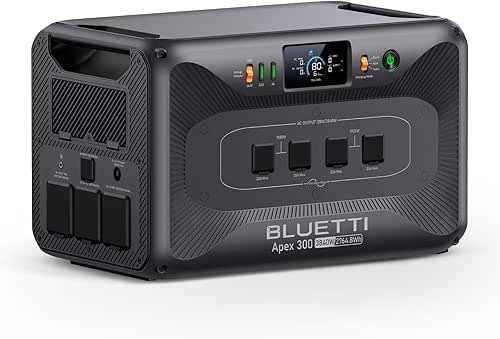
Serious EV drivers who need simultaneous 120V/240V output will appreciate the BLUETTI Apex 300’s muscle: a 2764.8Wh LiFePO4 pack delivering 3840W continuous (7680W surge) across six AC outlets. We can plug in Level 1 chargers, tools, or appliances without shore power, and even run 120V and 240V loads at once. It’s built for homes, RVs, and off‑grid stops.
Charging is fast: AC tops up to 80% in 45 minutes, solar hits 2400W (up to 6400W expanded), and generator compatibility is broad. With 6,000+ cycles to 80% and a CNAS‑certified, 33‑test pedigree, it’s durable. Expand with B300K modules to 58kWh. Includes AC/car cables.
Best For: Serious EV drivers, RV owners, and off‑grid users who need high-wattage, dual-voltage (120V/240V) power with fast charging and long-cycle LiFePO4 durability.
Pros:
- 3840W continuous (7680W surge) with six AC outlets and simultaneous 120V/240V output for versatile loads.
- Rapid recharging: up to 80% via AC in 45 minutes; 2400W solar input (expandable to 6400W); broad generator compatibility.
- Long lifespan LiFePO4 battery with 6,000+ cycles to 80% and CNAS-certified reliability; expandable to 58kWh with B300K.
Cons:
- 2764.8Wh base capacity may be limited for multi-day, whole-home backup without expansions.
- High power capability likely comes with significant weight/size, reducing portability for some users.
- Dual-voltage and expansion features may add setup complexity and cost compared to simpler power stations.
Factors to Consider When Choosing Portable Power Stations for EV
Let’s start by matching battery capacity to our real-world range needs and confirming the output wattage can handle our EV’s charging draw. We’ll check supported EV charging options, the unit’s voltage and ports (AC, DC, USB-C), and whether they align with our connector and adapter setup. Finally, we’ll compare charging speed methods—AC wall, solar, and car input—to minimize downtime on the road.
Battery Capacity Needs
How much battery do we really need for EV-ready power on the go? Capacity, measured in watt-hours (Wh), decides runtime. Bigger packs—2048Wh, 3840Wh, 4096Wh—run the same loads longer, so we should target multi‑kWh units. For EV support plus daily essentials during outages, 3–4 kWh is a smart baseline, with more if we expect extended off‑grid stays.
Remember, runtime hinges on what we power. A station rated for 3600W continuous with ~3686Wh can handle heavy appliances, but high loads drain capacity quickly. That’s why expandability matters: add batteries to stretch use without downtime and match changing needs.
Chemistry counts too. LiFePO4 typically delivers 3,000–4,000+ cycles and steadier capacity retention, helping our investment keep usable Wh over years of charge–discharge cycles.
Output Wattage Requirements
Why does output wattage make or break a portable power station for EV use? Because continuous AC output determines what we can run at once. A 3600W unit can handle typical home-style loads, while a 6000W peak lets it absorb short surges from high-start appliances. We should always check both running and surge specs—think 3600W continuous with 4500W surge—so inductive loads like fridges or A/Cs don’t trip the system.
For multi-device use, we add up running watts and keep the total under the station’s continuous rating. Surge headroom prevents brownouts when compressors kick on. Dual-voltage or split-phase (120V/240V) expands what we can power, including heavier tools or circuits. For EV or RV scenarios, confirm peak capability and that brief high-watt draws won’t throttle or shut down.
EV Charging Options
Curiously, not all “EV-capable” power stations charge an EV the same way, so we need to match features to our use case. Some units include dedicated EV outlets (like NEMA 14-50) that push up to 6,000W, delivering true Level 2–style speeds without extra adapters. Others rely on standard AC outputs, which can work but often charge slower.
We should consider how we’ll refuel the power station itself. Flexible input options—AC wall, solar, car outlet, EV chargers, or a smart home panel—let us recharge on-grid or off-grid and keep trips moving. Fast recharge claims (0–80% in roughly 50–80 minutes) minimize downtime between drives. For larger batteries or multiple vehicles, scalable systems with expansion packs or linked units help sustain higher output. Finally, verify compatibility and grounding to ensure safe, compliant operation.
Voltage and Ports
Charging options set the pace, but voltage and ports determine what we can actually plug in and how fast power flows. We should match a station’s output to our gear: 120V covers most household devices, while dual-voltage 120V/240V units unlock heavier loads that require 240V. The port mix matters, too. Multiple AC outlets, high-wattage USB-C, legacy USB-A, 12V car outlets, and DC ports let us power laptops, tools, and accessories simultaneously.
We also check for RV and appliance-specific connections—XT60, Anderson, or RV-ready inlets—so we’re not juggling adapters. Pay attention to continuous versus surge ratings; starting spikes from compressors or induction cooktops can trip smaller inverters. Finally, battery chemistry affects voltage stability. LiFePO4 packs typically hold output under sustained draw and deliver longer cycle life.
Charging Speed Methods
How quickly can we get back on the road? We should compare charging methods by real input power, not just marketing claims. AC recharge speed is often listed as a percent: many units hit 80% in about 1.5 hours and 0–100% in 1.5–2 hours, assuming robust wall input. Solar varies more: smaller stations accept roughly 500–800W, while larger models take 2,400W or more, letting us top up faster under strong sun.
We also value pass-through charging—combining AC, solar, and even car input—so we can recharge while powering gear. For direct EV needs, a NEMA 14-50–style output mimics high-power, grid-like delivery, cutting downtime. Remember, “0–80% under an hour” depends on chemistry (often LiFePO4) and the actual wattage available.
Cycle Life Durability
Two numbers matter for longevity: cycle life and the warranty that backs it. Cycle life tells us how many full charge–discharge cycles a battery endures before notable capacity loss. For EV-focused power stations, LiFePO4 chemistries commonly deliver 3,000–4,000+ cycles and retain strong capacity well past 1,000 cycles, translating to reliable performance for years. Higher cycle life usually aligns with multi-year warranties, signaling confidence and lowering long-term replacement costs.
We should also weigh real-world variables. Usage patterns, depth of discharge, and thermal conditions shape actual lifespan—deep discharges and heat shorten it. Some brands tout 10+ years, but that hinges on care. Look for an advanced BMS that monitors cell health, balances packs, and safeguards rapid charge/discharge. It preserves cycles, protects safety, and sustains dependable output.
Weight and Portability
Long life only matters if we can actually bring the power station along, so we should size and carry it wisely. Weight and portability vary widely: smaller units can be around 11–12 inches wide and 8–12 inches tall, making them easy to hand-carry. As capacity rises, weight climbs quickly—models span roughly 27 to 99 pounds—so we should match runtime needs to what we can lift or roll.
If we need 2000–4096Wh for extended sessions, we should expect significant bulk. In that case, wheels and sturdy, well-placed handles become essential for moving across parking lots, campsites, or uneven ground. We’ll get the best experience by comparing weight-to-capacity ratios and prioritizing mobility features that let us transport the unit without strain or awkward maneuvers.
Safety and Warranty
Safety and warranty should be nonnegotiable when we’re charging an EV from a portable power station. We should favor LiFePO4 packs for their inherently safer chemistry, 3000+ cycle life, and stable performance under heavy loads. Robust safety design matters: look for multi-layer protections (over/under-voltage, overcurrent, short-circuit), active thermal management, and fire-resistant enclosures rated UL94-V0.
We also need clarity on UPS/EPS behavior. Confirm transfer times, bypass limits, and any reduced wattage in UPS mode so our chargers won’t trip or throttle. On warranty, a minimum five-year term with explicit coverage for the battery, BMS, inverter, and ports is key. Verify what’s excluded, how claims work, response times, and whether registration unlocks extensions. Reliable support beats bold marketing every time.
Conclusion
We’ve covered compact chargers to colossal-capacity contenders, all built for quick, quiet, and quality power on the go. Whether we favor dual‑voltage dynamos, LiFePO4 longevity, or solar-ready speed, we can confidently choose a station that suits our road trips, repairs, and real‑world emergencies. Let’s match features to our needs—ports, power, portability—and stay charged, safe, and stress‑free. From daily drives to disaster days, these smart, scalable solutions keep our EVs energized and our adventures effortlessly electrified.