Nearly 60% of mobile DJs now rely on battery power at least part-time, and the stakes are high when silence isn’t an option. We’re focusing on compact stations that deliver clean pure-sine power, quiet cooling, and fast, flexible charging for laptops, mixers, and controllers. We’ll compare real-world runtimes, surge handling, and weight, plus which models recharge fastest between sets. If you’ve ever eyed the breaker panel mid-show, you’ll want to see what actually holds up.
Key Takeaways
- Prioritize pure sine wave inverters with adequate surge headroom to protect mixers, controllers, laptops, and powered speakers from noise and startup spikes.
- Choose LiFePO4 batteries for 3,000+ cycles, better thermal stability, and consistent capacity across seasons—ideal for frequent gigs and travel.
- Match capacity to your rig: runtime ≈ (Wh × 0.8–0.9 efficiency) ÷ total watts; plan extra for lights and peak draws.
- For quiet stages, pick compact units with fanless or low-noise cooling, pass-through charging, and fast USB-C PD (60–100W) for laptops.
- High-capacity options like 2000Wh/2200W units suit multi-speaker setups; 300–600W compact stations excel for minimalist DJ rigs and quick sets.
ALLWEI 300W Portable Power Station (280Wh Solar Generator)
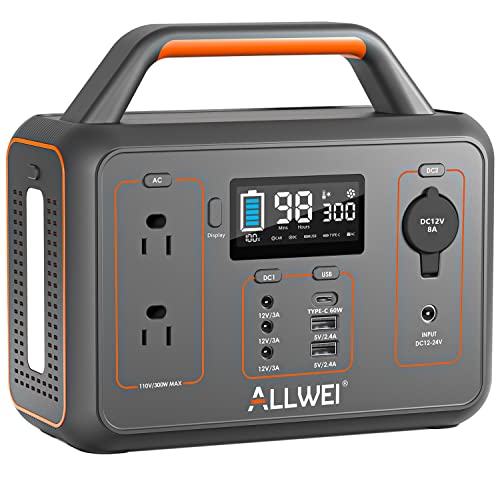

Need a compact, quiet backup for small DJ rigs or ceremony setups? We like the ALLWEI 300W Portable Power Station. It’s a 280Wh, 6.5-pound unit with a pure sine wave 110V AC output and nine ports: 2 AC, USB-C PD 60W, 2 USB-A, 3 DC, and a car socket. Expect about 280Wh x 85% efficiency divided by your device’s watts for runtime. It handles 300W continuous, 600W surge, with overload protection and a silent smart fan.
Recharging’s flexible: wall (5.5–6.5h), car (4.5–5.5h), or 100W solar (3–4h) via built-in MPPT. It’s sturdy, quiet, ceremony-friendly, and ideal for light-to-moderate DJ needs.
Best For: DJs and mobile performers needing a compact, quiet, pure-sine backup to power small rigs, ceremony systems, or light event gear under 300W.
Pros:
- Pure sine wave 110V AC with 2 AC outlets plus USB-C PD 60W and multiple DC ports (power up to 9 devices simultaneously)
- Lightweight and portable (6.5 lb) with 280Wh capacity and built-in MPPT for faster, flexible solar charging
- Quiet operation with smart cooling, overload protection, and clear runtime estimation (≈280Wh x 85% ÷ device watts)
Cons:
- 300W continuous/600W surge limits exclude larger speakers, amps, or lighting fixtures
- 280Wh capacity may be insufficient for long events without recharging or a second unit
- Solar panel not included; fastest solar recharge (3–4h) assumes ideal 100W panel and full sun conditions
Pecron E600LFP Portable Power Station (614Wh LiFePO4)

For DJs who want LiFePO4 longevity without the bulk, the Pecron E600LFP hits a sweet spot: 614Wh on tap, 1200W AC output, and three full-size outlets in a compact 11.7 x 7.8 x 8.5-inch frame. We can power mixers, controllers, laptops, and lights through 11 ports, including 100W USB-C, USB-A, DC 5525, a 12V car socket, and a top wireless charger. It recharges in about 3.3 hours from the wall, or up to 350W via solar through the GX16MF port. The LiFePO4 pack delivers 3500+ cycles with BMS protections. Note there’s no UPS. Warranty is 1 year, extendable to 2.
Best For: DJs, campers, and mobile creators who need a compact, long-life LiFePO4 power station with ample ports and 1200W AC output without the weight of larger units.
Pros:
- 614Wh LiFePO4 battery rated for 3500+ cycles with robust BMS protections
- Versatile I/O: three 1200W AC outlets, 100W USB-C, USB-A, DC 5525, 12V car port, and wireless charger
- Fast recharge: ~3.3 hours from wall; up to 350W solar via GX16MF (10–60V)
Cons:
- No UPS function for seamless switchover during outages
- 614Wh may be limiting for all-day or high-draw setups without solar
- 1-year warranty standard (requires registration to extend to 2 years)
Dabbsson 2000L Solar Generator Portable Power Station (2048Wh, 2200W)
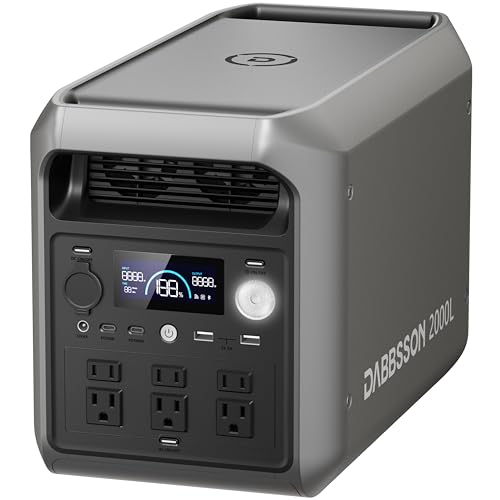
Quiet power with real muscle makes the Dabbsson 2000L a standout pick for DJs running multi-speaker rigs and lights without tripping breakers. We get 2048Wh of semi-solid LiFePO4, a 2200W AC output with P-Boost to 3300W, and six AC outlets for amps, mixers, and lighting. It’s compact at 11.2 × 18.3 × 8.9 inches and 41 lbs, with a built-in handle and UL94-V0 fire-resistant build. The app-enabled, AI-driven BMS delivers 15 ms EPS switching and quiet modes. Charge to 80% in 1.5 hours (1500W AC) or up to 800W solar, with passthrough. Expect 4000+ cycles, 10+ years, and a 5-year warranty.
Best For: DJs, campers, homeowners, and RV travelers who need a compact yet high-output power station to run multiple appliances or audio/light rigs reliably on or off-grid.
Pros:
- 2200W AC output with P-Boost up to 3300W plus six AC outlets supports power-hungry tools, speakers, and appliances simultaneously
- Fast, flexible recharging: 80% in 1.5 hours via 1500W AC, up to 800W solar with MPPT, car input, and passthrough charging
- Long-life semi-solid LiFePO4 battery (2048Wh, 4000+ cycles), smart app with AI BMS, 15 ms EPS, and robust UL94-V0 fire-resistant build with 5-year warranty
Cons:
- At ~41 lbs, it’s portable but still heavy for frequent hand-carry over longer distances
- 800W max solar input may limit peak solar recharge speed for larger off-grid arrays
- No mention of 240V split-phase capability or native expandable battery modules for higher-capacity setups
Enphase IQ PowerPack 1500 Portable Power Station
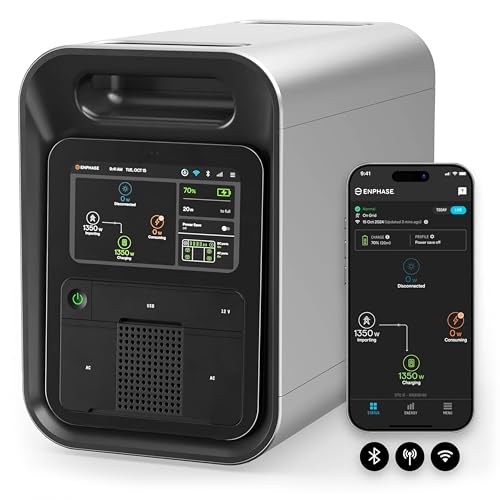
DJs who demand grid-like stability will appreciate the Enphase IQ PowerPack 1500’s 1,500 W continuous output paired with ultra-fast AC recharging in under 75 minutes. We get 1,500 Wh of LiFePO4 reliability, 3,000 W surge, and four 120 V AC outlets for mixers, controllers, and speakers. The three IQ8 microinverters deliver clean, low-latency power with sub-10 ms switchover—great for sensitive rigs. A 7” color touchscreen, app control, and 4G/Wi‑Fi/Bluetooth keep us in command. It’s rugged, quiet, and UL certified for indoor/outdoor sets. Solar tops up in ~4 hours, vehicle DC in ~14. At ~46 lb, it’s portable, supported 24/7, and warrantied 5 years/2,500 cycles.
Best For: DJs, campers, and homeowners who need grid-like stable power with fast recharging, clean AC output, and reliable indoor/outdoor performance.
Pros:
- 1500 W continuous/3000 W surge with four 120 V AC outlets and low-latency power from three IQ8 microinverters (sub-10 ms switchover).
- Ultra-fast AC recharge in under 75 minutes; versatile inputs with solar (~4 hours with two panels) and 12 V vehicle (~14 hours).
- Rugged, UL-certified design with 7″ touchscreen, Enphase App control, and 4G/Wi‑Fi/Bluetooth connectivity plus 5-year/2,500-cycle warranty.
Cons:
- ~46 lb weight may be cumbersome for frequent carrying or air travel.
- 1500 Wh capacity limits run time for high-draw equipment over extended sessions.
- Solar fast-charging requires purchasing separate compatible panels.
Portable Power Station 150W, 133Wh/36000mAh Rechargeable Generator for Camping and Emergency

Need a lightweight, quiet backup for small DJ rigs or rehearsal spaces? This 150W, 133Wh (36,000mAh) portable power station punches above its class, delivering about 1.5x the capacity of common 88Wh rivals. We get five outputs—1 AC (110V), 1 DC, 2 USB-A, and 1 USB-C—plus dual‑way 65W PD for fast charging both the unit and devices. It hits 0→80% in 2 hours, runs at just 25dB, and weighs about 4.36 lb with a sturdy aluminum shell and handle.
Expect ~120W continuous on AC; it’s great for controllers, laptops, and lights, not large speakers. LED flashlight/SOS, auto‑shutdown, solar/car input, and a 1‑year warranty.
Best For: Musicians, DJs, campers, and emergency preppers who need a lightweight, quiet power source for small electronics (laptops, controllers, lights) with fast USB-C PD charging.
Pros:
- 133Wh capacity with fast 65W USB-C PD (charges unit and devices), plus five outputs (AC, DC, 2x USB-A, USB-C)
- Quiet 25dB cooling and rugged 4.36 lb aluminum build with handle, LED flashlight/SOS
- Quick recharge to 80% in ~2 hours; supports wall, USB-C, car, and solar input
Cons:
- AC outlet offers ~120W continuous; not suited for high‑draw gear or large speakers
- Only one AC socket limits simultaneous plug-in appliances
- Some users report finicky AC activation and device compatibility variances; 1‑year warranty is short
OUPES Exodus 1200 Portable Power Station (992Wh, 1200W, Solar Optional)

Looking for a rock-solid UPS with <20ms switching and true 1200W continuous output? The OUPES Exodus 1200 delivers. Its 992Wh LiFePO4 pack (3,000+ cycles) powers mixers, controllers, laptops, and PA amps with three pure sine AC outlets (1200W/3600W surge). We get 10 total ports, including 140W USB-C PD for fast laptop charging, plus USB-A and a car socket. It recharges in about 2 hours via AC, supports 240W solar, and allows pass-through use. At 23 lbs, it’s compact yet sturdy, FCC/CE certified, and backed by a 5-year warranty. Reliable for gigs, rehearsals, RV trips, and outage-ready home backup.
Best For: Campers, RVers, musicians, and home users needing a portable UPS with <20ms switching, true 1200W continuous output, and robust 992Wh LiFePO4 capacity for reliable off-grid or backup power.
Pros:
- 1200W continuous/3600W surge with pure sine AC; stable for sensitive electronics and most appliances.
- Long-life 992Wh LiFePO4 (3,000+ cycles), fast 2-hour AC recharge, pass-through use, and 240W solar support.
- Versatile I/O: 10 ports including 3 AC outlets and 140W USB-C PD; compact 23 lb design with 5-year warranty.
Cons:
- 240W max solar input limits recharge speed compared to higher-input competitors.
- UPS transfer time <20ms may not suit the most latency-sensitive or true online UPS requirements.
- 1200W continuous output can’t sustain high-draw space heaters, large microwaves, or full-size power tools for long durations.
HOWEASY Portable Power Station (88Wh Solar Generator)

Travel-light performers will appreciate the HOWEASY Portable Power Station (H120): an 88Wh, 2.3 lb unit with 8 outputs that’s TSA-friendly and perfect for small, quiet gigs or backup on the road. We get two 110V AC sockets (120W rated, 150W peak), USB-C 18W, two QC 3.0 USB, a 5V/2.4A USB, and two 12V/10A DC ports—enough for laptops, lights, fans, phones, and cameras. The hidden handle, 6.6 x 3 x 4-inch frame, and LED status display make travel easy. Recharge via wall, 12/24V car, or 15–24V solar. Expect 1500+ cycles, a bright LED (steady/flash/SOS), and a 24-month warranty. Note: some 20V laptops aren’t compatible.
Best For: Ultralight travelers, campers, and musicians who need a compact, TSA-friendly 88Wh power station for small electronics, lights, and brief laptop use on the go.
Pros:
- Versatile 8-output array: dual 110V AC (120W/150W peak), USB-C 18W, two QC 3.0, 5V/2.4A, and dual 12V/10A DC.
- Highly portable at 2.3 lb with hidden handle, compact 6.6 x 3 x 4-inch size, and built-in LED light (steady/flash/SOS).
- Flexible recharging (wall, 12/24V car, 15–24V solar), 1500+ cycle life, LED status display, and 24-month warranty.
Cons:
- Limited output: 120W rated (150W peak) won’t power high-draw appliances and only 88Wh capacity.
- Some 20V laptops may be incompatible or require specific adapters; solar panel not included.
- Charge speeds and run times can vary; two AC sockets share the 120W total limit.
VTOMAN Jump 600X Portable Power Station (299Wh, 600W)

Quiet stages and quick changeovers matter, so the VTOMAN Jump 600X stands out with 600W AC output (1,200W surge) and a long‑life LiFePO4 battery rated for 3,000 cycles—ideal for DJs running controllers, mixers, routers, and laptops without generator hum. We get 299Wh on board, plus expansion to 939Wh with the add-on battery for longer sets. Two AC sockets, a 60W USB‑C PD for laptops, three USB‑A (QC 3.0), two DC5521, and a 12V car port cover booth and backup needs. It supports pass‑through charging, regulated 12V, and robust LIFEBMS protections. At 6 kg, it’s compact, reliable, and stage‑ready with a 2‑year warranty.
Best For: DJs, campers, and mobile creators who need a quiet, compact power station with reliable 600W AC output, long‑life LiFePO4 cells, and pass‑through charging for gear like laptops, mixers, CPAPs, and fridges.
Pros:
- Durable LiFePO4 battery with 3,000 cycles to 80% and LIFEBMS protections for enhanced safety and lifespan
- Versatile outputs (2x AC, 60W USB‑C PD, 3x USB‑A QC, DC5521, 12V car port) with regulated 12V and pass‑through charging
- Expandable from 299Wh to 939Wh with add‑on battery for longer runtimes
Cons:
- 600W AC limit may be insufficient for high‑draw appliances despite 1,200W surge
- Extra battery required to reach 939Wh increases total cost and weight
- Batteries are not user‑replaceable; unit is about 6 kg, which may be heavy for ultralight travel
Portable Power Station Bank 300W (220Wh) with AC Outlets for Camping and Emergencies
Need a compact, fanless unit to power small DJ rigs or emergency essentials without background noise? This 300W (600W peak) 220Wh power station hits the sweet spot for quiet sets and blackout backups. At 5 lbs and 8.5 x 6.7 x 4.1 inches, it’s ultra portable yet practical.
We get two pure sine wave 110V AC outlets, three USB-A (5V/3.1A), a USB-C (5V/3A, 9V/2A), and a 9–12.6V DC car port. It supports simultaneous charging and solar input. The BMS safeguards voltage, temp, and short circuits, with indicators for energy and AC status. Tips: keep 40–70% charge for storage; recharge every 2–3 months. 12-month warranty.
Best For: Quiet camping, small DJ rigs, and emergency backup users who need a compact, fanless 300W pure sine wave power station with versatile ports and solar-ready charging.
Pros:
- Pure sine wave AC with 2x110V outlets; clean power for sensitive gear up to 300W (600W peak)
- Lightweight and compact (5 lbs; 8.5 x 6.7 x 4.1 in) with seven outputs, including USB-C and 12V car port
- Fanless, quiet operation; BMS protections and >1000 charge cycles for reliability
Cons:
- 220Wh capacity limits run time for higher-draw devices and won’t support appliances over 300W
- USB-C is limited to 5V/3A or 9V/2A (no high-wattage PD for laptops)
- Solar panel not included; some users report slower charging via wall/car inputs
Portable Power Station 600W 293Wh with 100W PD and 120V AC Outlet

DJs who want a compact rig with real AC muscle will appreciate this 600W pure sine wave power station (1200W surge) and its 100W USB‑C PD for fast laptop and controller charging. At just 7.7 lbs with a 293Wh grade‑A lithium pack, it’s easy to carry between gigs while powering mixers, controllers, cameras, and drones. We get seven outputs: 1×120V/600W AC, 1×100W USB‑C PD, 1×24W USB‑C, 2×QC3.0 USB‑A, 1×car port, and 1×DC. The premium BMS safeguards voltage, current, and temperature, supports 1500+ cycles, and a clear LCD shows status. Included: AC adapter and manual. Tip: hold AC button three seconds.
Best For: DJs, campers, and travelers who need a lightweight, compact power station with true 600W pure sine AC output and fast 100W USB‑C PD for laptops and gear.
Pros:
- 600W pure sine wave AC (1200W surge) plus 100W USB‑C PD handles laptops, controllers, mixers, and cameras smoothly
- Lightweight 7.7 lbs with 293Wh grade‑A lithium battery and 7 versatile ports for multi‑device setups
- Premium BMS with voltage/current/temperature protection, 1500+ cycles, and clear LCD status display
Cons:
- 293Wh capacity limits run time for higher‑draw devices or longer sessions
- Only one AC outlet may require a power strip for multi‑AC rigs
- Car charger cable not included; must be purchased separately
Factors to Consider When Choosing Portable Power Stations for DJ
As we size up a power station for DJ work, we’ll look at power output headroom, battery capacity needs, and the assurance of a pure sine wave for clean audio. We’ll also check port selection flexibility to cover mixers, controllers, laptops, and lights without adapters. Finally, we’ll weigh recharge speed options so we can turn around between sets or events without stress.
Power Output Headroom
How much headroom should we budget beyond the wattage we think we’ll use? We should target generous power output headroom—the gap between continuous AC and peak surge—so the station handles transient spikes without tripping. For devices with startup surges (fans, mini-fridges, CPAP heaters), pick true sine wave units and aim for 1.5× to 2× the highest startup wattage. A 300W continuous/600W surge example shows the right ratio.
When we run multiple devices, keep total simultaneous draw well below the continuous rating to preserve headroom. That margin helps with brief hits from mixer boot-ups, powered speaker inrush, and lighting transitions. Also consider outlet distribution and inverter efficiency; spreading loads across outlets and ports reduces bottlenecks and sag, maintaining stable voltage and cleaner audio.
Battery Capacity Needs
When we size a portable power station, battery capacity is the anchor that determines real run time. Capacity is rated in watt-hours (Wh) or milliamp-hours (mAh); for the same load, higher Wh means longer playtime. To estimate uptime, we use: run time ≈ (battery Wh × efficiency) ÷ device watts. In real use, efficiency sits around 80–90%, so we plan conservatively.
Most portable units span roughly 88–992 Wh. That range dictates whether we’re just topping off phones and controllers or powering mixers and lights through a full set. We also weigh chemistry. LiFePO4 packs offer thousands of cycles and better thermal stability, preserving capacity across seasons. For off-grid shows or emergencies, we total daily Wh needs—like overnight CPAP versus multi-day charging—and pick accordingly.
Pure Sine Wave
Why does pure sine wave matter for DJs? Because our gear expects the same smooth, clean AC waveform we get from the wall. Pure sine wave inverters mimic household power, preventing the harmonic distortion that causes buzz, hum, and heat in sensitive audio circuits. That means our mixers, turntables, controllers, and precision processors run quietly and safely, with stable voltage and frequency.
Modified sine wave outputs can introduce artifacts, throttle performance, or even trigger thermal issues. Laptop power adapters and high-end amplifiers are especially picky; they typically require pure sine wave to avoid glitches, audio dropouts, or coil whine.
When we evaluate a power station, we verify the inverter is explicitly labeled “pure sine wave,” then check peak surge ratings to ensure it can handle startup transients from amps and DJ hardware.
Port Selection Flexibility
Need a power station that plays nice with every piece of our rig? Port selection makes or breaks a DJ setup. We want at least two AC outlets for mixers, controllers, and speakers, plus USB-C PD (60W or higher) for laptops and fast-charging phones. Add a couple USB-A ports for peripherals, a 12V car/cig lighter port, and 3–4 DC/12V outputs so we can power routers, lights, or CPAPs without clunky adapters.
Look for high-amp AC with 600–1200W surge handling to cover startups, while regulated 12V and USB ensure clean power for low-draw gear. Pass-through capability and a UPS function let us run the booth while charging, protecting sensitive equipment during brief outages. With this flexibility, we can plug in, swap, and keep the show moving.
Recharge Speed Options
Ports sorted, the next question is how fast we can get back to 100% between sets. Recharge speed hinges on input. From an AC wall, most stations need about 5.5–6.5 hours, though ultra-fast models push 80% in 1.5–2 hours and full in roughly 2–3. Car charging usually lands around 4.5–5.5 hours—handy en route but slower than high-rate AC.
Solar’s the wild card: panel wattage and sun matter. With quality MPPT controllers, a solid 100W panel in full sun can refill in roughly 3–4 hours; clouds and angle extend that. Pass-through charging helps us perform while topping up, but it lengthens effective time to full.
Battery chemistry matters too. LiFePO4 lasts longer and may accept different charge rates versus standard lithium-ion.
Portability and Durability
How easily can we move a power station between the car, stage, and a rooftop set without babying it? Portability starts with size and weight. Compact 220–700 Wh units typically come in at 5–9 pounds, so we can sling them into a backpack or under a DJ table without strain. Built‑in handles and slim profiles matter when we’re threading through crowds or mounting in a van rack.
Durability is about materials and internals. Rugged enclosures and protective casing protect against bumps and light weather. LiFePO4 or robust Li‑ion chemistries add safety and stability. We also check continuous wattage and surge ratings; underpowered units overheat or trip when gear peaks. Finally, battery life cycles—think 1,500–3,500+—determine long‑term reliability for frequent mobile gigs.
Conclusion
As we wrap up, the right portable power station is the quiet heartbeat behind a flawless set. From compact 300W units to expandable 2kWh beasts, we’ve got options that keep laptops, mixers, and controllers humming without a hiccup. Let’s choose based on clean sine-wave output, surge handling, ports, recharge speed, and weight—so we’re ready anywhere the crowd gathers. With smart BMS protection and whisper-quiet fans, we can spin with confidence—rain or shine, city or camp, like thunder in velvet gloves.