Finding a portable power station that keeps a CPAP running quietly through the night isn’t just convenient—it’s peace of mind. We’ve tested travel-ready units with clean sine-wave output, long-life LiFePO4 batteries, and fast recharge options, from compact 300W picks to 1000Wh workhorses. We’ll compare real-world runtimes, airline suitability, and features like app control and solar compatibility. If you want reliable overnight power without the fuss, here’s where the standouts separate themselves.
Key Takeaways
- Jackery Explorer 1000 v2: 1,070Wh LiFePO4, 1,500W pure sine inverter, 30 dB quiet mode, app controls; dependable overnight CPAP runtime and fast recharge.
- ALLWEI 300W (280Wh): ultra-compact, pure sine 300W/600W surge, USB-C PD 60W; airline-friendly backup for shorter CPAP nights or travel.
- EcoFlow DELTA 3 Plus: LiFePO4 longevity, 1,000W inverter with rapid AC/solar charging; robust multi-device support, heavier but outage-ready for CPAP.
- Jackery Solar Generator 1000 v2 + 200W panel: fast 1-hour emergency charging, quiet overnight operation; turnkey CPAP solution with solar included.
- EnginStar 300W (296Wh): 6.5 lb, pure sine, multiple DC/USB ports; quiet bedside backup for partial-night CPAP or minimalist trips.
Jackery Explorer 1000 v2 Portable Power Station


If you need a quiet, fast-charging power station that can comfortably run a CPAP overnight, the Jackery Explorer 1000 v2 stands out with its 1,070Wh LiFePO4 battery, three pure sine wave AC outlets, and whisper-quiet 30 dB charging mode. We like its 1,500W output (3,000W surge) and PD 100W USB-C for modern gear. At 23.8 lbs with a foldable handle, it’s road-trip ready. The app lets us toggle ChargeShield 2.0 modes, enable 1-hour emergency charging, or preserve longevity with the default 1.7-hour fill. Expect 4,000 cycles to 70% capacity and a 10-year lifespan. Note: solar panel sold separately, Jackery-compatible only.
Best For: Campers, RVers, and emergency-prep users who want a portable, quiet, fast‑charging power station that can reliably run essentials like a CPAP overnight.
Pros:
- 1,500W AC output (3,000W surge) with three pure sine wave outlets and PD 100W USB‑C for modern devices
- Fast charging options via ChargeShield 2.0, including 1-hour emergency fill; quiet 30 dB overnight charging mode
- Long-lasting LFP battery rated for 4,000 cycles to 70% capacity and a ~10-year lifespan; portable 23.8 lbs with foldable handle
Cons:
- Solar panel not included and solar charging is compatible only with Jackery panels
- App requires account management and adds complexity for some users
- Screen size and price may not suit all buyers; listed battery capacity spec may cause confusion (Wh vs mAh)
ALLWEI Portable Power Station 300W (280Wh Solar Generator)
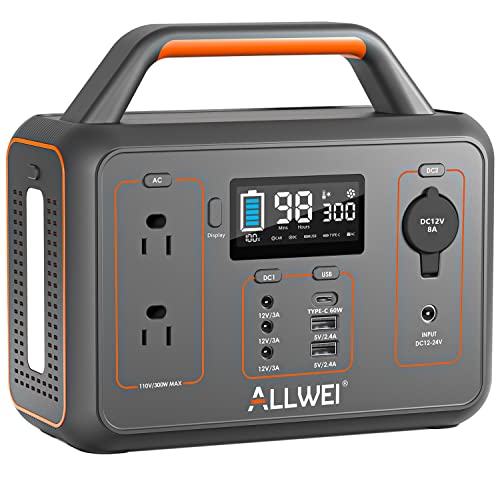
ALLWEI’s 300W, 280Wh power station stands out for CPAP users who want a compact, airline-friendly companion that still handles overnight runs. At about 6.5 pounds and 9 x 4.7 x 7.8 inches, it’s easy to pack yet offers pure sine wave AC for safe CPAP use.
We like the balanced I/O: two AC outlets, USB-C PD 60W, two USB-A, three DC ports, and a car socket—up to nine devices at once. Expect runtime ≈ 280Wh x 0.85 ÷ your CPAP’s watts. Recharge via wall (5.5–6.5h), car (4.5–5.5h), or 100W solar (3–4h) with MPPT. It’s quiet, protected by a full BMS, and built for 1,500 cycles.
Best For: CPAP users, campers, and emergency backup seekers who want a compact, 300W pure sine wave power station with versatile ports and fast recharging.
Pros:
- Balanced I/O: 2 AC outlets, USB-C PD 60W, 2 USB-A, 3 DC, and car socket; supports up to 9 devices simultaneously
- Fast, flexible recharging via wall (5.5–6.5h), car (4.5–5.5h), or 100W solar (3–4h) with built-in MPPT
- Lightweight and quiet with pure sine wave output and 1,500-cycle lithium-ion battery plus full BMS protections
Cons:
- 300W continuous/600W surge limit can’t power higher-draw appliances
- 280Wh capacity may be insufficient for multi-day use without recharging
- Fan noise can be noticeable under heavier loads or during charging
EF ECOFLOW DELTA 3 Plus Solar Generator with 220W Bifacial Panel
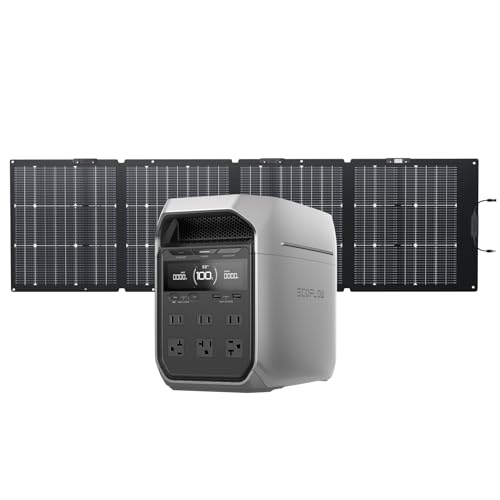
Need a fast, quiet recharge for overnight CPAP use on trips or outages? We like the EF ECOFLOW DELTA 3 Plus with its 220W bifacial panel and 1000W solar input. It’s LiFePO4, rated 4000 cycles to 80% (about 10 years), and the IP65 battery pack shrugs off dust and splashes. Charge to 80% in 40 minutes via 1500W AC, or hit 80% in about an hour on solar; hybrid AC+solar is similarly quick.
It powers 13 devices and X-Boost handles resistive loads over 2200W. Two independent 500W solar inputs add flexibility. Downsides: it’s heavy and pricey, and you should budget for conversion losses.
Best For: Travelers, campers, and home users who need fast, quiet recharging and reliable off-grid power for essentials like CPAPs, fridges, and computer gear, with flexible solar input and long-lasting LFP durability.
Pros:
- Fast charging: 80% in ~40 mins via 1500W AC or ~1 hour via solar; hybrid AC+solar supported
- Long-life, safe LFP battery rated 4000 cycles to 80% (about 10 years) with IP65 dust/splash resistance
- Versatile power: runs up to 13 devices, X-Boost for >2200W resistive loads, and two independent 500W solar inputs
Cons:
- Heavy and relatively expensive compared to smaller-capacity power stations
- Real-world energy losses (~20%) reduce usable capacity; plan accordingly for longer outages
- Best solar performance requires optimal sun and panel positioning; partial shade reduces efficiency
Jackery Solar Generator 1000 v2 with 200W Solar Panel and 1070Wh Portable Power Station

Looking for a CPAP-ready power station that fast-charges in an hour and runs quietly overnight? Jackery’s Solar Generator 1000 v2 pairs a 1,070Wh LiFePO4 battery with a 200W solar panel and a 1,500W (3,000W surge) inverter—great for CPAPs, fridges, or routers. We get one-hour 0–100% fast charging by enabling Emergency Charging in the Jackery app (do this before each use); default full charge is 1.7 hours to protect battery health. Overnight mode drops to about 30 dB. At 23.8 lbs with a foldable handle, it’s travel-friendly. Three AC outlets, PD 100W USB-C, app controls, ChargeShield 2.0, and a 5-year warranty round it out.
Best For: Campers, RVers, and emergency-prep users who want a CPAP-ready, quiet overnight power station with true 1-hour fast charging (via app) and solid 1,500W output.
Pros:
- 1-hour 0–100% fast charging when Emergency Charging is enabled in the app; default 1.7 hours for battery health
- Quiet overnight mode (~30 dB) and robust 1,500W (3,000W surge) inverter for CPAPs, fridges, routers
- Durable 1,070Wh LiFePO4 battery (4,000+ cycles to 70%), 200W solar panel included, PD 100W USB-C, 5-year warranty
Cons:
- Must manually enable Emergency Charging in the app before each use to get 1-hour fast charging
- App login and small display may be inconvenient for some users
- Solar panel and generator ship separately; 23.8 lbs may be heavy for ultralight travel
EnginStar Portable Power Station 300W (296Wh)

Quiet bedside power tops your list? We like EnginStar’s 300W, 296Wh portable power station for compact CPAP backup. It delivers two 110V pure sine wave AC outlets for clean, quiet output, plus 8 total ports: regulated 12V/24V DC, USB-A (5V/3.1A max), and USB-C 18W. At 9 x 5.5 x 7.5 inches and about 6.5 lb, it’s easy to carry.
The BMS manages voltage and temperature, guarding against short circuit, overcharge, and overload, with 1000+ cycles. Recharge via wall, 12V car, or 12–25V solar; expect ~7 hours at up to 65W. Package includes home charger and car cable, plus a 12‑month warranty.
Best For: Campers, travelers, and CPAP users who need a compact, quiet 300W portable power station with multiple clean AC/DC/USB outputs for overnight or emergency backup.
Pros:
- Two 110V pure sine wave AC outlets plus 8 total ports, including regulated 12V/24V DC, USB-A (5V/3.1A), and USB-C 18W
- Lightweight and compact (296Wh, ~6.5 lb; 9 x 5.5 x 7.5 in) with 1000+ cycle lithium-ion battery and robust BMS protections
- Flexible recharging: wall, 12V car, or 12–25V solar (built-in controller), ~7 hours at up to 65W
Cons:
- 300W continuous output limits high-draw appliances
- USB-C tops out at 18W, not ideal for fast-charging modern laptops
- Solar panel not included; recharge speed capped at ~65W so full charges aren’t especially fast
Factors to Consider When Choosing Portable Power Stations for CPAP Machines
Next, we’ll match battery capacity to your nightly needs by looking at your CPAP’s power draw and doing quick runtime calculations. We’ll confirm the inverter is pure sine wave for sensitive electronics and check ports for your CPAP’s plug or DC adapter. With these basics, we can pick a power station that runs your therapy safely and long enough without guesswork.
Battery Capacity Needs
How much battery do we really need to keep a CPAP running through the night? We should size capacity to match our expected outage window. As a rule of thumb, target 280–1070Wh depending on how long we need autonomy and our machine’s typical usage profile. More watt-hours extend runtime; a 300Wh unit may cover several hours, while a 1000Wh pack can last much longer or support extra devices.
We also account for real-world efficiency. Expect only about 70–85% of the rated watt-hours to be usable due to inverter and conversion losses. Battery chemistry matters, too. Lithium iron phosphate (LFP) power stations deliver longer cycle life and deeper usable capacity over time. Finally, confirm the station can handle brief surges from heated humidifiers without tripping.
CPAP Power Draw
Two key variables drive CPAP power draw: steady wattage and short startup surges. Most machines sip 30–60W continuously, but they can spike above 100W at power-on. We should pick a power station that comfortably handles 100–150W surge so the CPAP starts reliably.
For overnight use, plan on 8–12 hours at roughly 40–60W, which works out to about 320–720Wh. That informs capacity needs: a 300Wh unit runs a few hours; a 600–1000Wh unit can cover multiple nights, assuming efficient settings.
Don’t forget optional features. Heated humidifiers and similar add-ons draw another 30–60W, shrinking runtime if we don’t budget for them. We can extend runtime by lowering humidity or turning heat off, especially when we’re stretching a smaller battery.
Inverter Type Purity
Why does inverter purity matter so much for CPAPs? Because CPAPs are sensitive electronics that expect clean, steady 60 Hz power. Pure sine wave inverters replicate household AC, delivering stable voltage that prevents irregular pressure, glitches, or random resets. Modified sine wave units chop the waveform, which can cause CPAPs to stall, fail to start, or run erratically.
Humidifiers raise the stakes. Heating elements can buzz, run hot, or draw unevenly on a modified sine wave, while pure sine wave keeps them smooth and safe. We always favor pure sine wave for dependable therapy and quieter nights.
Sizing still counts. Match the inverter’s continuous rating to your CPAP’s running wattage and add the humidifier’s load. That headroom helps avoid overloads and maintains clean output under real use.
Port Compatibility Check
Before we plug in, let’s make sure the ports truly match our CPAP’s needs. We want a dedicated 110/120V AC outlet delivering a pure sine wave, since many CPAPs won’t tolerate modified sine. Next, confirm the inverter’s wattage covers both the CPAP’s steady draw and start-up surges, especially if we use humidifiers or heated tubing.
Let’s verify whether the manufacturer supports DC operation. Some CPAPs allow a DC cable, but generic DC or USB-C ports can’t replace continuous AC unless the brand provides an approved adapter. If not, stick with AC.
We’ll also check battery chemistry and cycle life—LiFePO4 packs often promise thousands of cycles, ideal for nightly use. Finally, ensure accessory features stay within the device’s total wattage envelope.
Runtime Calculations
How long will a power station actually keep our CPAP running? We start with a simple estimate: usable watt-hours divided by the CPAP’s watt draw. Many machines pull 30–60W. So, a 296Wh unit powering a 60W CPAP yields about 4.9 hours (296 ÷ 60 ≈ 4.93) in ideal math.
Real-world runtime is lower. Inverter efficiency—often 85–95%—shaves off 10–20%, so that same setup may deliver roughly 4–4.4 hours. Battery chemistry and depth of discharge policies matter, too. LiFePO4 packs sometimes allow 80–100% DoD, but some brands restrict usable capacity, changing results.
To cover full nights, we either choose higher Wh, reduce CPAP wattage (turn off heated humidifier/hoses if safe), or plan recharging via AC, solar, or a vehicle during longer outages.
Noise and Cooling
Ever tried to sleep while a power station’s fan kicks on and off? Noise matters when our CPAP runs all night. We look for units with silent or smart fans that only spin under high load. That keeps baseline operation quiet. Real-world reviews note a little fan noise as normal, so we set expectations accordingly.
Inverter design also plays a role. Pure sine wave output keeps CPAP motors and power bricks happier, often reducing the hum we’d hear from modified sine wave models. Temperature control is another factor: hotter batteries trigger fans more often, so placement and airflow can affect nighttime noise.
Finally, higher-capacity models often dissipate heat better, leading to fewer fan cycles and steadier, quieter performance during long CPAP sessions.
Weight and Portability
When we’re pairing a CPAP with a power station, weight and portability can make or break the experience. For travel or bedside backup, lighter units shine—compact models around 6.5 to under 7 pounds are easy to carry, stash, and reposition at night. By contrast, high-capacity stations in the 23–24 pound range deliver longer runtimes but compromise maneuverability, especially on stairs or in tight hotel rooms.
We also look at design details. Foldable handles and compact dimensions—roughly under 10 inches on one or more sides—help with bedside placement and overhead-bin or trunk space. Battery chemistry matters: LiFePO4 packs often weigh more than comparable lithium-ion, affecting long-term carry comfort. Finally, remember total kit weight—panels, cords, and adapters add bulk and slow setup.
Charging Options Speed
Curious how quickly we can get back to sleep-ready power? Let’s weigh charging options by speed. USB-C PD can push up to 100W—great for quick top-ups, not full refills. AC input is the sprinter: many stations accept about 1,000–1,500W, delivering 0–80% or even 0–100% in under an hour on select models. Some apps offer “fast-charge” emergency modes to hit full in roughly 60 minutes, while default profiles may slow things down to preserve battery health.
Solar varies most. Under ideal sun, premium units accept up to 1,000W (often split across two inputs), but expect ~20% losses from panels and BMS regulation. Typical wall times for small stations run 5–6 hours; larger, high-input models recharge far faster—if we feed them enough watts.
Conclusion
So after all this talk of watts, watt-hours, and pure sine waves, we’ve basically admitted we like sleeping—quietly. The irony? The best power stations do their job so well we forget they exist. Whether we’re packing an airline-friendly cube or a solar-charging beast, we’re really buying peace of mind. Choose the capacity your CPAP needs, LiFePO4 longevity, and fast recharge options—and then enjoy the most exciting technology of all: eight hours of absolutely nothing happening. Perfect.