Planning a camping trip with a CPAP in 2025 means we need quiet, reliable power that’s easy to carry and airline-friendly. We’ll compare compact LiFePO4 stations with pure sine wave output, low fan noise, and fast AC recharge, plus pass-through charging and solid warranties. From ECOFLOW to Anker and Jackery, some models stand out for multi-night runs without fuss. Let’s see which five units actually earn a spot in our gear—and why one might surprise us.
Key Takeaways
- Choose LiFePO4 units with pure sine wave inverters, 3,000+ cycles, robust BMS, and 5-year warranties for safe, long-lasting CPAP use.
- Aim for 500–1000Wh for 1–2 CPAP nights; 200–300Wh works for single nights without humidifier or with fast recharge.
- Prioritize quiet models (25–30 dB) and pass-through charging to run CPAP while topping up via wall, car, or solar.
- Verify continuous output exceeds CPAP draw with surge headroom; multiple ports allow phone charging and small fans simultaneously.
- Top picks: EcoFlow River 2 Max, Anker SOLIX C300, Jackery Explorer 300, EcoFlow DELTA 2, Jackery Explorer 1000 v2.
EF ECOFLOW River 2 Max Portable Power Station (500)


If you’re camping with a CPAP and want fast, reliable power in a compact build, the EF ECOFLOW River 2 Max (499Wh LiFePO4) stands out. We like its 1-hour AC recharge via X-Stream and 499Wh capacity that handles nightly CPAP use plus phones and lights. With up to 1000W output and pure sine wave AC (300W outlets), it supports 11 devices at once, runs quietly, and offers pass-through charging for UPS needs. Solar’s fast too—about 2.3 hours with a 220W panel. At 13.3 lbs and 10.6 x 10.2 x 7.7 inches, it’s compact. The LiFePO4 battery, advanced BMS, and 5-year service inspire confidence.
Best For: Campers, RVers, and home backup users who need a compact, fast-charging power station for CPAPs and multiple small devices with reliable, quiet operation.
Pros:
- 1-hour AC recharge via X-Stream and fast solar (≈2.3 hours with 220W) for quick turnaround
- 499Wh LiFePO4 battery with advanced BMS, pure sine wave output, and 5-year service
- Up to 1000W total output with multiple ports (including USB-C) to power up to 11 devices simultaneously
Cons:
- 300W AC outlet rating limits higher-draw appliances despite 1000W combined output
- Solar panel not included; additional cost for off-grid charging
- 499Wh may be insufficient for extended multi-day use without recharging
Anker SOLIX C300 Portable Power Station

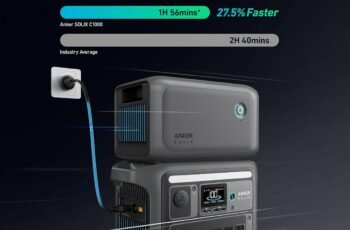
Looking for a compact CPAP-friendly power station that stays quiet through the night? We like Anker’s SOLIX C300 for its 25dB whisper, 288Wh LiFePO4 battery, and steady 300W output (600W surge). It’s travel-ready at 9.02 pounds with an integrated handle and 6.46×6.34×9.45-inch footprint. Expect 3,000+ cycles, smart temp control, and a 5-year warranty.
For ports, you get 3 AC, a 12V car socket, 2 USB-C (one 140W PD 3.1), a 15W USB-C, and a USB-A. It recharges to 80% in ~50 minutes via wall, supports solar (60–100W; not PS30/PS200/PS400), car, and USB-C, with pass-through charging—ideal for CPAP camping and weekend trips.
Best For: Quiet, compact power needs like CPAP users, car campers, and travelers who want fast recharging and reliable overnight power without bulky gear.
Pros:
- Whisper-quiet 25dB operation and stable 300W output (600W surge) ideal for CPAPs and laptops
- Fast top-up to 80% in ~50 minutes via wall; versatile recharging (USB-C PD 3.1, solar 60–100W, car) with pass-through
- Durable LiFePO4 battery (3,000+ cycles), lightweight 9.02 lb design, 5-year warranty
Cons:
- 288Wh capacity may be limiting for multi-night CPAP use without humidifier or frequent recharges
- Not suitable for high-wattage appliances (kitchen devices, power tools >300W)
- Incompatible with Anker SOLIX PS30/PS200/PS400 panels; strap not included by default
Jackery Explorer 1000 v2 Portable Power Station (1070Wh LiFePO4)

Powering a CPAP all night without babysitting cables gets easier with the Jackery Explorer 1000 v2, thanks to its 1,070Wh LiFePO4 battery and quiet 30 dB overnight charging mode. We get 1,500W AC output (3,000W surge), three pure sine AC ports, two USB-C (100W PD), USB-A, and a 12V car port—plenty for humidifiers or heated tubing. It weighs 23.8 lbs with a foldable handle and lasts over 10 years, retaining 70% after 4,000 cycles.
We like the app’s 1-hour emergency charging and energy-saving controls; default full charge is 1.7 hours for battery care. Note: solar panels aren’t included and must be Jackery-compatible.
Best For: Campers, RVers, and emergency-prep users who need a portable, fast-charging LiFePO4 power station that can quietly run essentials like CPAPs, fridges, or small appliances overnight.
Pros:
- Fast charging with app-enabled 1-hour emergency mode (default ~1.7 hours for battery health), plus PD 100W USB-C and three pure sine wave AC outlets
- Long-life LiFePO4 battery rated for 4,000 cycles to 70% capacity and over 10 years of use; durable, portable 23.8 lbs with foldable handle
- Smart App controls including quiet 30 dB overnight charging and energy efficiency mode
Cons:
- Solar panel not included and solar charging compatible only with Jackery panels
- App requires account management; some users note UI/screen size and price concerns
- 1,500W continuous output may be insufficient for very high-draw tools or appliances beyond brief 3,000W surge
EF ECOFLOW DELTA 2 Portable Power Station (1024Wh, LiFePO4)

Serious CPAP campers who value fast turnarounds will appreciate the DELTA 2’s standout trick: it sips from the wall to 80% in just 50 minutes and hits full in about 80. With 1024Wh of LiFePO4 storage and 3000+ cycles, we can count on long life and safe operation via its BMS. The 1800W AC output (2700W surge) and 15 ports cover heated humidifiers, routers, lights, and mini-fridges. At 27 pounds, it’s portable yet substantial. We like the 500W solar input and expandable capacity to 3kWh for multi-night trips. In the box: unit, AC cable, manual, and a 5-year customer service promise.
Best For: Serious campers, RVers, and home-backup users who want ultra-fast recharging, robust 1800W output, and long-life LiFePO4 reliability with optional solar and expandable capacity.
Pros:
- Blazing AC recharge: 0–80% in ~50 minutes (0–100% in ~80); great for quick turnarounds
- 1024Wh LiFePO4 battery with 3000+ cycles, strong BMS, and 1800W/2700W surge to power most appliances
- Versatile I/O (15 ports), 500W solar input, and expandable up to ~3kWh for longer trips or outages
Cons:
- At ~27 lb, it’s portable but still hefty for frequent carry
- Full 3kWh expansion requires purchasing extra batteries, increasing total cost
- Fan noise and accessory cable length (e.g., XT60 extensions) can be minor annoyances for some setups
Jackery Portable Power Station Explorer 300 (293Wh)

For campers who want a lightweight CPAP-ready option without overkill, the Jackery Explorer 300 hits a sweet spot: a 293Wh lithium pack in a 7.1 lb body with two pure sine wave AC outlets and a 300W output (500W surge) that’s gentle on sensitive electronics. We like its quiet, no-fumes operation, pass-through charging, and versatile ports: 2 AC, 60W USB-C PD in/out, QC3.0, USB-A, and a 12V car port. It recharges fast—about 80% in 2 hours using wall plus 60W USB-C—and pairs well with a SolarSaga 100 via MPPT. Expect reliable overnight CPAP support (humidifier off), plus phones, routers, fans, and lights.
Best For: Campers, road-trippers, and emergency preppers who need a lightweight, quiet, CPAP-ready portable power station for small devices and overnight essentials.
Pros:
- Compact 7.1 lb design with clean pure sine wave power; 2 AC, 60W USB‑C PD in/out, QC3.0, USB‑A, and 12V car port for up to 6 devices.
- Fast recharge to about 80% in 2 hours via wall plus 60W USB‑C; pass‑through charging supported.
- Solar-ready with MPPT for efficient pairing with SolarSaga 100; quiet, no fumes, low maintenance.
Cons:
- 300W output (500W surge) limits use with high‑draw appliances like induction cooktops or blenders.
- 293Wh capacity may be tight for power‑hungry gear or multi‑day trips without recharging.
- Solar panel not included; full solar setup adds cost and depends on sun conditions.
Factors to Consider When Choosing Portable Power Stations for CPAP Camping
Before we pick a power station, let’s match our CPAP’s power requirements to the unit’s battery capacity and inverter output rating. We’ll estimate runtime based on watt-hours versus our CPAP’s average watts, including any humidifier usage. We should also consider noise and fan levels so the unit won’t disrupt sleep.
CPAP Power Requirements
Wondering how much power a CPAP really needs when we’re off-grid? Most machines draw 30–120 watts depending on model, pressure, and features like humidifiers. We should plan for the high end so the device runs quietly and without cutouts all night.
Match the power station’s continuous output to exceed the CPAP’s running wattage with a safety margin. A pure sine wave inverter is essential—modified or square-wave units can cause noise, heat, or premature wear. We also favor LiFePO4 batteries for stability, long cycle life, and consistent performance over many trips.
For uninterrupted nights and variable conditions, we’ll want at least 200–300Wh and either extra reserve or fast recharge options. That way, extended stays or cloudy solar days won’t interrupt therapy.
Battery Capacity Needs
How much battery do we really need to sleep through the night without stress? Let’s translate capacity into hours. Battery capacity is in watt-hours (Wh). To estimate runtime, we divide the CPAP’s wattage by the pack’s usable Wh after losses—assume 85–90% efficiency. A 200Wh station yields about 170Wh usable. With a 30W draw, that’s roughly 5–6 hours; at 60W, about 2.5–3 hours. So, for a full night or multiple nights, we should step up.
For weekends, 500Wh (≈425Wh usable) typically covers 1–2 nights at 30–60W, especially if we disable humidification. Want margin for humidifiers or phone charging? Consider 700–1000Wh. If we camp frequently, LiFePO4 pays off with far longer cycle life. Using solar? Match panel input and realistic sun hours to replace daily usage.
Inverter Output Rating
So where does inverter output rating fit into a stress-free CPAP setup? It tells us how much continuous power, in watts, a station can deliver without hiccups. We match that number to our CPAP’s measured draw, then add a safety margin so startup surges don’t trip the unit. For CPAP-only use, we confirm the inverter’s surge capacity exceeds the machine’s initial spike to avoid shutdowns.
We also prefer pure sine wave inverters. They provide clean, utility-like power that CPAPs expect, which helps prevent malfunctions, odd noises, or error codes. If we plan to charge a phone or run a fan while sleeping, a higher inverter watt rating gives us headroom to power multiple devices at once. Bottom line: right-size continuous watts, verify surge, and choose pure sine.
Runtime Estimations
Curiously, runtime boils down to simple math: we divide a station’s battery capacity (Wh) by our CPAP’s average draw (W) to estimate hours of use. A 500 Wh LiFePO4 running a 40 W CPAP yields about 12–13 hours; at 60 W, expect roughly 8–9 hours. For typical overnight windows of 8–12 hours, we should target 600–800 Wh if our CPAP draws 40–50 W; smaller packs likely need a mid‑night recharge.
Heated humidifiers change the equation. They often pull 70–90 W, so runtime drops proportionally. If we enable heat, we should either upsize capacity or plan for external charging.
Finally, startup surge matters. CPAPs can momentarily spike above running watts; choosing a power station with 1.5–2× surge headroom helps prevent hiccups.
Noise and Fan
Quiet matters when we’re trying to sleep with a CPAP in the woods, and a power station’s fans can make or break the night. We look for units that idle around 25–40 dB, which blend into campsite ambience and won’t mask apnea alerts. Fan behavior is just as important as the rating: some stations stay whisper-quiet at low loads but jump in volume under higher draws or during fast charging.
LiFePO4 models often manage heat better, keeping fans slower during long CPAP sessions. Ambient temperature plays a role, too—hot tents can trigger more frequent or continuous fan cycles. We favor designs with passive cooling and efficient power management, since they reduce fan spin-ups. When in doubt, test at night with your CPAP settings and typical charging routine.
Weight and Portability
How much weight are we willing to haul to the campsite? For CPAP camping, portability matters as much as watt-hours. Units span roughly 7.1 to 27 pounds; that range determines whether we toss one in a daypack or commit to trunk-only transport. Compact dimensions—about 6.3 to 10.6 inches on one or more sides—help it slide beside a CPAP case or fit under a seat.
We look for LiFePO4 models when possible; they deliver strong energy density, longer cycle life, and better long-term carryability. Higher-capacity choices around 1000Wh usually weigh more, so backpack-friendly handles—or even wheels—become essential for trailheads and long walks from parking. Built-in, well-balanced handles and blocky, compact shapes make single-handed carries and short campsite moves far easier.
Charging Options Variety
Why pin our CPAP comfort to a single outlet when a good power station can recharge three ways? We should prioritize models that accept AC wall charging, a 12V car cigarette lighter, and solar input. That flexibility keeps therapy running through travel days, trailheads, and cloudy mornings.
Speed matters. Fast AC top‑ups—about 0–80% in 50–60 minutes—cut downtime between sleeps. For solar, we’ll check compatibility, MPPT support, and input wattage; pairing 100–220W panels with MPPT maximizes midday harvest and shortens generator time.
Pass‑through charging is a must so we can run the CPAP while the station recharges. Finally, we’ll verify continuous output and surge headroom to handle CPAP startup without brownouts. A balanced mix of inputs, speed, and stability wins.
Safety and Battery Life
Even off-grid, we can’t treat CPAP power as an afterthought—safety and battery life need to lead our shortlist. We should prioritize LiFePO4 batteries for their 3,000+ cycles, cooler thermal behavior, and design life approaching a decade. That longevity means fewer replacements and more predictable nights.
Next, we verify a robust BMS. It must monitor voltage, current, and temperature, and guard against overcharge, over-discharge, short circuits, and overheating. For CPAPs, pure sine wave inverters are non-negotiable; they deliver clean power that avoids stressing sensitive electronics.
If we want pass-through charging or UPS-like backup during outages, we confirm the unit’s protections remain active while powering the CPAP. Finally, long warranties—five to ten years—signal confidence in safety, durability, and real-world reliability.
Conclusion
So, we’ve crowned our quiet, TSA-charming power bricks—because nothing says romance like LiFePO4 whispering sweet BMS lullabies while our CPAP purrs. We’ll take pure sine waves over tent snores, fast AC recharges over “wilderness character,” and warranties longer than the hike in. ECOFLOW, Anker, Jackery—compact, civilized, and blissfully boring. Choose capacity for your nights, check noise, confirm pass-through, and pack the mask. We’ll sleep like domesticated campers, heroically plugged in under the stars.