Planning a car-camping setup for 2025, we want power that’s light to carry, safe to store, and versatile in the wild. LiFePO4 batteries now lead for longevity, while fast USB-C and regulated 12V ports keep fridges, lights, and laptops humming. Some units charge from the car in under an hour; others can expand for multi-day stays. We’ll compare compact picks, mid-range workhorses, and big-capacity rigs—and highlight what truly matters when you’re off-grid.
Key Takeaways
- Pick LiFePO4 models for longevity; 3,000+ cycles on Anker SOLIX C300 and EcoFlow DELTA 2 outlast typical lithium-ion packs.
- Balance weight and capacity: 5–10 lb units (Anker C300, ALLWEI 300W, Jackery 300) suit weekend car camping.
- Size power to devices: Runtime ≈ (Wh × 0.85) ÷ watts; skip high-draw appliances unless using DELTA 2 or BLUETTI AC200L.
- Prioritize fast recharge: EcoFlow DELTA 2 hits 80% in 50 minutes; Jackery 300 reaches ~80% in ~2 hours.
- Ensure versatile ports and solar: Look for USB-C PD, multiple AC, MPPT solar (60–500W), and quiet operation for overnight use.
ALLWEI Portable Power Station 300W (280Wh Solar Generator)
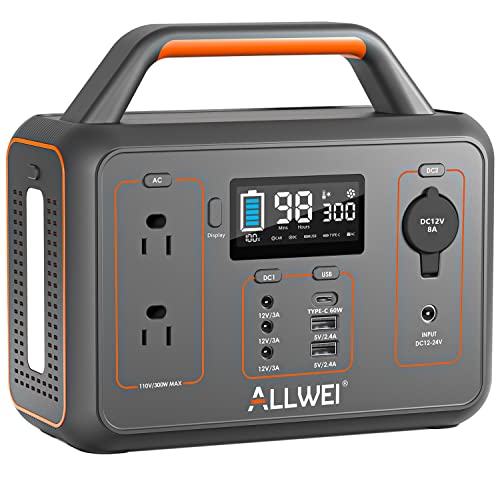

If you’re packing light but still need dependable AC power for essentials, the ALLWEI 300W (280Wh) is a sweet spot for car campers. We like its 6.5-pound build, compact 9 x 4.7 x 7.8-inch size, and pure sine wave 110V AC. With 2 AC outlets, USB-C PD 60W, 2 USB-A, 3 DC ports, and a car socket, we can run up to nine devices. Expect roughly 280Wh x 0.85 divided by your device watts for runtime. It recharges via wall (5.5–6.5h), car (4.5–5.5h), or 100W solar (3–4h) with MPPT. The BMS, quiet fan, SOS light, and 1500 cycles add value.
Best For: Car campers, travelers, and emergency backup users who need a lightweight, compact 300W power station with versatile ports and dependable pure sine wave AC for essential devices.
Pros:
- Compact 6.5 lb design with 2 AC outlets, 60W USB-C PD, multiple DC/USB ports; powers up to 9 devices simultaneously
- Solid performance for size: 300W continuous (600W surge), pure sine wave, ~238Wh usable (280Wh x ~85% efficiency), built-in MPPT for faster solar
- Good recharge flexibility and speed: wall (5.5–6.5h), car (4.5–5.5h), 100W solar (3–4h); 1500 life cycles and BMS protections
Cons:
- 300W AC limit rules out higher-draw appliances (e.g., kettles, hair dryers, larger power tools)
- Fan noise can be noticeable under heavier loads or during charging
- Solar panel not included; real-world solar times depend on weather and panel quality
Jackery Portable Power Station Explorer 300

Jackery’s Explorer 300 stands out for car campers who want true grab-and-go power without the heft. We like its 293Wh capacity, 300W pure sine output (500W surge), and quiet, maintenance‑free operation. At 7.1 pounds, it’s easy to stash. Ports cover the basics: two AC, 60W USB‑C PD (in/out), Quick Charge 3.0, USB‑A, and a 12V car port—powering up to six devices at once.
Recharging’s quick: hit 80% in about two hours using the wall plus 60W USB‑C. It supports car and solar, with MPPT optimizing a SolarSaga 100. Pass‑through charging keeps critical gear running. It’s not for high‑draw appliances, but it’s reliable, protected power for trips and outages.
Best For: Car campers, weekend travelers, and emergency preppers who need a lightweight, quiet, grab-and-go power station for small devices and essentials.
Pros:
- Compact 7.1 lb design with 293Wh capacity and clean 300W pure sine output (500W surge)
- Versatile ports (2 AC, 60W USB‑C PD in/out, QC 3.0, USB‑A, 12V car) powering up to six devices simultaneously
- Fast recharge to ~80% in ~2 hours via wall + 60W USB‑C; supports car and solar with MPPT optimization and pass‑through charging
Cons:
- Not suitable for high-draw appliances (e.g., induction cooktops, blenders)
- Solar panel sold separately; adds cost for full off-grid setup
- Modest capacity limits runtime for larger electronics compared to bigger power stations
BLUETTI AC200L Portable Power Station (2048Wh LiFePO4, Expandable)

For campers who need serious off‑grid muscle without firing up a gas generator, BLUETTI’s AC200L delivers a 2048Wh LiFePO4 battery, a 2400W inverter, and a 30A RV outlet that can run fridges, induction cooktops, and small A/C units. We get rapid AC recharging up to 2400W—0–80% in about 45 minutes—and 1200W solar input for quick top‑offs. It’s expandable to 8192Wh with B300K, B300, B210, or B230 batteries, and offers 11 ports including 100W USB‑C and a 48V/8A DC. At roughly 61.4 pounds, it’s hefty but quiet, app‑connected (Wi‑Fi/Bluetooth), and RV‑ready with the D40 regulator. Warranty: 5 years.
Best For: Campers, RVers, and homeowners who want high-capacity, fast-recharging off-grid power with RV compatibility and optional expansion for extended backup.
Pros:
- 2400 W inverter (3600 W surge) with 30A RV outlet runs fridges, induction cooktops, and small A/C units.
- Fast recharging: up to 2400 W AC (0–80% ~45 min) and 1200 W solar; expandable to 8192 Wh with multiple battery options.
- Durable 2048 Wh LiFePO4 battery, quiet operation, robust app control (Wi‑Fi/Bluetooth), 5‑year warranty.
Cons:
- Heavy at ~61.4 lb, making frequent transport harder without a cart.
- Some proprietary connectors and 48 V DC use may require the D40 regulator; 12 V car port limited to 10 A.
- Expansion batteries add cost and footprint; 110 V AC model may not suit 220–240 V regions.
EF ECOFLOW DELTA 2 Portable Power Station (1024Wh, LiFePO4)

Serious weekender or road-tripper who hates downtime? We love the EF ECOFLOW DELTA 2 for its speed, output, and longevity. Its 1024Wh LiFePO4 battery delivers 1800W AC (2700W surge) across 15 outlets, powering 90% of camping and household gear—fans, lights, mini-fridges, even small tools. It recharges absurdly fast: 0–80% in 50 minutes, 0–100% in 80, or sip 500W from solar. At 27 pounds, it’s portable yet substantial, with robust BMS safety and 3000+ cycles.
We appreciate the expandable capacity to 3kWh, quick wall charging, and plug-and-play backup. Notes: occasional fan noise, cable length quirks, and price—but real-world feedback is overwhelmingly positive.
Best For: Serious weekenders, road-trippers, and home backup users who want fast recharging, strong 1800W output, and long-lasting LiFePO4 reliability with optional solar and expandable capacity.
Pros:
- Blazing recharge: 0–80% in 50 minutes (0–100% in 80) and up to 500W solar input
- 1800W AC (2700W surge) across 15 outlets powers 90% of common appliances
- Durable 1024Wh LiFePO4 battery with 3000+ cycles and robust BMS safety; expandable to 3kWh
Cons:
- Heavier than ultra-portables at ~27 pounds
- Occasional fan noise and some accessory cable length quirks
- Premium price compared to smaller-capacity power stations
Anker SOLIX C300 Portable Power Station (288Wh, 300W)

Compact yet capable, the Anker SOLIX C300 shines when we want lightweight power for weekend car camping without hauling a brick. It packs a 288Wh LiFePO4 battery, 300W output (600W surge), and eight ports: 3 AC, 1 car socket, 3 USB-C (up to 140W), and 1 USB-A. We love the 140W bidirectional USB‑C for fast top-offs and pass-through charging. It’s quiet at 25dB, only 9.02 pounds, and 15% smaller than peers. Recharge to 80% in ~50 minutes via wall, or use 60–100W solar. Expect 3,000+ cycles, smart temp control, and a 5‑year warranty. Not for high‑wattage appliances.
Best For: Weekend car campers, travelers, and emergency backup users who need a lightweight, quiet power station for laptops, phones, cameras, and small devices—not high‑wattage appliances.
Pros:
- Fast charging: 80% in ~50 minutes via wall; 140W bidirectional USB‑C with pass‑through charging
- Portable and quiet: 9.02 lb, compact footprint, 25 dB operation
- Durable LiFePO4 battery with 3,000+ cycles, smart temp control, and 5‑year warranty
Cons:
- 300W continuous output limits use with high‑wattage appliances
- Solar input relies on 60–100W panels and weather; not compatible with Anker PS30/PS200/PS400
- Carry strap not included by default; better for car camping than backpacking
Portable Power Station 300W (192Wh LiFePO4 Solar Generator)

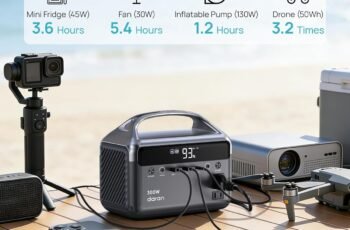
Need a lightweight LiFePO4 option that still powers essentials? We like this 300W, 192Wh mini station from DARAN (NEOZL). At 5.5 lb with a carry handle and storage bag, it’s road-friendly and doubles as a backpack. You get 2 AC outlets (300W, 600W surge), DC5521 (120W), USB‑C (45W), and two USB‑A (18W). Expect roughly 163Wh usable (≈85% efficiency): a 30W CPAP runs about 5.4 hours; a 150W device about 1.1 hours. It’s not for coffee makers. Charge via wall, car, or optional solar. The LiFePO4 pack, BMS protections, LED/SOS, and 1‑year warranty inspire confidence, though reviews note some unit variance.
Best For: Ultralight campers, road-trippers, and emergency backup seekers who need a compact LiFePO4 power station to run small essentials under 300W.
Pros:
- Lightweight 5.5 lb design with carry handle and storage bag; doubles as a backpack for easy travel
- Reliable LiFePO4 battery with BMS protections, LED/SOS, and multiple outputs (2 AC, USB-C 45W, 2 USB-A, DC5521)
- Reasonable runtime for small devices (≈163Wh usable; e.g., 30W CPAP ~5.4 hours) and flexible charging via wall, car, or solar
Cons:
- Limited 300W continuous/600W surge means no high-draw appliances (e.g., coffee makers)
- Modest capacity (192Wh) may be insufficient for longer trips without recharging
- Some reports of unit-to-unit quality variance; warranty only 1 year
EF ECOFLOW DELTA 2 Portable Power Station (1024Wh)
If you prize fast turnarounds and real-world power, the EcoFlow Delta 2 stands out with 0–80% recharging in about 50 minutes and a stout 1,800W AC output that runs 90% of car-camping appliances. We get 1,024Wh of LiFePO4 storage, rated for 3,000+ cycles, plus 15 ports including 100W USB-C. At 27 pounds, it’s portable yet substantial, with reliable BMS protections.
For longer trips, we can add extra batteries to reach 3kWh or feed it up to 500W of solar. It’s quiet versus gas, supports plug-and-play home backup, and recharges 0–100% in 80 minutes. Downsides: price and fan noise reports.
Best For: Campers, RVers, and homeowners who want ultra-fast recharging, strong 1800W output, and expandable LiFePO4 backup power with solar support.
Pros:
- 0–80% in ~50 minutes (0–100% in ~80 minutes) with AC; up to 500W solar input
- 1,024Wh LiFePO4 battery with 3,000+ cycles; robust BMS and 15 total ports including 100W USB-C
- 1,800W AC output (2,700W surge) powers most household and camping appliances; expandable to ~3kWh
Cons:
- Price can be high, especially with extra batteries or solar panels
- Fan noise reported by some users during heavy charge/discharge
- 27 lb weight is portable but substantial for frequent carrying
MARBERO Portable Power Station 88Wh (Solar Panel Optional)

Looking for an ultra-light, glovebox-ready power pick for weekends on the road? We like the MARBERO M82: an 88Wh, 80W (120W peak) lithium-ion station that weighs just 2.29 lb and measures 6.5 x 4.6 x 3.1 inches. It packs eight outputs—AC, DC, USB, and USB-C PD—plus a car socket, and its BMS safeguards against shorts, overloads, and over-voltage.
It charges fast to 80% in about two hours via wall, supports pass-through charging, and pairs with 30W or 60W solar panels. We’ve powered phones, tablets, a laptop, and small 12V gear. The built-in flashlight (three levels plus SOS) impresses. Note: some users report fan noise and slower full charges.
Best For: Ultralight, glovebox-ready backup power for road trips, camping, and emergencies where you need to run/charge small devices via AC/DC/USB and value fast top-ups and portability.
Pros:
- Compact and lightweight (2.29 lb) with handle; 8 outputs including AC, DC, USB, and USB-C PD plus car socket
- Fast wall charging to 80% in ~2 hours with pass-through charging; compatible with 30W/60W solar panels
- Built-in flashlight with 3 levels + SOS; BMS protections for overcharge, short circuit, overload, and over-voltage
Cons:
- Limited power capacity (88Wh, 80W output, 120W peak) not suited for high-draw appliances
- Reports of fan noise during DC use and slower time to reach 100% charge
- Long-term reliability can vary per user feedback; not ideal as a sole home backup solution
DEWALT DXAEPS14 Jump Starter and Power Station with Compressor and Inverter

Power-hungry car campers who want a road-rescue multi-tool will appreciate the DEWALT DXAEPS14, a 2000-peak-amp jump starter that also packs a 500W AC inverter, 120 PSI digital compressor with auto-stop, and both USB-A (15W) and USB-C (25W) ports. We like that it jump-starts up to V8 engines, inflates tires with a SureFit nozzle, powers small electronics, and charges phones fast. At 17.3 pounds and trunk-friendly dimensions, it’s built for roadside use, camping, and tailgates. Reverse-polarity protection and an LED work light add safety. Users praise power and durability, though compressor performance can vary. Warranty details and a 30-day return ease concerns.
Best For: Power-hungry car campers, road-trippers, and emergency-prepared drivers who want an all-in-one jump starter, compressor, and portable power station for vehicles up to V8.
Pros:
- 2000-peak-amp jump starter handles cars and trucks up to V8; reverse-polarity protection for safer use
- Built-in 500W AC inverter plus 15W USB-A and 25W USB-C for charging and running small electronics
- 120 PSI digital compressor with auto-stop and SureFit nozzle for quick, accurate tire inflation
Cons:
- At 17.3 lbs, it’s heavier than compact jump packs and takes more trunk space
- Some user reports of variable compressor performance and earlier quality-control hiccups
- 500W inverter limits use to small devices; not suitable for high-draw appliances
Jackery Explorer 1000 v2 Portable Power Station

Jackery’s Explorer 1000 v2 stands out for campers who want fast, flexible power without the bulk, pairing a 1,070Wh LiFePO4 battery with a true 1,500W AC output (3,000W surge). At 23.8 lbs with a foldable handle, it’s easy to pack yet powerful enough for AC units, fridges, and electric pots. We like the three pure sine wave AC outlets, two USB-C (100W PD), one USB-A, and a 12V car port. ChargeShield 2.0 and the app add smart touches: 1-hour emergency charging, quiet 30 dB nights, and efficiency mode. Expect over 4,000 cycles to 70% capacity and 10-year longevity. Note: solar panels sold separately and must be Jackery-compatible.
Best For: Campers, RVers, and emergency preppers who need a portable yet powerful LiFePO4 power station with fast charging, robust 1,500W AC output, and smart app control.
Pros:
- 1,500W AC output (3,000W surge) with three pure sine wave outlets plus dual 100W USB-C for versatile, fast device charging
- Rapid charging options including 1-hour emergency charge via app; ChargeShield 2.0 enhances safety and battery care
- Long-life LFP battery rated for 4,000 cycles to 70% capacity and 10+ years of use in a 23.8 lb portable design
Cons:
- Solar panel not included and solar charging is limited to Jackery-compatible panels
- App requires account management and settings control, which some users may find inconvenient
- Display and overall price-to-capacity value may not satisfy users seeking larger screens or lower cost per Wh
Factors to Consider When Choosing Portable Power Stations for Car Camping
Before we pick a power station, let’s match our power output needs and battery capacity range to the gear we plan to run. We’ll weigh battery chemistry types for safety, cycle life, and weight, then check that the port selection covers AC, USB-A/C, and 12V. Finally, we’ll compare recharge methods and speed—wall, solar, and car—to keep us topped up between stops.
Power Output Needs
How much power do we actually need on the road? We start by adding the running watts of everything we’ll use at the same time and making sure the power station’s continuous output exceeds that total. Then we check surge needs: devices with motors or compressors—like air pumps or mini fridges—can draw double at startup, so the unit’s surge rating must handle that spike.
Next, we match outlets to gear. If we rely on USB-C PD for laptops, AC for a CPAP, and a 12V car port for a cooler, we need those exact ports—and enough of them—so we don’t daisy-chain high loads.
We also plan for peak scenarios. CPAP plus laptop and phone should sit safely below the rated output. For flexibility, we may step up to 1000–1800W.
Battery Capacity Range
Once we’ve checked output and surge headroom, we size the battery in watt-hours because that dictates how long our gear actually runs. Higher Wh equals longer runtime for the same load. As a quick gut check, a 60W device on 280Wh lasts about 4.7 hours versus roughly 17 hours on 1024Wh (assuming ~85% efficiency). Runtime scales with load: a steady 300W draw drains 280Wh in about 0.9 hours.
For car camping, we match capacity to trip length and devices. For CPAP-style continuous use, 150–300Wh works for short weekends; 600–1000Wh suits longer trips or heavier draws. We also budget for simultaneous devices and startup spikes, ensuring total Wh covers the day’s energy while the inverter’s watt rating handles peaks.
Battery Chemistry Type
Why does chemistry matter? Because the cells inside a power station dictate safety, lifespan, and how confidently we run gear on the road. We favor lithium iron phosphate (LiFePO4) for car camping. It typically delivers 3,000+ cycles, far outlasting many traditional lithium-ion packs, and it handles heat better, lowering the risk of thermal runaway under moderate abuse.
LiFePO4 also keeps a steadier voltage as it discharges, so sensitive devices see cleaner, more reliable power. Its higher allowable depth of discharge means more usable capacity without punishing longevity—great when we’re off-grid for days. The tradeoff is slightly lower energy density, so weight can be a bit higher.
For storage, LiFePO4 shines: safer, longer shelf-life, and commonly 2–5+ years of solid service with proper care.
Port Selection Variety
Curiously, ports make or break a power station’s usefulness on the road, so we look for a balanced mix that fits real camp life. We want AC outlets for appliances, USB-C PD for fast-charging laptops and phones, USB-A for headlamps and speakers, and a 12V car socket for coolers or inflators.
We check the total port count and wattage per port to run several devices at once without tripping limits. USB-C PD at 60–100W handles most laptops; higher-watt AC outlets keep kettles or induction plates realistic. We also compare peak vs running wattage to see if a CPAP and mini-fridge can operate together.
Finally, we value systems that support expansion batteries, letting us scale capacity for longer trips without changing our port layout.
Recharge Methods Speed
How fast a power station refuels can make or break a camp day, so we weigh AC, car, and solar inputs carefully. Wall charging is usually quickest: compact units refill in roughly 2–6 hours, with many 1,000–1,200Wh models finishing in about 2–3 hours if they support high-wattage adapters. Car (12V) charging is slower at around 4–6+ hours, constrained by the unit’s accepted input and BMS protections.
Solar is the most variable. Expect charge speed to scale with panel wattage and sun quality; a single 100W panel typically needs about 8–12+ hours to refill a 1,000Wh pack in prime conditions. We favor models with MPPT and fast-charge modes, plus pass-through charging—while managing loads to avoid overheating and exceeding 300–500W input limits.
Weight and Portability
Which power station you can actually carry matters as much as how much it can power. For car camping, weight and form factor dictate how often we’ll bring a unit along. Lighter models (about 2.3 lb to 9–15 lb) are easy to shuttle from trunk to picnic table but may trade capacity and output. LiFePO4 chemistries help here, delivering longer cycle life and strong energy density, so portability holds up over years of trips.
We also look at handles, dimensions, and straps. A well-balanced handle or backpack-compatible design makes short hauls painless. Remember, weight scales with capacity and inverter wattage—high-output stations (around 1800–2400W) can hit 20–60+ lb. Ultra-compact picks under 3–5 kg suit lights, phones, and cameras, but offer fewer ports and lower continuous power.
Safety and Warranty
Ultimately, a great power station keeps us safe and backed up if something goes wrong. We should prioritize units with a robust protective BMS that guards against overloads, short circuits, and high/low temperatures. That’s what prevents failures when we’re charging gear overnight.
Battery chemistry matters, too. We look for LiFePO4 packs with clearly stated cycle life—ideally 3,000+ cycles—for stable performance and longevity. Safety isn’t just internal; a clear 24/7 standby protection mode and audible/visible alerts for faults or overheating help us act before issues escalate.
On warranty, longer terms—typically 2–5 years—often signal better build quality. We confirm who handles support, where repairs happen, and how to contact them. Finally, we verify documented return policies and service options in case performance falls short on the road.
Conclusion
We’ve covered ultra-portable cubes to powerhouse stations, but the best pick is the one that fits your trip length, charge speed needs, and outlet mix. Here’s a fun stat: with a 1024Wh unit like the DELTA 2, we can recharge two modern smartphones roughly 80–90 times total—plenty for a long weekend plus friends. Let’s match capacity to comfort, keep lithium iron phosphate chemistry for longevity, and hit the road knowing our campsite’s quiet, charged, and ready.