Planning a road trip or just want backup power in the car? We’ve rounded up 2025’s best portable power stations that balance compact size, reliable output, and smart charging. From LiFePO4 workhorses like the Jackery Explorer 2000 v2 and Anker SOLIX C300 to lightweight everyday picks like MARBERO and EHOM EP350, we compare what actually matters—capacity, ports, recharge speed, and safety. Let’s see which ones truly keep fridges, laptops, and cameras running when it counts.
Key Takeaways
- Prioritize compact stations (250–300Wh, ~6–8 lb) with car charging; ideal examples include Jackery Explorer 300 and ALLWEI 300W for road trips.
- Ensure versatile ports: at least two AC outlets, USB-C PD 60–100W, USB-A, and a 12V car socket for multi-device support.
- Choose LiFePO4 batteries for longevity (3,000–4,000 cycles) and safety; models like Anker SOLIX C300 and Jackery V2 lines excel.
- Look for fast recharge: 0–80% in under 70 minutes via wall, plus MPPT solar support for campsite or emergency top-ups.
- Consider extras: pass-through charging, pure sine wave output, clear LCD, quiet cooling, and built-in lights for vehicle and campsite use.
Car Battery Jump Starter with Air Compressor and Power Bank (1000A, 12V, 10000mAh)


If you want a single unit that can jump-start most 12V cars and light trucks and also top up tires on the spot, this 1000A lead‑acid jump starter with a 260 PSI air compressor is the practical pick. We like that it handles gas or diesel engines up to 5L and works from -4° to 130°F. The compressor inflates to 30 PSI in about 2–3 minutes, with a gauge to avoid over-inflation and three nozzles for tires, balls, and inflatables. The 10,000 mAh power bank offers 5V/2.1A USB and 12V/11A DC outputs. Keep it fully charged; follow the 8-hour car/24-hour indoor charging limits.
Best For: Drivers who want an all-in-one emergency solution to jump-start most 12V cars/light trucks (up to 5L gas or diesel), inflate tires quickly, and charge devices on the go.
Pros:
- 1000A peak current jump-starts up to 5L gas or diesel engines; operates from -4° to 130°F with multiple safety protections.
- Built-in 260 PSI air compressor inflates to 30 PSI in about 2–3 minutes; includes gauge and three nozzles for tires and inflatables.
- 10,000 mAh power bank with 5V/2.1A USB and 12V/11A DC outputs for phones and in-car devices.
Cons:
- Heavier lead-acid design (about 10.39 lb) compared to lighter lithium jump starters.
- Requires careful charging management (max 8 hours via car, 24 hours indoors) and periodic top-ups to stay ready.
- No USB cable included; jump-start attempts may require waiting 4–5 minutes between retries.
ALLWEI Portable Power Station 300W (280Wh Solar Generator)
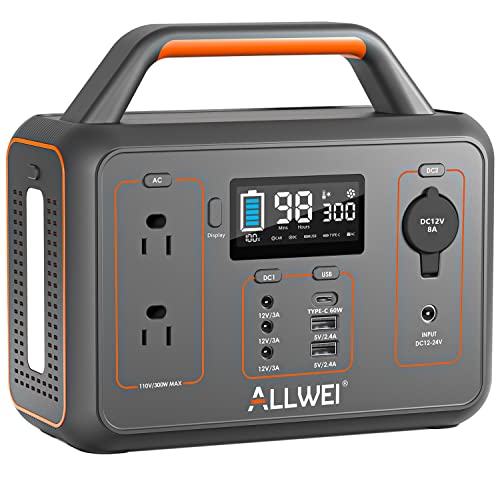
Looking for a compact, car-ready power source that can reliably run essentials without weighing you down? We like the ALLWEI 300W (280Wh) for road trips, camping, and emergencies. At ~6.5 lb and 9 x 4.7 x 7.8 inches, it’s easy to stow. You get two 110V pure sine wave AC outlets, USB-C PD 60W, two USB-A, three DC ports, and a car socket—power up to nine devices at once.
Expect about 238Wh usable (≈85% efficiency). Example: a 60W laptop runs ~4 hours. Recharge via wall (5.5–6.5h), car (4.5–5.5h), or 100W solar (3–4h) with MPPT. Quiet fan, LED SOS light, BMS protections. Charge every three months if stored.
Best For: Travelers, campers, and emergency preppers who need a lightweight, car-friendly power station to run small essentials (laptops, phones, CPAP, cameras) without exceeding 300W.
Pros:
- Compact and light (~6.5 lb) with versatile outputs: 2 AC, USB-C PD 60W, 2 USB-A, 3 DC, and car socket (up to 9 devices).
- Fast, flexible recharging via wall, car, or 100W solar (MPPT) with clear LCD and quiet smart fan.
- Reliable 280Wh capacity (~238Wh usable) with pure sine wave AC and robust BMS protections; up to 1500 life cycles.
Cons:
- 300W continuous/600W surge limit excludes higher-draw appliances (e.g., kettles, hair dryers, many power tools).
- Fan noise can be noticeable under heavier loads or charging.
- Solar panel not included; real-world runtime varies and is less than rated capacity due to efficiency losses.
6-in-1 Portable Car Jump Starter with Air Compressor and Power Inverter

Road-trippers and DIY fixers will appreciate a true do-it-all unit: FlyAuto’s 6-in-1 jump starter pairs 1,800 peak amps with a built-in 260 PSI digital air compressor and a 400W inverter. We get two 110V AC outlets, two 12V DC ports, and a 5V/2.1A USB for phones or lightweight laptops. The 20Ah lead-acid battery and upgraded copper wiring support most 6.0L gasoline and 5.0L diesel vehicles, plus bikes, boats, and mowers. It includes spark-proof, reverse-polarity protection, a bright LED work light, and a sturdy handle. Note the 20.3-pound weight and mixed compressor feedback; fully charge 24 hours before heavy use.
Best For: Road‑trippers, DIYers, and vehicle owners who want an all‑in‑one jump starter with built‑in air compressor and 400W inverter for emergency power and tire inflation across cars, trucks, RVs, boats, and mowers.
Pros:
- Powerful jump start capability (1800 peak amps) for most 6.0L gas/5.0L diesel engines with spark-proof and reverse-polarity protection
- Versatile power options: 2×110V AC, 2×12V DC, and 5V/2.1A USB plus bright LED work light
- Integrated 260 PSI digital air compressor with gauge and included nozzles for tires, bikes, balls, and inflatables
Cons:
- Compressor performance reports vary; some users only see ~20 PSI in practice
- Heavy and bulky at 20.3 lb (13.2 × 12.7 × 9.9 in), less convenient for frequent carry
- Lead-acid battery requires full 24-hour charge before first use and regular maintenance for best results
Jackery Portable Power Station Explorer 300 (293Wh)

Prefer a light, car-friendly power hub that still handles real-world loads? The Jackery Explorer 300 packs 293Wh, delivers clean 300W output (500W surge), and weighs just 7.1 pounds. We get two pure sine wave AC outlets, a 60W USB-C PD port (in/out), QC 3.0, USB-A, and a 12V car port—quiet, no fumes, no maintenance.
Recharge fast: hit 80% in about two hours using wall plus 60W USB-C. On the road, top up via car outlet or optional SolarSaga 100; MPPT optimizes solar input. Run routers, fans, TVs, cameras, laptops, and phones simultaneously. Note: not for induction cooktops or blenders. Accessories included; solar panel sold separately.
Best For: Campers, road trippers, and emergency preppers who want a lightweight, car-friendly power station that cleanly runs small-to-medium devices and recharges quickly, including via solar.
Pros:
- Compact 7.1 lb design with 293Wh capacity; clean 300W output (500W surge) via two pure sine wave AC outlets
- Fast recharge to ~80% in about 2 hours using wall plus 60W USB-C; MPPT for efficient solar with SolarSaga 100
- Versatile ports (PD 60W in/out, QC 3.0, USB-A, 12V car) and pass-through charging for multiple devices
Cons:
- Not suitable for high-power appliances like induction cooktops or blenders
- Solar panel sold separately, adding cost for off-grid setups
- Limited capacity (293Wh) may not sustain larger loads or long outages without frequent recharging
MARBERO Portable Power Station 88Wh (Solar Panel Optional)

If you need an ultra-portable jump-start to your car kit, MARBERO’s 88Wh M82 stands out with 8 outputs (including AC and a car charger outlet) in a 2.29 lb, palmable body. We like its 80W rated output (120W peak) for phones, tablets, small laptops, and glovebox tools like a car vacuum, mini air compressor, or a compact fridge. It fast-charges to 80% in about two hours and supports pass-through charging. Add a 30W/60W MARBERO panel for sunny top-ups. The flashlight (three levels plus SOS) runs up to 68 hours. BMS protections, cooling vents, and auto shutoff boost safety; some users report fan noise and slower full charges.
Best For: ultralight travelers, campers, and emergency kits needing a compact 88Wh power station to run/charge small devices and glovebox tools with occasional AC use.
Pros:
- 8 outputs (AC, DC, USB, USB-C PD, car outlet) in a 2.29 lb compact body for versatile, portable power
- Fast wall charging to 80% in ~2 hours with pass-through charging support
- Built-in flashlight with 3 levels + SOS (up to ~68 hours) and robust BMS protections
Cons:
- Limited power: 80W rated (120W peak) not suited for high-draw appliances
- Some users report fan noise and slower times to reach 100% charge
- Small 88Wh capacity requires frequent recharging for continuous or multi-device use
VTOMAN Jump 600X Portable Power Station (299Wh, 600W)

Looking for a compact, car-friendly power box that still handles real gear? We like the VTOMAN Jump 600X: a 299Wh LiFePO4 station with 600W AC output (1,200W surge) and robust LIFEBMS protections. It supports pass-through charging and powers up to nine devices at once.
You get two 110V AC outlets, two DC5521 (12V/10A), a regulated 12V car port, three USB-A (QC 3.0 up to 18W), and a 60W USB-C PD for laptops. All 12V rails are regulated—great for CPAPs and fridges. It weighs about 13.2 lb, measures 10.2×8.7×8.6 inches, offers 3,000 cycles to 80%, expandable to 939Wh, and includes a 2‑year warranty.
Best For: Campers, road-trippers, and emergency preppers who need a compact, car-friendly LiFePO4 power station with regulated 12V outputs and enough AC muscle to run real gear.
Pros:
- 600W AC output (1,200W surge) with pass-through charging and up to 9 devices powered simultaneously
- Long-life LiFePO4 battery (3,000 cycles to 80%) with comprehensive LIFEBMS protections
- Versatile ports including 2x AC, regulated 12V car/DC outputs, 3x USB-A QC, and 60W USB-C PD; expandable to 939Wh
Cons:
- 299Wh base capacity may be limiting without the extra battery (sold separately)
- USB-C tops out at 60W, which may be modest for high-wattage laptops
- Batteries are not user-replaceable; unit is ~13.2 lb which may be heavy for ultralight setups
Jackery Explorer 2000 v2 Portable Power Station (2042Wh, 2200W)

We’d pick the Jackery Explorer 2000 v2 for drivers who want big power without big bulk. Its 2042Wh LiFePO4 pack and 2200W output (three AC ports, plus 100W USB‑C PD) handle fridges, TVs, and coffee makers, yet it weighs just 39.5 pounds—far lighter than many 2kWh rivals. CTB construction boosts safety and compactness.
Charging impresses: 0–80% in 66 minutes, full in 102 minutes via Emergency Super Charging, about six hours on 400W solar, or five hours in near‑silent mode. It supports pass‑through and acts as a UPS. The app and LCD aid control. Watch promos—prices swing from ~$800 to ~$1,500.
Best For: Drivers and homeowners who want high-capacity backup power without heavy bulk, fast AC/solar charging, and quiet operation for road trips, camping, or home outages.
Pros:
- 2042Wh LiFePO4 battery with 2200W output (3 AC ports + 100W USB‑C PD) powers fridges, TVs, coffee makers, and laptops.
- Lightweight and compact for its class at 39.5 lb with CTB construction; quieter operation (<30 dB in Silent mode).
- Fast, flexible charging: 0–80% in 66 minutes, full in 102 minutes (Emergency Super Charging), pass‑through and UPS support, solar-ready.
Cons:
- 120V-only AC output limits compatibility with some 240V appliances and tools.
- App connectivity can be quirky per user reports.
- Price fluctuates widely ($800–$1,500), so value depends on timing and promos.
Anker SOLIX C300 Portable Power Station (288Wh, 300W)

Meet the Anker SOLIX C300, a compact 288Wh LiFePO4 power station that shines for car campers and road-trippers who need quiet, fast, and flexible charging without bulk. We like its 300W output (600W surge) across 8 ports: three AC, a 12V car socket, two USB-C up to 140W, a 15W USB-C, and a USB-A. It recharges to 80% in about 50 minutes from the wall and supports 100W solar, car, or USB-C PD 3.1 input with pass-through.
At 9.02 lb with a sturdy handle, it runs at 25dB, lasts 3,000+ cycles, and carries a 5‑year warranty—ideal for laptops, cameras, and essentials.
Best For: Car campers, road-trippers, and emergency backup users who want a compact, quiet, and fast-charging 288Wh power station for laptops and small essentials.
Pros:
- Fast recharge to 80% in ~50 minutes; supports wall, car, solar (100W), and USB-C PD 3.1 with pass-through
- Versatile I/O: 8 ports including 3× AC (300W), dual high-power USB-C (up to 140W), 12V car socket
- Durable, quiet, and portable: LiFePO4 (3,000+ cycles), 25dB operation, 9.02 lb with sturdy handle, 5-year warranty
Cons:
- 300W continuous output limits use with high-wattage appliances (e.g., kettles, hair dryers)
- Not compatible with Anker SOLIX PS30, PS200, or PS400 solar panels; best with 60–100W panels
- Strap not included by default; not ideal for backpacking due to size/weight
Jackery Explorer 1000 V2 Portable Power Station

Serious road-trippers who need fast, reliable power will appreciate the Jackery Explorer 1000 V2’s 1,500W AC output (3,000W surge) and true one-hour emergency full charge via the Jackery app. We get a 1,070Wh LiFePO4 battery, over 70% capacity after 4,000 cycles, and a 10-year lifespan. At 23.8 lbs with a foldable handle, it’s easy to pack. Ports include three pure sine AC outlets, two USB-C (100W PD), one USB-A, and a 12V car port. ChargeShield 2.0 boosts safety. The app toggles standard 1.7-hour charging, quiet 30 dB overnight, and efficiency modes. Note: solar panel sold separately and Jackery-only compatible.
Best For: Road-trippers, campers, and RV users who need fast, reliable portable power with app-controlled charging and robust AC output for appliances.
Pros:
- 1,500W AC output (3,000W surge) with three pure sine wave outlets and dual 100W USB-C PD for versatile, high-demand devices
- LiFePO4 battery rated for 4,000 cycles to 70%+ capacity and 10-year lifespan; 1-hour emergency full charge via app
- Portable 23.8 lbs design with foldable handle; smart app modes (standard 1.7h, 30 dB quiet overnight, efficiency) and ChargeShield 2.0 safety
Cons:
- Solar panel not included and solar charging is compatible only with Jackery panels
- App requires account management and adds complexity for some users
- Limited port variety (one USB-A) and relatively high price for capacity/features
EHOM Portable Power Station 350W (EP350)

Road-trippers and weekend campers who want fast top-ups and balanced ports will appreciate the EHOM EP350. This 299Wh, 350W (700W peak) power station weighs 14 pounds and delivers a 120V pure sine wave AC outlet, two USB-A (18W each), two USB-C (65W and 100W), and a 12V car port. NitroGo charging hits 80% in 55 minutes, full in about 1.25 hours. Recharge via AC, 12V/24V car, gasoline generator, or up to 200W solar through its MPPT. We like the clear LCD, bright LED (strong/warm/SOS), robust BMS, 3,500 cycles, and 5-year warranty. Box includes AC/car cables and support.
Best For: Road-trippers, campers, and emergency-preppers who want a compact 299Wh power station with fast AC charging, balanced ports, and solar-ready flexibility.
Pros:
- NitroGo fast charging: 80% in 55 minutes, full in ~1.25 hours
- Versatile outputs: 120V pure sine AC, dual USB-A, dual USB-C (65W/100W), 12V car port; charges up to 6 devices
- Long life and support: up to 3,500 cycles, robust BMS, clear LCD, bright LED, 5-year warranty
Cons:
- 350W rated output limits high-draw appliances; 700W peak only for short surges
- Only one AC outlet; DC port total and USB-A capped at 18W each
- Solar input max 200W and panel not included
Factors to Consider When Choosing Portable Power Stations for Car
As we choose a power station for the car, we should match power output to our devices and weigh battery type and lifespan for long-term value. We’ll also compare charging options (AC, car socket, solar) and ensure the port selection fits our mix of USB, USB-C, and 12V needs. Finally, we’ll balance size and weight against the capacity we actually need for road use.
Power Output Capacity
How much power do we really need from a car-friendly portable station? Let’s match output to our devices. Running wattage is the continuous rating; surge (peak) covers short startup spikes. A 300W running/600W surge unit handles phones, cameras, CPAPs, and mini coolers. Step up to 600W running/1200W surge for laptops, small coffee makers, or compact fridges. If we’re powering tools or bigger appliances, target 600–1000W+ running and confirm the surge rating exceeds the initial draw of motors and compressors.
For multi-device setups, look for multiple AC outlets with a combined continuous rating that meets our total load—e.g., two 110V outlets totaling 300W running. Also consider inverter efficiency and thermal management; heat and conversion losses can trim real-world output under sustained loads.
Battery Type Lifespan
Wondering which battery chemistry will go the distance? We look first at lifespan. Lithium iron phosphate (LiFePO4) leads, typically delivering 3,000+ full cycles and a design life up to 10 years. It also holds a higher percentage of capacity after thousands of cycles, so performance stays consistent on long trips and daily use. Standard lithium and especially lead-acid packs trail here; lead-acid is heavier and often fades faster, which hurts durability and portability over time.
We also weigh modularity. Expandable or swappable battery packs let us replace a tired module instead of the entire station, stretching value and uptime. Finally, habits matter. Avoid deep discharges, don’t store at empty, and follow recommended recharge intervals to extend real-world lifespan—whatever chemistry we choose.
Charging Method Options
Which charging path fits our routine best? Most power stations let us recharge three ways: AC wall outlets, a 12V car port, and solar via an MPPT controller. If we need speed before a trip, AC is fastest—many units hit 80% in 50–80 minutes, while larger capacities may take 5–6 hours.
On the road, 12V car charging is slower but handy. Expect limits—some cap draw around a 120W car outlet—so topping up during drives is realistic, full charges less so.
For off-grid camping, solar adds flexibility. Output depends on panel wattage and sun; MPPT maximizes harvest, and many stations accept roughly 30–200W input.
Finally, pass-through charging lets us power devices while recharging, keeping fridges, fans, or lights running continuously.
Port Selection Variety
With charging methods covered, we should make sure the ports match what we actually plug in. We want a mix: AC outlets for laptop bricks and small appliances, 12V DC for inflators or coolers, plus USB-A/C for phones and tablets. Prioritize USB-C PD for fast laptop and phone charging.
Match inverter capacity to our toughest load. If a device runs at 300W but surges to 600W on start-up, the station’s continuous and peak ratings must exceed both. That prevents overloads and nuisance shutoffs.
Verify a 12V car-port and cigarette lighter socket if we plan to power in-vehicle accessories or use a car charger. Look for pass-through charging to keep gear running while the station refuels. Finally, compare total port count and distribution to power everything simultaneously.
Size and Weight
How much bulk can we realistically live with in a car? Size and weight dictate where a power station fits and how often we’ll actually bring it. Smaller units (about 6–10 pounds) slide under seats or into cramped trunks thanks to compact dimensions under roughly 10 inches. They’re easy to grab and stash between stops.
Once we cross 15 pounds, handle design and balance matter. A well-shaped grip and centered mass make one‑hand carries manageable; poor ergonomics turn short walks into hassles. Larger models often exceed 20 pounds and grow thicker and taller with higher watt‑hours, which can crowd small vehicles.
Trade-off alert: lighter, lower‑capacity units won’t sustain high‑draw devices as long, so we may recharge more often during longer trips.
Safety Protections Included
Weight and footprint set where a unit rides in the car, but the protections it carries decide how safely we use it. We should insist on multi-layer safeguards: reverse polarity, short circuit, overcurrent, overcharge, overvoltage, and overheat protection. Spark-proof clamps and automatic shutoff when connections are wrong or loads spike help prevent arcs and component damage.
We also want temperature monitoring and smart thermal management for sustained, high-demand use. A robust battery chemistry matters—LiFePO4 or a well-regulated sealed lead-acid pack—with a solid BMS to stop over-discharge and overcharge, balance cells, and manage current limits.
Finally, clear indicators make safety usable: bright LEDs and audible alerts for faults, status, and full charge guide us to correct mistakes fast and keep operation simple.
Operating Temperature Range
Ever wonder why some power stations falter in winter or shut down in summer heat? Operating temperature range is the reason. We should look for units rated to run across wide extremes—many span roughly -4°F to 130°F—so performance stays predictable on ski trips and desert drives. A broad range helps maintain battery efficiency and avoids reduced capacity or protection shutdowns when cabins bake or frost.
Thermal management matters, too. Smart fans and well-designed passive cooling keep internals stable under high ambient temps or heavy inverter loads. In the cold, we may need to pre-warm the unit or keep it topped up to limit voltage sag and preserve starting capability. For storage, keep it partially charged and avoid prolonged exposure outside the recommended range to protect battery health.
Warranty and Support
Ultimately, a great power station isn’t just about specs—it’s backed by a warranty and support you can count on. We start by checking warranty length and what it actually covers, especially battery degradation and power electronics. A solid brand also has a reputation for responsive after‑sales support.
We look for clear return and exchange policies—ideally 30 days or more—and straightforward instructions for initiating claims. Multiple support channels matter: phone, email, and an online portal, plus stated response times we can trust.
We verify if warranty registration is required and whether maintenance—like periodic full-charge cycles—is needed to keep coverage valid. Finally, we review extended or upgraded warranty options, their costs, and the added benefits, such as longer coverage, faster service, or advance replacements.
Conclusion
As we wrap up, let’s pack smarter than Odysseus—choosing power that keeps every mile mythical. From lightweight LiFePO4 champs like the SOLIX C300 and Jackery Explorer 2000 v2 to balanced picks like the Explorer 1000 V2, we’ve got options for fridges, laptops, and cameras. Add solar-ready MPPT, fast USB‑C, and safe pass-through charging, and we’re road-trip ready. Pick the capacity, outputs, and warranty that fit your journey—and let the open road be our reliable companion.