We’re rounding up Home Depot’s best portable power stations for camping in 2025, focusing on real-world runtime, weight, recharge speed, and safety. We favor LiFePO4 models for longevity, strong surge protection, and MPPT solar input, plus compact units with USB-C PD for everyday gear. We’ll highlight what each powers—from phones and fans to CPAPs and mini-fridges—and where expansion batteries make sense. Let’s see which five actually earn a spot in our kit…
Key Takeaways
- Jackery Explorer 1000 v2: 1,500W AC (3,000W surge), 1,070Wh LFP, 23.8 lb, app control, dual 100W USB-C; ideal for CPAPs, mini-fridges, and short appliance use.
- Bailibatt 300W: 257Wh, ultra-light 3.6–4.6 lb, dual AC, USB-A/C; best for phones, lights, and small fans; budget-friendly starter unit.
- VTOMAN Jump 600X: 600W output, 299Wh LFP expandable to 939Wh, pass-through charging, regulated 12V; versatile mid-tier for camps powering up to nine devices.
- GRECELL 300W: 230.88Wh with MPPT and included 40W solar panel, 60W USB-C PD; compact option for off-grid trickle charging and essentials.
- Jackery HomePower 3600 Plus: 3,600W/3,584Wh LFP, expand to 21kWh, dual-voltage 120/240V; premium basecamp power with fast hybrid recharge and wheels.
Jackery Explorer 1000 v2 Portable Power Station (1070Wh LiFePO4)


If you want fast, dependable power in a compact build, the Jackery Explorer 1000 v2 stands out for campers and RVers who need real AC output without the bulk. We like its 1,500W AC output (3,000W surge), pure sine wave ports, and 1,070Wh LiFePO4 battery that lasts over 10 years with 4,000 cycles to 70% capacity. At 23.8 lbs with a foldable handle, it’s easy to haul. Dual USB-C with 100W PD, USB-A, a car port, and three AC outlets cover laptops to fridges. ChargeShield 2.0 and app control add 1-hour emergency charging, quiet night mode, and efficiency settings. Solar panel sold separately.
Best For: Campers, RVers, and emergency preppers who need a portable, long‑lasting LiFePO4 power station with true 1,500W AC output and fast, app-enabled charging controls.
Pros:
- 1,500W AC output (3,000W surge) with three pure sine wave outlets handles appliances like fridges and small AC units
- Long-life LiFePO4 battery rated for 4,000 cycles to 70% (10+ year lifespan) in a 23.8 lb portable form with foldable handle
- Smart app features including 1-hour emergency charging, quiet night mode (~30 dB), and efficiency settings; dual 100W USB-C PD
Cons:
- Solar panel not included and solar charging is compatible only with Jackery panels
- Default full-charge time is 1.7 hours to protect battery unless using emergency 1-hour mode
- App requires account management and the display size/pricing may not satisfy all users
Bailibatt Portable Power Station 300W (257Wh)

Looking for an ultra-light, budget-friendly power pick for weekend camping or emergency phone-and-laptop top-offs? We like the Bailibatt Portable Power Station 300W (257Wh), model HP200D. At 3.6–4.6 lbs, it’s easy to pack yet delivers 300W across dual 120V pure sine AC outlets, 12V/120W DC, plus USB-A and USB-C. Power up to eight devices (≤300W) and monitor everything on the clear LCD. The Grade-A 257Wh lithium pack supports 1,500+ cycles and stays quiet. Safety’s covered with a premium BMS, overload, and short-circuit protection. Note: no car or solar charging cables included. Recharge every 1–2 months. Backed by a 1-year warranty.
Best For: Budget-minded campers and emergency preppers who need a super-light, quiet 257Wh power station for phones, laptops, and small gadgets under 300W.
Pros:
- Lightweight (3.6–4.6 lbs) with dual 120V pure sine AC, 12V/120W DC, plus multiple USB-A/USB-C ports
- Solid 257Wh Grade-A lithium battery rated for 1,500+ cycles with clear LCD and quiet operation
- Built-in BMS with overload and short-circuit protection; can power up to eight devices (≤300W)
Cons:
- No car charger cable or solar charging accessories included
- Limited to 300W output and 257Wh capacity—not suitable for high-draw appliances
- Conflicting listed weight (3.6 lb vs. 4.6 lb) may affect pack planning
VTOMAN Jump 600X Portable Power Station (299Wh, 600W)

With a durable LiFePO4 battery and true 600W output (1,200W surge), the VTOMAN Jump 600X stands out for campers who want long cycle life and safe, regulated power in a compact build. We like its 299Wh capacity, expandable to 939Wh with the extra battery, giving flexibility for weekends or longer trips. Two 110V AC outlets, regulated 12V ports, a 60W USB-C PD, and three USB-A (QC 3.0 up to 18W) cover laptops, CPAPs, car fridges, and inflators. It powers up to nine devices while charging, supports pass-through, and includes robust LIFEBMS protections. At 13.2 lb, it’s portable, practical, and backed by a 2-year warranty.
Best For: Campers, RVers, and emergency-prep users who want a compact, safe LiFePO4 power station with true 600W output, pass-through charging, and optional expansion for longer trips.
Pros:
- Long-life LiFePO4 battery (≈3,000 cycles to 80%) with comprehensive LIFEBMS safety protections
- Versatile, regulated outputs: 2x 110V AC (600W/1200W surge), 12V DC ports, 60W USB-C PD, and multiple USB-A (QC 3.0)
- Expandable from 299Wh to 939Wh and supports pass-through charging for powering up to 9 devices simultaneously
Cons:
- 60W USB-C PD may be underpowered for high-wattage laptops or fast charging large devices
- Base 299Wh capacity can be limiting without the extra battery (sold separately)
- Batteries are not user-replaceable; unit weighs ~13.2 lb which may be heavy for ultralight travel
GRECELL 300W Portable Power Station (230.88Wh Solar Generator)

Compact power and clean AC output make the GRECELL 300W (230.88Wh) a smart pick for campers who mostly run essentials under 330W—think laptops, lights, cameras, small fans, or a CPAP. We get a 110V pure sine wave AC outlet, USB-C PD 60W and 18W, two USB-A QC ports, and a car port—six outputs total. At 7.3 pounds, it’s easy to pack. The BMS with overload, overcharge, and short-circuit protection, plus dual silent fans, inspires confidence. Recharging’s flexible: wall, car, or the included 40W solar panel with MPPT. Expect real-world output slightly below rated; heating appliances can trip limits.
Best For: Campers, travelers, and home backup users who need a lightweight, portable power station for essentials under 330W like laptops, lights, cameras, small fans, and CPAP machines.
Pros:
- Pure sine wave 110V AC with six versatile outputs, including USB-C PD 60W and MPPT-optimized solar input
- Lightweight and compact (7.3 lb) with robust BMS protections and dual silent cooling fans
- Flexible charging options (AC, car, and included 40W solar panel) with fast USB-C PD charging
Cons:
- Limited 230.88Wh capacity and 330W continuous output won’t support most heating appliances or higher-wattage tools
- Real-world usable capacity/output slightly below rated due to conversion losses and inefficiencies
- Input charging rate constraints can lengthen recharge times, especially via solar or some wall adapters
Jackery HomePower 3600 Plus Portable Power Station with Solar Panels
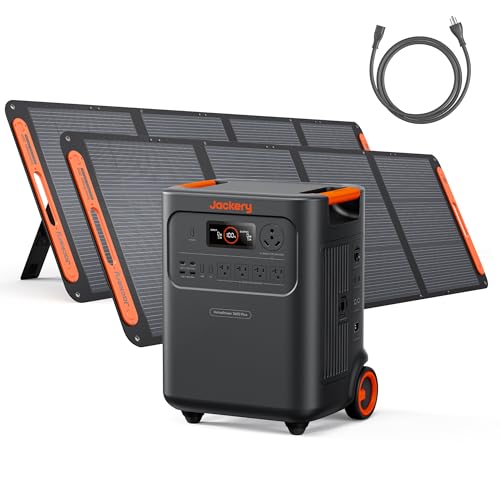
Serious campers who want home-grade backup in the woods will appreciate the Jackery HomePower 3600 Plus: a 3,584Wh LFP powerhouse that delivers 3,600W output (and up to 7,200W in parallel) with optional 120V/240V dual-voltage. We like its expandability to 21kWh per unit (or 43kWh with multiple units), hybrid AC+DC full recharge in 2 hours, and included 2x200W solar panels. It’s the lightest 3.6kWh LFP, 34% smaller and 29.3% lighter, with wheels and a telescopic handle. Safety stands out: 6,000 cycles, 10-year lifespan, -4 °F operation, and 302 °F testing. Notes: ~50W UPS drain, app quirks, separate shipments.
Best For: Serious campers, RVers, and homeowners seeking a highly portable, safety-focused, expandable backup power station with fast hybrid charging and optional 240V capability.
Pros:
- 3,600W output (7,200W parallel), dual-voltage 120/240V, and expandable from 3,584Wh to 21kWh per unit (up to 43kWh multi-unit)
- Fast recharge: hybrid AC+DC in 2 hours; AC in 2.5 hours; solar in 4 hours; gas generator in 2.5 hours; includes 2x200W solar panels
- Ultra-portable design: lightest 3.6kWh LFP, 34% smaller and 29.3% lighter, wheels and telescopic handle; robust safety with 6,000 cycles, 10-year lifespan, -4 °F operation, and 302 °F thermal testing
Cons:
- Notable ~50W constant draw when used as a UPS can drain battery over time
- App connectivity and scheduling quirks may affect user experience
- Power station and solar panels ship separately, which can complicate delivery timing and setup
Factors to Consider When Choosing Portable Power Stations for Camping Home Depot
Before we pick a power station, let’s match our power output needs to the gear we plan to run and the battery capacity range we’ll want for trip length. We’ll weigh the pros and cons of battery chemistry types (like LiFePO4 vs. NMC) alongside weight and portability. Finally, we’ll check the outlet and port mix to ensure enough AC, USB-C, and DC options for our setup.
Power Output Needs
How much power do we really need for a weekend in the woods? Let’s total our continuous watts first. Add up the running draw for lights, fans, phones, and any small appliances, then pick a power station whose continuous rating meets or exceeds that sum. Next, check surge capacity. Devices with motors or compressors can spike at startup, so we want an inverter that can handle brief bursts beyond its continuous rating.
Match outlets to our gear: enough AC sockets for larger loads, plus DC and USB-A/USB-C ports—ideally at least one high-wattage AC outlet for items like a coffee maker or induction plate. Finally, think about scalability. If we might expand our setup or go longer off-grid, favor models that support parallel units or expansion.
Battery Capacity Range
With our wattage needs in mind, the next question is how much battery we should carry. Capacity is measured in watt-hours (Wh). For camping, consumer models typically span about 230Wh to 1,070Wh. Smaller packs (around 257–300Wh) handle phones, headlamps, lanterns, and small fans for many hours. Stepping up to the 1,000Wh class supports mini-fridges, CPAPs, induction of short appliance use, and longer runtimes.
Battery Chemistry Type
Curiously, battery chemistry shapes how long a power station lasts, how safe it runs, and how much it weighs in our pack. At Home Depot, we’ll see two main types: lithium iron phosphate (LiFePO4) and conventional lithium-ion (often NMC or LiCoO2). LiFePO4 stands out for longevity—thousands of cycles, often retaining over 70% after 4,000+—and excellent thermal stability that reduces thermal runaway risk. It’s a strong fit for repeated camping use and harsher temperature swings.
Lithium-ion NMC/LiCoO2 typically offers higher energy density, but cycle life is shorter and capacity fade can arrive sooner. Warranties often mirror this: LiFePO4 models frequently advertise longer coverage and end‑of‑life confidence. When we compare listings, we prioritize chemistry transparency, lifecycle ratings, and safety certifications before price.
Weight and Portability
Where does portability really show up on a campsite? We feel it the moment we load the car or hike to a site. Weight sets the tone: compact units around 3.6–4.6 lbs slip into daypacks, while larger models near 23.8 lbs demand two hands and trunk space. Lighter often means less capacity or output, so we balance runtime needs against carry comfort.
Handle design matters more than specs suggest. Foldable handles and compact dimensions make tight packing easier, and balanced chassis reduce wrist strain. Battery chemistry plays a role too—LiFePO4 brings longer cycle life but can add weight compared with some Li‑ion packs.
Planning to expand later? Extra batteries raise total mass. For long walks or extended trips, wheels or a rugged carry case can be worth it.
Outlet and Port Mix
How many plugs do we really need at camp? The short answer: more than we think. A smart power station gives us a balanced mix—pure sine wave AC outlets for laptops, CPAP machines, and small appliances, plus DC/12V ports for coolers and lights. We also want multiple USB options, including USB-C PD, so we can fast‑charge phones and tablets while still running gear from wall plugs.
Port count and layout matter. The right distribution lets us power several devices at once without adapters or daisy‑chaining. Look for regulated 12V/car ports with clear wattage limits (some cap at 120W) to keep car accessories and mini-fridges stable. Finally, an integrated display or app showing per‑port load and total wattage helps us balance everything confidently.
Charging Methods Speed
When we compare charging methods, speed becomes a make-or-break factor for camp readiness. AC recharge rates vary a lot—some stations sprint from empty to full in 1–2 hours under ideal conditions, while others need 4–6+ hours. That difference dictates whether we’re topped up before sunrise.
We also look for pass-through charging. Being able to run lights or a fridge while the unit recharges changes real-world timing and keeps camp routines uninterrupted.
For solar, MPPT controllers paired with sufficient panel wattage determine how fast we recover capacity during daylight. More optimized input equals fewer idle hours.
USB-C PD (60–100W) ports shorten top-offs for laptops and phones versus USB-A.
Finally, expect slower recharge in extreme heat or cold, which reduces efficiency.
Safety and Protections
Why trust a power station at camp if it can’t protect itself and our gear? We should prioritize models with a robust battery management system (BMS) that monitors voltage, current, and temperature. That means built‑in protections for over-charge, over-discharge, over-voltage, overloads, short circuits, and high temperatures.
Thermal safeguards matter when we’re running devices for hours. Auto-stop charging when the battery is full helps prevent heat buildup and extends battery life. Pure sine wave AC output is essential for sensitive electronics—think laptops, cameras, and CPAPs—so they receive clean, stable power.
We also want sturdy housings and proper venting to dissipate heat during continuous use. Finally, look for third-party certifications or clear manufacturer claims about multi-level protections and chemistry stability (LiFePO4 or well-managed Li‑ion) to ensure long-term reliability off-grid.
App Control Features
Curious what a good app can add to a power station? Quite a lot. With app control, we can monitor charge level, see remaining capacity in real time, and check outlet status. We can switch charging modes, enable energy‑saving or overnight charging, and even schedule charging to protect battery health when we’re off-grid.
Some apps include a 1‑hour emergency boost to reach a usable state fast—handy when we need lights or to power a fridge—though full recharge still takes longer. Temperature alerts add safety by flagging heat issues before they escalate.
There are tradeoffs. App integration may require account setup and can introduce software quirks or connectivity hiccups that affect performance. We look for stable Bluetooth/Wi‑Fi, clear dashboards, and reliable scheduling.
Conclusion
As we pack up our campsite, let’s see each power station as a lantern along a forest trail. The Jackerys are sturdy beacons, VTOMAN and GRECELL nimble fireflies, and Bailibatt a pocket torch for quick paths. Together they light different journeys—heavy loads, fast charges, quiet nights. If we match capacity to our steps, weight to our pack, and solar to the sun’s arc, we’ll walk out with steady light—and return ready for the next trail.