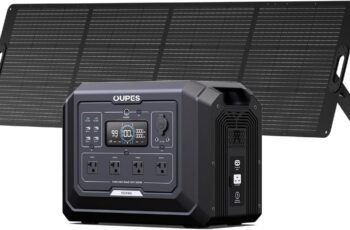
Can a compact power station realistically keep an air conditioner running when we’re off-grid? We think so, but only if we match surge handling, inverter quality, and capacity to the job. We’ll compare three portable options that balance wattage, battery size, and charging speed, and explain where each shines. From brief outages to cooling a small room, we’ll outline what to expect—and what not to risk—so we can choose confidently before the next heat wave hits.
Key Takeaways
- Match the AC’s running and startup (surge) watts; choose a station with surge capacity clearly above the startup requirement.
- Prefer pure sine wave inverters to safely run compressors and sensitive electronics in air conditioners.
- For practical runtimes, pick higher-capacity units (700–800Wh+); 280–300Wh models give short, limited AC use.
- Check recharge speed and input limits; faster AC/solar input and MPPT reduce downtime in hot conditions.
- Consider ALLWEI 300W or EnginStar 300W for brief, low-power AC starts; larger stations are better for sustained cooling.
ALLWEI Portable Power Station 300W (280Wh Solar Generator)
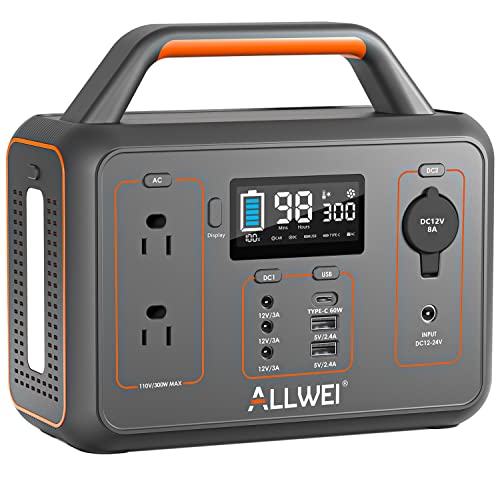

If you need a compact backup to run small, efficient AC units or cycle a fan during heat waves, the ALLWEI Portable Power Station 300W (280Wh) stands out for its 300W continuous/600W surge output, pure sine wave AC, and versatile ports. We like its two AC outlets, 60W USB-C PD, USB-A, DC ports, and car socket—powering up to nine devices. At 6.5 pounds, it’s easy to carry. Expect about 238Wh usable; estimate runtime as 280Wh x 85% ÷ device watts. It recharges by wall, car, or 100W solar in roughly 3–6 hours. Built-in MPPT, BMS, LED SOS, and smart cooling add confidence.
Best For: Campers, emergency preppers, and travelers who need a lightweight, versatile 300W portable power station to run small devices (CPAP, phones, laptops, cameras) and light AC loads with pure sine wave output.
Pros:
- 300W continuous/600W surge with pure sine wave and two AC outlets; up to nine devices via USB-C PD 60W, USB-A, DC, and car socket
- Fast, flexible recharging (AC, 12V car, or 100W solar in ~3–6 hours) with built-in MPPT and smart cooling
- Compact 6.5 lb build with LCD, LED SOS light, and robust BMS protections; about 238Wh usable energy
Cons:
- Not suited for appliances drawing over 300W continuous; limited for larger heaters, kettles, or full-size fridges
- Fan noise can engage under higher loads or during charging
- Solar panel not included; real-world capacity ~85% (≈238Wh) reduces runtime versus rated 280Wh
EnginStar Portable Power Station 300W (296Wh)

Best for light, short bursts of cooling, the EnginStar Portable Power Station 300W (296Wh) suits users running small window units or portable ACs on low settings for brief periods. With a 300W pure sine wave AC output and two 110V outlets, it handles low-power compressors or fan-only modes cautiously. We like its eight outputs, regulated 12V/24V DC ports, USB-A fast charge, and 18W USB-C for phones and accessories. At 6.5 lb, it’s compact. Expect roughly 65W max charging and about seven hours to refill via wall, car, or 12–25V solar. Safety features include BMS protections and 1000+ cycle lithium cells. Includes chargers and a 12‑month warranty.
Best For: campers, travelers, and emergency users who need a compact 300W power station for short bursts of light-duty AC use (fan-only or low-load devices), plus reliable multi-device charging.
Pros:
- Two 110V pure sine wave AC outlets with 300W output and eight total ports, including regulated 12V/24V DC, fast USB-A, and 18W USB-C
- Portable at about 6.5 lb with 296Wh capacity and 1000+ cycle lithium cells, protected by a robust BMS
- Versatile recharging via wall, 12V car, or 12–25V solar (built-in controller), with included home and car charger cables
Cons:
- Limited 300W AC output and 296Wh capacity restrict runtime, especially for compressors or portable ACs beyond brief, low-power use
- Max charging speed around 65W means roughly 7 hours to fully recharge
- Solar panel not included, and high-draw appliances may trigger overload protection
EF ECOFLOW Rapid Power Bank (25,000mAh, 170W)

Power users who juggle a laptop and phone on the go will appreciate the EF ECOFLOW Rapid Power Bank’s 170W total output and 100W USB‑C fast charge. With 25,000mAh, it tops up a laptop and phone together, and delivers up to 100W on a single port without throttling. We like the built-in retractable 100W USB‑C and lanyard USB‑C cables, plus extra USB‑C and USB‑A ports for up to four devices. It recharges to 50% in about 26 minutes (100W input) and supports pass-through charging. The smart TFT shows live wattage, health, and temperature. At 1.54 lb, TSA-friendly, and rugged, it’s ideal for travel and remote work.
Best For: Power users, travelers, and remote workers who need fast, multi-device USB‑C charging for laptops and phones in a TSA-friendly, rugged power bank.
Pros:
- 170W total output with 100W single-port fast charging; can charge up to four devices simultaneously without throttling
- Built-in retractable 100W USB‑C and lanyard USB‑C cables plus extra USB‑C/USB‑A ports reduce cable clutter
- Smart TFT display shows real-time wattage, health, temperature, and cycles; supports pass-through charging and rapid 50% recharge in ~26 minutes
Cons:
- 1.54 lb weight may feel heavy for everyday pocket carry
- Only 25,000mAh capacity limits multi-day laptop use without recharging
- Port layout and cable mix may be confusing (multiple USB‑C options plus a single USB‑A)
Factors to Consider When Choosing Portable Power Stations for Air Conditioner
Before we pick a unit, we’ll match your AC and surge watt needs to the power station’s continuous and peak output. We’ll size battery capacity to your runtime goals, confirm a pure sine wave inverter, and ensure it can handle the air conditioner’s starting current. We’ll also compare recharging speed options so you can get back to cool faster.
AC and Surge Watts
Why do surge watts matter so much with air conditioners? Because compressors draw a sharp burst of power at startup—often 2–3 times their running watts. If our portable power station can’t supply that brief surge above its continuous rating, it’ll trip or shut down.
We should match the station’s surge (peak) watt rating to the AC’s startup requirement. For example, if a small unit runs at 300W, we’d target at least 600W of surge capacity to cover the initial inrush comfortably. Most power stations list both continuous and surge ratings, so we’ll verify both before buying.
Using an AC with a high startup inrush? Choose a model with ample headroom—surge clearly above the AC’s peak—to ensure reliable starts and avoid overload interruptions.
Battery Capacity Needs
So how much battery do we really need to keep an AC humming? Battery capacity, measured in watt-hours (Wh), dictates runtime. Higher Wh means longer operation before recharging. We start by estimating required Wh using: required Wh = (AC watts × desired hours) / efficiency. For most portable stations, we assume about 85% efficiency.
Let’s apply it. If a unit draws 300W and we want 2 hours, we need roughly (300 × 2) / 0.85 ≈ 706Wh. A 700–800Wh station should cover that. Real-world checks help: a 300W-rated station with 280Wh usable at 85% efficiency yields about (280 × 0.85) / 300 ≈ 0.79 hours.
We also plan for start-up surges of 2–3× running watts to prevent overload. For multi-day or hot conditions, we scale capacity or add solar/backup charging to maintain cycles.
Inverter Type Matters
How much does inverter type really matter when we’re running an AC from a power station? A lot. We should pick a pure sine wave inverter because it delivers clean, stable AC that compressors like. Modified sine wave can cause humming, heat, or premature wear. We also want strong inverter efficiency so we don’t waste precious battery capacity.
Next, look at wattage specs. A higher continuous rating helps the compressor and fan run without tripping protections under load. Many compact ACs draw under 300W running, but power stations still need ample headroom. Thermal design matters too; poor cooling can throttle output during long, hot sessions.
Finally, consider system synergy: battery chemistry, inverter design, and efficient MPPT charging together determine realistic runtime for air conditioners.
Starting Current Handling
Curiously, the toughest moment for a power station isn’t keeping an AC running—it’s getting the compressor to start. That surge, or starting current, can spike to 2–3x the running wattage. We need a unit whose peak (surge) rating clearly exceeds the AC’s startup draw, not just its continuous needs.
Look for pure sine wave inverters; they handle surges more smoothly and reduce tripping or potential damage versus modified sine wave models. Many stations list both ratings—for example, 300W continuous with 600W surge. That 600W figure dictates whether a mini-split or portable AC actually kicks on.
If your AC has a high surge, choose a power station with higher peak watts or integrated soft-start support to tame inrush and prevent overload at startup.
Recharging Speed Options
When we’re pairing a power station with an AC, recharging speed dictates downtime and usability. We should check each unit’s input limits: if the adapter tops out at 65W or 100W, that caps how fast we can refill, regardless of battery size. Typical AC wall charging runs about 5.5–6.5 hours; car 12V takes roughly 4.5–5.5 hours.
Solar is more variable. Panel wattage and sun matter most; a quality 100W panel can recharge in about 3–4 hours under ideal, full-sun conditions. Built-in MPPT controllers improve harvest, and some stations allow simultaneous inputs—AC plus solar—to shorten total time.
Finally, thermal design affects real-world results. Smart fans and temperature management sustain higher charge rates and protect battery health in hotter conditions.
Conclusion
We’ve reached the finish line, and the path is clear: pick the power station that fits your AC needs like a glove. The ALLWEI punches above its weight for short cooling and solar sips, EnginStar delivers steady bursts when temps climb, and ECOFLOW keeps smaller units humming on the fly. Pair the right capacity, surge handling, and ports, and we’ll turn swelter into a breeze. Let’s pack smart power—and keep our cool wherever we roam.