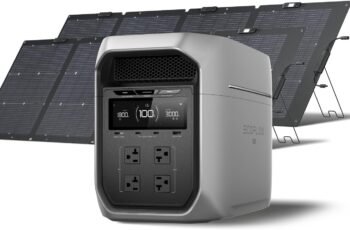
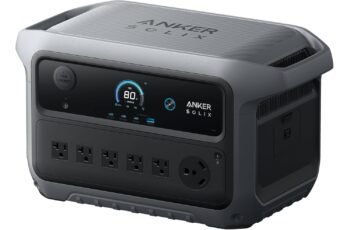
Worried they’re all the same bricks with outlets? They’re not. We’ve narrowed the 10 best portable power stations of 2025 to models that actually fit real needs—home backup, road trips, or emergencies—balancing capacity, weight, recharge speed, and lifespan. We’ll highlight LiFePO4 longevity, UPS features, solar input options, and warranties that matter, plus where each shines and falls short. If you want confidence when the lights go out or you’re off-grid, start here.
Key Takeaways
- Prioritize LiFePO4 models for longevity: 3,000–4,000+ cycles, 10-year design life, and stronger warranties around five years.
- Look for ultra-fast AC recharge: 0–80% in ~43–50 minutes; top picks hit 100% in about one hour.
- Ensure ample output and ports: 1,800–2,000W AC continuous, 10–15 outlets, USB-C up to 140W, and 10 ms UPS for home backup.
- Verify solar capability: 500–600W input recharges ~1–2 hours in ideal sun; confirm panel compatibility and connectors.
- Match capacity to use case: 1,000–2,000Wh for home/RV backup; 250–300Wh for travel; balance weight versus portability.
Anker SOLIX C1000 Portable Power Station
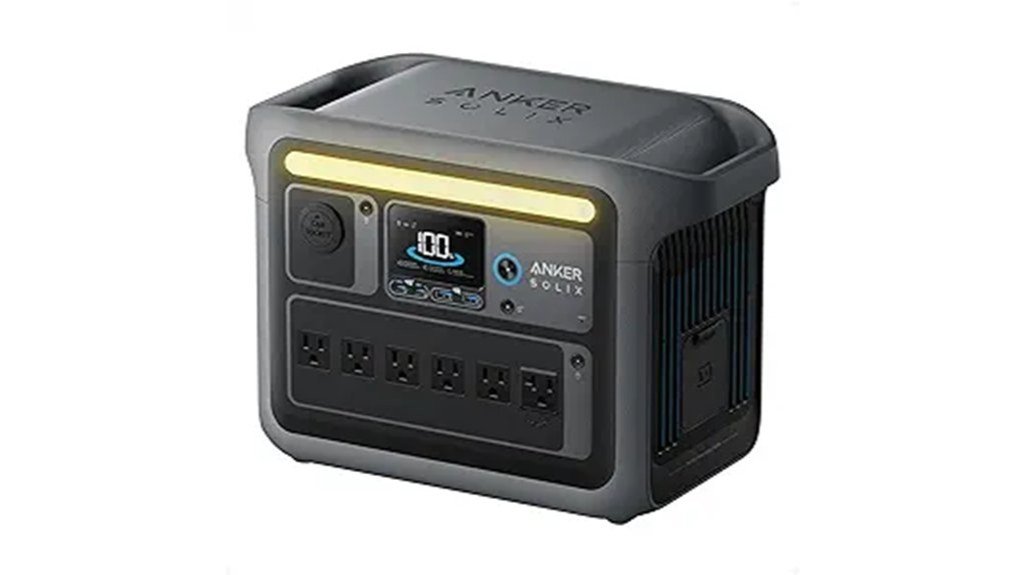
Looking for a compact 1kWh unit that recharges insanely fast? We rank the Anker SOLIX C1000 near the top for its balance of speed, power, and size. It packs 1056Wh with a 1800W output (2400W peak) and SurgePad tech to run 99% of appliances. Expect durable LiFePO4 cells rated for 3,000 cycles over 10 years.
Recharging is the ace: 80% in 43 minutes and a full AC charge in under an hour via the app’s UltraFast mode. Solar’s strong too—up to 600W for a full in about 1.8 hours. It’s 15% smaller, offers 11 ports, and includes AC, car, and solar connectors.
Best For: Home backup users, RV travelers, and campers who want a compact ~1kWh power station with exceptionally fast AC and solar recharging and enough output to run most household appliances.
Pros:
- UltraFast AC recharge: 80% in 43 minutes and full in under 1 hour via the app
- Strong output for size: 1800W (2400W peak) with SurgePad to power 99% of appliances
- Long-life LiFePO4 battery rated for 3,000 cycles over 10 years; 15% smaller with 11 versatile ports
Cons:
- Full-speed AC recharging control requires the Anker smartphone app
- 600W solar input requires adequate sun and compatible panels (optional)
- 1056Wh capacity may be limiting for extended outages without recharging
Jackery Explorer 1000 v2 Portable Power Station
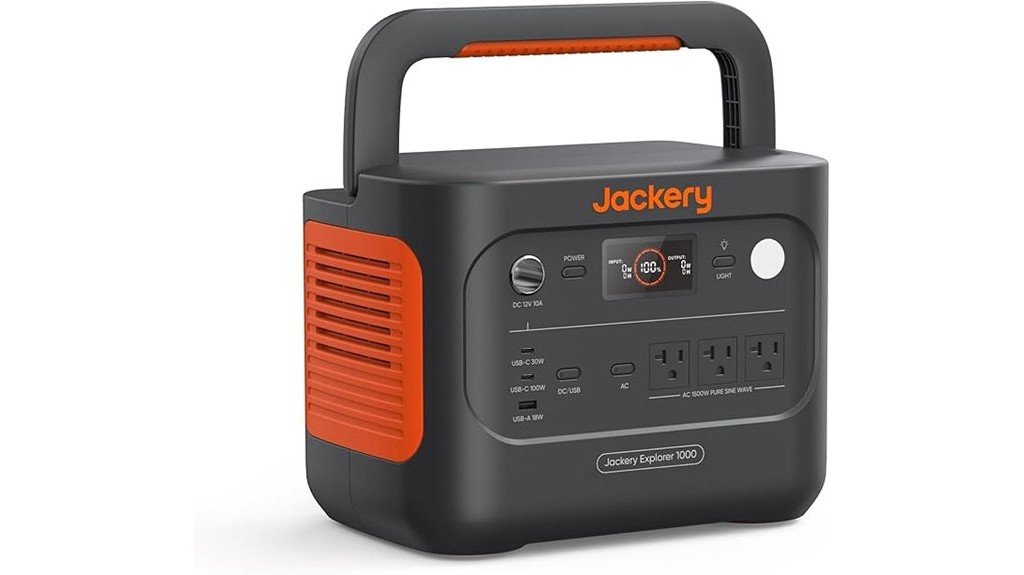
With a 1,500W AC output (3,000W surge) and a 1,070Wh LiFePO4 battery that fast-charges to full in as little as one hour, the Jackery Explorer 1000 v2 is ideal for campers, road-trippers, and homeowners who need dependable backup that’s still easy to carry at 23.8 lbs. We like its three pure sine wave AC ports, dual 100W USB‑C, USB‑A, and 12V car port. Jackery’s ChargeShield 2.0 and app let us toggle modes, enable 1‑hour emergency charging, or run a 30 dB quiet overnight charge. Expect 4,000 cycles to 70% and a 10‑year lifespan. Note: solar panel sold separately and limited to Jackery panels.
Best For: Campers, RVers, road‑trippers, and homeowners who want a portable yet robust power station with fast charging, app control, and long LFP lifespan for backup or off‑grid use.
Pros:
- 1,500W AC output (3,000W surge) with three pure sine wave outlets plus dual 100W USB‑C, USB‑A, and 12V car port
- Fast charging to 100% in as little as 1 hour (emergency mode) with ChargeShield 2.0 and smart app features
- Long-lasting LiFePO4 battery rated for 4,000 cycles to 70% and a 10‑year lifespan in a 23.8 lb portable design
Cons:
- Solar panel not included and solar charging is limited to Jackery-branded panels
- App requires account management and may add setup complexity
- Display size and overall price may not satisfy all users
Bailibatt Portable Power Station 300W (257Wh)

Travelers and weekend campers who value true grab-and-go portability will appreciate the Bailibatt Portable Power Station 300W (257Wh). At just 3.6–4.6 pounds, it’s easy to stash in a pack yet delivers 257Wh and 300W of pure sine wave power across two 120V AC outlets, plus multiple USB-A/USB-C and 12V/120W DC ports. We can run up to eight devices simultaneously as long as the total stays under 300W—perfect for laptops, phones, cameras, and small coolers.
A clear LCD, BMS protections, and 1500+ cycles inspire confidence. Long-press to toggle AC output. Note: no car or solar cables included. One-year warranty. Recharge every 1–2 months.
Best For: Travelers, campers, and weekend adventurers who want an ultra-portable, lightweight power station to run small essentials (laptops, phones, cameras, small coolers) under 300W.
Pros:
- Lightweight 3.6–4.6 lb design with 257Wh capacity and pure sine wave dual 120V AC outlets
- Can power up to 8 devices at once (≤300W total) with multiple USB-A/USB-C and 12V/120W DC ports
- Robust safety and longevity: clear LCD, BMS protections, and 1500+ cycle lifespan
Cons:
- No car charging cable or solar charging accessories included
- Limited to 300W output; not suitable for high-draw appliances
- Conflicting listed weight (3.6 lb vs. 4.6 lb) may cause expectations mismatch
Portable Power Station 600W 293Wh with 100W PD and 120V AC Outlet
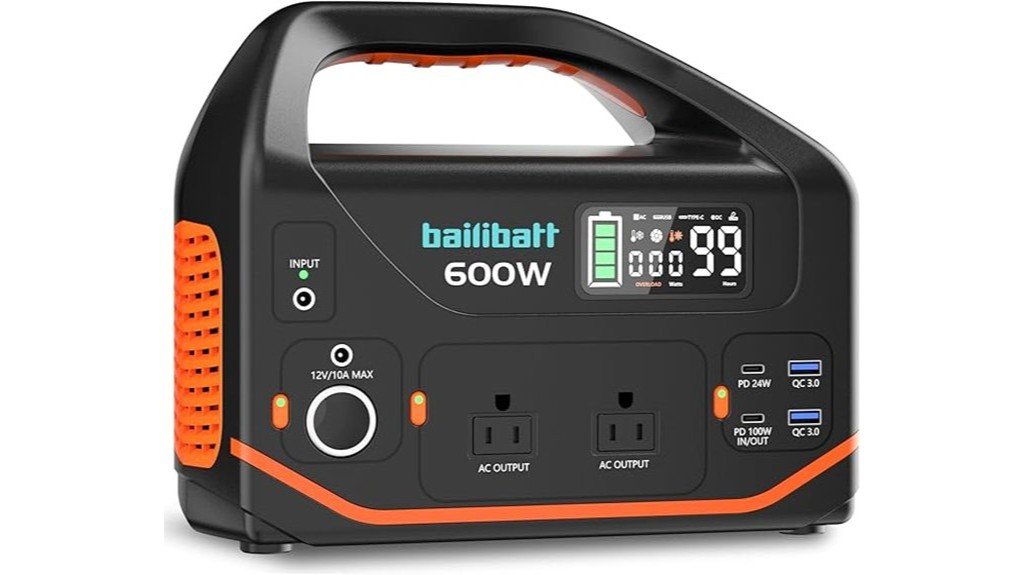
Need a grab-and-go power box that still runs real appliances? This 600W/293Wh unit delivers pure sine wave AC with 1200W surge, yet weighs only 7.7 lbs. We get seven outputs: one 600W/120V AC outlet, a PD 100W USB‑C, a PD 24W USB‑C, two Fast Charge 3.0 USB ports, a car port, and a DC port—great for laptops, drones, cameras, and everyday gear.
The premium BMS monitors voltage, current, and temperature, supports over 1,500 cycles, and a clear LCD shows status. It’s ideal for home backup, camping, travel, and emergencies. Included: power station, AC adapter, manual, and 24/7 support. Tip: hold AC button three seconds. Recharge every 1–2 months. Note: car charger cable not included.
Best For: Campers, travelers, and home users who need a lightweight, grab-and-go power station to run and charge essentials up to 600W with multiple fast-charging ports.
Pros:
- 600W pure sine wave AC (1200W surge) plus 7 versatile outputs including 100W USB‑C for laptops
- Lightweight 7.7 lbs with clear LCD and premium BMS for safety and >1500 charge cycles
- Ideal for emergencies and outdoor use; supports most daily appliances under 600W
Cons:
- Only one 120V AC outlet limits simultaneous AC device use
- 293Wh capacity may be insufficient for high-draw devices over extended periods
- Car charger cable not included; must remember to recharge every 1–2 months for maintenance
Anker SOLIX C300 Portable Power Station (288Wh, 300W)
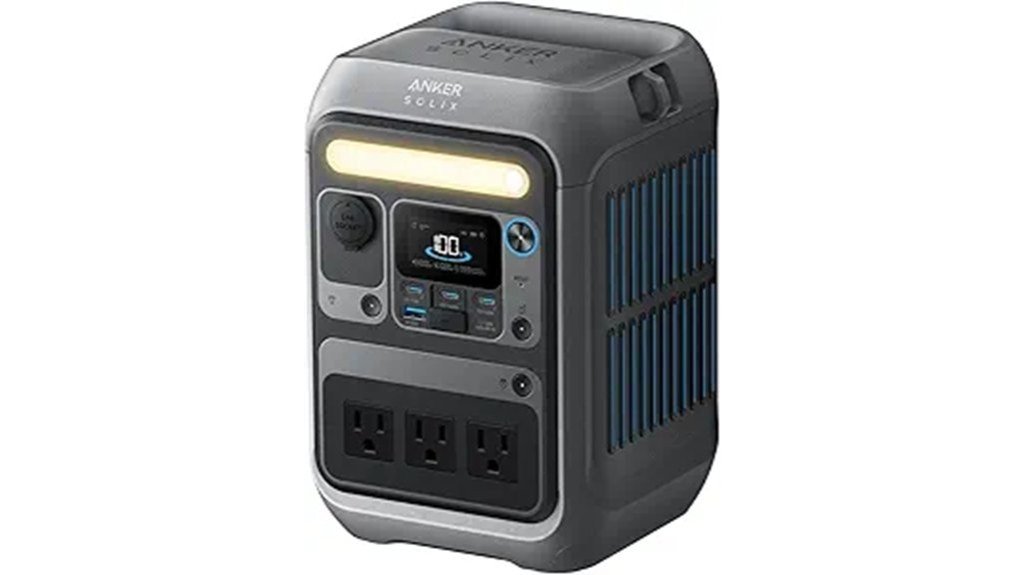
Compact yet capable, the Anker SOLIX C300 shines for those who want lightweight backup power for laptops, cameras, and small appliances without the noise or bulk. We like its 288Wh LiFePO4 battery, 300W output (600W surge), and quiet 25dB operation. With 8 ports—3 AC, car socket, 3 USB-C (up to 140W), and USB-A—it handles work essentials and travel gear. Fast-charge to 80% in about 50 minutes via wall, or recharge from solar (60–100W), car, or USB-C PD 3.1. It weighs 9.02 pounds, adds pass-through charging, and offers 3,000+ cycles plus a 5-year warranty. Not for high-wattage appliances.
Best For: Travelers, campers, and remote workers who need a lightweight, quiet power station to run laptops, cameras, and small devices—not high-wattage appliances.
Pros:
- Compact 9.02 lb design with 288Wh LiFePO4 battery and 3,000+ cycles (10-year design life)
- Versatile I/O: 8 ports including 3 AC (300W), 140W USB-C two-way fast charging, car socket, and pass-through charging
- Fast recharging: ~80% in about 50 minutes via wall; multiple recharge options (USB-C PD 3.1, solar 60–100W, car)
Cons:
- 300W continuous output limits use with high-wattage kitchen tools and space heaters
- Solar performance depends heavily on sunlight; not compatible with Anker SOLIX PS30/PS200/PS400 panels
- Strap not included by default, and not ideal for backpacking despite portability
Anker SOLIX C1000 Gen 2 Portable Power Station (1,024Wh, 2000W)

Looking for a fast-recharging, home-ready backup that still travels well? The Anker SOLIX C1000 Gen 2 delivers 2,000W (3,000W peak) from a 1,024Wh LiFePO4 pack, recharging to 100% in 49 minutes via 1,600W HyperFlash or about 1.8 hours with 600W solar. It’s 14% smaller and 11% lighter than peers, yet powers up to 10 devices and switches to 10 ms UPS for essentials. We like the app’s TOU scheduling to dodge peak rates, the clear display, and quiet operation. Caveats: solar cables may be extra, app history feels limited, and mixed input while discharging can face limits. Five-year warranty, 10-year InfiniPower longevity.
Best For: Homeowners and travelers who need a compact, fast-recharging portable power station for outages, camping, and running multiple essential devices with minimal downtime.
Pros:
- UltraFast 49-minute full recharge via 1,600W HyperFlash; 600W solar recharges in ~1.8 hours
- 2,000W output (3,000W peak) with 10 ms UPS and 10 ports in a smaller, lighter LiFePO4 package
- Long-life battery (≥80% after 4,000 cycles), app TOU scheduling, clear display, quiet operation
Cons:
- Solar cables/accessories may be sold separately
- App history/analytics are limited compared to some competitors
- Mixed input while discharging and certain DC/AC configurations can hit compatibility or power limits
Anker SOLIX F2000 Portable Power Station (PowerHouse 767)

Serious home backup or RV users who want fast recharge and high output will appreciate the Anker SOLIX F2000 (PowerHouse 767). We get 2048Wh of LiFePO4 capacity, 2400W continuous (2800W peak), and SurgePad to start loads up to 3600W. With 13 ports—4 AC, 3 USB-C, 2 USB-A, 2 car outlets, and an RV port—it covers fridges, lights, and small appliances. HyperFlash recharges 0–80% in about 1.5 hours. It’s quiet, solar-ready, and rolls on wheels, though it’s 67.3 pounds. Note the UPS caveat: bypass mode tops out around 1440W. We like the 5-year warranty and app control; monitor cycles for longevity.
Best For: Home backup and RV users who need fast recharging, high output, multiple ports, and quiet LiFePO4 power with app control and solar readiness.
Pros:
- 2048Wh LiFePO4 battery with 2400W continuous output (SurgePad up to 3600W) powers fridges, ACs, and small appliances
- HyperFlash charging: 0–80% in ~1.5 hours; 13 ports including RV and multiple USB-C; solar compatible
- Durable build with wheels/handle, quiet operation, and 5-year full-device warranty
Cons:
- Heavy at 67.3 lb, limiting portability without the wheels
- UPS/bypass mode limits AC output to ~1440W and isn’t a true online UPS
- Reports of occasional 30A port inconsistencies and mixed app/support experiences
EF ECOFLOW DELTA 2 Portable Power Station (1024Wh)

If fast, plug-and-play power matters, the EcoFlow Delta 2’s 0–80% recharge in just 50 minutes makes it a standout for home backup and weekend getaways. With a 1024Wh LiFePO4 battery, 1800W AC output (2700W surge), and 15 outlets, we can power 90% of appliances—from mini-fridges and fans to tools and lights. It weighs 27 pounds, so it’s portable yet substantial.
We appreciate the 500W solar input, app-friendly outputs (including 100W USB-C), and expandable capacity up to 3kWh for longer outages. The LFP chemistry offers 3000+ cycles and a smart BMS for safety. In the box: unit, AC cable, manual, and a 5-year support pledge.
Best For: Home backup users, campers, and RVers who want fast plug-and-play power, solar-ready charging, and expandable capacity in a portable 27 lb unit.
Pros:
- Blazing AC recharge: 0–80% in ~50 minutes (0–100% in ~80), plus up to 500W solar input
- 1800W AC output (2700W surge) with 15 outlets, including 100W USB-C, powers ~90% of appliances
- Long-life LiFePO4 battery (3000+ cycles) with smart BMS; capacity expandable to ~3kWh
Cons:
- Heavier than ultraportables at 27 pounds
- Higher upfront price compared to smaller power stations
- Some users note fan noise/behavior and may need longer accessory cables for certain setups
Portable Power Station 600W 293Wh with 100W PD and 120V AC Outlet

Need compact but capable backup power for trips or outages? This 600W, 293Wh portable power station delivers pure sine wave AC (120V) with 1200W surge, yet weighs just 7.7 lbs. We get seven ports: one 600W AC outlet, a 100W USB-C PD, a 24W USB-C, two Fast Charge 3.0 USB-A, a car port, and a DC port—perfect for laptops, drones, and cameras.
A premium BMS monitors voltage, current, and temperature, supports 1500+ cycles, and a clear LCD shows status. It handles appliances under 600W for camping, home backup, and emergencies. Included: power station, AC adapter, manual. Recharge every 1–2 months. Hold AC button three seconds.
Best For: Campers, travelers, and homeowners needing a lightweight, compact backup power station for laptops, cameras, small appliances, and emergency use under 600W.
Pros:
- 600W pure sine wave AC with 1200W surge and versatile 7-port array, including 100W USB-C PD for fast laptop charging
- Lightweight 7.7 lbs with clear LCD and robust BMS for voltage/current/temperature protection and 1500+ cycles
- Suitable for camping, home backup, and travel; supports most everyday devices under 600W
Cons:
- Single AC outlet limits simultaneous plug-in of multiple AC devices
- 293Wh capacity may be insufficient for high-draw or long-duration use
- Car charger cable not included; must hold AC button for 3 seconds to toggle output
Jackery Explorer 2000 v2 Portable Power Station

Packing 2,042Wh of long‑life LiFePO4 capacity and a 2,200W AC output across three outlets, the Jackery Explorer 2000 v2 stands out for homeowners and travelers who want fast, quiet, and safe backup power without gas hassle. We like its Emergency Super Charging: 0–80% in 66 minutes and full in 102 via the app. It also supports 100W USB‑C PD, 30dB silent charging in 5 hours, and 6‑hour solar with 400W. The 20ms UL1778‑certified UPS keeps fridges, sump pumps, TVs, and coffee makers running. At ~40 lbs, it’s portable enough, CTB‑built, fumes‑free, and app‑controlled via Wi‑Fi/Bluetooth—often discounted around $900–$1,100.
Best For: Homeowners, RVers, and small business owners who want fast-charging, quiet, gas-free backup power with true UPS functionality for outages and essential appliances.
Pros:
- 2,042Wh LiFePO4 battery with 2,200W output (3 AC ports) powers fridges, sump pumps, TVs, coffee makers, and more; up to 10-year lifespan.
- Extremely fast charging options: 0–80% in 66 minutes (full in 102 via app), 30dB silent mode (~5 hours), or ~6 hours with 400W solar.
- 20ms UL1778-certified UPS with pass-through charging; Wi‑Fi/Bluetooth app control and 100W USB‑C PD.
Cons:
- Nearly 40 lbs can be heavy for frequent carrying or stairs.
- Solar input speed assumes 400W panels and good conditions; panels add cost and bulk.
- Typically priced higher than smaller units; best value often requires waiting for sales.
Factors to Consider When Choosing Portable Power Stations
Before we pick a unit, we should match power output capacity to our real needs, from laptops to fridges. We’ll weigh battery chemistry type and cycle life rating to understand longevity and safety. Then we’ll compare charging speed options and port variety count so we can recharge fast and run everything we bring.
Power Output Capacity
Start with power output capacity—it dictates what you can actually run. Continuous wattage tells us the sustained power a station delivers—typically 300W to 2000W+—and determines which appliances we can power simultaneously. Surge (or peak) wattage covers short startup spikes, like 600W surge on a 300W unit, useful for devices that momentarily draw more.
Match output to your gear. For refrigerators, AC units, and other motor-driven loads, ensure continuous output meets or exceeds their running draw and accounts for startup surge. If we plan to run multiple devices, add their wattages and include peak demands.
Balance ambition and practicality: higher-output models run more at once but add weight and cost. Finally, consider duration: some stations handle brief surges yet can’t sustain prolonged high-wattage loads.
Battery Chemistry Type
Which battery chemistry sits inside a power station shapes safety, lifespan, weight, and cost, so we should choose it deliberately. Today’s top contenders are lithium iron phosphate (LiFePO4) and nickel-rich Li-ion blends like NMC/NCA. LiFePO4 stands out for stability: it tolerates heat and overcharge better, reduces thermal-runaway risk, and delivers a steadier voltage under load. It also holds capacity well over time, supporting long calendar life and the multi‑year reliability many brands advertise.
Trade-offs matter. LiFePO4 packs are heavier per watt-hour than NMC/NCA, so a unit with the same capacity may weigh more. Still, for home backup, frequent use, or hot climates, LiFePO4’s safety margin and durability are compelling. If you prioritize the lightest weight, NMC/NCA may fit, but expect shorter overall longevity.
Cycle Life Rating
How long will a power station actually last? Cycle life rating tells us. It’s the number of full charge–discharge cycles a unit can handle before capacity drops to a set threshold, usually 80% of its original. We use it to gauge real-world longevity, especially if we’ll cycle the battery often.
LiFePO4 models lead here, commonly delivering 3,000+ cycles with minimal capacity loss. Many brands pair that with robust BMS protection and claim “10-year design life.” Look for concrete specs like “80% after 4,000 cycles” rather than vague promises.
Higher cycle life generally means lower degradation per cycle, which pays off for daily use, off-grid trips, or long-term backup. If we’ll use a station frequently, we should prioritize a higher cycle rating over marginal capacity or weight savings.
Charging Speed Options
When speed matters, charging options can make or break a power station’s usefulness. We look for ultra-fast AC inputs that slash downtime: top units hit 0–80% in about 43–49 minutes, and some offer emergency charging to reach 0–100% in roughly an hour. If we rely on the sun, solar input matters even more—typical 100–600W arrays can refill in as little as 1.8 hours at 600W, or take several hours with lower wattage or weak sunlight.
We also value multiple recharge paths—AC, solar, and car/DC—so we can top up while running gear via pass-through charging. LiFePO4 systems handle fast charging with stable performance and 3,000+ cycle lifespans. Finally, app-managed TOU and smart modes let us schedule, throttle, or trigger emergency charging to cut costs and time.
Port Variety Count
Port variety count tells us how many and what kinds of outputs we get, and it often decides whether a power station fits our gear without dongles. We look for a balanced spread: AC outlets for appliances, USB-C and USB-A for phones and tablets, and a car/12V DC port for coolers or routers. Typical setups include 2–4 AC sockets, 1–3 USB-C, 1–2 USB-A, plus at least one 12V DC.
More ports let us power laptops, phones, and a small appliance at once, avoiding adapters. We also check distribution. A unit with high-watt AC plus multiple USB-C/USB-A serves both high- and low-watt devices in a single session. Fast USB-C alongside standard USB-A boosts versatility for modern gear while keeping legacy devices covered.
Weight and Size
After we map out the ports we need, we should size the power station to match how and where we’ll use it. Capacity drives both weight and dimensions. Compact 257–300Wh units typically weigh about 3–5 lbs and measure roughly 6–9 inches long and under 10 inches tall—great for daily carry or flights. Step up to 1024–2048Wh and we’re looking at 20–40+ lbs, with bodies approaching 15–20 inches—better for car camping or home backup.
LiFePO4 models help here: they pack higher energy density for a given capacity, so we get lighter, smaller units with longer cycle life. For frequent travel, choose a lighter, lower-capacity pack to cut carrying effort. For home backups, accept bulk for runtime. Handles—and on midsize/large units, optional wheels—improve portability.
Solar Compatibility
So how do we know a power station will play nicely with solar? We start by matching input wattage and voltage. High-end units accept roughly 600W solar input for faster top-ups; budget models pair with 100W–400W panels and charge slower. We always check the DC input voltage limit—many cap around 60V—and choose panels or a controller that stay within spec.
Connector type matters. Let’s confirm MC4, 8mm, or proprietary ports and use the manufacturer’s recommended panel specs. Some models support expansion—extra batteries or parallel panels—so we can scale capacity and charging speed.
Expect real-world results to vary. Output depends on panel wattage, sun angle, clouds, temperature, and the power station’s charging algorithm, not just the panel’s nominal rating.
Warranty and Support
How long will the company stand behind the battery and the box that houses it? We look for a clearly stated warranty period—ideally five years—and whether it covers the full device or just the battery. Terms matter: some brands back LiFePO4 cells for thousands of cycles (e.g., 3,000+ or a guaranteed percentage after 4,000 cycles), but limit other components.
We also check support quality. We want published response times and multiple channels—phone, email, live chat, and app support. Constraints can hide in the fine print: UPS/bypass modes or certain app features may affect eligibility, so we confirm allowed use cases.
Finally, we verify logistics. Who pays shipping for repairs or replacements? Is there an advance replacement option? Clear, fair policies signal reliable long-term support.
Conclusion
We’ve covered standout portable power stations for homes, trips, and emergencies—balancing capacity, LiFePO4 longevity, fast recharging, and smart outputs. Whether it’s an Anker SOLIX, Jackery, EcoFlow, or a compact 300W unit, we can match power to our lifestyle, not the other way around. Think weight, ports, UPS needs, and solar compatibility—plus those five-year warranties. Choose what fits now and scales later. Then, like dialing up a mixtape on Spotify, we’ll be ready when the lights flicker.