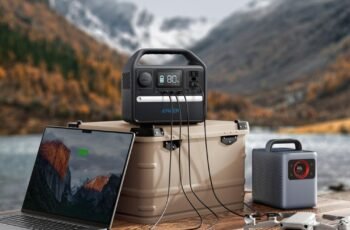
Most campers don’t realize the quietest power stations can hum under 30 dB, softer than a whisper. As we plan trips, we want packs that stay light, recharge fast, and use long‑life LiFePO4 cells without skimping on ports. From 200–300 Wh pocket units to 2 kWh workhorses, the right choice depends on your setup, recharge options, and overnight loads. Let’s compare the 2025 standouts and see which one actually fits your camp.
Key Takeaways
- Prioritize LiFePO4 stations with 3,000+ cycles and 5-year warranties for safety, longevity, and reliable camping performance.
- Match capacity (Wh) and continuous wattage to your gear; ensure surge headroom for fridges, blenders, and compressors.
- Seek lightweight, quiet units; sub-10 lb options like Anker SOLIX C300 run near 25 dB for tent-friendly nights.
- Favor fast-charging models: 0–80% in ~50–80 minutes via AC, plus MPPT solar support and pass-through charging.
- Consider expandability for longer trips; 1kWh bases like ECOFLOW DELTA 2 or OUPES Mega 1 scale to multi-kWh.
Anker SOLIX C300 Portable Power Station (288Wh, 300W)


If you want a compact, ultra-quiet power station for car camping or weekend trips, the Anker SOLIX C300 stands out with 288Wh of LiFePO4 storage, 300W continuous (600W surge), and just 25dB of noise. We like its eight outputs: three AC ports, a 12V car socket, two USB-C (one up to 140W), an extra 15W USB-C, and a USB-A. It fast-charges to 80% in about 50 minutes and supports solar (60–100W), car, or wall with pass-through. At 9.02 lb, it’s travel-friendly yet durable, rated for 3,000+ cycles and backed by a 5-year warranty. It’s ideal for laptops, cameras, and camp lighting.
Best For: Car campers, weekend travelers, and emergency backup users who need a compact, quiet power station to run laptops, cameras, lights, and other small devices.
Pros:
- Fast charging to 80% in ~50 minutes; versatile recharging via wall, solar (60–100W), car, and USB-C PD 3.1
- Eight ports including 3 AC outlets and a 140W USB-C for high-speed laptop charging; pass-through supported
- Durable LiFePO4 battery with 3,000+ cycles, quiet 25dB operation, and a 5-year warranty in a 9.02 lb form factor
Cons:
- 300W continuous output limits use with high-wattage appliances (e.g., kettles, space heaters)
- Solar input performance depends heavily on sunlight; not compatible with Anker PS30/PS200/PS400 panels
- Carry strap not included by default; not ideal for backpacking due to weight and size
EF ECOFLOW DELTA 2 Portable Power Station (1024Wh)

Need fast recharge and serious output without lugging a brick? The EcoFlow DELTA 2 packs a 1024Wh LiFePO4 battery, 1800W AC output (2700W surge), and 15 outlets into a 27-pound, camp-ready unit. We love that it jumps from 0–80% in 50 minutes and hits full in about 80. Add up to 3kWh with extra batteries or plug in up to 500W of solar for clean, quiet charging.
It powers 90% of appliances—mini-fridges, fans, tools, lights—making it ideal for camping, RVs, or short home backups. The durable LFP chemistry boasts 3000+ cycles, a smart BMS, and a 5-year support promise, though some note fan noise and cable-length quirks.
Best For: Campers, RVers, and homeowners who need a fast‑recharging, portable power station with strong 1800W output and expandable capacity for short backups or off‑grid use.
Pros:
- Lightning-fast AC recharge: 0–80% in ~50 minutes, 0–100% in ~80 minutes; supports up to 500W solar.
- Robust 1024Wh LiFePO4 battery with 3000+ cycles, smart BMS, and 1800W (2700W surge) to power 90% of appliances.
- Expandable to ~3kWh and offers 15 total outlets including 120V AC and 100W USB‑C for versatile use.
Cons:
- At ~27 lb, it’s portable but still hefty to carry frequently.
- Some users report noticeable fan noise and occasional fan warnings under load/charging.
- Accessory/cable length (e.g., XT60 solar leads) may require extensions; warranty specifics beyond “5-year support” not fully detailed.
Jackery HomePower 3000 Portable Power Station with Solar Panels
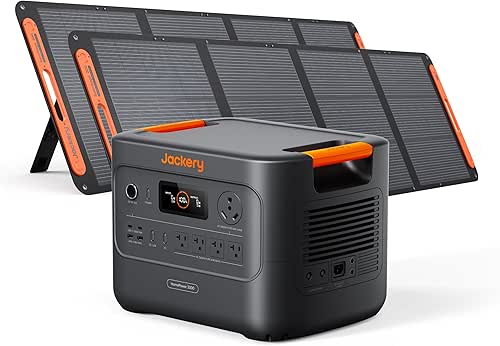
Serious campers who want true home-backup muscle at the campsite will appreciate the Jackery HomePower 3000’s 3600W output (7200W surge) and 3072Wh LiFePO4 battery. We get four AC outlets, USB-A/C, DC ports, and a TT-30 RV port, plus two 200W SolarSaga panels in the box. At 59.5 pounds, it’s hefty but manageable, and the ≤20ms UL-certified UPS keeps fridges, routers, and lights running. Expect up to 15 hours of household essentials or roughly 36 hours for a typical fridge. It fast-charges in 2.2 hours (1.7 with hybrid AC/DC), supports car and generator input, offers app monitoring, and earns a 30% tax credit.
Best For: Campers, RVers, and homeowners who want a portable yet serious backup solution that can power essential appliances, recharge fast, and integrate solar with app-based monitoring.
Pros:
- 3600W output (7200W surge) with 3072Wh LiFePO4 battery and ≤20ms UL-certified UPS for seamless backup.
- Fast recharge: ~2.2 hours via AC or ~1.7 hours with hybrid AC/DC; includes 2x200W SolarSaga panels.
- Versatile ports (4 AC, USB-A/C, DC, TT-30 RV) plus WiFi/Bluetooth app for real-time monitoring; eligible for 30% tax credit.
Cons:
- Heavy at 59.5 lb and limited to four AC outlets, which may constrain multi-device setups.
- Solar expansion can require extra adapters/cables and Jackery panels are pricier than some third-party options.
- Solar charging speed highly dependent on sunlight; full-day sun may still only reach ~80% with the included panels.
Jackery Explorer 2000 v2 Portable Power Station (2042Wh, 2200W, LiFePO4)

Looking for a high-capacity yet camp-friendly powerhouse? The Jackery Explorer 2000 v2 packs 2042Wh of LiFePO4 endurance and 2200W across three AC outlets, plus 100W USB-C PD for laptops. It’s about 40 lbs, but quiet (<30dB) with a smart fan and a compact CTB build that boosts safety and stability.
We love its speed: 0–80% in 66 minutes via AC, full in 102 with Emergency Super Charging, or around 6 hours on 400W solar. Silent charge takes about 5 hours. UPS switching hits 20ms (UL1778), great for outages. Pass-through charging keeps gear running. The app handles monitoring, toggles outputs, and connectivity. Price often dips around $900–$1100 on sale.
Best For: campers, homeowners, and small businesses needing a quiet, fast-charging, high-capacity LiFePO4 power station with reliable UPS backup and strong 2200W AC output.
Pros:
- 2042Wh LiFePO4 battery with up to 10-year lifespan; 2200W output across 3 AC outlets plus 100W USB-C PD
- Rapid AC charging (0–80% in 66 min; full ~102 min) and pass-through power with 20ms UPS switching (UL1778)
- Quiet operation (<30dB) with smart fan; app control for monitoring and toggling outputs
Cons:
- Heavy at ~40 lbs, which limits portability for some users
- Solar recharge at 400W still takes several hours (~6 hours) and requires separate panels
- Price can be high at regular MSRP; best value often tied to sales and coupons
OUPES Mega 1 Portable Power Station (1024Wh LiFePO4)

Craving fast charging and expandable capacity for longer trips? The OUPES Mega 1 delivers with a 1024Wh LiFePO4 battery that scales to 5kWh using the B2 extra battery. We get 2000W continuous (4500W peak) from four 120V AC outlets, plus 2×100W USB-C, 4×18W USB-A, DC5521, and a car port. It fast-charges at 1400W (0–80% in ~50 minutes), supports 700W slow charge, and accepts solar with 800W MPPT or hybrid AC+solar up to 2200W.
At 27.8 lb and ~58 dB, it’s campsite friendly. UPS (20ms) keeps gear running. App control, 5-year warranty, and included AC, car, and MC4 cables seal it.
Best For: Power users needing a fast-charging, expandable, quiet portable power station for camping, road trips, and home backup that can run high-watt devices and support UPS.
Pros:
- 2000W continuous (4500W peak) with 4×120V AC, plus 2×100W USB-C, 4×USB-A, DC, and car port for versatile powering
- Rapid recharge: 1400W fast charge (0–80% ~50 min), hybrid AC+solar up to 2200W with 800W MPPT; app control
- LiFePO4 longevity, 5-year warranty, UPS ~20ms, expandable from 1024Wh to 5kWh with B2 battery
Cons:
- 27.8 lb may feel heavy for frequent carrying or ultralight setups
- Peak/continuous limits mean some large appliances or tools may exceed capacity despite high surge rating
- Extra battery and solar panels sold separately, increasing total system cost
VTOMAN Jump 600X Portable Power Station (600W, 299Wh)

Need a compact camp power box that still handles real gear? We like the VTOMAN Jump 600X: a 299Wh LiFePO4 station with 600W AC output (1,200W surge) and pass-through charging. It powers up to nine devices via 2 AC outlets, 2 DC5521, a 12V car port, 3 USB-A (QC 3.0 up to 18W), and a 60W USB-C PD for laptops.
All 12V ports are regulated—great for CPAPs or car fridges. Safety’s solid with LIFEBMS and 3,000 cycles to 80%. At 13.2 lb, it’s campsite-friendly, and it expands to 939Wh with an extra battery. Included cables and a 2-year warranty round it out.
Best For: Campers, RVers, and emergency preppers who need a compact, safe LiFePO4 power station with enough regulated outputs to run real gear and support pass-through charging.
Pros:
- 600W AC output (1,200W surge) with regulated 12V ports for CPAPs, car fridges, and sensitive devices
- Long-life LiFePO4 battery with ~3,000 cycles to 80% and robust LIFEBMS protections
- Expandable from 299Wh to 939Wh; powers up to 9 devices simultaneously including 60W USB-C PD
Cons:
- 299Wh base capacity may be limiting for longer trips without the extra battery
- 60W USB-C PD is adequate but not top-tier for high-wattage laptops
- Batteries are not user-replaceable; extra battery sold separately
Jackery Explorer 1000 v2 Portable Power Station

Built for campers who want fast, quiet power without extra bulk, the Jackery Explorer 1000 v2 delivers 1,500W AC output (3,000W surge) from a 1,070Wh LiFePO4 battery in a 23.8 lb package. We get three pure sine AC ports, two USB‑C (100W PD), one USB‑A, and a 12V car port. It fast‑charges in one hour via the app’s emergency mode (default 1.7 hours to protect the pack) with ChargeShield 2.0 and whisper‑quiet 30 dB overnight charging. Expect 4,000 cycles to 70% and a 10‑year lifespan. It runs fridges, pots, even small ACs. Note: solar panel not included and solar works only with Jackery panels.
Best For: Campers, RVers, and emergency preppers who need fast, quiet, high‑output portable power with long battery life and app control in a compact package.
Pros:
- 1,500W AC output (3,000W surge) with three pure sine wave outlets plus dual 100W USB‑C for versatile, fast device charging
- Rapid charging: 1-hour emergency fast charge via app (1.7 hours default) with ChargeShield 2.0 and quiet 30 dB overnight mode
- Durable LiFePO4 battery rated for 4,000 cycles to 70% and a 10-year lifespan in a 23.8 lb portable design
Cons:
- Solar panel not included and solar charging is limited to Jackery-branded panels
- App setup/account management required to access emergency fast charge and smart modes
- Display size and price may not satisfy budget shoppers or those wanting a larger screen
Portable Power Station 297Wh Backup Lithium Battery Generator

Looking for a compact camp companion with real-world muscle? We like the Giomre M6: a 297Wh, 9.7-pound lithium power station with 600W AC output and 800+ cycle life. It’s UL-certified, BMS-protected, and offers nine ports: 2x600W AC, 65W USB-C, USB-A, 18W QC 3.0, 15W wireless pad, 2x12V DC, and a car port. The LED camping light helps at night.
Charging’s flexible and fast: about 3 hours via 120W wall, 5 hours by car, or solar-ready with 100W panels. The digital display simplifies management. Power phones, laptops, mini-fridges, and fans—just keep loads under 600W and avoid high-inrush motors. Includes AC adapter, car charger, and guide.
Best For: Campers, travelers, and emergency preppers who want a lightweight, 297Wh power station with versatile ports and a true 600W AC output for small appliances and devices.
Pros:
- 600W AC output with nine ports (including 65W USB-C and 15W wireless) covers most small-device and mini-appliance needs
- Fast, flexible charging: ~3 hours wall, ~5 hours car, solar-ready (100W); clear digital display and built-in LED light
- UL-certified lithium battery with BMS protection and 800+ cycle life in a portable 9.7 lb form factor
Cons:
- 297Wh capacity limits runtime for higher-draw devices and mini-fridges over long periods
- Not suitable for loads over 600W or high-inrush motor devices (e.g., some power tools, compressors)
- Solar panel not included; car and solar charging are slower than wall charging
MARBERO Portable Power Station 88Wh (Solar Panel Optional)

Ultralight campers and weekenders who value portability over sheer capacity will appreciate the MARBERO M82: an 88Wh, 2.29 lb power station that slips into any pack yet powers phones, tablets, and small gadgets via eight outputs, including AC, DC, USB, and USB-C PD. We get 80W continuous (120W peak), enough for small appliances and laptop charging. It juices from 0–80% in about two hours via wall, and pairs with MARBERO’s 30W/60W solar panels. The ergonomic handle, compact 6.5 x 4.6 x 3.1-inch body, and pass-through charging boost convenience. Safety-wise, its BMS guards against shorts, overload, and over-voltage. Bonus: a long-lasting multi-level SOS flashlight.
Best For: Ultralight campers, weekend travelers, and emergency kit builders who need a compact, easy-carry power source for phones, tablets, small gadgets, and occasional laptop tops-offs rather than high-capacity, high-wattage use.
Pros:
- Extremely portable (2.29 lb, compact size) with ergonomic handle and 8 outputs including USB-C PD, AC, DC, and car port
- Fast wall recharge to 80% in ~2 hours with pass-through charging; compatible with 30W/60W solar panels
- Built-in multi-level flashlight with long runtimes and SOS; BMS protections for safe operation
Cons:
- Limited capacity (88Wh) and 80W continuous/120W peak restricts use to small devices and light-duty appliances
- Reports of slower full charge, fan/noise under DC load, and occasional long-term reliability concerns
- Not ideal for high-draw devices or extended off-grid use without frequent recharging or larger solar input
GRECELL Portable Power Station 300W (230.88Wh Solar Generator)

For campers who want a compact, quiet power box for lights, laptops, and a CPAP, GRECELL’s 300W (230.88Wh) station hits the sweet spot. We like its 330W continuous/600W surge output, pure sine wave AC, and six ports: 1 AC, 60W USB-C PD, 18W USB-C, 2x USB-A QC, and a car port. At 7.3 pounds, it’s easy to pack. The upgraded BMS, dual silent fans, and automatic stop on full charge boost safety. Recharge via wall, car, or the 40W solar panel with MPPT. Expect reliable power for low-to-medium loads; heating appliances may trip limits. Real-world runtimes trail specs slightly, as usual.
Best For: Campers and travelers who need a compact, quiet power source for low-to-medium loads like lights, laptops, phones, and CPAP machines.
Pros:
- 330W continuous/600W surge with pure sine wave AC for safe, stable power to sensitive electronics
- Versatile I/O: 6 ports including 60W USB-C PD, 18W USB-C, 2x USB-A QC, 1 AC outlet, and a 12V car port
- Portable and safe: 7.3 lb design with upgraded BMS, dual silent cooling fans, MPPT solar charging, and auto stop when full
Cons:
- Limited capacity (230.88Wh) and single AC outlet restricts multi-device AC use and runtime
- Not suitable for high-draw or heating appliances; loads above ~330W will trip limits
- Real-world efficiency and input charging cap can make recharge and runtimes slightly lower than rated specs
Factors to Consider When Choosing Portable Battery Power Stations for Camping
Before we pick a power station, we should match capacity to runtime needs and check continuous vs surge wattage for devices like fridges or CPAPs. Let’s look for the right port mix—AC, USB-A/C, and 12V—so we can charge everything without adapters. We’ll also compare recharging methods and solar compatibility to keep power flowing off-grid.
Capacity and Runtime
Wondering how long a power station will actually keep your gear running? Capacity tells us. It’s measured in watt-hours (Wh) or kilowatt-hours (kWh) and directly maps to runtime before recharging. As a rule, higher capacity extends runtime but adds weight and bulk, so we balance needs against portability.
Match capacity to your loads. A 600Wh unit running a steady 600W device lasts about 1 hour; the same pack powers a 100W device for roughly 6 hours. For weekend trips, we estimate total daily watt-hours, then size up with a buffer.
Battery chemistry matters too. LiFePO4 packs hold capacity more consistently over many cycles, keeping runtimes steadier as the power station ages. Planning longer stays? Consider expandable models that accept extra batteries to scale capacity.
Continuous Vs Surge Wattage
Capacity tells us how long a station runs; wattage tells us what it can run. Continuous wattage is the steady output the inverter sustains; surge wattage is the short burst it can deliver to start motors or compressors—think a blender or mini-fridge kicking on. For camping, we should size the continuous rating to cover our running loads—laptops, lights, fans—without hovering at the limit.
Next, account for startup spikes. If a fridge needs 120W running but 400–600W to start, we’ll want a unit with continuous capacity for the 120W plus a surge rating comfortably above the peak. Exceeding continuous draw can trigger shutoff or stress the battery. For tools or fridges, prioritize both high continuous output and a robust surge margin.
Port Selection
While wattage tells us what a station can handle, the ports decide what we can actually plug in. We should map our gear to the outlet mix: AC sockets for appliances, USB-C and USB-A for phones and cameras, and a 12V car port for inflators, fridges, and some CPAP setups. Check how many devices we need to run at once and whether each port supplies enough watts.
Look for USB-C PD with high wattage (60–140W) to fast‑charge laptops. Confirm per‑port limits and the station’s total continuous vs. surge output; a unit rated 300W running won’t reliably power a 600W blender, even if it has AC ports. For backpacking, fewer ports and lower continuous power keep weight down. For car camping or longer trips, prioritize more outlets and consider models with expandability for extended runtime.
Recharging Methods
Ports decide what we can power; recharge options decide how quickly we’re back in action. Most stations top up from an AC wall outlet; fast models reach 0–80% in about 50–80 minutes and finish in roughly 80–120 minutes, depending on capacity and charger speed. When the grid’s available, that’s the quickest reset.
On the road, 12V car charging keeps us going, though it’s slow and usually takes several hours. Some units accept multiple inputs at once—AC plus car or AC plus another source—for faster turnarounds and pass-through operation, so we can run gear while the battery refuels. Higher-wattage or expandable input helps slash wait times. LiFePO4-based stations typically support safer, higher-current charging and offer longer cycle life, making frequent recharges less stressful.
Solar Compatibility
How quickly can we refuel off-grid? Solar compatibility determines it. We look for units that accept solar input, list a high maximum solar wattage (500W beats 60W), and include an MPPT controller to squeeze more current from panels. Faster 0–80% or 0–100% solar charges hinge on three variables: panel wattage, sunlight quality, and MPPT efficiency.
We also check panel requirements. Some stations specify compatible 60W–100W panels and demand certain connectors or adapters; matching input specs prevents bottlenecks. If the system supports expansion batteries, we plan capacity and panel size together—more capacity extends runtime but needs more solar to recharge by day’s end.
Real-world results vary. Weather, shading, and panel angle matter, so quality panels, good tilt, and clear sun maximize the advertised speeds.
Weight and Size
Solar-ready specs set the pace for recharging, but weight and size decide how we carry that power. Capacity and mass move together: sub-300Wh units usually land around 2–3 kg, while 1000Wh-plus models jump to 20–30+ lbs. For hike-in trips, we favor sub-3 kg; for car camping, heavier packs are fine.
Dimensions matter in tight spaces. Smaller camping-focused stations often measure roughly 6–10 inches long and 6–9 inches wide, slipping into daypacks, trunk corners, or under a cot. Form factor changes the fit: compact cubes ride well in backpacks, rectangular bricks stack neatly, and low-profile designs slide under seats.
Modular systems complicate trade-offs. Expansion batteries add capacity when we need it and stay home when we don’t, preserving portability for lighter trips.
Noise Level
Often overlooked until lights-out, noise level can make or break camp comfort. We should check decibel ratings and real-world behavior, not just marketing claims. Many portable power stations idle around 25–30 dB at a few feet—roughly a whisper—when charging lightly. That’s ideal for tents or quiet evenings.
Noise usually comes from cooling. Fans that ramp under load can raise volume significantly. Some models use near-silent cooling or even fan-free designs to cut ambient sound at night. Heavier, higher-watt units with larger fans may hit 40–60 dB under load, which can intrude on conversation or sleep.
Let’s match expectations to use. If we’ll run lights, a small fan, or charge phones, we should confirm the unit stays near whisper-quiet under those typical loads.
Battery Chemistry and Lifespan
Quiet campsites only matter if the battery lasts through the trip and the next hundred. That’s why we look closely at battery chemistry and lifespan. LiFePO4 is our go-to for camping: it’s thermally stable, safer to handle, and typically delivers 3,000+ full charge cycles with a design life around 10 years. Many models retain about 70–90% of original capacity after thousands of cycles, so performance doesn’t fall off a cliff.
Cycle life matters because higher counts (3,000–4,000+) generally mean slower capacity fade under regular use. Depth of discharge also influences longevity; keeping a higher state of charge—rather than draining to empty—helps extend life. While some Li-ion variants pack more energy per pound, we favor LiFePO4 for dependable, outdoor-friendly reliability and consistent capacity over years of trips.
Conclusion
As we zip our tents and douse the lantern, these power stations feel like pocket suns—quiet orbits of certainty in the wild. We’ve weighed watts and watt-hours, but what we’re really packing is time: warm coffee at dawn, a charged map at dusk, a chilled fridge through the night. Choose the light that fits your trail. With LiFePO4 hearts and gentle fans, they’re campfire constellations—steady, sober, and ready to rise whenever our adventures eclipse the grid.