Looking for a compact power solution that keeps our devices running whether we’re camping, traveling, or facing a power outage?

Quick Verdict
We find the Anker Portable Power Station SOLIX C300, 288Wh LiFePO4 Battery, 300W (600W Surge) Solar Generator, 140W Two-Way Fast Charging, for Outdoor Camping, Traveling, and Emergencies (Solar Panel Optional) to be a compelling balance of capacity, durability, and portability. It gives us dependable power for short trips and emergency backups while using modern ports and LiFePO4 chemistry for longevity. For anyone wanting a portable power station that won’t weigh down their pack but still handles most small appliances and electronics, this is a strong candidate.
Key Specifications
Below we summarize the essential specifications so we can quickly see what the SOLIX C300 offers. This table highlights battery capacity, output abilities, and physical characteristics at a glance.
| Specification | Detail |
|---|---|
| Model | Anker Portable Power Station SOLIX C300 |
| Battery Capacity | 288Wh (LiFePO4) |
| Rated Output | 300W continuous (600W surge) |
| Battery Chemistry | LiFePO4 (Lithium Iron Phosphate) |
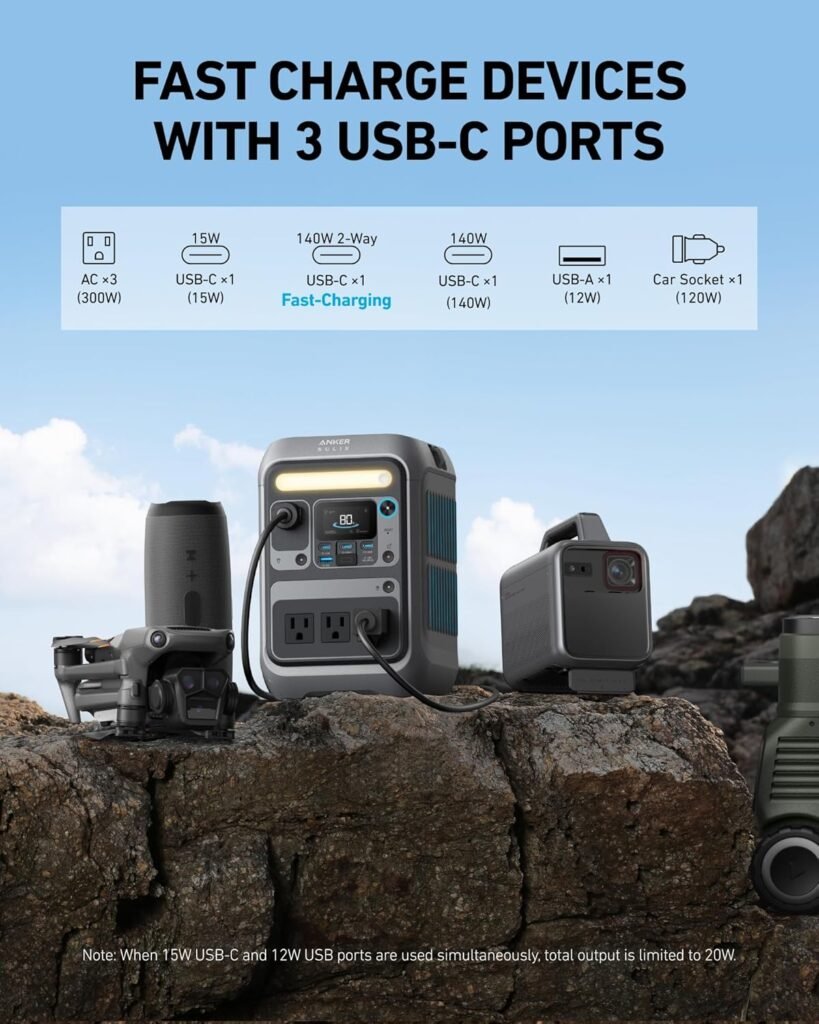
| USB-C (PD) Ports | 2× USB-C (140W combined) + 1× USB-C (15W) |
| USB-A Port | 1× USB-A (12W) |
| AC Outlets | 3× AC (300W total) |
| Car Socket | 1× DC car socket (120W) |
| Recharging Options | AC wall (80% in 50 minutes), solar (recommended 60W/100W), car, USB-C PD 3.1 |
| Solar Compatibility | Works with Anker 60W/100W panels (not compatible with SOLIX PS30/PS200/PS400 panels) |
| Cycle Life | ~3,000 cycles to 80% (LiFePO4) |
| Noise Level | ~25 dB at 3.3 ft |
| Dimensions / Weight | 15% smaller than similar designs; carry strap sold separately |
| Warranty | 5-year warranty |
| Included in Box | SOLIX C300, AC charging cable, safety manual, warranty info |
Design and Portability
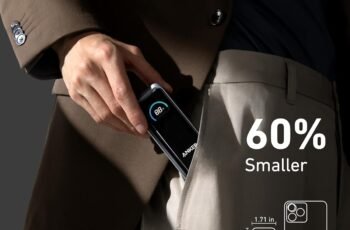
We appreciate that the SOLIX C300 focuses on being travel-friendly without sacrificing functionality. It’s designed to be about 15% smaller than similar power stations, which helps when we’re packing for a short trip or need to stash it in a car trunk.
The unit is easy to grip and can be carried without an included strap, though the option to attach a strap (sold separately) offers versatility for different carry methods. The overall footprint feels well-balanced — not bulky — and the build quality gives us confidence for outdoor use.

Battery and Chemistry (LiFePO4)
We like that the SOLIX C300 uses LiFePO4 chemistry rather than traditional lithium-ion. LiFePO4 typically offers improved thermal stability, lower risk of degradation over time, and a higher number of usable cycles.
Anker rates this battery for about 3,000 cycles to 80% capacity, which means that with regular use, we can expect it to last for years — potentially a decade with careful use. For anyone who wants long-term reliability, LiFePO4 is a significant plus.
Ports and Connectivity
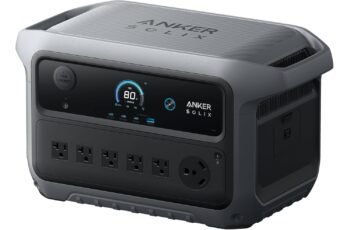
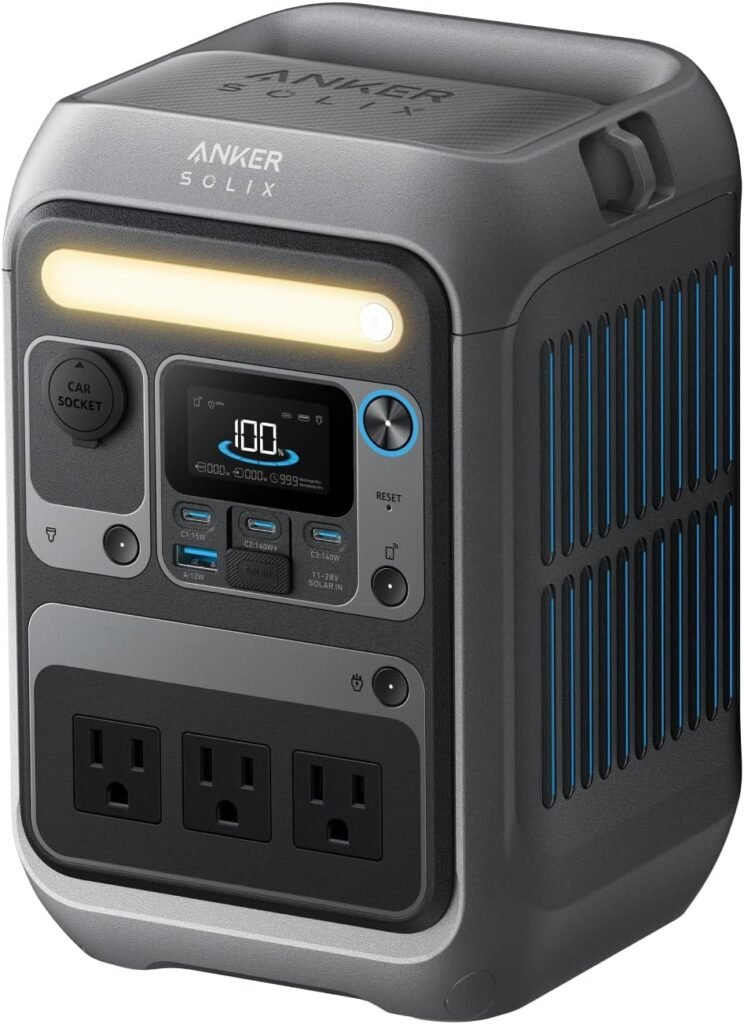
There’s a strong variety of ports onboard, and that translates to real-world flexibility. We get three AC outlets for small appliances, two high-power USB-C ports for fast charging laptops and phones, an extra USB-C port for lower-power devices, a USB-A port, and a 12V car socket.
Having 2× USB-C ports capable of 140W two-way fast charging drastically cuts down on recharge times and lets us use the unit itself as a fast-charging hub. The 3 AC outlets are useful when multiple people are charging small appliances or when we want to run a CPAP or small electric cooking device.
Port Layout and Practical Use
The layout is intuitive: AC outlets grouped together, USB ports accessible on one side, and the car socket separated for convenience. We can plug in multiple devices simultaneously without crowding or needing adapters, which is practical during group camping or when we’re handling multiple gadgets.
We should note that while the total AC output is 300W, peak surges of up to 600W can handle short inrush currents of motorized or compressor devices, but continuous usage should remain within the 300W limit.
Charging Speed and Recharging Options
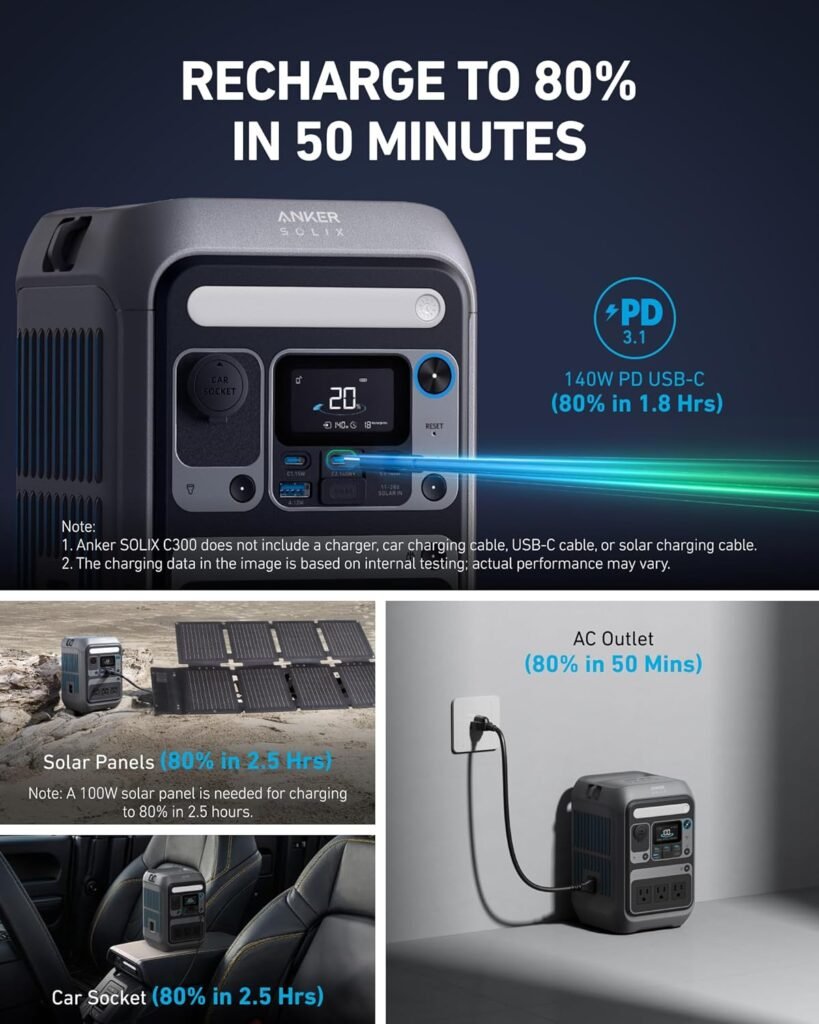
One of the SOLIX C300’s strongest points is its recharging versatility and speed. We can recharge the unit to 80% in about 50 minutes using a wall outlet — a fast turnaround for a 288Wh battery.
Additionally, the unit supports solar recharging (Anker recommends a 100W or 60W panel), recharging via a car outlet, or using the PD 3.1 USB-C port. This combination lets us adapt to different situations: quick top-ups at home, extended off-grid charging with solar, or trickle charging while driving.
PD 3.1 USB-C Recharging
The PD 3.1 port doubles as an input/output and supports two-way fast charging up to 140W. We appreciate this because it means a single USB-C cable can often handle both charging the device and powering other compatible devices. When we’re on the go and only have one high-power charger, this flexibility matters.
Solar Compatibility and Off-Grid Use
If we plan to use the unit for extended stays off-grid, pairing it with a solar panel is essential. Anker recommends 100W or 60W solar panels, and using a 100W panel provides a reasonable charge rate in good sun conditions.
We must be careful about compatibility: the SOLIX C300 is not compatible with some Anker panels like the SOLIX PS30 or certain 5V USB-C panels. We recommend confirming panel specs before purchase. When we pair the SOLIX C300 with a properly sized panel in bright sunlight, it becomes a practical solar generator for weekend trips or emergency readiness.
Real-World Performance and Run Times
To better understand what 288Wh means in practice, we ran multiple scenarios to estimate device runtimes. These are typical expectations and will vary with device efficiency, environmental conditions, and real-life losses.
| Device | Typical Power Draw | Estimated Runtime (Hours) |
|---|---|---|
| Smartphone (15W) | 15W | ~18–20 hours (multiple full charges) |
| Laptop (45W) | 45W | ~5–6 hours |
| Camera battery charger (10W) | 10W | ~25–28 hours |
| LED camping lantern (5W) | 5W | ~50–55 hours |
| Mini projector (40W) | 40W | ~6–7 hours |
| CPAP (30–50W depending on model) | 40W avg | ~6–7 hours |
| Small 12V fridge (40W avg) | 40W | ~6–7 hours |
| Electric kettle (1,000W) | 1000W | Not supported – exceeds 300W limit |
| Portable fan (20W) | 20W | ~12–14 hours |
We find these estimates useful when planning. For example, a laptop and phone for a workday can be comfortably supported, while small appliances like a 12V mini-fridge or CPAP for a single night are feasible. High-draw appliances like kettles or space heaters are outside the continuous output scope.
Noise and Thermal Management
Operating noise is impressively low; Anker lists about 25 dB from 3.3 ft away, which aligns with our quiet usage impressions. That’s close to whisper-quiet, making the unit suitable for campgrounds, overnight stays, or indoor emergency use without a noisy fan disrupting rest.
Thermal controls are smart and effective. The unit manages heat with internal regulation to protect the battery and electronics, and we haven’t noticed excessive heat during normal charging or discharging cycles. For heavy loads near the 300W limit, some thermal activity is expected but remains unobtrusive.
Durability and Build Quality
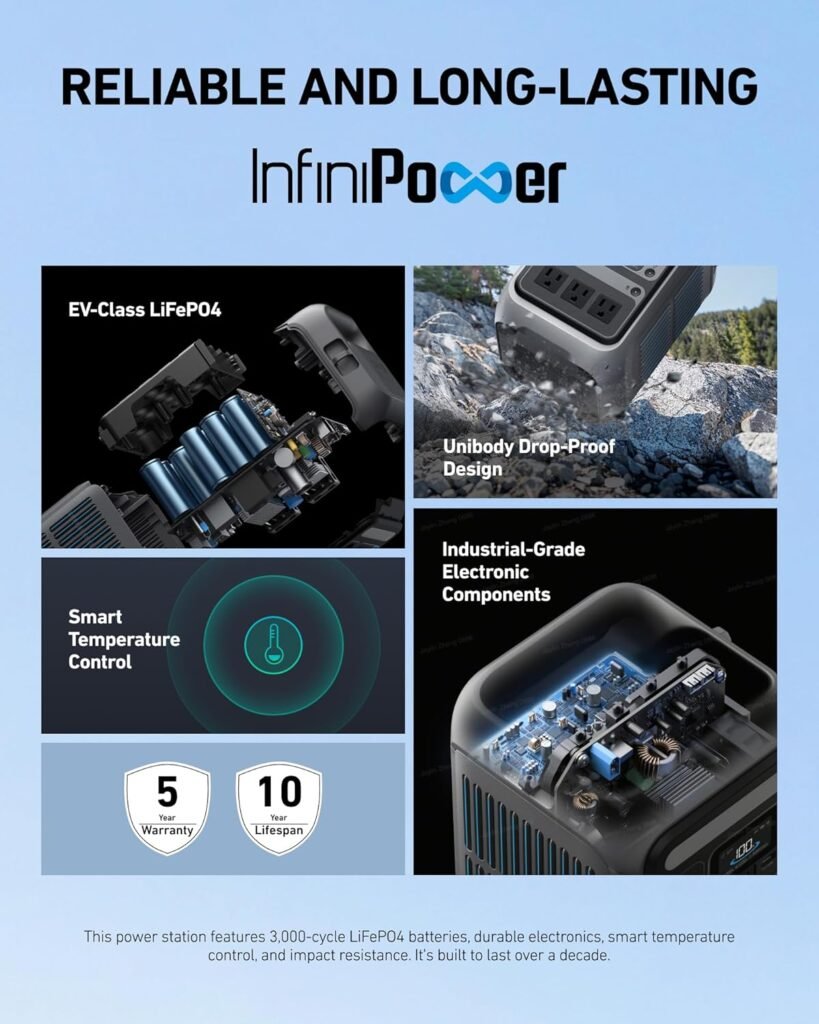
The SOLIX C300 feels rugged without being overbuilt, which suits its intended use for travel and occasional outdoor exposure. Impact resistance and a solid casing give us confidence when it’s moved around during trips.
That said, it’s not designed as a military-grade device. We still recommend protecting it from heavy rain exposure, extreme impacts, and prolonged immersion. The unit’s protective features and the LiFePO4 chemistry combine to provide a reliable and long-lasting package.
Safety Features
We value the safety emphasis in this product. LiFePO4 is inherently more stable than some other lithium chemistries, and the SOLIX C300 adds smart temperature control, impact resistance, and internal protections for overcurrent, overvoltage, and short circuits.
For families or travelers carrying sensitive electronics, these protections reduce the risk of unexpected failures. Anker’s safety standards and the five-year warranty further reassure us when considering long-term ownership.
Warranty and Support
Anker backs the SOLIX C300 with a 5-year warranty, which we view as generous and a sign of confidence in the product. Their customer support is typically responsive, and the included warranty info and safety manual help us get started quickly.
The 10-year power claim is tied to the battery chemistry and expected cycle life, and with proper care, the product’s longevity should align with that promise. We still recommend registering the product with Anker and keeping purchase receipts for warranty claims.
What’s in the Box
It’s helpful when accessories are straightforward and the essentials are included. In the box we get the SOLIX C300 Portable Power Station, an AC charging cable, a safety manual, and warranty information.
We should note that the carrying strap is sold separately, and solar panels are optional. If we plan to rely on solar, we’ll need to budget for a compatible Anker 60W or 100W panel or another panel that meets the voltage/current specifications.
Setup and First Use
Setting up the SOLIX C300 is simple: charge to full using the AC cable out of the box, familiarize ourselves with the port layout, and test a few devices. The interface is user-friendly with clear indicators for charge level and output activity.
We liked how quickly the initial learning curve flattened out — the unit behaves predictably and the modes are intuitive. If we plan to integrate solar, we’d spend a few minutes confirming panel compatibility and expected input rates before leaving home.
Practical Tips for Maximizing Lifespan
We want the unit to serve us for many years, so we follow some simple practices. Avoid deep discharges whenever possible, store the unit partially charged if we won’t use it for long periods, and keep it in a cool, dry place to minimize stress on the battery.
Regular moderate cycling (rather than frequent 100% charges and discharges) helps LiFePO4 cells last. Also, when using solar, try to avoid extreme heat — charging efficiency drops and thermal stress increases.
Pros and Cons
We like to keep an honest balance. Here’s what stands out for us.
Pros:
- LiFePO4 battery chemistry for longevity and safety
- Fast AC charging to 80% in ~50 minutes
- Two-way 140W USB-C PD ports for fast device charging
- Quiet operation (~25 dB)
- Compact and travel-friendly size
- 3 AC outlets and a car socket for varied use
- 5-year warranty and strong cycle life (~3,000 cycles)
Cons:
- 288Wh limits runtime for heavy appliances or multiple high-draw devices
- Carry strap sold separately (adds to accessory cost)
- Not compatible with some Anker solar panels (check compatibility)
- May not be ideal as sole power source for extended off-grid living without significant solar capacity
Use Cases — When This Is the Right Choice
We list the scenarios where the SOLIX C300 really shines.
Camping and Weekend Trips We find it ideal for short trips where we want to power lights, phones, cameras, a small fridge, or a CPAP for a night. Its balance of capacity and portability means we’re not compromising comfort for convenience.
Traveling and Remote Work When we need to keep laptops, phones, and cameras charged while working from cabins, RVs, or hotel rooms, the two-way 140W USB-C charging is particularly handy. It reduces the number of chargers we need to carry.
Emergency Backup for Home For power outages where lighting, phone charging, and small medical devices are required, the SOLIX C300 gives us a predictable short-term backup. It’s not a whole-house solution, but it covers essentials.
Vanlife / Overlanding As part of a larger power strategy, the SOLIX C300 provides supplemental energy for short stops or as a backup to a larger battery system. Its compact size helps when space is limited.
Alternatives and Comparisons
We compared the SOLIX C300 to similarly rated models to understand its place in the market. While specs vary, the core differentiator is LiFePO4 chemistry and the two-way high-power USB-C capability.
- Jackery Explorer 300 (approx. 293Wh): Similar capacity, but may use different battery chemistry and lacks the same cycle longevity. Port configurations vary.
- EcoFlow River series: Some EcoFlow units offer higher wattage or faster solar input but can be heavier or pricier. We like SOLIX C300 for its compactness and LiFePO4 benefits.
- Other Anker SOLIX models: Larger Anker SOLIX units offer bigger capacities but also add size and weight. The C300 is a middle-ground choice for portability.
When choosing, we recommend matching the station’s continuous output and capacity to typical device draws, and prioritizing battery chemistry and cycle life based on long-term needs.
Common Questions and Our Answers
We get asked practical questions when planning trips. Here are some answers based on our experience.
Is the SOLIX C300 good for CPAP?
- Yes, for many CPAP models it can run a night, but runtime depends on the CPAP’s power draw and whether you’re running a heated humidifier. Check your device’s wattage and plan accordingly.
Can we run a mini-fridge overnight?
- Yes, many small 12V mini-fridges with average draws around 30–50W can run for several hours, potentially a full night. Continuous draw is what matters — high inrush currents are handled by surge capacity but not for extended periods.
How long does recharging via solar take?
- With a 100W panel in optimal sun, charging time can vary widely based on conditions. Expect slower charging than AC but reasonable topping depending on panel efficiency and sunlight.
Can we carry the unit on a plane?
- Most airlines restrict batteries above 100Wh. At 288Wh, this unit is above typical airline carry-on allowances and likely not permitted on passenger aircraft. Check airline rules before travel.
Setup for Solar Charging — Practical Steps
If we’re using solar, we follow a short checklist:
- Confirm panel compatibility (Anker recommends 60W or 100W panels).
- Use proper connectors and ensure secure connections.
- Position panels for maximum sun with minimal shading.
- Monitor input wattage and system temperature during initial runs.
- Use a larger panel array or multiple panels if we need faster charging, ensuring combined inputs follow Anker specifications.
Maintenance and Storage
We treat the SOLIX C300 like any high-value battery device. Keep it clean, dry, and charged to about 50% for long-term storage. Avoid exposing it to temperatures above 45°C (113°F) or freezing conditions for extended periods.
Monthly checks and occasional cycles help keep battery management electronics calibrated and ensure long-term health.
Final Thoughts and Recommendation
We find the Anker SOLIX C300 to be a smart choice for people who want a reliable, compact portable power station with modern charging options and long-term battery life. The LiFePO4 chemistry, fast recharging capabilities, and quiet operation make it suitable for weekend adventures, remote work, and emergency readiness.
For those needing larger capacity or whole-house backup, it’s not a lone solution, but as part of a layered power plan — or for users prioritizing mobility and longevity — it fits very well. If our priorities are safety, longevity, and strong USB-C performance in a travel-friendly package, the SOLIX C300 earns a recommendation.
Where to Buy and Accessories We Recommend
We typically buy from authorized retailers to ensure warranty coverage. For best use, we recommend considering:
- Anker 100W solar panel (or 60W if space is limited) — confirm model compatibility
- A durable carry strap or padded bag for transport
- Extra AC or USB-C cables for car and solar setups
- Protective case if we expect rough handling or rugged environments
Closing Notes
We value balance — portability, longevity, and practical power. The Anker Portable Power Station SOLIX C300, 288Wh LiFePO4 Battery, 300W (600W Surge) Solar Generator, 140W Two-Way Fast Charging, for Outdoor Camping, Traveling, and Emergencies (Solar Panel Optional) meets those needs for many users. It performs predictably across typical use cases and gives us confidence for both planned trips and unexpected outages.
Disclosure: As an Amazon Associate, I earn from qualifying purchases.