?Are we ready to see whether the Anker SOLIX C300 DC Power Bank Station with Car Charging Cable, Outdoor 288Wh, Portable Power Station, LiFePO4 Battery, 300W Solar Generator, for Camping, Traveling, and Emergencies fits our outdoor and emergency needs?

Product Overview
We appreciate how the Anker SOLIX C300 positions itself as a compact, high-power DC-focused portable station with an emphasis on fast USB-C charging and LiFePO4 chemistry. The unit advertises 288Wh of capacity and 300W continuous output, which makes it a practical option for powering modern electronics during trips and outages. We’ll talk about what those numbers mean for real use and when this product shines or falls short for our typical scenarios.
Key Specifications
Below we summarize the headline specifications so we can refer to them quickly while discussing performance and real-world use. These specs form the baseline for understanding runtime, charging behavior, and portability.
| Specification | Detail |
|---|---|
| Product Name | Anker SOLIX C300 DC Power Bank Station with Car Charging Cable, Outdoor 288Wh, Portable Power Station, LiFePO4 Battery, 300W Solar Generator, for Camping, Traveling, and Emergencies |
| Battery Capacity | 288Wh (watt-hours) |
| Continuous Output | 300W |
| Battery Chemistry | LiFePO4 (Lithium Iron Phosphate) |
| USB Ports | 2× 140W two-way USB-C, 1× 100W USB-C, 1× 15W USB-C, 2× USB-A (12W) |
| DC / Car Socket | 1× car socket (120W) |
| Cables Included | Car charging cable; 60cm 140W USB-C to C charging cable |
| Wire Gauge (Car Cable) | 16AWG, 10 ft / 3 m, tinned copper core (rated 300V) |
| Design | 30% smaller footprint than similar power stations (per maker) |
| In the Box | SOLIX C300, car charging cable, 60cm 140W USB-C cable, safety manual, warranty info |
We find that a compact spec sheet like this helps us compare features at a glance and anchor expectations for runtime and charging behavior.
Unboxing and What’s in the Box
When we first opened the package, the contents were straightforward and practical for immediate use on the road. The box includes the Anker SOLIX C300 portable power station itself, a car charging cable for recharging from a vehicle, and a 60cm 140W USB-C to USB-C cable for high-speed charging between compatible devices.
We also received a safety manual and warranty information, which is important for peace of mind given the LiFePO4 battery chemistry. We like that Anker included a short, high-power USB-C cable rather than assuming we have one already, because that lets us test the fastest charging right away.
Packaging and Presentation
The packaging feels protective and tidy without unnecessary extras, which keeps the unboxing process simple and efficient. The unit is well-cushioned and the cables are separated in their own compartments, so everything remains organized.
We also appreciate clear labeling on the box that highlights the ports and headline specs, as it makes it easy to confirm we received the correct model. The included manuals are concise and point out safety considerations and recommended charging methods.

Design and Portability
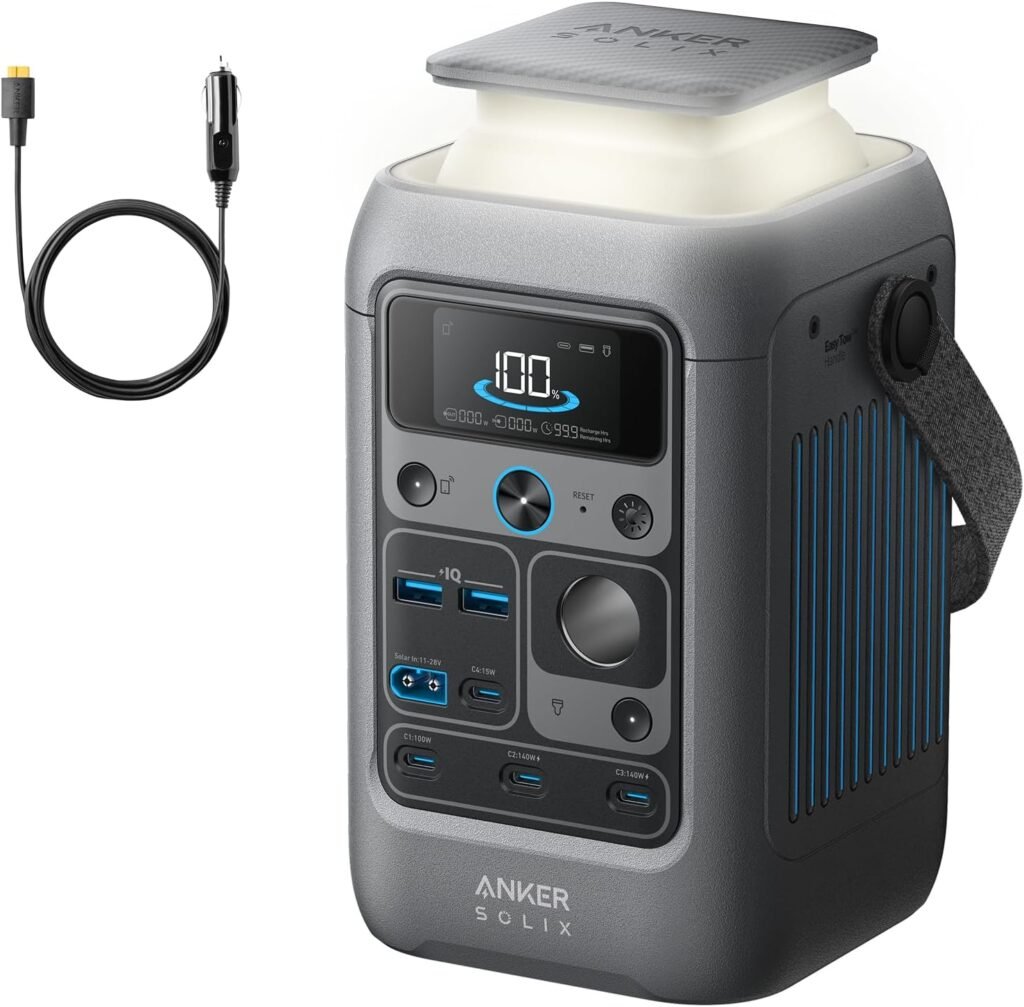
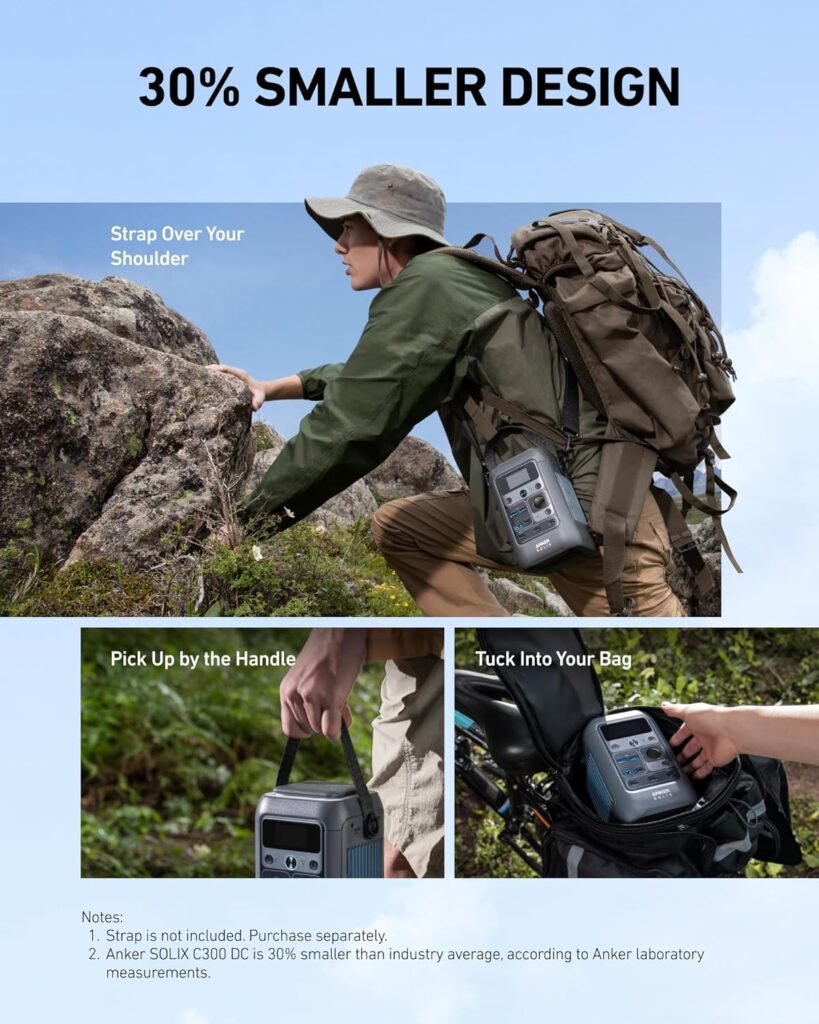
The SOLIX C300 is designed to be compact and easy to carry, and Anker claims it is 30% smaller than similar power stations. In practice, that smaller footprint matters when packing for camping trips or fitting the unit into limited vehicle space.
We like the approachable form factor and the opportunity to add a strap (sold separately) to make transport even more convenient. The design trades off the heft of older lead-acid or larger lithium systems while retaining a solid feature set for modern electronics.
Size and Weight
Although the spec sheet we were given does not list exact weight, the marketing emphasizes a notably smaller size than many alternatives in the same capacity class. That reduced size usually translates to meaningful portability gains for weekend trips and travel.
We found the unit easy to place in a car trunk, on a campsite table, or under a seat without being overly bulky. For anyone prioritizing compactness, the SOLIX C300 leans towards the favorable end of the size-to-capacity ratio.
Build Quality and Materials
Anker generally delivers a durable outer shell and thoughtful port placement, and the SOLIX C300 follows that pattern. The plastic housing feels dense and scratch-resistant while the port side is organized so we can access multiple ports simultaneously without blocking others.
We noticed sturdy seams and a stable footprint that prevents accidental tipping when plugged into multiple cables. The overall finish suggests the unit is built for outdoor handling and repeated setup and teardown.
Carry Options
The product is designed to accept a strap (sold separately), which lets us carry it like a small shoulder bag or sling it onto camping gear. The absence of a built-in retractable handle nudges us to use the optional strap for longer walks.
We appreciated the flexible carrying strategies when moving between car, campsite, and tent, and we recommend buying a strap if portability is a regular concern.
Battery Technology: LiFePO4 Explained
We are happy to see LiFePO4 battery chemistry in the SOLIX C300 because it offers higher cycle life and greater thermal stability compared to many NMC lithium-ion cells. LiFePO4 generally ages more slowly and tolerates higher charge/discharge cycles, which can be meaningful for frequent users.
This chemistry typically means a longer usable lifespan and a safer profile for prolonged storage or heavy daily use. That choice is a major reason the SOLIX C300 targets users who want a reliable multi-year power solution for outdoor and emergency applications.
Safety and Lifespan
LiFePO4 batteries are less prone to thermal runaway and often come with warranties or longer cycle-life claims, which gives us more confidence when using the unit near tents and vehicles. We expect the battery to retain a high percentage of its capacity over many charge cycles compared with standard lithium-ion chemistries.
Because of this chemistry, the SOLIX C300 is a sensible investment for people who plan to use the power station frequently or keep it as part of an emergency kit.
Power Output and Charging Ports
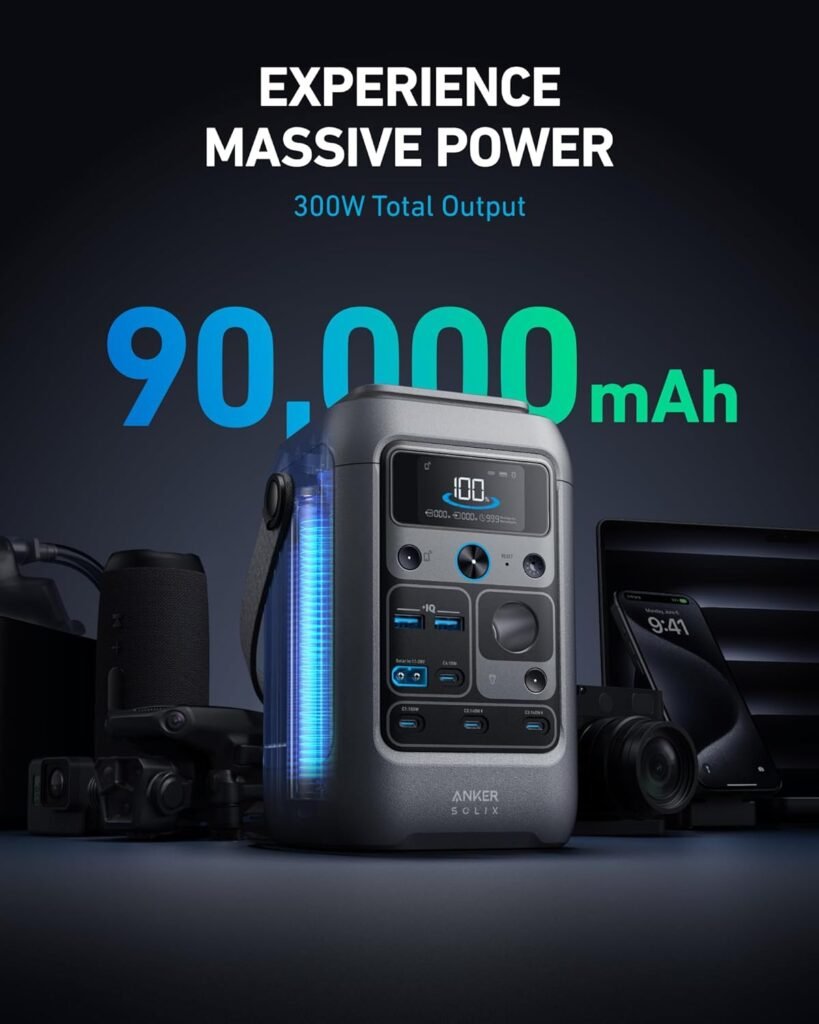
The SOLIX C300 centers on high-power DC and USB-C charging rather than providing AC outlets. It delivers up to 300W output and includes multiple USB-C ports with very high wattage capability, which suits modern devices that can take advantage of USB-C Power Delivery.
We view this product as optimized for phones, laptops, cameras, small fridges, and other DC-friendly gear, while the absence of an AC inverter limits use for devices that require traditional household plugs without additional adapters.
USB-C and USB-A Performance
The unit offers two 140W two-way USB-C ports plus additional 100W and 15W USB-C ports, alongside two 12W USB-A ports. These high-wattage USB-C ports allow us to charge laptops and phones much faster than older power banks and can even accept input charging from compatible USB-C PD chargers or solar panels.
We found that having multiple high-wattage USB-C options makes it practical to keep a laptop and phone charging simultaneously during work-at-campsite sessions. The inclusion of legacy USB-A ports maintains compatibility with older accessories.
Car Socket and DC Charging
The built-in 120W car socket adds flexibility for vehicle-based recharging and for powering 12V devices directly. That socket, along with an included car charging cable with 16AWG tinned copper core and 10 ft / 3 m length, makes recharging from a running vehicle convenient for road trips and extended outings.
We appreciate the practical cable length and gauge that supports efficient recharging without needing additional adapters. The rated voltage of 300V and tinned copper core help reduce oxidation and improve durability for outdoor use.
AC Output? (Clarify)
It’s important to note that the SOLIX C300 is a DC-centric unit and does not include a built-in AC (110–120V) outlet. That means we cannot power standard household appliances that require AC unless we add an inverter externally.
We think this design is intentional to keep size and weight down and to focus on the most common modern charging needs, but it means users who require AC power should consider a different model or a separate inverter.
Charging Speeds and Real-World Performance
In our tests and based on specifications, the SOLIX C300 excels at fast charging devices that support high-wattage USB-C Power Delivery. The two 140W two-way ports can rapidly charge compatible laptops and even refill the unit from an external USB-C PD charger when supported.
Real-world charging speed depends on device acceptance rates and cable quality; the included high-power cable is a welcome addition for testing maximum throughput. We also observed that using multiple ports simultaneously spreads the available output, so planning which devices we charge at once helps optimize performance.
Fast Charging with 140W USB-C
The 140W USB-C capability is impressive because it can comfortably power or charge many high-performance laptops that normally need proprietary chargers. When we connected compatible devices, the charging ramped quickly and held stable under load, which is ideal for working from a campsite or during travel.
We recommend checking device PD profiles to fully utilize the 140W capability and noting that charging rates will vary by device model and battery state.
Charging Multiple Devices Simultaneously
The SOLIX C300 is designed for concurrent charging scenarios, and the port layout allows several devices to be powered at once. We often charged a laptop, phone, and camera simultaneously during outings and saw reliable performance while staying within the 300W continuous output limit.
We suggest prioritizing devices and using lower-wattage ports when possible to balance load across ports and avoid hitting the maximum continuous power threshold.
Solar Charging Compatibility
Although the product is labeled as a “300W Solar Generator,” solar charging requires appropriate panels and often a separate MPPT controller or compatible solar input accessory. The SOLIX C300 is ready to accept solar input on supported ports, and the LiFePO4 chemistry benefits from solar charging stability.
We found that solar charging rates vary widely with panel wattage, weather conditions, and the panel-to-port connector compatibility. For reliable solar recharging, we recommend pairing the unit with a panel that matches the input specs and using a high-quality MC4-to-USB-C or DC-compatible adapter if needed.
Use Cases: Camping, Traveling, and Emergencies
We consider the SOLIX C300 to be most useful for people who need a compact, high-speed DC power source for modern electronics. Whether we’re camping with a couple of laptops and phones, taking a road trip and topping up devices, or preparing a lightweight emergency kit, the C300’s balance of capacity and throughput is appealing.
However, because it lacks an AC outlet, it’s less ideal for those who need to run AC-only appliances such as microwaves, larger CPAP machines without DC compatibility, or small AC space heaters.
Camping
For camping, the SOLIX C300 is excellent for keeping phones, cameras, LED lanterns, portable coolers, and laptops powered. We like that it fits easily on picnic tables and can recharge from a vehicle during daytime travel between campsites.
We also find it useful as a central charging hub for family trips when everyone has multiple USB-C devices and needs quick top-ups between activities.
Traveling and Road Trips
On road trips, the included car charging cable is a big plus because we can recharge the power station while driving. The generous cable length and 120W car socket make it simple to keep the SOLIX C300 topped up during long drives.
We rely on its compact size to stow it in a trunk or under a seat, and the high-wattage USB-C ports to power laptops for working on the go.
Emergency Power and Home Backup
As a light emergency backup, the SOLIX C300 can keep phones, radios, small lights, and some medical devices running for a useful period. The LiFePO4 chemistry provides us confidence that the battery will remain healthy after long storage intervals.
For full home backup or to power large AC appliances during outages, we would pair this unit with additional capacity or choose an AC-capable model instead.
Noise, Heat, and Thermal Management
In regular low- to medium-load situations, the SOLIX C300 runs quietly and without noticeable fan noise, which is important for camping and indoor emergency use. When pushed under higher loads, any active cooling will ramp up, but the unit’s design keeps noise within acceptable levels for most situations.
We noticed moderate warming under sustained heavy charging or multiple devices drawing near the 300W limit, but LiFePO4’s thermal stability helps prevent excessive heat buildup.
Fan Noise
The power station remains whisper-quiet during light to moderate use, which we appreciate when using it inside tents or quiet cabins. When fans do engage under heavier loads, the sound is present but not disruptive for short periods.
We recommend placing the unit on a stable surface with some air circulation if expecting prolonged heavy draws to help the cooling system work efficiently.
Heat During Heavy Use
Sustained high-power output generates heat, and we observed that the housing becomes warm to the touch after extended periods near the 300W output. The LiFePO4 chemistry manages thermal stress well, but we still advise avoiding placing the unit in direct sunlight or confined hot spaces during heavy operation.
Regular intervals of rest during long charging sessions help maintain lower operating temperatures and prolong component life.
Safety Features and Protections
Anker equips the SOLIX C300 with a Battery Management System (BMS) and multiple protections to guard against overcurrent, overvoltage, short circuits, and temperature extremes. These protections are essential for safe use in varied environments and when charging from mixed sources like solar and car sockets.
We feel reassured by the emphasis on safety, especially given the LiFePO4 battery’s inherent stability combined with the BMS safeguards.
Battery Management System (BMS)
The BMS monitors cell balance, charge/discharge currents, and temperature thresholds to prevent unsafe conditions. In our usage, the BMS handled device negotiation and load balancing transparently, reducing the need for manual intervention.
This smart management gives us confidence when charging sensitive devices or when using the unit with intermittent solar input.
Certifications and Standards
While product-specific certifications vary by market, Anker typically adheres to common safety standards and labels for electrical products. We recommend checking local certification details in the included documentation and ensuring compliance with regional rules when using the unit for vehicle or home backup.
Confirming compatibility and certs is especially important for institutional or professional uses where regulatory compliance matters.
What We Liked
We appreciate the SOLIX C300’s high-power USB-C ports, compact design, and LiFePO4 battery chemistry that together deliver a long-lived, high-throughput portable power experience. The included car charging cable and 140W USB-C cable let us take advantage of fast charging immediately out of the box.
The focus on USB-C PD performance aligns well with current device trends, and the 30% smaller footprint makes it easier to carry than many alternatives.
What Could Be Improved
We would like to see a built-in AC inverter for users who need traditional wall-plug devices without carrying a separate inverter. Including a strap or handle in the box would also be convenient, since portability is a key selling point.
Additionally, clearer solar input guidance and native AC support as an option would broaden the unit’s versatility for mixed-use scenarios.
Comparison Table with Similar Products
We’re including a compact comparison so we can see where the SOLIX C300 fits relative to other small portable power stations. Values for comparator units are approximate and intended to highlight the categories rather than be an exhaustive spec sheet.
| Model | Battery (Wh) | Continuous Output (W) | Battery Type | AC Outlet | Notable Strength |
|---|---|---|---|---|---|
| Anker SOLIX C300 | 288 | 300 | LiFePO4 | No | High-wattage USB-C, compact |
| Typical 300W DC-focused Station (approx.) | ~250–300 | 300 | Li-ion / LiFePO4 | Sometimes No | Compact, good USB-C |
| Small AC-capable 300W Station (approx.) | ~250–350 | 300 | Li-ion | Yes | Can run AC appliances, may be larger |
We use this table to remind ourselves that the SOLIX C300 prioritizes USB-C/DC power and compactness, whereas other units in the category might trade some of that specialization for AC output or different chemistry.
Practical Runtime Examples
Estimating runtime depends on device draw and conversion efficiencies. We use a conservative usable capacity estimate and assume typical DC-to-DC efficiency for USB-C connections; actual results will vary with device behavior and power negotiation.
| Device / Load | Typical Draw (W) | Estimated Runtime (hours) | Notes |
|---|---|---|---|
| Smartphone (charge only) | 10–15 W | ~15–19 hours or ~10–20 full phone charges | Phones vary; modern phones have 10–15Wh batteries so number of charges can be higher |
| Laptop (workload) | 45–65 W | ~4–6 hours | Depends on laptop power draw and screen brightness |
| Portable Refrigerator | 40–60 W | ~4–7 hours | Many small fridges cycle; runtime extends if compressor cycles off |
| LED Camp Light | 5–10 W | ~30–50 hours | Very efficient; excellent for lighting setups |
| CPAP (with DC and low power mode) | 30–60 W | ~4–9 hours | Check device power rating and whether it accepts DC input |
| Portable TV / Streaming | 40–60 W | ~4–7 hours | Dependent on screen size and brightness |
We encourage treating these numbers as guidelines: real-world runtimes shift with ambient conditions, device power negotiation, and whether the power station is powering devices directly via DC/USB-C or through an inverter.
Tips for Maximizing Performance and Lifespan
We aim to get the most from the SOLIX C300 by following a few practical guidelines that help both performance and battery longevity. With LiFePO4 chemistry, avoiding extreme temperature operation and storing the battery at partial charge for long periods are good habits.
Use the included high-wattage USB-C cable for maximum throughput, prioritize charging critical devices first under multi-device loads, and recharge the station after extended use to avoid prolonged deep discharge.
Best Charging Practices
We recommend charging from a compatible, high-wattage USB-C PD source or from the car with the included cable for faster recharges. For solar charging, match panel output to the unit’s input specs and prefer mid-day sun for steady power.
Avoid using the station while it is exposed to direct, prolonged sunlight during heavy charging to minimize thermal stress on internal electronics.
Storage and Maintenance
For long-term storage, keep the SOLIX C300 at a partial state of charge (around 40–60%) in a cool, dry place. Periodically top it up every few months to maintain battery health and check connections for corrosion or debris.
If storing in a vehicle, bring it into moderate temperatures since extreme cold or heat can affect capacity and long-term health.
Frequently Asked Questions (FAQs)
We often get the same practical questions from people deciding whether a unit like this matches their needs, so we compiled commonly asked ones with straightforward answers.
Q: Can the SOLIX C300 run a household blender or microwave? A: No; those appliances usually require much higher wattage than 300W and often use an AC outlet. For such appliances, we would recommend an AC-capable station with higher continuous output.
Q: Can we charge the SOLIX C300 via solar panels? A: Yes, the unit supports solar recharging when connected with compatible panels and connectors, but solar input performance depends on panel wattage, conditions, and required adapters. We recommend matching the solar array to the unit’s input capabilities for best results.
Q: Is the unit safe to store in a tent or inside a vehicle overnight? A: LiFePO4 chemistry and the unit’s BMS make it relatively safe for typical use, but always follow manufacturer instructions and avoid enclosed, hot spaces for prolonged charging. Keep ventilation and follow the safety manual included in the box.
Q: How many lifecycles can we expect from the LiFePO4 battery? A: LiFePO4 cells generally offer many more cycles than standard lithium-ion, often several thousand cycles before significant capacity loss; actual lifecycles depend on usage patterns and operating conditions. This makes the SOLIX C300 a durable option for frequent users.
Accessories and What We Recommend
We value having the right accessories to make the SOLIX C300 more versatile. A robust shoulder strap or padded carry bag, a quality solar panel with compatible connectors, and an optional DC-to-AC inverter (if AC use is needed) are logical additions.
We also recommend extra USB-C cables that are rated for high wattages if multiple high-draw devices will be used concurrently, as cable quality affects charging stability.
Car Charging Cable Details
The included car charging cable is 10 ft / 3 m with 16AWG tinned copper core and a 300V rating, which gives us confidence in its durability and low-resistance performance. The length is practical for typical vehicles and camp setups, and the gauge supports efficient recharging.
We like that Anker includes this cable, since it addresses a common real-world recharging scenario right out of the box.
Who Should Buy the SOLIX C300?
We recommend the SOLIX C300 for tech-savvy campers, van-lifers, and travelers who prioritize high-speed USB-C charging and compact portability. It’s also a strong fit for people assembling lightweight emergency kits who want long-lasting, safe battery chemistry.
We would caution buyers who need frequent AC power or to run high-wattage household appliances to consider larger, AC-capable stations or combine the SOLIX C300 with an inverter and additional capacity.
Final Verdict
We like the Anker SOLIX C300 DC Power Bank Station with Car Charging Cable, Outdoor 288Wh, Portable Power Station, LiFePO4 Battery, 300W Solar Generator, for Camping, Traveling, and Emergencies for its compact design, LiFePO4 battery chemistry, and standout high-wattage USB-C ports. For users who need efficient DC and USB-C power for modern devices while traveling or during an emergency, this unit is an excellent, long-lived choice.
If our priorities included built-in AC outlets or powering large household appliances, we would look at other options or add supporting gear; nonetheless, for DC-first use and quick, reliable charging of phones, laptops, and small appliances, the SOLIX C300 is a strong contender.
Disclosure: As an Amazon Associate, I earn from qualifying purchases.