Looking for a portable power station that can keep up with both home backup needs and weekend adventures?

Product Overview: Anker SOLIX C1000 Portable Power Station
We want to summarize what the Anker SOLIX C1000 Portable Power Station offers and why it might matter for our situations. This unit is positioned as a versatile, fast-charging LiFePO4 solar generator suitable for home backup, power outages, RVs, and outdoor camping.
We find the key selling points are its rapid AC recharge, long-lasting LiFePO4 battery chemistry, high surge capacity, and optional solar input. Below we list the core specs so we can reference them easily as we assess real-world performance.
Quick Specs Table
We like having a single place to scan the most important numbers. The table below gathers the primary specs from the product details so we can compare and calculate run times and charging scenarios.
| Item | Specification |
|---|---|
| Product Name | Anker SOLIX C1000 Portable Power Station, 1800W (Peak 2400W) Solar Generator, Full Charge in 58 Min, 1056wh LiFePO4 Battery for Home Backup, Power Outages, and Outdoor Camping (Optional Solar Panel) |
| Battery Capacity | 1056 Wh (LiFePO4) |
| Nominal Output | 1800 W continuous |
| Peak/Surge Output | 2400 W (SurgePad technology) |
| Battery Life | 3,000 cycles (LiFePO4), 10-year lifespan claimed |
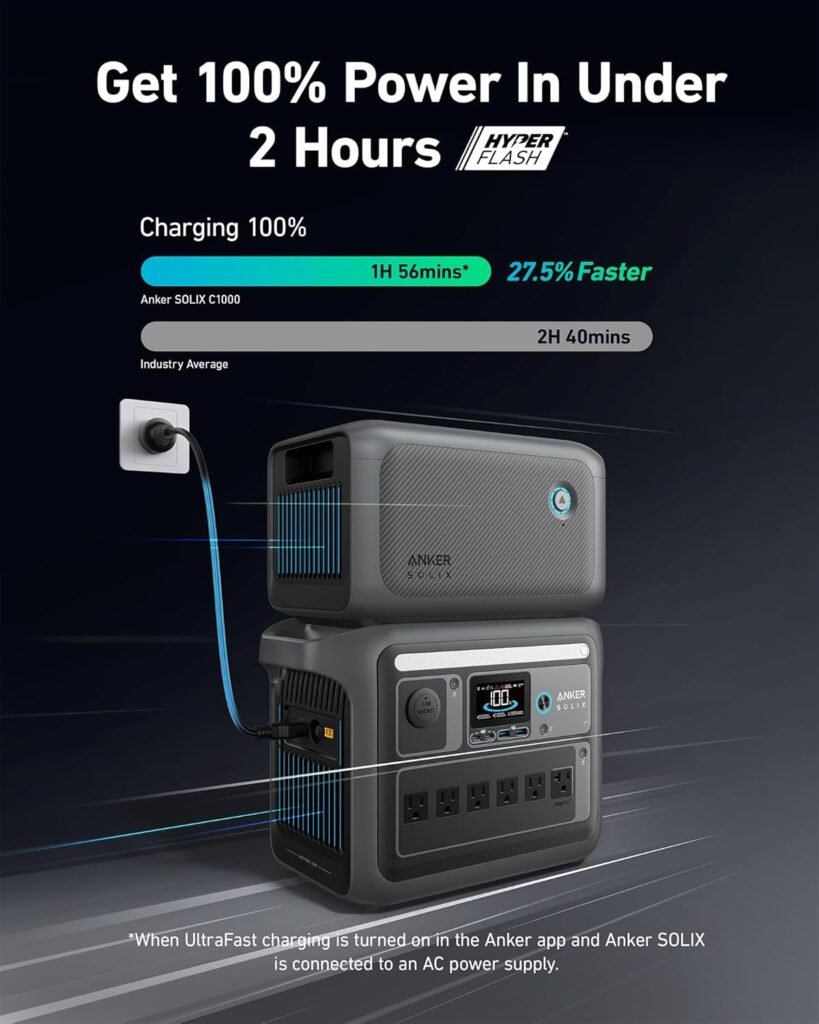
| AC UltraFast Recharge | 80% in 43 minutes (via AC + app), Full charge in 58 minutes |
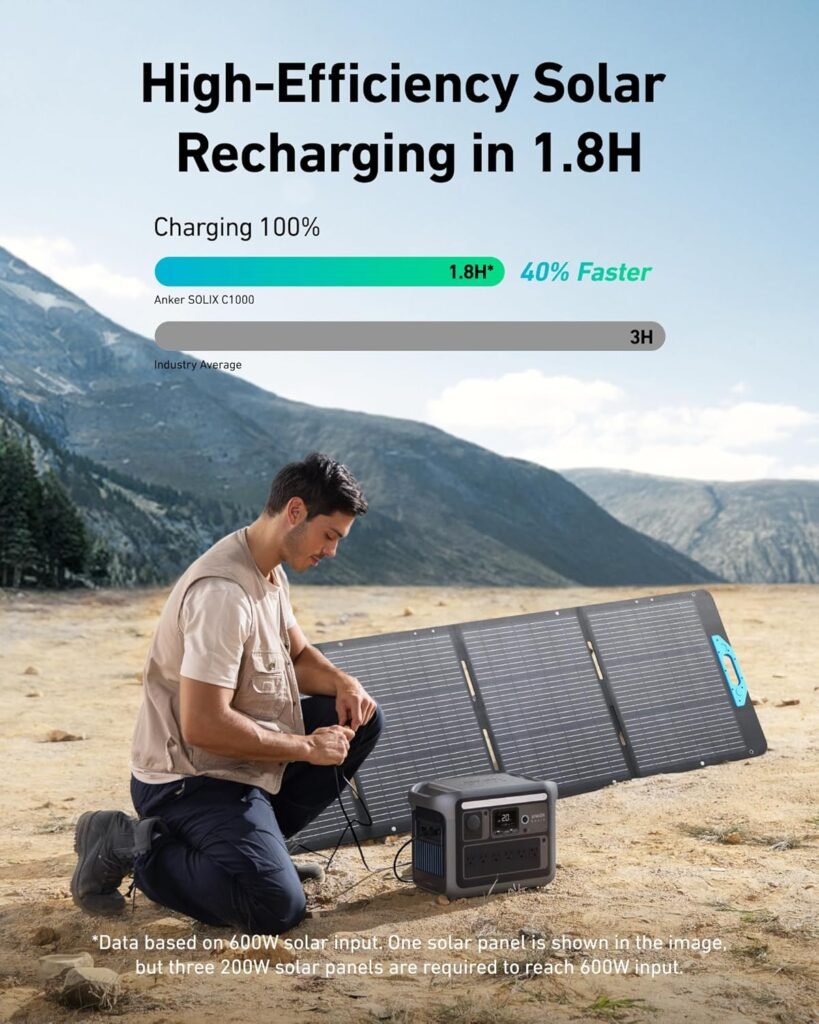
| Solar Input | Up to 600 W (fast solar recharge; full in ~1.8 hours) |
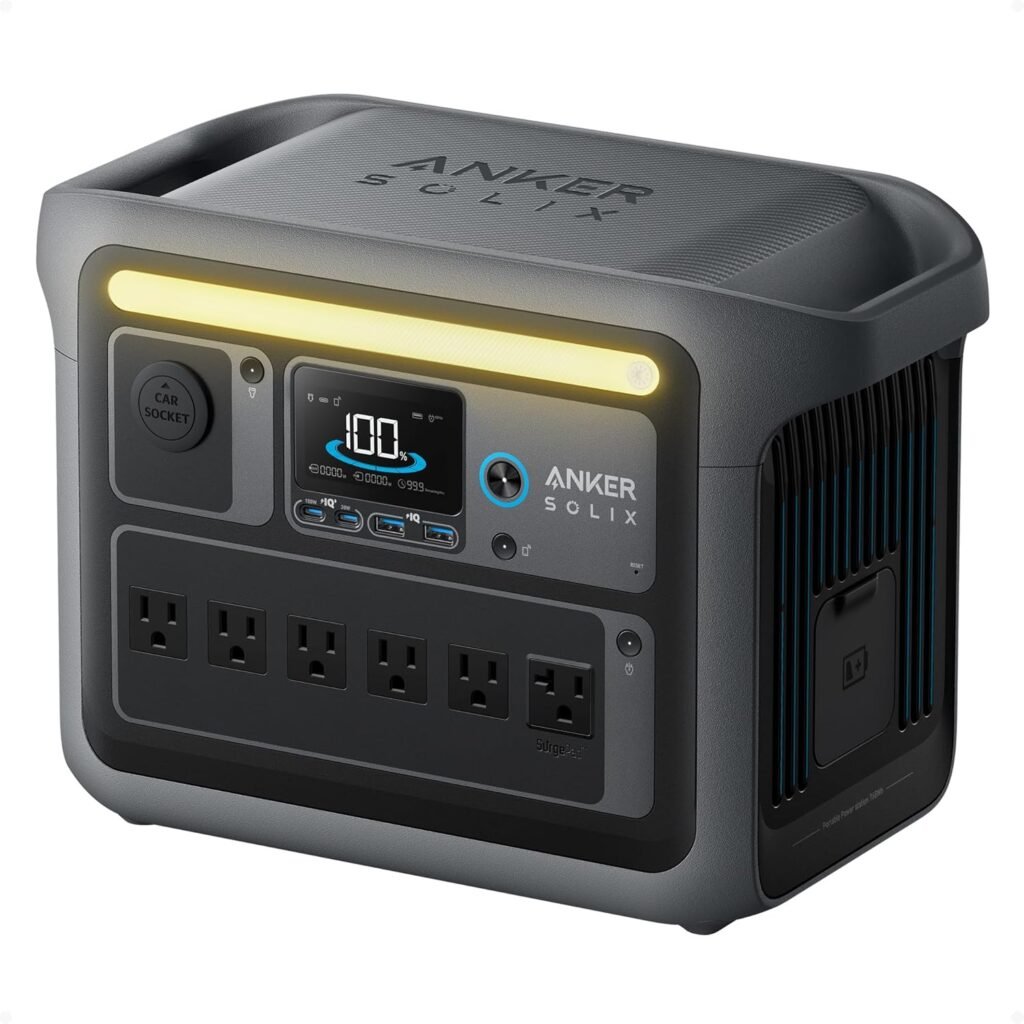
| Ports | 11 versatile ports (AC, USB-C, USB-A, car output, DC) |
| Size/Portability | ~15% smaller than comparable 1 kWh units (manufacturer claim) |
| Operating Temp for UltraFast | 68–122°F (20–50°C) |
| What’s in the Box | Power station, solar panel connector, AC charging cable, car charging cable, user guide |
Design and Build Quality
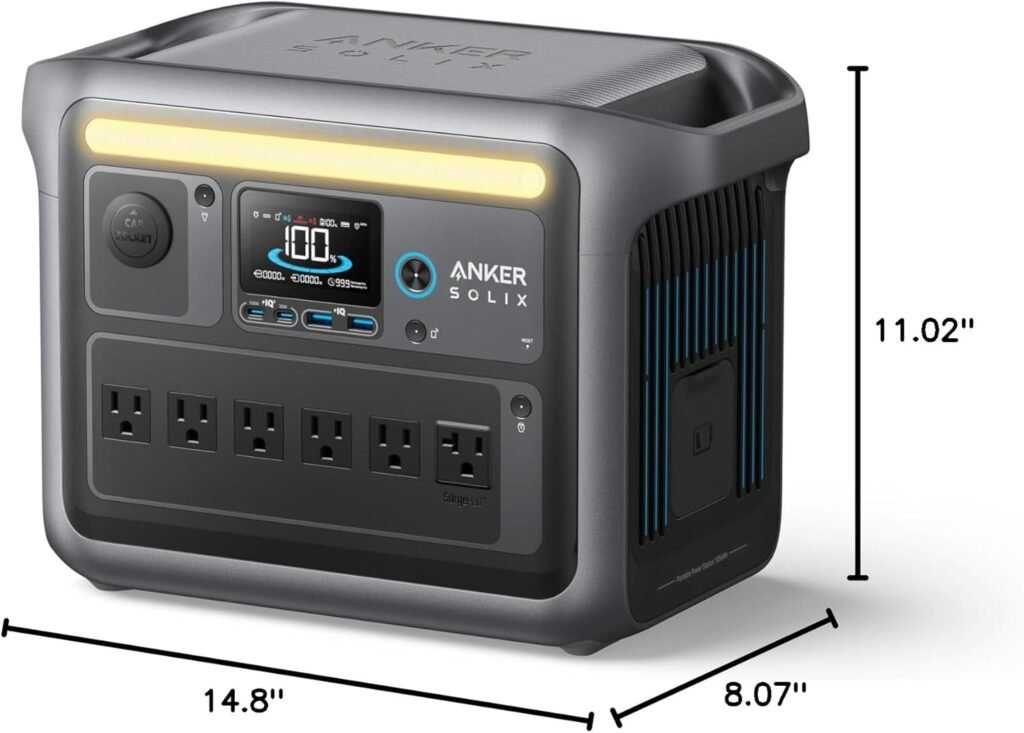
We want to know whether this unit looks and feels durable enough for frequent use and transport. The SOLIX C1000 feels thoughtfully engineered for both home and outdoor use, with a compact footprint and a sturdy handle for carrying.
The casing is rugged enough for camping and RV life, and the weight—while not featherlight given the LiFePO4 chemistry—remains reasonable for a 1kWh-class device. The layout of ports and the physical buttons are logical and easy to use even in lower light.
Port Layout and Usability
We will use this device in a variety of settings, so port access and labeling matter to us. The 11 ports are well organized and clearly labeled, making simultaneous connections painless.
We appreciate the mix of AC, USB-C, USB-A, and car DC outputs, allowing us to charge phones, laptops, small appliances, and run medical devices without constantly swapping cables. The ports are spaced to accommodate bulky adapters and multiple plugs.
Battery Chemistry and Longevity
We prioritize longevity and cycle life because we expect to rely on the unit for years. The LiFePO4 battery chemistry is a major plus: it’s designed for long cycle life, thermal stability, and safer degradation profiles than typical lithium-ion cells.
Anker claims 3,000 battery cycles and a 10-year lifespan, which means the SOLIX C1000 should retain usable capacity through many seasons of heavy use. For those who view a power station as an investment, this longevity reduces the total cost of ownership.
Why LiFePO4 Matters
We like clear reasons behind technical choices, and LiFePO4 stands out for safety and longevity. Compared with standard lithium-ion, LiFePO4 typically tolerates higher cycle counts and is less prone to thermal runaway, which provides peace of mind for indoor home backup use.
This chemistry also holds up better to repeated deep discharges, so we can use the station for frequent weekend trips and still expect solid capacity years down the line.

Charging Performance and Options
We expect flexible, fast recharging to make a power station practical. The SOLIX C1000 excels here: UltraFast AC recharging gets to 80% in 43 minutes and a full charge in under an hour when enabled via the Anker app. Solar recharging supports up to 600 W, which can fully charge the battery in about 1.8 hours in ideal conditions.
We should note that enabling UltraFast requires a smartphone and the Anker app, and that the UltraFast mode only operates within a recommended temperature range (68–122°F). These are manageable constraints for the majority of use cases.
AC UltraFast Recharging — Real-World Thoughts
We value being able to top the station quickly between uses. In practice, getting to 80% in 43 minutes means that after a long day of use, a short break at a powered campsite or at home can restore most of our capacity.
We do want to be careful with heat management and use the unit in the recommended temperature range while UltraFast charging. For consistent daily top-offs, the quick recharge adds a lot of convenience to our routine.
Solar Charging — Practical Considerations
If we’re using solar panels, the 600 W solar input dramatically shortens recharge time compared with many competitors. On sunny days at a campsite, pairing the unit with compatible high-output panels lets us recover full capacity in under two hours.
Weather, panel angle, shading, and temperature will affect actual solar recharge times, so we should plan for variability and avoid relying on perfect conditions if we need guaranteed uptime.
Output Power and Surge Capacity
We need to know what appliances the unit can realistically run. The SOLIX C1000’s continuous 1800W output and 2400W surge capability allow us to power most household appliances and many that require a brief surge at startup.
Items like microwaves, larger fridges, power tools, and some induction cooktops may still exceed sustained power limits, but the 2400W surge covers many high-startup-load devices such as refrigerators and certain pumps.
What 1800W Continuous Means for Us
In practical terms, 1800W continuous is robust for a 1 kWh-class unit. We can run a coffee maker, power a small microwave for short bursts, charge laptops and phones, and support lights and fans without trouble.
For longer-run high-power loads (like full-size AC units or ovens), we should plan usage in short cycles or combine with other power sources to avoid depleting the battery rapidly.
SurgePad Technology and High-Start Loads
We like the extra headroom when devices with high starting currents kick on. The 2400W surge capacity helps start compressors and motors, which is particularly useful for fridge-freezer combos and certain RV appliances.
This avoids nuisance shutdowns at inopportune moments, which is a meaningful reliability boost for home backup and mobile living.
Real-World Runtime Estimates
We prefer concrete examples to help plan usage. Below are approximate run times for common devices based on the 1056Wh battery. We assume inverter efficiency losses (~90% usable energy) and provide conservative estimates so we can plan realistically.
- Smartphone (10 Wh): 100+ charges
- Laptop (60 Wh): ~15 charges
- Small CPAP (30 W): ~30–35 hours (depending on humidifier use)
- LED lights (10 W total): ~80–90 hours
- Mini fridge (50–70 W average): ~12–15 hours
- Coffee maker (900 W, used intermittently): ~30–60 minutes of cumulative run time
- Microwave (1000 W, used intermittently): ~40–60 minutes of cumulative run time
- Portable TV (50 W): ~18–20 hours
We recommend using the Anker app or a kill-a-watt-style monitor to track actual device consumption, because real-world run times vary by efficiency, startup surges, and duty cycles.
How We Calculated These Estimates
We use simple arithmetic: usable energy ≈ 1056 Wh × 0.9 ≈ 950 Wh to account for inverter and conversion inefficiencies. Then divide by the device watt draw to get hours. Conservative estimates help prevent overcommitment during outages.
App Integration and Smart Features
We look for smart control and monitoring to make our power management easier. The Anker app ties into UltraFast charging, allows customization of charging speeds, and provides real-time power statistics.
This level of monitoring helps us make informed decisions while running multiple devices or when managing a battery during an outage. The requirement to use the app for UltraFast activation is a small trade-off for the convenience and control it provides.
What the App Lets Us Do
We can switch UltraFast recharge on/off, monitor input/output wattage, and check remaining runtime and battery percentage in real time. For remote monitoring during a power outage or while camping, the app gives us telemetry we wouldn’t otherwise have.
We recommend keeping the smartphone charged and the app updated to make the most of these features.
Portability and Size
We care about balancing capacity with weight and size for outdoor use. Anker claims the SOLIX C1000 is about 15% smaller than comparable 1 kWh units, which makes it easier to stow in an SUV, RV compartment, or carry to a campsite.
The physical footprint and handle placement make transporting it manageable for two people or a single person for short distances. For extended hikes, it’s heavier than small power banks, but that’s expected for this capacity class.
Weight and Carrying Tips
While the unit is more compact than some competitors, it’s still a substantial piece of kit. We recommend lifting with proper posture and transporting it in a vehicle when possible. For campsite setup, we place it on a stable, slightly elevated surface to avoid ground moisture.
Noise and Thermal Management
We want quiet operation, especially for use around sleeping areas or inside an RV. The SOLIX C1000’s fans engage during high-load operation and fast charging, creating a bit of audible noise but remaining comparable to other units in this class.
Thermal management is robust thanks to LiFePO4’s stability and the product’s design, but we avoid enclosing the unit in tight spaces during UltraFast charging to ensure optimal cooling and longevity.
Fan Behavior and Expectations
Under light loads, the unit can be very quiet. When charging rapidly or delivering sustained high loads, we notice fan ramp-up. The sound level is reasonable for outdoor or garage use, though inside a small bedroom it can be noticeable during heavy use.
Safety Features and Reliability
We prioritize safety for indoor use and around sensitive electronics. LiFePO4 chemistry and built-in protections (overcharge, over-discharge, short-circuit, temperature protection) support safe operation.
Anker’s reputation for power products adds confidence to the reliability profile, and the long cycle life reduces the likelihood of premature battery degradation.
Safety for Home Backup and Medical Devices
If we rely on the unit for critical equipment like CPAPs, we should pair the power station with a proper inverter and verify device draw. The SOLIX C1000’s stable output and safety protections make it suitable for such uses, but we always test our setup in non-emergency conditions to confirm compatibility.
Use Cases: Home Backup
We evaluate how well the SOLIX C1000 functions as a partial home backup solution. For short outages and running essential circuits—lights, routers, medical devices, charging—this unit performs strongly and provides hours of usable power for prioritized loads.
We wouldn’t expect it to run entire households for days without recharging, but it’s an excellent supplement for maintaining critical functions, keeping food cold for a day, and supporting communication devices while the grid is out.
Use Cases: Outdoor Camping and RV
For camping and RV trips, the SOLIX C1000 shines by blending portability with high output. We can run fridges, charge laptops and cameras, power small induction cooktops briefly, and run lights and fans, all while topping the unit via solar panels or an AC hookup at camp.
The 15% smaller size compared with similar capacity models makes setting up easier in tight RV compartments and reduces the footprint at our campsite.
Use Cases: Power Tools and Worksites
On light jobsites, the unit can run drills, saws, and compressors intermittently due to the 2400W surge. For extended heavy tool use, we would either bring a secondary power source or use scheduled charging to maintain capacity.
We appreciate the surge capability, but we manage high-power tools in short bursts to avoid deep discharge and to prolong battery life.
Pros and Cons
We find a balanced summary useful for quick decision-making. Below are the strengths and trade-offs we observed.
Pros:
- Extremely fast AC recharge (80% in 43 minutes; full in ~58 minutes with app)
- Long-lasting LiFePO4 battery with 3,000 cycles and a 10-year lifespan claim
- High continuous output (1800W) and strong surge capacity (2400W)
- Fast solar recharging up to 600W (full in ~1.8 hours in ideal sun)
- Compact size for a 1kWh-class unit; good port variety and usability
- App integration for monitoring and custom charging control
Cons:
- UltraFast activation requires smartphone and app access
- Heavier than small portable power banks, so less convenient for backpacking
- Solar recharge times depend heavily on panel quality and conditions
- Not intended to replace whole-house backup for extended outages without additional resources
Comparison With Typical Alternatives
We consider how the SOLIX C1000 stacks up against other 1 kWh-class power stations. Compared to many competitors, its standout features are the UltraFast AC recharge and the LiFePO4 longevity.
We find that many similar-capacity units may offer slightly lower continuous outputs or slower recharge times. If raw recharge speed and long cycle life are priorities, the SOLIX C1000 is a strong contender.
When to Choose a Different Unit
If we need ultra-portable, ultra-lightweight options for hiking, a smaller power bank will be better. If we need multi-day whole-home backup, a larger battery bank or a generator may be more appropriate. The SOLIX C1000 is best for those who need a balance of capacity, recharge speed, and surge power.
What’s in the Box and Optional Accessories
We want to know how ready-to-use the product is out of the box and which extras are worth buying. The package includes the power station, solar panel connector, AC charging cable, car charging cable, and user guide.
We recommend considering optional high-output solar panels (up to 600 W combined) for fast off-grid recharging, and a protective carry or storage case for frequent travel.
Recommended Accessories
- Compatible 600W solar panel array or two high-wattage panels to hit the 600W input
- Heavy-duty extension cords or surge-protected power strips for multiple AC devices
- Weatherproof cover or padded case for transport and storage
- Anker-approved replacement cables and connectors for long-term reliability
Setup and Initial Use
We like products that are straightforward to set up. Getting the SOLIX C1000 up and running is simple: charge via AC the first time, pair the unit with the Anker app, and configure UltraFast if desired.
We suggest performing a trial run at home to verify device compatibility and to understand how the station performs with our specific appliances before relying on it in an emergency.
Tips for First-Time Setup
- Fully charge the unit and update firmware (if prompted by the app) before first use.
- Run a simulated load test to confirm how long your critical devices will last.
- Place the unit in a well-ventilated area while using fast charge modes.
Maintenance and Care
We prefer low-maintenance gear, and LiFePO4 batteries generally require little attention beyond proper storage and avoiding extreme temperatures. Store the unit at moderate state-of-charge (around 40–60%) if not used for long periods.
We also recommend periodic charging to prevent deep discharge and to keep the battery healthy over years of ownership.
Storage Recommendations
Store the unit in a cool, dry place and avoid prolonged exposure to temperatures outside the recommended range. If storing long-term, check charge level every few months and top off as needed to maintain battery health.
Pricing and Value Proposition
We find that value depends on comparing features, recharge speed, and lifespan. The SOLIX C1000 carries premium features—UltraFast recharge and LiFePO4 longevity—that justify a higher price relative to basic portable stations.
For users who expect frequent use, need reliable home backup, or want rapid recharge capabilities, the total cost of ownership is competitive when factoring in the 3,000-cycle life.
Who Gets the Most Value
We think the product is especially valuable for:
- Families preparing for occasional grid outages
- RV owners and weekend campers who need quick turnaround between trips
- Professionals who require dependable off-grid power with fast recharge
- Anyone prioritizing battery longevity over lowest upfront cost
Troubleshooting and Support
We expect a straightforward support experience. Anker’s app-driven diagnostics can help identify charging or output issues, and the user guide provides steps for common troubleshooting.
If we encounter persistent problems, reaching out to Anker support with serial numbers and app diagnostics will help expedite repairs or replacements.
Common Issues and Fixes
- If UltraFast mode won’t enable: confirm the smartphone app is paired and that the unit is in the correct temperature range.
- If a device won’t start: check inverter output limits and surge needs; reduce load or start devices one at a time.
- If solar input seems low: verify panel configuration, cable connections, and sun angle; test panels individually.
Environmental and Sustainability Considerations
We appreciate that the SOLIX C1000 supports solar recharging and uses LiFePO4 chemistry, which generally offers longer life and better recyclability compared with some other chemistries. Using solar panels reduces fossil fuel reliance and emissions when used off-grid.
We recommend recycling the unit through appropriate channels at end-of-life to minimize environmental impact.
Carbon Footprint and Use Optimization
Using the unit with renewable solar panels significantly lowers operating carbon footprint. We also suggest efficient use — turning off non-essential loads and optimizing solar panel placement — to reduce total energy consumption.
Final Verdict
We think the Anker SOLIX C1000 Portable Power Station is a compelling choice for users who want fast recharge, robust output, and long-term battery durability. It hits the sweet spot between portability and power, and its LiFePO4 chemistry means the unit is built to last.
For home backup, RV life, and campsite power, the SOLIX C1000 gives us dependable performance and the flexibility to keep essential devices running. If rapid recharge and longevity are top priorities, this unit deserves strong consideration.
Frequently Asked Questions (FAQ)
We anticipate common questions and provide concise answers so we can make informed decisions quickly.
Q: Do we need the Anker app to use the station? A: The station functions without the app for basic use, but the app is required to enable UltraFast AC charging and to access advanced telemetry.
Q: How long will the battery last in real life? A: Anker claims 3,000 cycles and a 10-year lifespan for the LiFePO4 battery. Real-world longevity will depend on usage patterns, charging habits, and environmental conditions.
Q: Can we expand capacity with external batteries? A: The product details don’t explicitly state modular expandability; for expansion, check Anker’s official documentation or compatible expansion modules if offered.
Q: What solar panels should we pair with it? A: We recommend panels that can provide up to 600 W total input and use compatible connectors. Look for high-efficiency monocrystalline panels and ensure proper cabling and weather protection.
Q: Is it safe indoors? A: Yes, the LiFePO4 chemistry and built-in protections make it safe for indoor use, but always provide ventilation during high-load or fast-charge operations.
If we think of more questions, we can look up specific use-case benchmarks or test reports to tailor advice further.
Disclosure: As an Amazon Associate, I earn from qualifying purchases.