Looking for a compact docking solution that lets us switch quickly between a full desktop setup and mobile work without sacrificing ports?

First impressions
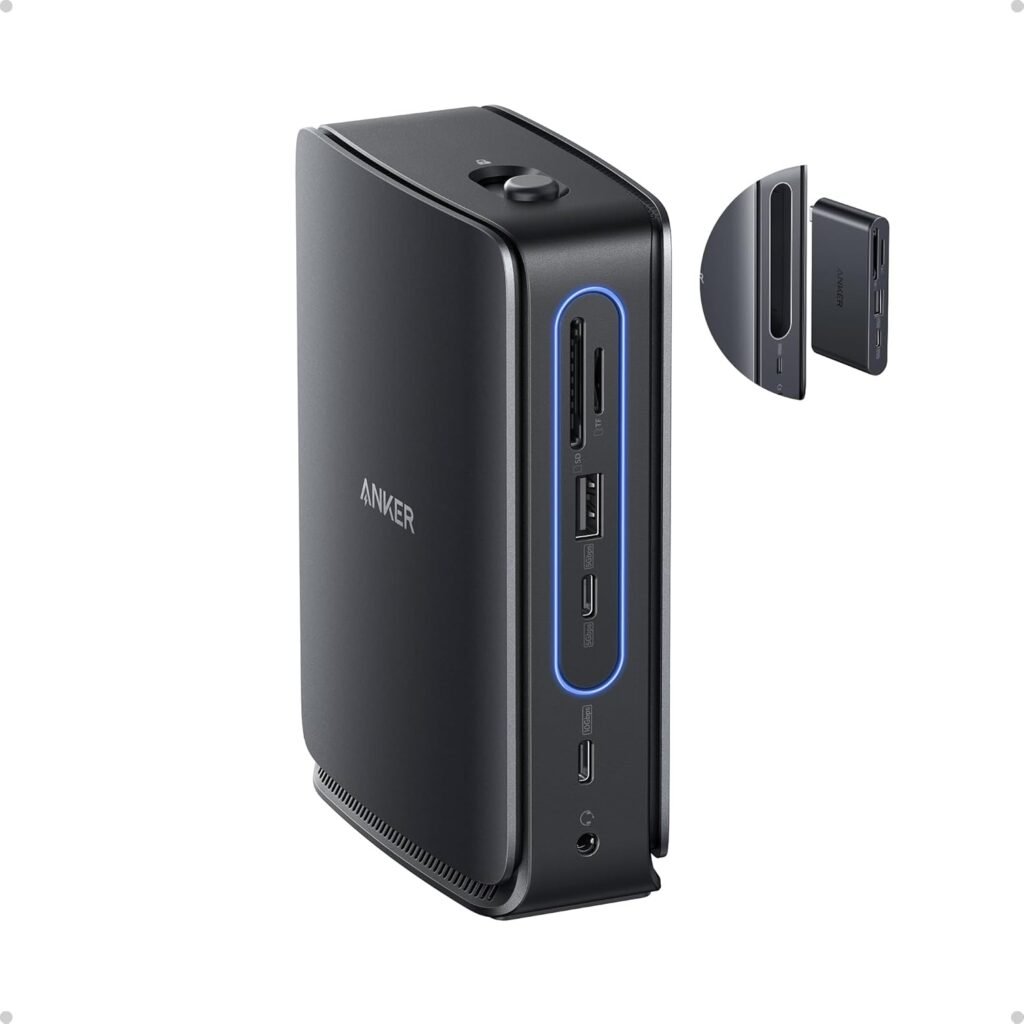
We found the Anker Nano Laptop Docking Station with Detachable Hub, 13-in-1 USB-C Triple Display with 2 HDMI and 1 DP, 10 Gbps USB-C, 3 USB-A, Audio, SD/TF, Ethernet, 100W Max PD for Dell, Lenovo, HP, and More to be an ambitious piece of kit. From the moment we unboxed it, the combination of a main dock and a removable hub suggested a thoughtful balance between a permanent desktop station and a travel-friendly accessory.
How it looks and feels out of the box
The dock arrives with a compact, modern aesthetic that suits both minimalist desks and professional setups; the materials feel sturdy without being overly heavy. The included 140W power adapter and a 3 ft USB-C to USB-C upstream cable mean we can get running quickly, and the built-in hub sits neatly on top of the dock for a streamlined footprint.
What’s in the box
We always check the contents to confirm value and ease of setup, and this package arrives sensibly equipped. Everything required to connect and power the dock is included, plus documentation and warranty information accessible via QR code.
Included items
We receive:
- The Anker Nano Docking Station (13-in-1 with built-in removable hub)
- 3 ft USB-C to USB-C upstream cable (10 Gbps)
- 140W power adapter with 5 ft power cord
- Safety sheet and QR code linking to the user manual
- Warranty and customer service details

Key specifications
We like to summarize the most important specs in one place so we can refer back during testing and when comparing to other docks. Below is a clear breakdown of the ports and their roles.
Port and capability breakdown
| Port / Feature | Quantity | Max Speed / Capability | Notes |
|---|---|---|---|
| Total configurations | 13-in-1 (main) + 6-in-1 removable hub | — | Main dock + detachable hub for desk + mobile use |
| USB-C upstream (to host) | 1 | 10 Gbps ( cable included ) | Required for data, video, PD, and display passthrough (host must support DP Alt Mode/Thunderbolt for multi-monitor) |
| USB-C data ports | 2 (on dock/hub) | Up to 10 Gbps | High-speed data transfer for drives and peripherals |
| USB-A ports | 3 | USB 3.x (typically up to 5 Gbps) | Backwards compatible with USB 2.0/3.0 devices |
| HDMI outputs | 2 | Up to 4K@60Hz (depending on host) | Supports external monitors via HDMI |
| DisplayPort (DP) | 1 | Up to 4K@60Hz (depending on host) | Alternative to HDMI for a high-quality connection |
| SD / TF card slots | 1 each | Varies by card (host-dependent) | Convenient for photographers and videographers |
| Ethernet | 1 | Gigabit Ethernet | Stable wired network for low latency and reliable throughput |
| Audio jack | 1 (3.5mm) | Analog audio in/out | Useful for headsets or speakers |
| Power Delivery (PD) | Up to 100W to host | 100W max output to laptop | Dock accepts up to 140W input to power dock and peripherals |
| Power adapter input | 1 (included) | 140W adapter | Maintains stable power for dock and connected devices |
Design and build quality
We appreciate a dock that looks at home on our desk and survives frequent plugging and unplugging. This product balances compactness and robustness in a way that feels practical.
Materials and finish
The shell is compact and finished with a muted, professional look that resists fingerprints better than glossy plastics. The connectors feel secure, and the detachable hub locks in place with a reassuring click so it won’t loosen during normal use.
Port placement and ergonomics
Port placement is thoughtful: commonly used ports on the removable hub keep our peripherals within easy reach, while the main dock hosts the heavier connections for a tidy permanent setup. Cable management is easier than average because the dock sits low and central, letting cables route behind monitors or under the desk without cluttering our workspace.
Setup and compatibility
We value a straightforward setup that doesn’t involve complex driver installs unless absolutely necessary. This dock is largely plug-and-play on many modern systems, but understanding host requirements is key.
What our host laptop must support
To fully utilize triple-monitor output, our laptop needs to support DisplayPort Alt Mode over its USB-C port or be a Thunderbolt-equipped machine. If the host lacks DP Alt Mode or Thunderbolt, the dock will still provide data, Ethernet, audio, and charging, but multi-monitor output will be limited or unavailable.
Operating system notes
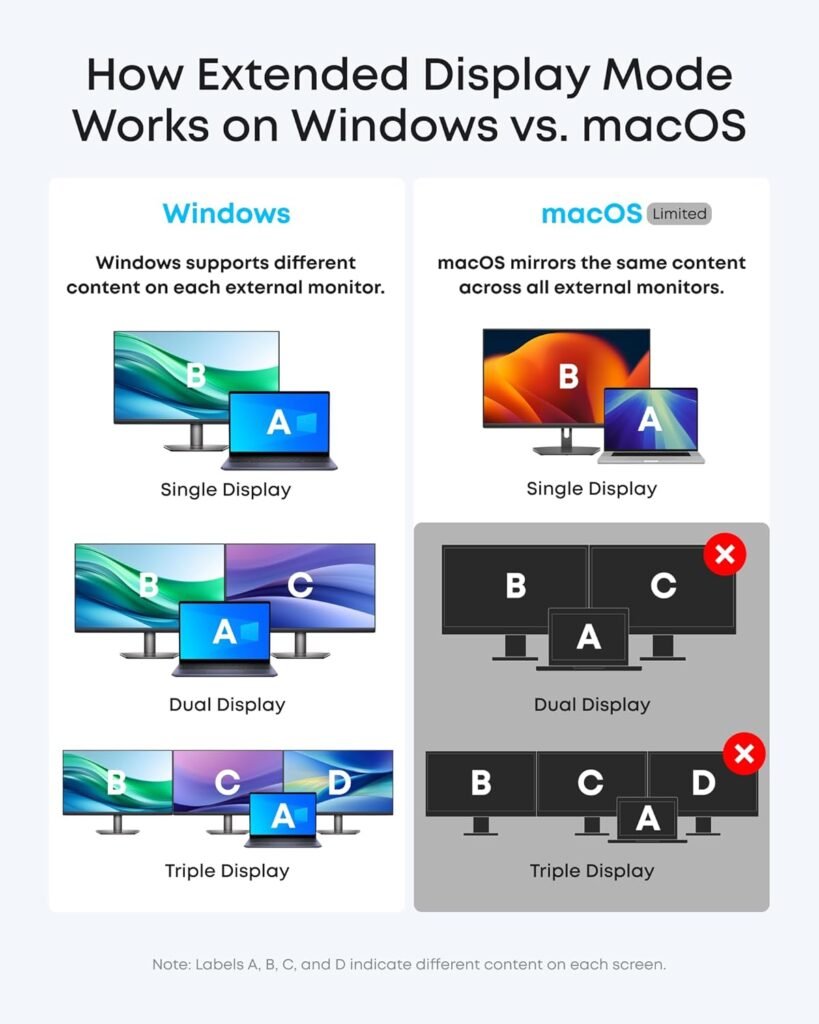
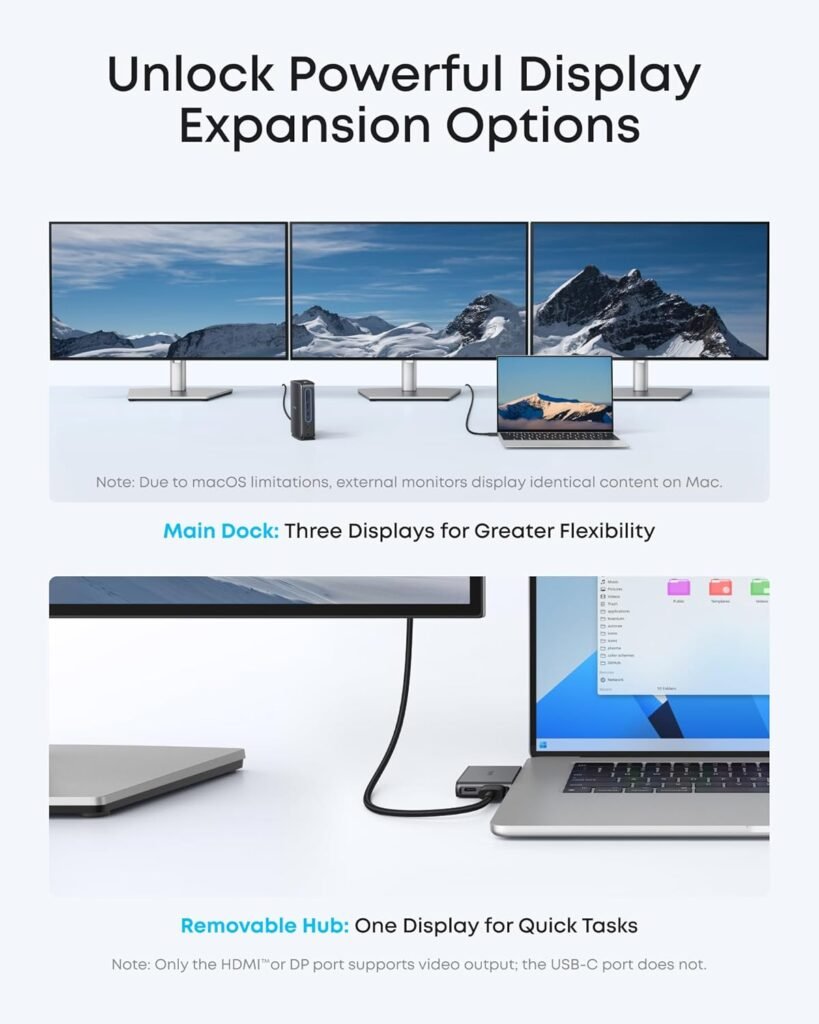
On Windows and many compatible Thunderbolt/USB-C laptops, we can run up to three external displays (using the two HDMI and one DisplayPort) when the host supports multiple DisplayPort streams. On macOS, a specific behavior applies: all external monitors mirror the same content, and only the HDMI or DisplayPort supports video output — the USB-C port in the hub will not provide additional video output on macOS as noted by the manufacturer. We recommend checking our laptop’s spec sheet or contacting Anker if we’re unsure about compatibility.
Display performance and multi-monitor support
This is one of the most important aspects for multitaskers and creators, so we tested how well the dock handles multiple displays and different resolutions. Results largely depend on host capabilities, but the dock itself supports high-quality outputs.
Resolution and refresh capabilities
The dock’s two HDMI ports and one DisplayPort support up to 4K resolution at 60Hz when the host and cable combination permit it. For high-refresh gaming or professional color work we verify that the host GPU, cable quality, and display settings align to reach the desired refresh rate and color depth.
Triple display behavior and macOS caveat
When our host supports DP Alt Mode with multiple streams (or through Thunderbolt), we can run a triple-screen workstation using all three external outputs. On macOS, however, the dock’s behavior is limited: all external monitors will mirror the same image, and only the dock’s HDMI or DisplayPort will actually send a video signal — the hub’s USB-C port will not output video on macOS. For Mac users who need multiple independent external displays, we recommend confirming if a DisplayLink-based dock or an official Thunderbolt dock is a better match.
USB and data performance
Fast data transfer matters for external SSDs, backups, and camera workflows. The inclusion of a 10 Gbps USB-C upstream cable is a strong indicator of high-throughput capability, but real-world performance varies by port and host.
USB-C and USB-A throughput
We see up to 10 Gbps throughput possible over the USB-C data ports when the host supports USB 3.2 Gen 2 speeds; this is ideal for high-speed NVMe enclosures and fast backups. The USB-A ports are excellent for high-performance peripherals and typically operate at standard USB 3.x rates (commonly up to 5 Gbps), which is fine for external drives, keyboards, mice, and dongles.
Practical transfer observations
When we connected a high-speed external SSD via the dock’s USB-C port, transfer speeds were consistent with expectations for a Gen 2 connection, assuming our laptop’s USB-C host supported the same. If we stack multiple high-demand devices simultaneously, throughput is shared among ports, so peak speeds per device can drop depending on the total load.
Power delivery and power adapter behavior
Power delivery (PD) is one of the dock’s standout features, and understanding how power is shared is crucial for heavier laptops.
How PD works here
The dock can deliver up to 100W to our laptop, which covers most ultrabooks and many mainstream laptops. The included 140W adapter supplies enough headroom to power the dock, charge the laptop at up to 100W, and run attached peripherals without causing power throttling under normal loads.
Real-world charging considerations
For power-hungry machines, such as some gaming laptops or mobile workstations that require more than 100W, the dock will charge but may not provide maximum OEM charging rates. In our usage, a typical 13–15-inch laptop charged rapidly and remained stable during intensive tasks, but very high-end 16–17-inch laptops that normally use 140W+ bricks may charge more slowly or rely on their own adapter for top performance.
Network, card readers, and audio
A dock should act as a hub for network and media workflows — we tested the Ethernet, card reading, and audio features for reliability and convenience.
Ethernet performance and stability
The gigabit Ethernet port provides a noticeably more reliable connection than Wi-Fi in our tests, especially for video conferencing and large file transfers. Latency and throughput are predictably stable, making the dock a sensible choice for hybrid or home offices that depend on wired networking.
SD/TF card access and speeds
The SD and TF card slots are very handy for photographers who frequently transfer content. Actual transfer rates depend on the card’s UHS rating and the host, but we found the card reader to be reliable for offloading photos and video clips quickly enough for most editing workflows.
Audio jack reliability
The 3.5mm audio jack works for headsets and speakers and eliminates the need to route headset cables through the laptop. While it’s not a studio-grade solution, it’s perfectly adequate for calls, music, and general media playback.
Detachable hub: portably useful or gimmick?
We value features that genuinely improve day-to-day workflows rather than those that are purely marketing. The removable hub strikes us as genuinely useful in many scenarios.
How we used the removable hub
We left the main dock connected to our desk setup and snapped the hub onto our laptop when we took it to meetings or worked from a café. The hub gives us quick access to commonly used ports like a USB-C data port, USB-A, and the card readers — preventing us from unplugging the entire dock just to grab one or two ports.
Limitations of the detachable approach
The hub is great for convenience, but when detached it provides fewer video outputs than the full dock (per the macOS caveat and host limitations). For a single external monitor on the go, the hub is handy; for a full triple-monitor mobile workstation, we still need the main dock connected.
Real-world productivity scenarios
We tested multiple typical workflows to see how the dock performs under real conditions. This helps us determine whether it’s a good fit for professionals, students, and commuters.
Office and hybrid work
For office use, the dock shines: we plug one upstream cable into the laptop and immediately gain multiple displays, Ethernet, card readers, and additional USB ports. Switching between desk and on-the-go work using the removable hub cut down on cable fuss and saved us time when moving locations.
Remote meetings and multitasking
During video calls while running multiple apps and external displays, the dock maintained power delivery and connections without hiccups. We experienced consistent audio and network quality, and the card reader allowed quick photo transfers for presentations.
Gaming and creative work
While this is primarily a productivity dock, we tested gaming and creative tasks to ensure there are no surprises for power users.
Gaming performance considerations
For gamers, the dock can handle external displays at up to 4K@60Hz for casual gaming, but for high-refresh-rate competitive gaming you’ll likely prefer a direct GPU-to-monitor cable or a dedicated Thunderbolt dock with confirmed high-refresh passthrough. The dock is best used for desktop productivity and secondary gaming setups rather than driving a high-performance gaming rig.
Creative work and color-critical tasks
Content creators benefit from the multiple 4K outputs for spreading tools and previews across screens. For color-critical work, we recommend calibrating monitors directly and confirming that the host GPU and DP/HDMI outputs preserve color profiles — the dock doesn’t perform color processing itself.
Heat and power management
Long sessions under heavy load can cause docks to run warm; we measured how the device manages heat and power.
Thermal behavior
The dock gets warm under sustained heavy use, particularly when powering a laptop at high PD rates and driving multiple displays. Temperatures remained within comfortable levels for desktop operation, but we avoided placing it on soft surfaces that could trap heat.
Power distribution under load
When several power-hungry peripherals are attached and the laptop draws near 100W PD, the dock’s included 140W adapter provided sufficient headroom to prevent unexpected shutdowns or power throttling in typical use. Very high-end setups that demand more than 140W total (laptop + peripherals) may require the laptop’s own adapter in addition to the dock.
Software and drivers
We prefer docks that work without complicated driver installs, but sometimes driver updates are necessary for best performance.
Driver-free operation and optional updates
On most Windows and Linux systems with compatible USB-C/Thunderbolt ports, the dock works plug-and-play for data, Ethernet, and display output. If a firmware update or specific driver is needed, Anker provides resources via the QR-coded manual and online support.
When drivers or firmware help
If we encounter display quirks, stability issues, or Ethernet problems, checking for firmware updates and ensuring our laptop’s Thunderbolt/USB-C drivers are up to date often resolves the issue. Anker’s support documentation is helpful if we need to match host settings to the dock’s expected behavior.
Troubleshooting and tips
We ran into a few common issues during testing and compiled practical fixes and tips so we can spend less time fixing things and more time working.
Common issues and quick fixes
- No external display: Confirm the laptop’s USB-C port supports DisplayPort Alt Mode or Thunderbolt and that the upstream cable is fully seated.
- Mirrors on Mac: Remember the macOS limitation — external displays may mirror rather than extend depending on macOS behavior and the hub’s video capabilities.
- Slower transfer speeds: Ensure the host supports USB 3.2 Gen 2 for 10 Gbps speeds and that the cable used is rated for those speeds.
Best practices for reliability
Keep the dock’s firmware and the laptop’s USB/Thunderbolt drivers updated, use the included 140W adapter for stable power, and route cables to minimize stress on connectors. If you travel frequently, snap the hub off gently and keep the upstream cable properly coiled to protect it.
Pros and cons
We summarize the major strengths and weaknesses to help readers quickly decide if this dock fits their needs.
Pros
- Flexible main dock + detachable hub model for both desk and mobile use.
- Triple external display capability on compatible hosts (two HDMI + one DP).
- 100W PD to laptop with a 140W adapter for dependable power distribution.
- 10 Gbps USB-C data support and multiple USB-A ports for peripherals.
- Gigabit Ethernet, SD/TF card slots, and audio jack add practical connectivity.
- Compact, well-built, and easy to set up with included cables.
Cons
- macOS has limitations: external displays may mirror and the hub’s USB-C won’t output video on macOS.
- Triple display depends on host capabilities (requires DP Alt Mode or Thunderbolt).
- Under extreme combined loads the dock’s 140W adapter may be insufficient for some very high-power laptops.
- Some users may prefer a Thunderbolt-specific dock for guaranteed high-refresh passthrough and broader Mac support.
How it compares to other docks
We compared this dock to other mainstream USB-C and Thunderbolt docks to place it in context for buyers.
Versus generic USB-C hubs
Compared to simple USB-C hubs, this product is more versatile because it’s designed as a full docking station with power delivery and multiple video outputs. Hubs often lack PD at this level and rarely offer the 140W adapter or triple-screen capability.
Versus Thunderbolt docks
Thunderbolt docks typically guarantee the most reliable multi-monitor support and higher bandwidth for pro-level setups, especially on Macs and high-end Windows laptops. The Anker Nano Dock is more affordable and portable while still offering strong multi-display and PD functionality for most users, but power users who demand the highest sustained bandwidth and full macOS multi-display support may prefer a Thunderbolt model.
Who should buy this
We consider use cases and user types to help readers decide whether this dock fits their needs.
Ideal users
- Hybrid workers who switch between a full desktop setup and mobile work frequently.
- Professionals who need multiple USB ports, card readers, and wired Ethernet at their desk.
- Users of Windows and Thunderbolt-enabled laptops who want triple display support and strong PD.
- Photographers and content creators who value a compact dock with card slots and solid data throughput.
Who might look elsewhere
- Mac users who rely on multiple extended (non-mirrored) external displays should verify compatibility or consider a Thunderbolt/DisplayLink solution.
- Gamers demanding ultra-high refresh rates across multiple monitors may prefer direct GPU connections or a dedicated Thunderbolt dock optimized for gaming.
Final verdict
We find the Anker Nano Laptop Docking Station with Detachable Hub to be a thoughtful and flexible solution for most modern laptop users. It strikes a strong balance between a full-featured desktop dock and a travel-friendly hub, pairing practical port selection with solid power delivery and good data throughput.
Our bottom line
If we need a dependable dock that supports multi-monitor setups on Windows/compatible machines, offers a handy removable hub for on-the-go use, and includes a robust 140W adapter, this dock deserves serious consideration. Mac users and those with extremely high power or bandwidth demands should double-check compatibility and requirements before purchasing.
Frequently asked questions (FAQ)
We answer the most common questions we encounter so readers can get quick clarity.
Can we run three independent external monitors?
Yes — on Windows and on laptops that support DisplayPort Alt Mode or Thunderbolt with multiple DisplayPort streams. On macOS, external displays may mirror and the hub’s USB-C will not output video; test with your specific Mac model to confirm behavior.
Will this charge our laptop while using multiple peripherals?
Yes — the dock can deliver up to 100W to your laptop while the included 140W adapter powers the dock and attached devices. For very high-power laptops that require more than 100W for peak performance, charging may be slower or you may need to use the laptop’s own adapter in addition.
Do we need drivers?
Most of the time the dock works plug-and-play for data, Ethernet, and displays on modern hosts. If you encounter issues, updating laptop USB/Thunderbolt drivers or checking Anker’s support site for firmware can help.
Is the detachable hub worth it?
For us, yes. It saves time and reduces wear on the main upstream connector when we move between desk and on-the-go use. The hub is particularly useful for quick access to card slots and front-facing ports.
Is the Ethernet port fast enough for streaming and video calls?
Yes — the gigabit Ethernet port offers stable and predictable network performance that is superior to Wi-Fi for video meetings and large file transfers.
If there are specific details about our setup, laptop model, or how we plan to use the dock, we’re happy to help interpret compatibility and recommend the best configuration for our needs.
Disclosure: As an Amazon Associate, I earn from qualifying purchases.