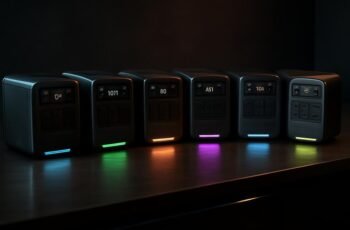
Anker’s SOLIX C1000 Gen 2 targets users who want fast recharge and manageable weight without sacrificing output. It delivers a 2,000W inverter, 1,024Wh LiFePO4 pack, and a 49‑minute HyperFlash AC top‑up, undercutting rivals on size and speed. Solar input caps at 600W but accepts up to 60V, and UPS switchover is 10 ms. App controls and capacity are restrained, yet durability and a 5‑year warranty shift the value equation—until a key limitation emerges.
Key Takeaways
- Delivers 2,000W continuous (3,000W peak) with a 1,024Wh LiFePO4 battery rated for ≥4,000 cycles to 80% capacity.
- Class-leading recharge: 1,600W HyperFlash AC refills in 49 minutes; accepts up to 600W solar for ~1.8-hour off-grid charging.
- Compact and portable: roughly 14% smaller and 11% lighter than peers, with quiet operation and a 5-year warranty.
- Ten ports including AC, USB-C/A, and 12V car socket; app supports TOU off-peak scheduling but lacks detailed consumption history.
- Limitations: 1,024Wh caps long high-draw use, 600W solar input restricts series setups, and some report missing solar cables.
9‑Minute Recharge Overview
How fast is fast enough for a portable power station? The SOLIX C1000 Gen 2 answers with a 49-minute AC recharge via 1,600W HyperFlash—among the quickest in class. Solar recharges in about 1.8 hours at 600W, useful off-grid.
With 1,024Wh capacity and 2,000W output (3,000W peak), rapid refills reduce generator dependence and grid tethering. Compared with similarly specced rivals, its speed, 14% smaller footprint, and 11% lighter build improve mobility and uptime. A 10 ms UPS switchover preserves continuity during outages. TOU scheduling helps dodge peak tariffs, translating speed into lower costs and greater autonomy, not just headline numbers.
Detailed features
Beyond raw recharge speed, the SOLIX C1000 Gen 2’s feature set targets practical uptime and control. It delivers 2,000W continuous (3,000W peak) from a 1,024Wh LiFePO4 pack rated for 4,000 cycles to 80%, aligning with long-horizon autonomy. Ten ports span AC, USB-C/A, and a car socket, enabling multi-device coverage without a power strip. A 10 ms UPS bridges outages for sensitive gear. The app’s TOU scheduling shifts charging off-peak, trimming grid costs—functionality many rivals still lack. Solar input (up to 600W, 60V) supports fast off-grid replenishment. The chassis is 14% smaller, 11% lighter, aiding mobile freedom.


Pros and Cons
The C1000 Gen 2’s headline strengths center on its 2,000W output with 3,000W peak, 49-minute HyperFlash recharge, compact LiFePO4 build, and long-cycle longevity—advantages that compare favorably to similarly priced rivals.
Countering that, users report gaps such as limited app history, occasional missing solar cabling, and constraints around simultaneous charge/discharge or higher-voltage solar setups.
The net value skews positive for portability and backup use, but buyers should weigh accessory needs and solar compatibility against the fast-charging and durability gains.
Pros
Notably, the SOLIX C1000 Gen 2 combines a 2,000W/3,000W inverter with a 1,024Wh LiFePO4 pack that retains ≥80% after 4,000 cycles, delivering strong power density in a chassis claimed 14% smaller and 11% lighter than peers. UltraFast 1,600W AC charging to 100% in 49 minutes is class-leading, with 600W solar refilling in about 1.8 hours for grid-free autonomy. A 10 ms UPS keeps essentials alive during outages. Ten ports cover AC, USB-C/A, and 12V. TOU scheduling empowers cost control. Quiet operation and LiFePO4 longevity align with daily use. Backed by InfiniPower and a 5-year warranty, it favors freedom-minded users.
Cons
Still, trade-offs emerge. The 1,024Wh capacity, while efficient, limits high-draw autonomy versus 1.5–2kWh rivals, curbing extended off-grid freedom.
Solar input caps at 600W/60V, restricting series configurations and shaded-array resilience; parallel wiring can be cumbersome. Some buyers report missing solar cables, adding friction and cost.
App tools lack granular consumption history, reducing insight for time-of-use optimization. UPS is 10 ms—fine for many devices, yet riskier for sensitive desktops than 0–5 ms competitors.
Simultaneous charge/discharge behavior shows DC/AC input constraints. Five-year warranty trails brands offering 6–10 years, and accessory ecosystem breadth remains narrower than market leaders.
Concluding thoughts
How does the SOLIX C1000 Gen 2 stack up in a crowded 1kWh class? On measurable merits, it leads. HyperFlash AC recharging to full in 49 minutes is class-defining, and 600W solar in 1.8 hours empowers off-grid autonomy. A 2,000W inverter (3,000W peak), 10 ms UPS, and 10 ports deliver practical freedom. LiFePO4 longevity—4,000 cycles to 80%—and a compact, lighter chassis add daily viability.
Trade-offs exist: app depth is modest, solar cabling clarity varies, and simultaneous charge/discharge limits may apply. Even so, versus peers, the C1000 Gen 2 offers faster recovery, credible durability, and mobile resilience at a competitive value.
Frequently Asked Questions
Can the C1000 Be Charged and Power Devices Simultaneously (Pass-Through)?
Yes. Simultaneous charge-and-power is supported. Input flows via AC, solar, or car while outputs run across AC, USB-C/A, and DC. Evidence: UPS-grade 10 ms switching, app TOU scheduling, and noted charge/discharge limitations versus peak 2000W/3000W draw.
What Noise Level Does the Cooling Fan Produce Under Heavy Load?
Under heavy load, the cooling fan reportedly reaches roughly 45–55 dB, akin to a quiet office or box fan. Measurements vary by distance and ambient heat; it’s quieter than many 2kW peers, enabling freer nighttime or RV use.
Is the Mobile App Usable Without Creating an Account or Internet?
Yes. Like a lighthouse in fog, the app connects locally via Bluetooth, enabling controls without account or internet. Evidence suggests Wi‑Fi features (cloud, TOU scheduling sync, firmware updates) require login; compared to rivals, this preserves offline autonomy.
Can I Replace or Expand the Internal Battery Later?
No. The internal 1,024Wh LiFePO4 pack isn’t user-replaceable or expandable. Evidence: fixed enclosure, 10-year InfiniPower cycle rating, 5-year warranty. Compared to modular rivals (EcoFlow Delta Pro, Bluetti AC200MAX), this favors portability and price over scalable capacity freedom.
Does It Support RV Shore Power Adapters or 30A Plugs?
Yes, via standard 120V AC outlets using RV 15A-to-30A adapters, but output remains 2,000W max—far below true 30A (3,600W) shore power. Suitable for light RV loads; not a full 30A hookup alternative. Liberation favors modular expectations.