Quiet nights meet power-on-demand: in 2025, compact solar stations let us pack light without sacrificing essentials. We’ve tested models that recharge fast, sip from the sun efficiently, and protect our gear with robust safety. From ultralight day hikes to fridge-ready car camps, we prioritized LiFePO4 longevity, MPPT solar input, and practical ports. Some units punch above their weight; others shine in reliability. The best part? There’s a clear fit for each trip—if we choose wisely.
Key Takeaways
- Prioritize LiFePO4 batteries for long cycle life, safety, and better cold-weather performance on multi-day camping trips.
- Match continuous output to your appliances; 300–1000W handles lights, laptops, and mini-fridges, 1500–1800W supports coffee makers and induction cookers.
- Fast AC recharge matters; top units hit 80% in 40–60 minutes, useful for quick top-ups before heading off-grid.
- Check solar input and MPPT support; 200–600W solar with MPPT enables 1–4 hour sun refills depending on capacity and conditions.
- Balance weight and capacity; sub-10 lb for ultralight (200–300Wh), 13–25 lb mid-size (~500–1000Wh), 50+ lb stations suit car camping basecamps.
EF ECOFLOW DELTA 2 Solar Generator with 2x220W Portable Panels


Looking for a fast-charging, camp-ready powerhouse? We like the EF ECOFLOW DELTA 2 with 2x220W portable panels for its 1024Wh LFP battery, 1500W running output (2700W surge), and 15 outlets in a compact 15.7 x 8.3 x 11.1-inch body. It weighs 57.8 pounds, but the kickstand panels and carry bag help mobility. We’ve run fridges, laptops, coffee makers, and radios, then recharged quickly via AC or solar. Charge-through means we can power gear while the panels refill the battery. Reviews average 4.5/5, praising speed and reliability. Notes: panel cables may need extensions; some report the AC button needs multiple presses.
Best For: Campers, RVers, and homeowners who want a portable, fast-charging solar power station for reliable backup and off-grid use with enough output for appliances and electronics.
Pros:
- 1024Wh LFP battery with 1500W continuous (2700W surge) and 15 outlets covers fridges, coffee makers, laptops, and more
- Fast AC and solar charging with charge-through capability to power devices while recharging
- Portable design with included 2x220W kickstand panels and carry bag; long-life LFP chemistry
Cons:
- 57.8 lb weight can be cumbersome for frequent moving or solo setup
- Solar panel cables may be too short for optimal placement; extensions often needed
- Some users report the AC power button requires multiple presses to engage
Anker SOLIX C1000 Portable Power Station (1056Wh, 1800W)

For campers who want fast turnaround and real appliance power, the Anker SOLIX C1000 stands out with 1800W output (2400W peak) and UltraFast recharging to 80% in just 43 minutes. We get 1056Wh of LiFePO4 capacity rated for 3,000 cycles—reliability for a decade of trips. SurgePad boosts to 2400W, so we can run 99% of camp and RV appliances. It’s 15% smaller than typical 1kWh units, yet includes 11 versatile ports. With 600W solar input, we can fully recharge in about 1.8 hours. In the box: power station, solar panel connector, AC and car cables, and a user guide.
Best For: Campers, RV travelers, and homeowners needing fast recharge, high output (1800W/2400W peak), and reliable 1kWh backup with long lifecycle.
Pros:
- UltraFast AC recharging: 80% in 43 minutes; full in under 1 hour
- 1800W output with 2400W SurgePad runs 99% of common appliances
- Long-lasting 1056Wh LiFePO4 with 3,000 cycles and 11 versatile ports in a compact design
Cons:
- Smartphone and Anker app required to control UltraFast recharging
- Optional solar panel not included (panel sold separately)
- 600W max solar input may limit recharge speed with smaller/less optimal arrays
GRECELL Portable Power Station 300W Solar Generator

Compact yet capable, the GRECELL Portable Power Station 300W (T300) stands out for campers who prize low weight and versatile ports over sheer capacity. At 7.3 pounds with a 230.88Wh battery and 330W output (600W surge), it’s ideal for lights, cameras, laptops, tablets, CPAP, and a mini-fridge under 330W. We like the 6 outputs: 110V pure sine AC, USB‑C PD 60W + 18W, two USB‑A QC, and a car port. Charging’s flexible via AC, car, or the 40W solar panel with MPPT. The upgraded BMS and dual silent fans boost safety. Note the input limit and modest capacity for heating appliances.
Best For: Campers, car travelers, and emergency backup users who need a lightweight, portable power station with versatile ports for low-to‑medium wattage devices (laptops, cameras, CPAP, lights, mini-fridge under 330W).
Pros:
- Compact and light (7.3 lb) with a 230.88Wh capacity and 330W pure sine wave AC output (600W surge)
- Versatile I/O: 6 outputs including 110V AC, USB-C PD 60W + 18W, 2x USB-A QC, and a 12V car port
- Built-in MPPT for efficient solar charging plus upgraded BMS and dual silent fans for safety
Cons:
- Limited capacity (230.88Wh) and 330W output not suitable for most heating appliances or higher-wattage tools
- Input charging limit can slow recharge times, especially versus larger units
- Only one AC outlet and real-world output may be slightly below rated due to efficiency losses
Jackery HomePower 3600 Plus Portable Power Station
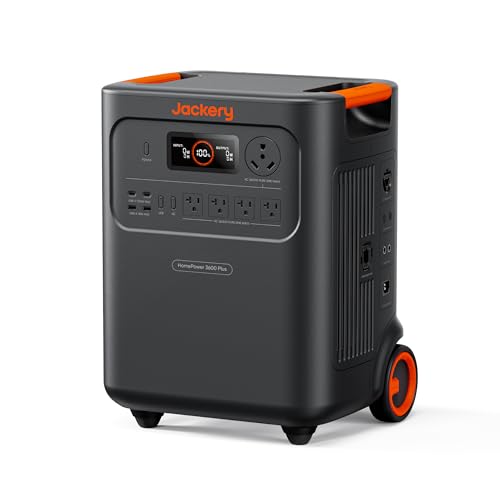
Meet the Jackery HomePower 3600 Plus, the 3.6kWh LFP powerhouse we’d pick when you need real home-backup muscle on a campsite or overland base. It delivers 3600W AC (7200W in parallel) and dual 120V/240V when paired, so pumps, heaters, and even dryers are fair game. With 3584Wh capacity, you can expand to 21kWh per unit or 43kWh across multiple units.
We like its rugged CTB build, ceramic-membrane cells tested to 302°F, 6,000 cycles, and -4°F operation. Recharge in 2 hours via hybrid AC+DC, 2.5h AC, 4h solar, or 2.5h generator. At 77 pounds, the wheeled, telescopic design rolls easily.
Best For: Homeowners, RV/overland travelers, and preparedness-minded users who need a high-output, expandable, plug-and-play power station for whole-home essentials and heavy appliances.
Pros:
- 3600W AC output (7200W parallel) with dual 120V/240V support for pumps, heaters, and dryers
- Expandable capacity from 3584Wh up to 21kWh per unit (43kWh multi-unit), fast recharge: 2h hybrid AC+DC, 4h solar
- Rugged CTB design with ceramic-membrane LFP cells: 6,000 cycles, 10-year life, tested to 302°F, operates down to -4°F
Cons:
- Heavy at ~77 lbs despite wheels; lifting into vehicles or upstairs can be challenging
- Full dual-voltage (240V) requires parallel setup with additional unit and hardware
- Higher upfront cost versus smaller power stations or single-fuel generators
EF ECOFLOW River 2 Max Portable Power Station (499Wh, up to 1000W)

Need a fast-charging, travel‑friendly power hub for weekend camps and RV stops? The EF ECOFLOW River 2 Max delivers 499Wh in a compact 13.3 lb body (10.6 x 10.2 x 7.7 in) and recharges from AC in just 1 hour via X-Stream. It pushes up to 1000W total output with pure sine wave AC, USB-C, and more, powering up to 11 devices at once.
We like its LiFePO4 battery rated for 10+ years, advanced BMS, quiet operation, and pass-through/UPS support. Add a 220W solar panel for a 2.3-hour top-up. It’s ideal for lights, laptops, cameras, projectors, and astrophotography rigs. Backed by a 5-year service plan.
Best For: Campers, RV travelers, and home users who want a lightweight, fast‑charging portable power station that can safely run multiple devices and double as a small UPS.
Pros:
- 1-hour AC recharge via X-Stream and fast solar top-up (~2.3 hrs with 220W panel)
- 499Wh LiFePO4 battery with 10+ year lifespan and advanced BMS; pure sine wave output
- Compact 13.3 lb design powering up to 11 devices (USB-C, AC, and more), quiet and emission-free
Cons:
- 300W AC outlet rating limits some high-draw appliances despite 1000W surge capability
- Solar panel not included; requires extra purchase for off-grid charging
- 499Wh capacity may be insufficient for extended outages or power-hungry gear
Portable Solar Generator 300W Power Station with 60W Foldable Solar Panel

For campers who want plug-and-play solar in a truly portable package, this 300W power station pairs a 280Wh lithium battery with an included 60W foldable monocrystalline panel for reliable off‑grid recharging. Weighing just 5.08 pounds, it delivers pure sine wave 110V power from two 300W AC outlets, plus DC, USB-A, quick-charge, and USB-C ports for phones, tablets, cameras, and small laptops. MPPT optimizes the panel’s ~20.5% efficiency, while AC, car, or solar recharging adds flexibility. The BMS safeguards against shorts, overloads, and overheating. Don’t run devices over 300W. Keep the junction box dry. For longevity, maintain 60–80% charge.
Best For: Campers, RVers, and emergency-prep users who want a lightweight, plug-and-play 300W power station with included 60W solar panel for off-grid charging of small devices and electronics.
Pros:
- Portable 5.08 lb design with 280Wh battery and included 60W foldable monocrystalline panel (MPPT for efficient solar charging)
- Versatile outputs: 2x 110V/300W pure sine AC, DC port, USB-A, quick-charge, and USB-C for phones, tablets, cameras, small laptops
- Robust protections via BMS (short circuit, over-current/voltage, overload, overheat) and auto-adjusting cooling fan
Cons:
- 300W output limit excludes many appliances (coffee makers, hair dryers, pumps)
- Junction box isn’t waterproof; requires dry conditions and careful handling outdoors
- AC recharge takes ~7–8 hours; solar performance varies with weather and panel positioning
Jackery Explorer 300 Portable Power Station (293Wh)

Traveling light but want real AC power? The Jackery Explorer 300 delivers 293Wh in a 7.1-pound, compact package with two pure sine wave AC outlets (300W, 500W surge). We get smooth, quiet, maintenance-free power and six total outputs: 2 AC, 60W USB-C PD in/out, QC3.0, USB-A, and a 12V car port.
Recharge fast: to 80% in about 2 hours using the wall plus 60W USB-C. On the road, use a car outlet or pair a SolarSaga 100; the built-in MPPT maximizes solar input. It supports pass-through charging, runs essentials like fans, routers, TVs, cameras, and laptops, and earns ~4.6/5 ratings. Accessories included; solar panel sold separately.
Best For: Campers, road-trippers, and emergency preppers who need a lightweight, quiet, 293Wh portable power station with true AC output for small electronics and essentials.
Pros:
- Fast recharge to ~80% in about 2 hours via wall plus 60W USB-C PD; supports pass-through charging and multiple devices at once.
- Clean, reliable power: two pure sine wave AC outlets (300W, 500W surge) plus USB-C PD, QC3.0, USB-A, and 12V car port in a 7.1 lb package.
- Solar-ready with MPPT for efficient charging from a SolarSaga 100; quiet, no fumes, low maintenance.
Cons:
- Not suitable for high-draw appliances (e.g., induction cooktops, blenders); 300W continuous limit.
- Solar panel not included; additional cost for off-grid recharging.
- 293Wh capacity may be limiting for extended trips or powering larger devices for long durations.
Jackery Explorer 1000 v2 Portable Power Station

Serious campers who want fast, dependable power will appreciate the Jackery Explorer 1000 v2’s 1,500W AC output (3,000W surge) and one-hour emergency fast charge. We like its 1,070Wh LiFePO4 battery, rated for 4,000 cycles to 70% and a 10-year lifespan. At 23.8 lbs with a foldable handle, it’s easy to haul. Ports cover most gear: three pure sine AC outlets, two USB-C (100W PD), one USB-A, and a 12V car port. The app lets us switch modes, enable 1-hour emergency charging, and use 30 dB quiet charging. Note: solar panels aren’t included and solar charging supports Jackery panels only.
Best For: Campers, RVers, and emergency-prep users who need fast, dependable off-grid power with robust AC output and long LFP battery life.
Pros:
- 1,500W AC (3,000W surge) with three pure sine outlets plus dual 100W USB-C for laptops and high-draw gear
- LiFePO4 battery rated for 4,000 cycles to 70% and 10-year lifespan; ChargeShield 2.0 and quiet overnight mode via app
- One-hour emergency fast charging; portable 23.8 lbs design with foldable handle
Cons:
- Solar panels not included and solar charging is limited to Jackery-branded panels
- App requires account management; some users note mixed experiences with app behavior
- Premium price for capacity; display and unit size may feel large for ultralight setups
MARBERO Portable Power Station 88Wh (Solar Panel Optional)

Looking for an ultralight backup you can toss in a daypack without thinking twice? We like the MARBERO M82: 88Wh, 80W output (120W peak), just 2.29 lb, and compact at 6.5 x 4.6 x 3.1 inches with a handy grip. It charges fast—0–80% in about 2 hours via wall—and can charge devices while it tops up. Add a 30W or 60W MARBERO panel for solar.
You get eight outputs (AC, DC, USB, USB-C PD) plus a car socket. It’ll handle phones, tablets, small laptops, a car fridge, or an air compressor. The flashlight runs up to 68 hours. Note: some users report fan noise and slower full charges.
Best For: Ultralight travelers, day-hikers, and emergency kit users who need a compact, easy-to-carry power station for phones, tablets, and small devices with occasional AC use.
Pros:
- Lightweight and compact (2.29 lb; 6.5 x 4.6 x 3.1 in) with ergonomic handle for grab-and-go portability
- Fast wall charging to 80% in ~2 hours; supports passthrough charging for devices
- Versatile I/O: 8 ports including AC, DC, USB, USB-C PD, and car socket; built-in flashlight up to 68 hours
Cons:
- Limited output (80W continuous, 120W peak) not suitable for high-draw appliances
- Some users report noticeable fan noise and slower time from 80% to full
- Small 88Wh capacity means frequent recharges for power-hungry gear or multi-day trips without solar
Anker SOLIX C300 Portable Power Station (288Wh, 300W)

Compact yet capable, the Anker SOLIX C300 suits campers who want real-world portability without sacrificing modern USB-C power. We like its 288Wh LiFePO4 battery, 300W output (600W surge), and quiet 25dB operation. With 8 ports—3 AC, car socket, 2× USB‑C (one 140W PD 3.1 in/out), 1× 15W USB‑C, 1× USB‑A—it handles laptops, cameras, lights, and CPAPs, but not high‑wattage kitchen gear.
Recharging’s flexible: 80% in ~50 minutes from the wall, solar via 60–100W panels (not PS30/PS200/PS400), USB‑C, or car, with pass‑through. At 9.02 lb, it’s travel‑friendly for car camping. Expect 3,000+ cycles, smart temp control, and a 5‑year warranty.
Best For: Campers, car travelers, and emergency backup users who want a compact, quiet LiFePO4 power station with strong USB‑C (140W PD) and enough AC capacity for laptops, cameras, lights, and CPAPs—not high‑wattage appliances.
Pros:
- Fast recharge to ~80% in about 50 minutes via wall; 140W USB‑C PD 3.1 in/out and pass‑through charging
- Lightweight and compact (9.02 lb) with quiet 25 dB operation; 8 versatile ports including 3 AC and car socket
- Long-life LiFePO4 battery (3,000+ cycles), smart temperature control, and 5‑year warranty
Cons:
- 300W continuous output limits use with high‑wattage kitchen devices and power tools
- Not compatible with Anker SOLIX PS30/PS200/PS400 solar panels; best with 60–100W panels
- Strap not included by default on some models; not ideal for backpacking due to weight and size
Factors to Consider When Choosing Solar Portable Power Stations for Camping
Let’s match a station to our trip by sizing power capacity for our devices, checking continuous output and surge for gear like coolers or pumps, and confirming fast charging options that fit our schedule. We’ll weigh portability against runtime so we’re not lugging extra pounds up the trail. Finally, we should ensure solar compatibility—panel wattage, connectors, and accessories—so recharging in camp is seamless.
Power Capacity Needs
How much capacity do we really need? Let’s size it to our essentials and how long we’ll be off-grid. Capacity, measured in watt-hours (Wh) or kilowatt-hours (kWh), tells us how long a station can run devices between charges. Lightweight units around 88Wh cover phones and headlamps for a night. Midrange packs (300–700Wh) handle lights, phones, cameras, and a small fan over a weekend. Larger options (1,000–3,584Wh) support fridges and longer trips.
We should add a buffer for cloudy days and charging gaps—plan 20–30% extra. Battery chemistry matters too: LiFePO4 typically delivers 3,000–6,000+ cycles and steadier usable capacity, great for frequent camping. Remember the trade-off: higher capacity usually means more weight and bulk—fine for vehicle camping, less ideal for backpacking.
Output Wattage and Surge
When we size a power station, continuous output and surge capacity matter as much as total Wh. Output wattage tells us the steady power available. Typical camping units range from 300W to 1800W, which dictates what we can run at once—think lights and laptops versus an induction cooker and a mini‑fridge together.
Surge (or starting) wattage is the short burst for high‑load startups. Fridges, AC compressors, and some power tools spike briefly; without enough surge, the station trips. Many mid‑range models deliver 500–1000W continuous with 1000–2000W surge.
We should list our critical devices, note the largest startup draw, and pick a station whose surge rating comfortably exceeds it. That cushion prevents nuisance shutdowns during transient loads and keeps multiple devices running smoothly.
Charging Speed Options
Why does charging speed matter on a camping trip? It dictates how quickly we’re back to full power between hikes, meals, and sundown. Fast AC recharge can push many stations to 80% in about 43 minutes to 2 hours, depending on inverter design and battery chemistry—perfect before we head out again.
Solar speed varies more. With strong sun and high-input models, we might see around 1.8 hours, but lower-watt panels or clouds stretch that to several hours. Know the max solar input and our panel’s wattage.
USB-C PD adds flexibility: 60–100W in/out can top up laptops and the station itself. We also value pass-through charging to run lights or a fridge while recharging. Multi-source options (AC, solar, car) help, though total input limits—often 150W–600W—cap the pace.
Portability and Weight
Out on the trail or shuffling gear from car to campsite, portability can make or break our setup. We should match weight to how we move. Sub-3 kg units are easy to hand-carry or strap to a pack, ideal for minimalist weekends. Mid-range models around 7–13 kg trade ounces for capacity, suiting car campers who still need manageable lifts.
Compact dimensions matter, too. Boxes roughly 9–10 inches in any direction slot into tight trunks, tent vestibules, and gear bins. We’ll also appreciate foldable or integrated handles—and wheels—for rolling across gravel or long RV pads.
Remember the trade-offs: lighter, smaller stations usually mean lower Ah/Wh and shorter runtimes. Higher wattage and surge headroom add kilos. Let’s pick the lightest unit that still powers our essential devices.
Solar Compatibility/Accessories
How quickly and easily can we harvest sun into usable watts? We look for MPPT charging and a high solar input ceiling. With MPPT and, say, 220W panels, some stations can fully recharge in about 1.8–2.3 hours in ideal sun; expect slower times under haze or clouds. Check the dedicated solar connector: some units accept standard MC4, others need proprietary panels or adapters.
We also consider pass-through charging. It’s handy for keeping lights or a fridge running while recharging, but heavy loads can throttle or interrupt solar input. Panel practicality matters, too. Foldable, lightweight panels with kickstands, long cables, and the right connectors let us place the unit in shade and the panel in full sun, then fine-tune tilt and alignment for maximum harvest at camp.
Conclusion
As we wrap up, think of these solar power stations as our camp’s beating heart—quiet, steady, and ready when adventure calls. From ultralight quick trips to power-hungry basecamps, we’ve highlighted packs that balance portability, longevity, and fast, safe charging. Pair LiFePO4 durability with MPPT-ready solar and versatile outputs, and we’re set for lights, laptops, fridges, and more. Choose the capacity that fits your style, pack smart, and let the sun carry us farther with confidence.