Like keeping a candle ready before the lights flicker, we understand reliable backup power isn’t a luxury—it’s peace of mind. This year’s standouts balance capacity, speed, and true home-friendly features. We’ll compare the Jackery Explorer 2000 v2, the compact Explorer 1000 v2, and the HomePower 3000 with UPS, and explain who each best serves. If you’ve wondered which unit can keep essentials running without fuss, the answer might surprise you.
Key Takeaways
- Prioritize LiFePO4 units (4,000+ cycles) for 8–10 years of reliable home backup with stable capacity.
- Look for fast AC recharge: 0–80% in ~1 hour minimizes downtime during outages.
- Ensure ≤20 ms UPS switchover to keep PCs, routers, and fridges running without reboot.
- Match capacity and output to needs: ~1–3 kWh and 1.5–3.6 kW for essentials and short blackouts.
- Verify port mix: multiple AC outlets, 100W USB‑C PD, 12V/TT‑30, plus app control and solar readiness.
Jackery Explorer 2000 v2 Portable Power Station (2042Wh LiFePO4)


If you want a dependable home backup that charges fast and runs most essentials, the Jackery Explorer 2000 v2 stands out with its 2042Wh LiFePO4 battery, 2200W AC output across three outlets, and 0–80% recharge in just 66 minutes. We like that it hits a full charge in 102 minutes via Emergency Super Charging, supports 100W USB-C PD, and weighs about 40 pounds. It’s quiet (<30dB), supports pass-through, and switches to UPS in 20ms (UL1778). Expect up to 10 years of life, CTB construction, and app control. In practice, it powers a fridge, TV, coffee maker, sump pump, lights, and fans.
Best For: Homeowners, campers, and small businesses needing a fast‑charging, quiet, UPS-capable portable power station that can run most essentials during outages or off-grid trips.
Pros:
- Rapid AC recharge: 0–80% in 66 minutes; full in ~102 minutes via Emergency Super Charging
- Robust power and capacity: 2042Wh LiFePO4, 2200W AC across three outlets, plus 100W USB‑C PD
- Quiet, safe, and durable: <30dB operation, LiFePO4 longevity (up to 10 years), UL1778 UPS with 20ms switchover
Cons:
- Heavy at ~40 lbs, less convenient for frequent carry without a cart
- Solar input speed requires sufficient panels (about 400W for ~6 hours), adding cost
- Typically pricey outside sales; best deals often tied to promos or coupons
Jackery Explorer 1000 v2 Portable Power Station

Need fast, quiet backup power without babysitting settings? The Jackery Explorer 1000 v2 delivers 1,500W AC output (3,000W surge) from a 1,070Wh LiFePO4 battery in a 23.8 lb, grab-and-go body with a foldable handle. We like the three pure sine AC outlets, dual USB‑C with 100W PD, USB‑A, and a 12V car port for flexible home and travel use.
ChargeShield 2.0 plus the app lets us pick modes: default 1.7‑hour full charge for longevity, 1‑hour emergency charging, 30 dB quiet overnight, and efficiency mode. Expect 4,000 cycles to 70%—over 10 years. Note: solar panels aren’t included and must be Jackery‑compatible.
Best For: Campers, RVers, and homeowners who want a portable, fast‑charging, app‑controlled power station that can quietly run essentials and small appliances with minimal fuss.
Pros:
- 1,500W AC output (3,000W surge) with three pure sine wave outlets plus dual 100W USB‑C, USB‑A, and 12V car port for versatile device support
- Fast, flexible charging via ChargeShield 2.0 and app modes: 1.7‑hour standard, 1‑hour emergency, 30 dB quiet, and efficiency mode
- Long‑life LiFePO4 battery rated for 4,000 cycles to 70% (10+ years) in a portable 23.8 lb form factor with foldable handle
Cons:
- Solar panels not included and solar charging is limited to Jackery‑compatible panels
- App requires account management; some users report mixed experiences with app behavior
- Display size and price may not suit all buyers, and the 1,070Wh capacity may be limiting for high‑draw, long‑duration needs
Jackery HomePower 3000 Portable Power Station with Solar Panels
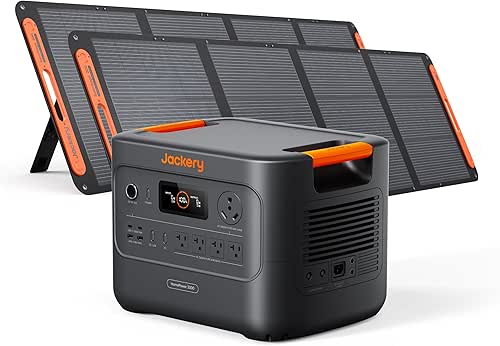
Serious about whole-home essentials during outages? We like Jackery’s HomePower 3000 for its 3600W output (7200W surge) and 3072Wh LiFePO4 battery. It handles fridges, routers, lights, and fans, with ≤20ms UPS switchover and UL certification. Expect up to 15 hours of typical household use; a fridge can run 1–2 days. It recharges in 1.7 hours via hybrid AC/DC or 2.2 hours on AC. Two 200W SolarSaga panels reach about 80% in roughly 9 hours of good sun.
You get 4 AC outlets, USB-A/C, DC, and a TT-30 port, plus app control. Note weight (59.5 lb), pricier panels, and potential accessory costs.
Best For: Homeowners and RV users who want a high-capacity, fast‑charging LiFePO4 backup with UPS functionality to keep essential appliances and networks running during outages.
Pros:
- 3600W output (7200W surge) with 3072Wh LiFePO4 battery and ≤20ms UL-certified UPS for seamless backup of fridges, routers, lights, and fans
- Fast recharge: 1.7 hours hybrid AC/DC or 2.2 hours AC; solar ready with included 2x200W panels and app-based monitoring
- Versatile ports including 4 AC outlets, USB-A/C, DC, and TT-30 RV port; durable design with 4,000-cycle lifespan
Cons:
- Heavy at 59.5 lb, reducing portability for frequent moves
- Solar expansion can require extra-cost adapters/splitters; Jackery panels are pricier than some alternatives
- Solar charging to 80% in ~9 hours depends on strong sun; real-world solar performance varies by conditions
Factors to Consider When Choosing Portable Power Stations for Home Use
Before we pick a unit, we should match power output to the appliances we’ll run and size battery capacity for the outage length we expect. We’ll compare battery chemistry (LiFePO4 vs. NMC) for cycle life and safety, and check charging options for fast AC, solar input, and car charging. We’ll also confirm UPS transfer time to protect sensitive gear during brief outages.
Power Output Needs
Power starts with matching what we actually run to what a station can deliver, both continuously and in short bursts. We list essentials, add their simultaneous watt draw, and ensure the station’s continuous AC rating comfortably covers it. Then we check surge capacity for startup spikes—think a fridge compressor—so peak load doesn’t trip the inverter; a 3000W surge buffer is a common target.
We compare top-end continuous outputs—roughly 1500W to 3600W—to our use cases: fridge, router, a few lights, and small appliances. Enough headroom prevents nuisance overloads without paying for unnecessary capacity. If we need an uninterrupted handoff, we pick a unit with UPS or ≤20ms switch time to protect sensitive electronics. Finally, we confirm recharge pathways—fast AC, solar, or car—to maintain operation during extended outages.
Battery Capacity Size
How much battery do we really need? Battery capacity, measured in watt-hours (Wh), tells us how long a power station can run our devices. Higher Wh equals longer runtime for the same load. As a quick guide, a 500W load drains a 1000Wh battery in about two hours; a 1000W load lasts roughly one hour, ignoring efficiency losses.
For typical home essentials, 1000–1500Wh can keep a fridge, router, and lights going for several hours. If we expect longer outages or heavier draws, 2000–3000Wh extends runtime and offers headroom for transient spikes. Remember, bigger batteries add weight and bulk, affecting portability and setup time. If outages are frequent or peak loads are likely, prioritize higher capacity to reduce recharge cycles and maintain reliable backup power.
Battery Chemistry Type
Capacity sets runtime, but the battery’s chemistry shapes safety, longevity, and weight. For home backup, we favor LiFePO4 (lithium iron phosphate) because it’s safer indoors and lasts far longer than many other lithium chemistries. Expect roughly 4,000–10,000 cycles with good management, while many packs still retain about 70–90% capacity after thousands of cycles.
LiFePO4’s thermal stability reduces the risk of thermal runaway, giving us confidence for long-term storage and frequent use. It also tolerates deep discharges and has a flatter discharge curve, so power delivery stays consistent as the battery drains.
The trade-off: LiFePO4 has lower energy density than lithium cobalt oxide options, so for the same capacity, units are heavier. We’ll accept extra weight for durability, predictable output, and enhanced safety.
Charging Speed Options
When minutes matter during an outage, charging speed can make or break a power station’s usefulness. We look for clear AC fill times—numbers like 0–80% in 66 minutes or full in about 102 minutes—so we know exactly how fast we’re back online. Some brands add a 1-hour emergency charge mode in-app, which is handy when the grid’s unstable.
We also want flexible inputs. USB-C PD up to 100W lets us quickly top laptops and phones without firing up the inverter. Solar input matters too; a 400W peak array can refill a mid-size unit in roughly 6 hours of ideal sun, longer in clouds. Hybrid charging (AC + car DC) shortens downtime. Finally, LiFePO4 packs sustain speed across years—4,000+ cycles with 70%+ capacity retention.
UPS Transfer Time
Fast charging gets us back to full, but staying online during the switchover matters just as much. UPS transfer time is the brief interval between an outage and when the power station’s output fully takes over. We look for specs in the 0–20 ms range; the shorter the gap, the lower the chance a PC, router, NAS, or server reboots.
Many premium models promise seamless switching in single-digit to low tens of milliseconds. That’s enabled by instant switchover circuitry designed for UPS duty, rather than simply letting the battery discharge and hoping the inverter catches up.
Expect real-world results to vary. Load type, state of charge, and whether we’re wired through a dedicated UPS output or essential-circuit connection can slightly lengthen transfer time.
Port Selection Variety
Why pick a power station with just one or two plugs when we can get a hub for everything? We should look for models with multiple AC outlets, several USB-A and USB-C PD ports, plus DC car and RV/TT-30 outputs. That mix lets us run a fridge, charge laptops and phones fast via 60–100W USB-C, and power lights or a router—all at once without extra adapters.
A LiFePO4 battery is a smart foundation. With 4,000+ cycles, it keeps those ports reliable for years of frequent use. We also value units that pair broad port arrays with UPS functionality, switching in roughly 20 ms to keep essential outlets live during an outage. Aim for 2–4 USB ports, multiple AC sockets, and RV compatibility to cover everyday and emergency needs.
Noise and Cooling
How quiet is quiet enough for a power station we’ll use in a living room or bedroom? We should look at decibel ratings during operation, not just marketing claims. Some units hit sub-30 dB in standby or low-power modes—great for nighttime or movie time—but noise can rise under heavier loads.
Smart cooling matters. Many models use temperature-controlled fans that spin only as needed, maintaining safe battery temps while minimizing sound. Passive cooling—heat sinks and well-designed venting—helps shed heat at light loads, keeping fans off longer.
Expect fan ramps at full load; better thermal management keeps noise spikes shorter and softer. When comparing options, check measured dB across load levels, not a single “quiet” figure. We want consistent low noise and efficient cooling, especially indoors.
Portability and Weight
Quiet power doesn’t help much if we can’t move the unit where we need it. Portability matters, and weights vary a lot—roughly 23.8 lb for compact models up to about 40 lb for higher-capacity units. We should match weight to how we’ll use it: quick room-to-room moves, loading into a car, or repositioning at a campsite.
Handle design and form factor make a real difference. A rectangular brick with sharp edges tires hands faster than a carry-friendly shape with balanced, padded grips. Heavier models usually deliver bigger battery reserves and more ports, trading convenience for runtime. If we want longevity without the bulk, some LiFePO4 options keep mass manageable. Before buying, let’s picture the actual lifts, steps, trunk height, and any tight spaces at home.
Conclusion
In the storm-tossed sea of modern life, these power stations are our steadfast lanterns. We’ve charted the Explorer 2000 v2, nimble 1000 v2, and guardian HomePower 3000 like ships with different sails, yet the same true north: resilience. When the grid blinks, they whisper continuity. Choose by voyage—capacity, output, UPS calm—so we don’t drift in the dark. In preparing light before nightfall, we’re not just backing up power; we’re safeguarding possibility.