When outages hit, we want backup power that’s safe, fast to recharge, and sized for real-world needs. In 2025, standout options range from UPS-ready heavy hitters to compact units you can stash in a closet. We’ll compare capacity, LiFePO4 longevity, surge output, solar input, and switchover speed—plus what actually runs a fridge, CPAP, or router. Some models even scale to multi-day storage. Let’s see which ones truly keep the lights on when it counts.
Key Takeaways
- Prioritize LiFePO4 models with 3,000–6,000 cycles for long life and safer home backup.
- Ensure pure sine wave inverters and 20 ms or faster UPS switchover for sensitive electronics.
- Match capacity to runtime: 1–3 kWh for short outages; 3–7+ kWh or expandable for whole-home needs.
- Favor fast recharge: hybrid AC+DC reaching 0–100% in 1–2.5 hours for rapid turnarounds.
- Look for robust ports: multiple 120V AC, 100W USB-C PD, 12V car, and app controls for flexibility.
Jackery HomePower 3000 Portable Power Station


Need whole-home muscle without a gas generator’s hassle? We like the Jackery HomePower 3000 for its 3600W output (7200W surge) and 3072Wh LiFePO4 battery. It keeps a fridge, fan, WiFi, and lights running for hours—fridges for 1–2 days. As a UL-certified UPS, it switches in ≤20ms to protect cameras, medical fridges, and Zoom calls. Ports abound: AC, USB-C/A, DC, dual 100W PD, plus a TT-30 for RVs. It recharges fast—1.7 hours hybrid, 2.2 hours AC—and up to 80% via two 200W panels in 9 hours. The app shows real-time power. It’s 59.5 lb, durable, and 30% tax-credit eligible.
Best For: Homeowners and RV users who want a fast-recharging, high-output, LiFePO4 backup power station that doubles as a UPS for seamless outage protection without the noise and upkeep of a gas generator.
Pros:
- Strong power and capacity: 3600W (7200W surge) with 3072Wh LiFePO4; runs essentials for hours and fridges 1–2 days
- Fast, flexible charging: 1.7 hr hybrid AC/DC, 2.2 hr AC; solar-ready; app shows real-time input/output and ETA
- Versatile ports and use cases: AC, dual 100W USB-C PD, TT-30 RV port; UL-certified UPS with ≤20ms switchover
Cons:
- Heavy at 59.5 lb, limiting portability for frequent moves
- Solar ecosystem can be pricey; panels and expansion cables/splitters add cost
- Solar recharge speed depends on sun; performance varies in low-light conditions
Jackery Explorer 1000 v2 Portable Power Station (1070Wh LiFePO4)

For homeowners who want fast, safe recharging and long-cycle longevity, the Jackery Explorer 1000 v2 stands out with 1,500W AC output (3,000W surge) and a 1,070Wh LiFePO4 battery rated for over 4,000 cycles to 70% capacity. We like its 23.8 lb portability, foldable handle, and balanced port mix: three pure sine AC outlets, two USB‑C (PD 100W), one USB‑A, and a 12V car port. ChargeShield 2.0 and the Jackery App enable 1-hour emergency charging (default 1.7 hours), quiet 30 dB nights, and efficiency mode. It runs fridges and small ACs, pairs with Jackery solar (panels not included), and promises 10-year life.
Best For: Homeowners, campers, and RV travelers who want fast, safe recharging, ample 1,500W AC power, and long-lasting LiFePO4 durability in a portable 23.8 lb package.
Pros:
- 1,070Wh LiFePO4 with 4,000+ cycles to 70% and 10‑year lifespan; robust 1,500W AC (3,000W surge) runs fridges and small ACs
- Fast charging with 1‑hour emergency mode (default 1.7 hours) plus ChargeShield 2.0; quiet 30 dB overnight mode and efficiency mode via app
- Versatile ports: 3 AC outlets, 2x USB‑C (PD 100W), USB‑A, and 12V car port; portable 23.8 lb design with foldable handle
Cons:
- Solar panels not included and solar charging is compatible only with Jackery panels
- App requires account management; some users note interface/screen size preferences
- Premium pricing for capacity; “1070 mAh” spec line may confuse—actual capacity is 1,070Wh
Duracell G800 Portable Power Station
Meet the Duracell G800, a compact 800Wh, 800W power station that suits homeowners who want dependable short-term backup for essentials like laptops, lights, Wi‑Fi, and small fans without hauling a heavy unit. We like its 120V AC outlets, USB‑A and USB‑C ports, car lighter output, and 360‑degree dimmable light. At 19.4 pounds and 12.47 x 8.35 x 11.79 inches, it’s easy to move.
Expect roughly 9 laptop charges, 67 hours of light, 26 hours of Wi‑Fi, or about 5 hours of TV. Recharge via wall, vehicle, or compatible 100W solar. Thoughtful touches include integrated cord storage, Kensington lock support, and a 2‑year warranty.
Best For: Homeowners and renters who need a lightweight, short-term backup power source for essentials like laptops, lights, Wi‑Fi routers, small fans, and mini coolers without the bulk of a larger generator.
Pros:
- 800Wh capacity with 800W output, multiple ports (AC, USB-A, USB-C, car lighter), and 360° dimmable light for versatile use.
- Portable and user-friendly design at 19.4 lb with integrated cord storage, soft-grip handle, and Kensington lock compatibility.
- Flexible recharging via wall, car lighter port, or compatible 100W solar panel; backed by a 2-year limited warranty.
Cons:
- Not suitable for high-draw appliances or extended whole-home backup beyond short-term essentials.
- Mixed user feedback as a UPS/router backup and reports of incompatibility with very low-load devices.
- Solar panel sold separately and relatively modest 100W solar input can lead to slower recharge times.
OUPES Mega 1 Portable Power Station (1024Wh LiFePO4)

Serious about fast, flexible backup power? We like the OUPES Mega 1 for its 1024Wh LiFePO4 battery, 2000W AC output (4500W peak), and 20ms UPS. It powers fridges, CPAPs, and essentials, and expands to 5kWh with the B2 battery. Ports are generous: 4×120V AC, 2×100W USB‑C, 4×USB‑A, 2×DC5521, and a car socket. Charging is a highlight—up to 2200W input with hybrid solar+AC, 1400W fast charge to 80% in about 50 minutes, or 700W to extend battery life. At 27.8 pounds, it’s compact, quiet (~58 dB), and app‑controlled. Included cables cover AC, car, and MC4. Five‑year warranty.
Best For: Power users who want a compact, fast‑charging LiFePO4 backup with 2000W output, UPS capability, and optional expansion to whole‑weekend/off‑grid capacity.
Pros:
- 2000W continuous (4500W peak) with 4×120V AC plus robust USB and DC ports; runs fridges, CPAPs, and small appliances.
- Ultra‑fast, flexible charging: up to 2200W hybrid solar+AC, 0–80% in ~50 minutes, or 700W slow charge to extend battery life.
- Expandable from 1024Wh to 5kWh; quiet (~58 dB), 27.8 lb, LiFePO4 chemistry, 5‑year warranty, app control (WiFi/Bluetooth).
Cons:
- 20ms UPS transfer may be too slow for some sensitive desktop PCs or servers.
- Solar panels not included; full 2200W input requires additional gear and ideal conditions.
- 1024Wh base capacity may be limited for multi‑day outages unless you add the B2 extra battery.
Jackery Explorer 2000 v2 Portable Power Station (2042Wh, 2200W, LiFePO4)

Need fast, quiet backup you can trust indoors? We like the Jackery Explorer 2000 v2 for its 2042Wh LiFePO4 battery, 2200W output, and whisper-quiet operation under 30dB. It hits 0–80% in 66 minutes via AC (102 minutes full) with Emergency Super Charging in the app, or charges silently in 5 hours. Solar’s doable in about 6 hours with 400W panels.
As a UPS, it switches in 20ms (UL1778), keeping fridges, sump pumps, TVs, coffee makers, and lights running. Pass-through charging works smoothly. We get 3 AC ports plus 100W USB-C PD. It weighs ~40 lbs, includes an AC cable, and often dips to $900–$1100 on sale.
Best For: Homeowners and campers who need a fast-charging, quiet, indoor-safe backup power station with reliable UPS functionality for appliances and electronics.
Pros:
- Rapid AC charging to 80% in 66 minutes (102 minutes full) with optional Emergency Super Charging via app
- Quiet operation under 30 dB, plus 5-hour “silent charging” mode and 20 ms UL1778-certified UPS switchover
- Robust 2042Wh LiFePO4 battery (long lifespan) with 2200W output, 3 AC ports, and 100W USB-C PD
Cons:
- Heavy at ~40 lbs, limiting portability for some users
- Solar recharge still requires sizable panels (around 400W for ~6 hours) sold separately
- Typically pricey at MSRP; best value depends on catching sales ($900–$1100)
Jackery Explorer 2000 v2 Portable Power Station (2042Wh, 2200W)
Looking for a fast-charging, UPS-capable backup that can run real appliances? The Jackery Explorer 2000 v2 delivers 2042Wh of LiFePO4 power and 2200W across three AC outlets, plus 100W USB‑C PD. It sprints from 0–80% in 66 minutes (102 to full) via Emergency Super Charging, or goes quiet with 30dB Silent Charging in about 5 hours. Solar hits in as fast as 6 hours with 400W. As a UL1778‑certified UPS, it switches in 20ms for seamless outages and supports pass‑through.
At ~40 lbs, it’s compact and sturdy with CTB construction. We’ve powered fridges, sump pumps, coffee makers, TVs, lights, and fans reliably.
Best For: Homeowners, RV/campers, and small businesses needing a fast-charging, UPS-capable portable power station that can run real household appliances during outages or off-grid.
Pros:
- 2042Wh LiFePO4 battery with 2200W AC output (3 outlets) and 100W USB‑C PD powers fridges, sump pumps, coffee makers, TVs, and more
- Ultra-fast AC charging: 0–80% in 66 minutes (102 min full) with Emergency Super Charging; quiet 30dB mode charges in ~5 hours
- UPS with 20ms switchover (UL1778), pass-through charging, long-life LiFePO4 cells, and sturdy CTB construction
Cons:
- Heavy at ~40 lbs; not ideal for frequent hand-carry without a cart
- Solar input “as fast as 6 hours” assumes 400W ideal conditions; slower in real-world sun
- Price can be high at regular MSRP; best value often requires waiting for sales/coupons
Enphase IQ PowerPack 1500 Portable Power Station
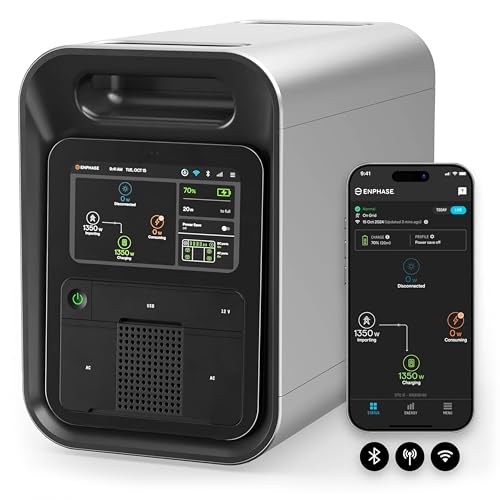
For homeowners who want a fast-recharging, app-connected backup they can trust, the Enphase IQ PowerPack 1500 stands out with 1,500 W continuous output and a 1,500 Wh LiFePO4 battery. We like its sub-75-minute AC recharge, ~4-hour solar refuel with two IQ Portable Solar Panels, and <10 ms transfer from grid to backup. With 11 ports—four 120 V AC, four USB-A, two 60 W USB-C, and a 12 V car port—it runs fridges, tools, and electronics at once. The 7-inch touchscreen and Enphase App (4G/Wi‑Fi/Bluetooth) simplify control. It’s UL certified, weather-ready, OTA upgradable, and backed by a 5-year/2,500-cycle warranty.
Best For: Homeowners, campers, and RV users who want a fast-recharging, app-connected, UL-certified portable power station that reliably runs essentials and tools with seamless backup switchover.
Pros:
- Rapid AC recharge in under 75 minutes; ~4-hour solar refuel with two IQ Portable Solar Panels
- Robust output and ports: 1500 W continuous/3000 W surge with 11 outputs and <10 ms transfer to backup
- Strong reliability features: LiFePO4 battery, OTA updates, SyncPulse checks, 5-year/2,500-cycle warranty, and 4G/Wi‑Fi/Bluetooth app control
Cons:
- Heavier than some rivals at ~45.9 lb, limiting portability for some users
- 1500 Wh capacity may be insufficient for high-demand, prolonged whole‑home backup
- Vehicle DC recharge is slow (~14 hours) compared to AC or solar options
Jackery HomePower 3600 Plus Portable Power Station
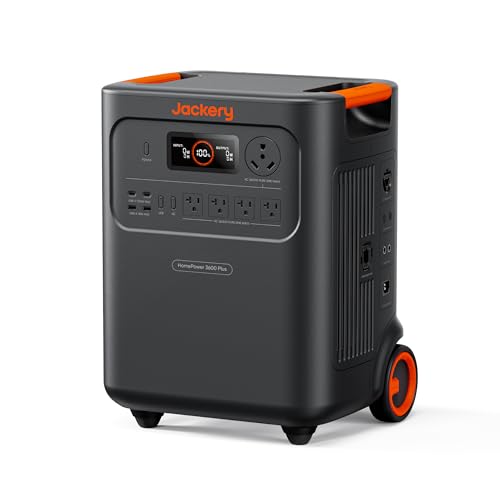
Serious about whole-home backup without hardwiring? The Jackery HomePower 3600 Plus brings 3600W AC output (7200W parallel) and dual 120/240V when paired, so we can run pumps, heaters, and even a dryer. Its 3584Wh LFP pack scales to 21kWh per unit or 43kWh with multiple units—enough to support a three-person household for two weeks of essentials.
We like its safety and longevity: high‑temp ceramic cells tested to 302 °F, 6,000 cycles, 10‑year life, and operation down to -4 °F. It recharges fast: 0–100% in 2 hours via hybrid AC+DC, 2.5h AC or generator, 4h solar. Despite 77 lbs, it rolls easily with wheels and a telescopic handle.
Best For: Homeowners and renters who want plug-and-play whole-home backup power (including 120/240V loads) without hardwiring, plus fast recharging and long battery life.
Pros:
- 3600W AC output (7200W in parallel) with dual 120/240V support for pumps, heaters, and dryers
- Expandable 3584Wh LFP capacity up to 21kWh per unit (43kWh with multiple units); 6,000 cycles and 10-year life
- Fast charging: 0–100% in 2 hours via hybrid AC+DC; operates in extreme temps (-4 °F to 302 °F-tested cells)
Cons:
- Heavy at ~77 lbs; portability relies on wheels and handle rather than easy lifting
- Full-home 240V capability requires parallel setup and additional unit(s)
- High upfront cost likely, with extra expense for expansion batteries and accessories
ALLWEI Portable Power Station 300W (280Wh Solar Generator)

Need a compact backup you can actually carry room to room? We like the ALLWEI Portable Power Station 300W, a 280Wh solar-ready unit that weighs about 6.5 pounds and measures 9 x 4.7 x 7.8 inches. It delivers 110V pure sine wave power across 2 AC outlets, plus 1 USB‑C PD 60W, 2 USB‑A, 3 DC ports, and a car socket—powering up to nine devices at once.
Expect 300W continuous, 600W surge. Rough runtime: 280Wh x 85% ÷ your device watts. Recharge via wall (5.5–6.5h), car (4.5–5.5h), or 100W solar (3–4h) with MPPT. It’s quiet, includes SOS light, BMS protections, and needs charging every few months.
Best For: Campers, travelers, and home users who need a lightweight, room‑to‑room portable power station for phones, laptops, CPAP, small appliances, and emergency backup within a 300W limit.
Pros:
- Compact 6.5 lb build with 2 AC outlets, 60W USB‑C PD, multiple DC ports, and car socket (power up to 9 devices)
- Pure sine wave 110V output, 300W continuous/600W surge, with BMS protections and quiet smart cooling
- Versatile recharging: wall (5.5–6.5h), car (4.5–5.5h), or 100W solar (3–4h) via built‑in MPPT
Cons:
- 280Wh capacity and 300W continuous limit won’t support high‑draw appliances (microwaves, kettles, hair dryers)
- Fan noise can be noticeable under heavier loads despite generally quiet operation
- Solar panel not included; needs periodic top‑up charge every few months for longevity
GRECELL 300W Portable Power Station (230.88Wh Solar Generator)

Looking for a compact backup you can actually carry around the house? GRECELL’s 300W Portable Power Station (T300) packs 230.88Wh into a 7.3-pound body with a pure sine wave 110V AC outlet (330W continuous, 600W surge). We like the six ports: 1 AC, USB-C PD 60W, USB-C PD 18W, 2x USB-A QC, and a 12V car port. It handles laptops, routers, lights, CPAP, cameras, even a mini-fridge under 330W.
Recharging’s flexible—wall, car, or the included 40W solar panel via MPPT. The upgraded BMS and dual silent fans add safety. Expect efficient, easy backup for low-to-medium loads; heating appliances may trip limits.
Best For: Campers, travelers, and home users who need a lightweight, portable backup to power laptops, routers, lights, CPAPs, and small devices under 330W.
Pros:
- Compact 7.3 lb design with pure sine wave 110V AC (330W continuous, 600W surge) for clean power
- Versatile I/O: 6 ports including USB-C PD 60W, USB-C PD 18W, 2x USB-A QC, AC outlet, and 12V car port
- Flexible recharging via wall, car, or 40W solar with built-in MPPT; upgraded BMS and dual cooling fans for safety
Cons:
- Limited capacity (230.88Wh) and single AC outlet may not suit larger or multiple high-draw devices
- Not suitable for most heating appliances; loads over 330W will trip protections
- Real-world output and recharge speeds can be lower than rated due to inefficiencies and input limits
Key Factors to Consider When Choosing Portable Power Stations for Home Backup
As we choose a portable power station for home backup, we should match power output and surge to our appliances and confirm the battery capacity and cycle life meet our runtime needs. Let’s list the port types we’ll actually use, then compare charging methods and speeds to minimize downtime. If we want seamless outage protection, we’ll also check the UPS switchover time.
Power Output and Surge
How much power a station can deliver—and for how long—matters more than any headline feature. We look first at continuous output, the steady wattage a unit sustains. Higher continuous ratings (think 1500–2200W) run larger appliances without browning out. Surge rating comes next: it’s the brief burst (often 3000–7200W) needed to start compressors and motors. A fridge, well pump, or AC can draw several times its running watts at startup.
Planning loads is simple math. Add the running watts of everything we’ll power simultaneously; that total must stay under the continuous rating. Then ensure the combined startup watts fit within the surge capacity. Favor inverters with strong surge to reduce nuisance tripping. And remember: a high surge with low continuous output won’t sustain heavier loads.
Battery Capacity Life
Why does battery capacity matter so much for home backup? It dictates how long we can keep essentials running. A 1070Wh unit might cover a fridge and a few lights for several hours; stepping to 2042Wh, 3072Wh, or 3584Wh meaningfully extends runtime for fridges, fans, and lighting during longer outages. Larger capacity equals longer runtime at the same load, but it also adds weight and size, affecting portability and placement.
Chemistry matters, too. LiFePO4 typically delivers around 4,000 cycles with better thermal stability, helping preserve about 70% of original capacity after years of use. That translates to more reliable backup over time. If we anticipate extended outages, expandable or modular batteries let us scale capacity with extra packs or linked units for greater total backup duration.
Port Types Needed
Capacity keeps appliances running, but the right ports determine what we can actually power. For home backup, we want a pure sine wave AC outlet to safely run refrigerators, routers, lights, and other sensitive electronics. Multiple AC sockets help split essential loads.
We also look for a balanced mix of DC and USB. A 12V car port keeps modems or medical gear powered. USB-C PD (60–100W or higher) fast-charges laptops and tablets, while USB-A handles phones and small accessories. More USB-C ports reduce adapters and clutter.
Port ratings matter as much as count. Ensure continuous wattage covers our essentials and that surge capacity handles appliance startup. If we need seamless failover, verify UPS functionality with sub-20 ms transfer to protect connected devices.
Charging Methods Speed
When the lights go out, charging speed determines how quickly we’re back in control. We should look at how fast a power station refuels and which inputs it supports. Pure AC charging often takes about 2–4 hours, while faster models use hybrid AC+DC to sprint from 0–100% in roughly 1–2 hours.
Solar matters, too. With strong sun and ample input capacity, some units can hit 80% in about 4–9 hours. Multi-source charging is even better: combining AC, solar, and car input can push total intake to around 2200W on select models, shortening downtime.
Battery chemistry and algorithms set safe limits. LiFePO4 paired with smart charge profiles (like ChargeShield 2.0) balances high-speed charging with cell protection, helping maintain cycle life without sacrificing turnaround time.
UPS Switchover Time
How quickly should a backup kick in before lights flicker or devices reboot? UPS switchover time is the gap between a grid outage and restored power. For true UPS behavior, we want 0–20 ms. Many portable power stations claim seamless switching around 20 ms or faster, which helps prevent resets on sensitive gear like medical devices, routers, and security cameras.
We should match switchover speed to our most demanding loads. If tolerance is longer, expect nuisance trips or brief interruptions on devices with strict power requirements. Look for UL or UL1778 certification, which signals adherence to rapid transfer standards. Also verify whether the unit supports uninterrupted transfer with multiple devices attached. Finally, confirm the system’s outage duration tolerance aligns with our home’s backup expectations.
Portability and Weight
Why does portability matter as much as watt-hours? When the lights go out, we may need to move a station from the garage to the living room—or up stairs—fast. Weight ranges widely: small 280Wh units can be about 6.5 pounds, while 3.6kWh models push roughly 77 pounds. That spread directly affects how easily we reposition backup power between rooms or to a vehicle.
We look for smart mobility features. Wheels and telescoping handles turn heavy packs into rollable carts. Compact, carry-friendly designs suit quick relocations. CTB construction and lightweight LiFePO4 cells add durability and safety without excessive bulk. Even larger units benefit from built-in handles and balanced weight distribution. Ultimately, portability competes with capacity, so we balance weight, size, and usable ports for true home-backup flexibility.
Conclusion
From heavy-duty home backups to lightweight grab-and-go units, we’ve covered the best portable power stations for 2025. Whether we need UPS-grade protection, fast recharge, expandable capacity, or solar-ready flexibility, there’s a reliable fit for every home and budget. Think about our priorities—runtime, outlets, mobility, and safety features—and match them to real-world use. When the lights flicker or we hit the road, wouldn’t we rather be ready with dependable power on demand? Let’s choose confidently.